Lecture 5 - Mechanical Treatments for Rangelands
 Call Kai
 Learn
Learn Practice Test
 Spaced Repetition
 Match
Match Flashcards
 Knowt Play
1/12

There's no tags or description
Looks like no tags are added yet.
Name | Mastery | Learn | Test | Matching | Spaced | Call with Kai | Chat |
|---|
No analytics yet
Send a link to your students to track their progress
13 Terms
Immediate results
Can be selective or broad
Soil disturbance may facilitate seeding efforts
May completely change vegetation
Often coupled with other types of treatments
EASY TO CARRY OUT
Advantages to Mechanical Control
Generally High average
Cost
May be limited by terrain
Soil disturbance can be severe
May disturb cultural and archaeological sites
May require specialized equipment and training
Disadvantages to Mechanical Control
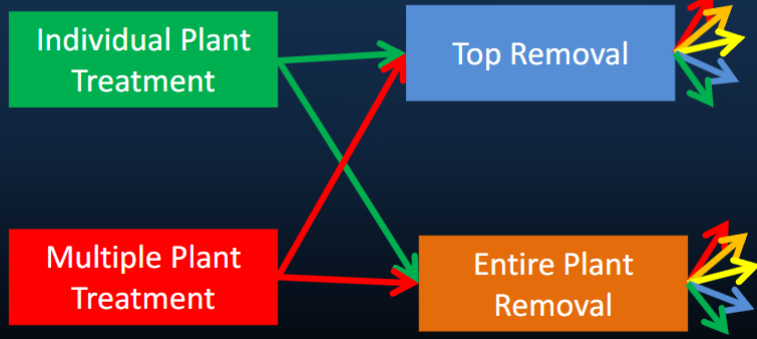
Mechanical Control – Types
Individual Plant Treatment
Multiple Plant Treatment
Top Removal
Entire Plant Removal
When/Why to Select Mechanical Control (or ANY control!)
1. Management objectives
2. Target Species Characteristics
3. Secondary Species Characteristics
4. Topography/Terrain
5. Soil kind, depth, texture, etc
6. Site Potential
7. Follow-up!
8. Public/Interest Group Pressure
Cost, Goals, Results
How to Treat Individual Plants:
Top-Killing
Hand Cutting/Chopping
Girdling
Power Mulching
Entire Plant Removal
Hand Grubbing
Power Grubbing
Important Factors to Consider:
1.Does the plant resprout
2.What is the plant densit
How to Treat Many Plants at Once
Top Killing
Bulldozing
Blading
Tree-dozing
Chaining/Cabling
Railing
Roller-chopping/Crushing
Shredding/Mowing
Harrowing
Entire Plant Removal
Plowing/Disking
Root Plowing
Root Raking
______: Great for removing non-resprouting species
Must dig out root-ball on resprouting species
Small plants are often missed or require more time
Bulldozing/Blading
________: Pull large anchor-chain between two tractors
Chain Modifications
Rails
Disks
Blades
Roller Balls
Weight Balls (for steep slopes)
Chaining/Cabling
_________: “A” rail, Supp rail, Random rail
Railing
Straight-blade
Spiral-blade; aerators/renovators
Land Imprinter
Roller-Chopper
________: One-way disk
Brushland Plow
Moldboard Plow
Standard Disk Plow
Offset Disk Harrow
Root Plow / Root Rake
Plows & Disks for Rangeland Use
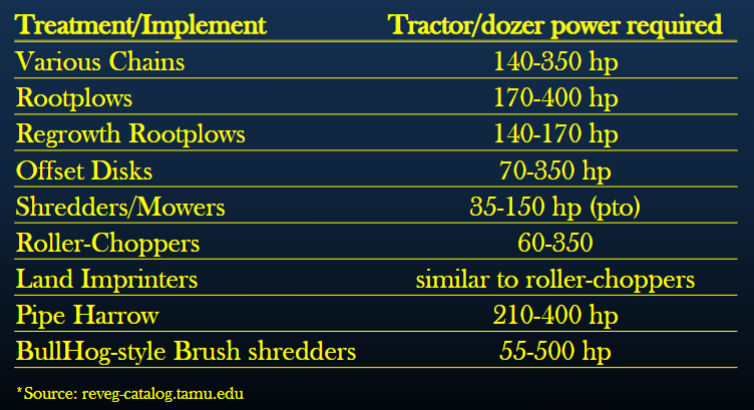
Treatment/Implement Tractor/dozer power required
Various Chains 140-350 hp
Rootplows 170-400 hp
Regrowth Rootplows 140-170 hp
Offset Disks 70-350 hp
Shredders/Mowers 35-150 hp (pto)
Roller-Choppers 60-350
Land Imprinters similar to roller-choppers
Pipe Harrow 210-400 hp
BullHog-style Brush shredders 55-500 hp
Power (cost?) Requirements: