Micro ch13 Monopoly
 Call Kai
 Learn
Learn Practice Test
 Spaced Repetition
 Match
Match Flashcards
 Knowt Play
1/19

There's no tags or description
Looks like no tags are added yet.
Name | Mastery | Learn | Test | Matching | Spaced | Call with Kai | Chat |
|---|
No analytics yet
Send a link to your students to track their progress
20 Terms
Whats a monopoly
A market…
That produces a good or service for which no close substitute exists
In which there is one supplier that is protected from competition by a barrier preventing the entry of new firms.
What are the key features of a monopoly
No close substitute
Barriers to entry
Three types of barriers to entry
Natural
Ownership
Legal
Natual Monopoly
A market in which economies of scale enable one firm to supply the entire market at the lowest possible cost. For example, water supply, electricity, trains…
Ownership barriers to entry
Occurs if one firm owns a significant portion of a key resource.
Legal Monopoly
A market in which competition and entry are restricted by the granting of:
Public franchise (like the U.S. Postal Service, a public franchise to deliver first-class mail)
Government license (like a license to practice law or medicine)
Patent or copyright
Two types of monopoly price-setting strategies
Single price monopoly and Price discrimination
Single-price monopoly
A firm that must sell each unit of its output for the same price to all its customers.
Price discrimination
Selling the same units of a good or service for different prices. Many firms price discriminate, but not all of them are monopoly firms.
Why is MR less than P in a single-price monopoly?
Because selling an additional unit requires lowering the price on all units sold, causing a loss of revenue on previous units.
MR = gain from new sale − loss on old sales
Relationship between elastic demand and MR
Elastic demand: MR > 0
Unit elastic demand: MR = 0
Inelastic demand: MR < 0
Monopoly always operates where demand is elastic (MR > 0)
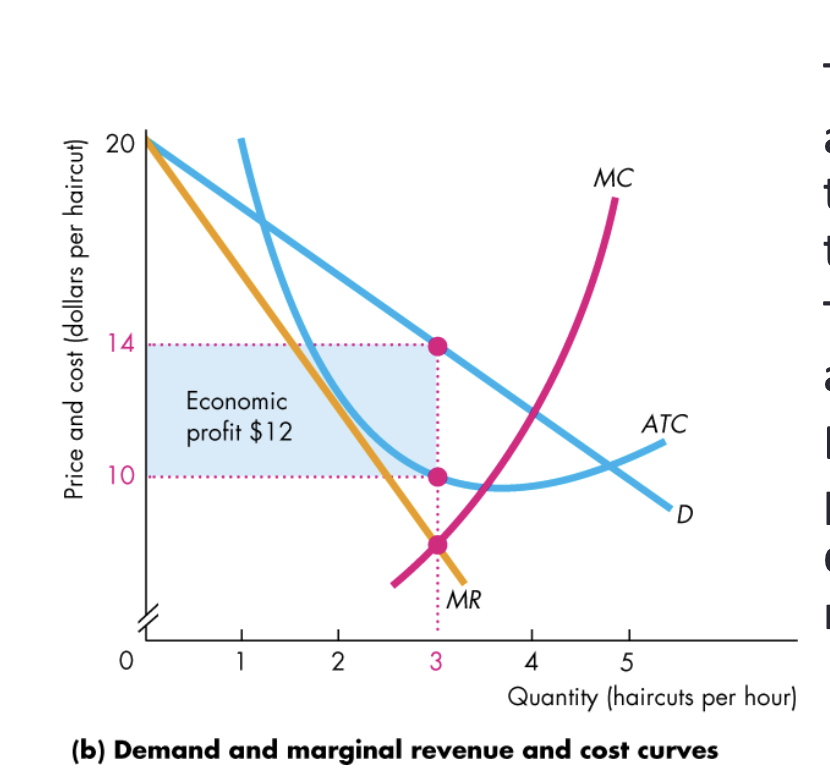
Monopoly Profit Maximization
MR = MC → Find profit-maximizing quantity (Q)
Go up to Demand → Find price (P)
Go to ATC → Find cost per unit
Economic Profit = (P − ATC) × Q
Profit = area of the shaded rectangle
why can a monopoly earn economic profit in the long run?
Because barriers to entry block competition.
Monopoly supply curve
A monopoly does not have a supply curve.
It chooses output using MR = MC, not supply and demand.
Whats better monopoly or perfect competition
Perfect competition is better because it produces the efficient quantity at a lower price and creates no deadweight loss, while monopoly charges a higher price, produces less output, and creates deadweight loss.