Endocrinology Quiz 1
 Call Kai
 Learn
Learn Practice Test
 Spaced Repetition
 Match
Match Flashcards
 Knowt Play
1/118

There's no tags or description
Looks like no tags are added yet.
Name | Mastery | Learn | Test | Matching | Spaced | Call with Kai | Chat |
|---|
No analytics yet
Send a link to your students to track their progress
119 Terms
Endocrine System
Helps to maintain homeostasis throughout the body along with the Nervous System
Homeostasis
Many different kinds of chemical messengers help to maintain ________ in the body
Homeostasis
Can be defined as the dynamic maintenance of internal environmental balance or equilibrium despite changing internal or external conditions
Endocrinology
Study of the endocrine system which consists of endocrine glands and tissues that produce “chemical messengers” that regulate the activity of other cells in the body.
Components of the endocrine system
Endocrine gland
Ductless gland composed of cells which secrete into the extracellular fluid (interstitial fluid)
Chemical messengers (hormones) that then diffuse into the blood
Ductless gland
Doesn’t have a tube and instead hormones are released directly into bloodstream
Exocrine gland
What is a gland with a duct called?
Hormone (classical definition)
Chemical messenger produced by an endocrine gland which is secreted into the blood and is carried to a target cell upon which it has a physiological effect
Hormone (recent definition)
Chemical products, released from the cell in very small amounts, that exert a biologic action on a target cell
Endocrine, paracrine, autocrine effect
What are the different classifications on basis of where hormones exert their effects?
Endocrine effect
Chemical messenger secreted into the bloodstream and travels to produce a biologic effect on distant target cells
Paracrine effect
Chemical messenger secreted into the interstitial fluid that exerts its effects in cells near its secretion site
Autocrine effect
Chemical messenger secreted into the interstitial fluid that acts upon the cell that secretes it
Adrenal and pituitary glands
Examples of endocrine glands
Oil and digestive glands
Examples of exocrine glands
Heterocrine gland
What term defines a gland that has both endocrine and exocrine?
Pancreas
Example of a heterocrine gland (because this produces insulin and pancreatic juice)
Neurohormone
A hormone produced by a nerve cell
Vasopressin
Example of a neurohormone
Neuropeptide
A peptidergic neurohormone
Vasopressin
Example of a neuropeptide
Peptide
Has to meet receptor on membrane as its a ______, can’t go through phospholipid bilayer
Pheromone
A chemical messenger released to the exterior of one animal to stimulate a response in another member of the same species
Parahormone
Other cell regulators that do not fit in the well-recognized classes of “hormones”
CO2 and lactic acid
Examples of parahormones
Pheromone and parahormones
Other chemical messengers that are not “true hormones'“
Hilda Bruce (1959)
From who did we first hear about pheromone?
Hilda Bruce
Who, in 1959, put two mice in the same cage, one being a pregnant female of a particular strain and another being a male of a different strain, in which the pregnant female mouse pregnancy got blocked/terminated after smelling an unfamiliar male (pheromones). Also called “Bruce effect.”
Pheromone
A Japanese beetle bag is an example of a ________ as its purpose is to lure male beetles which were attracted to the female ________ or a floral scent.
Japanese beetle bag
This ended up working as it collected male beetles which dropped in the bag preventing them eating on the garden, however also ended up causing an avalanche of beetles coming to the yard when the bag was occupied.
A.A. Berthold (1849)
Who removed the testes of a rooster by severing the nerves to it so that the nervous system has no role to play, then observing that the rooster turned to a Capon. Then conducted an experiment with the Capon by putting in testis graft (still no nerves) and turned back to a rooster.
Capon
A rooster with “no arrogance at all, a mess” as it has no testes
Rooster
A male chicken with combs and is very arrogant. Very attracted to females.
A.A. Berthold
Conclusion for this experimenter (1849): Testes releases “something” into the blood that maintains male behavior and secondary sex characteristics
A.A. Berthold (1849)
Never heard from him after this experiment so he is not referred to the father of endocrinology
Bayliss and Starling (1902)
Who used dogs and severed any nerves to the pancreas and to the small intestine so that the nervous system doesn’t play a role. Then added dilute HCl (simulating the acid coming from the stomach) which resulted in profuse flow of pancreatic juice into the small intestine.
Bayliss and Starling (1902)
Wanted to answer the question of how the pancreas and gallbladder knew when to release to the small intestine after acid chyme comes through.
No response
Critics explained what happened in this experiment by saying that there was increased flow due to absorption of HCl in the pancreas, so Bayliss and Starling took the pancreas with severed nerves and injected HCl directly into the pancreas intravenously, resulting in _________
Secretin
Intestine releases a substance into the blood which flows to the pancreas and causes secretion. What is this substance (hormone) called?
Dilute HCl
Used by Bayliss and Starling to simulate the acid coming from the stomach
A.A. Berthold
The first clear cut and successful experiment bearing on an endocrine gland was that of ______ published in 1849.
Nervous
During A.A. Berthold, the ________ system was considered the major regulating system in an organism
Addison’s disease
First clinical defect on an endocrine gland to be accurately described
Thomas Addison (1855)
First to connect the deterioration of cortex of adrenal gland which caused:
impaired appetite
low blood pressure
extreme muscular weakness
gastrointestinal upsets
decolorization of skin
eventual death
To a fatal clinical syndrome called Addison’s Disease
On top of kidney
Where is the adrenal glands located
Von Merling and Minkowski (1889)
Who took a dog and removed the pancreas, the dog then became diabetic developing diabetes mellitus
Murray (1891)
Took a sheep thyroid glands and mixed glycerin in it to create an emulsion in which he injected subcutaneously in a 46 year old women who was dying from hypothyroid condition. She was cured from this treatment and was the very first successful instance of helpful hormone replacement therapy.
Oliver and Schafer (1895)
Who injected adrenal extract in animals and witnessed an immediate rise in systemic blood pressure (epinephrine) as well as injecting animals with pituitary extract and witnessed arteries constricting (vasopressin)?
Function of the endocrine system
Maintenance of constant internal milleu through regulation of certain cellular processes in such a way as to promote homeostasis
Rates
Hormones govern the _____ of certain critical or rate-limiting reactions or processes
Ex: 2 H + ½ O2 —> H2O is accelerated by thyroid hormone, but O2 utilization does not cease after thyroidectomy
Small
Hormones are effective even when present in extremely _____ quantities
Higher
Intramuscular injection - _____ doses
Oral administration - still higher
10-3
Milligram (mg) is ___ gram
10-6
Microgram (μg) is ___ gram
10-9
Nanogram (ng) is ___ gram
10-12
Picogram (pg) is ___ gram
Microgram or nanogram
Intravenous injection (IV) are usually small doses and measured usually in ______ or ______
Balance
Under normal conditions there exists in the body a hormonal _______
Balance
A net result of total production and excretion or destruction
Destruction
Metabolic inactivation of hormone after which the broken down products are excreted from the body via urine or feces
Steroids
Majority of hormones are:
a) proteins or peptides
b) amino acid derivatives
c) ______
Steroids
_______ are part of the fat group (lipid) so its not soluble in water/hydrophobic. Can be carried by the plasma protein through bloodstream.
Inhibitory, synergistic, permissive
Numerous hormonal interactions and relations have been observed. They may be _______, _________, or ________ in nature.
Inhibitory interaction
Occurs when two hormones have opposite effects upon a target cell
Ex: Insulin and growth hormone (in excess)
Synergistic interaction
Occurs when the effects of the simultaneous administration of two (or more) hormones produces a greater effect than the sum of either given alone, or a new effect produced by neither alone.
Ex: Thyroid hormone and insulin —> Optimal growth effects
Insulin
Increases uptake and utilization of glucose in the cell
Permissive interaction
Less synergistic than previous group
One hormone “conditions” target cells for action of second hormone
Ex: norepinephrine in a normal animal causes pressor effect to be more (more increase in blood pressure) than norepinephrine in a adrenalectomized animal (- glucocorticoids)
Function of Hormones
Influence reactions that aid in the maintenance of homeostasis
Aldosterone
Has an effect on electrolytes by helping bring sodium into body
Anti-diuretic
Vasopressin has a role to play in water also known as ___-_____, helps keep water in cell
Morphogenic
Hormones have a ________ action (means change in shape)
Ex: growth process and development of sex characteristics
Autonomic
Hormones regulate ______ activity as well as central nervous system activity and behavioral patterns
Methods of Study of Hormones
Abiation by surgery or disease
Chemical abiation or impairment
Chemical extraction and cellular sources from gland or cell
Isotope tracer methods
In Vitro (outside of a living organism) techniques
Others
Chemical assay
Measurement of a hormone using chemical methods (e.g., extractions, separations)
Assay of Hormones
detection and quantitative determination
Bioassay
Method of measuring volume that uses a measurable change in a living system as an endpoint
Radioisotrope assays
Method of measuring hormones using radioactive isotope tracers
a. radioimmunoassay (RIA)
combines the specificity of an immune (antigen-antibody) reaction with the use of radioactive isotope tracers
Chemical assay, bioassay, radioisotrope assay, others
What are the four different assay of hormones?
Protein and peptide production
DNA is copied into mRNA inside the nucleus. The mRNA then leaves the nucleus and enters the cytoplasm, where a ribosome binds to it and begins translating it into a protein. This initial, full-length protein chain containing the signal sequence is called the preprohormone. As the ribosome finishes making the protein, the chain is pushed inside the rough ER where an enzyme cuts off the signal sequence. Once it loses its signal sequence, it is now called a prohormone. The prohormone is then packed into a transport vesicle and sent to the Golgi apparatus where the prohormone is folded into its final, active shape. The finished protein is packed into a secretory vesicle that buds off the Golgi. The active protein is now finally called a hormone. It waits in the cell until a signal triggers the vesicle to fuse with the cell membrane, releasing the hormone out of the cell.
Amino acid derivatives
Synthesized from the amino acid tyrosine
Catecholamines
Thyroid hormone (discussed later)
Catecholamines
Structure features a benzene ring with two hydroxyl (-OH) groups
Amino acid
Tyrosine is an ______ _____
Dihydroxyphenylalanine (DOPA), Dopamine, Norepinephrine, Epinephrine
What are the four catecholamines?
Steroids
Synthesized from cholesterol by a series of enzymatic reactions
Steroid hormone synthesis from cholesterol
Cholesterol ends up becoming at the end:
Mineralocorticoid: aldosterone
Glucocorticoid: cortisol
Androgen: testosterone/dehydroepiandrosterone
Aldosterone
Mineralocorticoid:
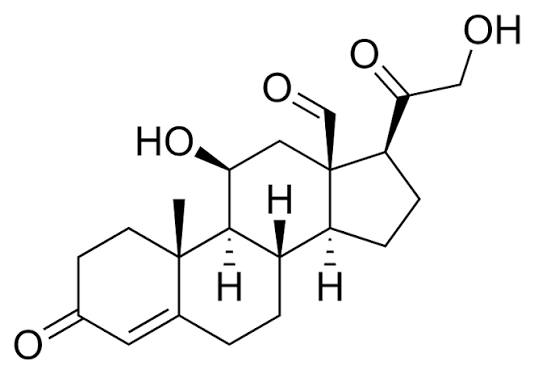
Cortisol
Glucocorticoid:

Dehydroepiandrosterone
Androgen:

Cholesterol
All of these steroids are synthesized from what?

Through receptor in target cell
How must the hormone be recognized?
Receptor
A specific protein in either the plasma membrane or interior of a target cell with which a hormone combines to exert its effect
Plasma membrane
Steroid hormone can meet receptor in cytoplasm or nucleus as it goes right through the _______ ________ and nuclear membrane
Receptors
Cell membrane components
Intracellular components
cytoplasmic
nuclear
Generated
An intracellular signal must be _________
Increased, decreased
One or more intracellular processes must be _______ or _______(e.g., enzyme reactions, ion movements)
Protein, polypeptide
First messenger is the _______, __________ hormone in which it binds to the membrane receptor on the plasma membrane which will relay the message to the 2nd messenger (another chemical/molecule) which binds to the effector protein resulting in cellular effects
Plasma membrane
Protein and polypeptide hormones can’t go through ________ ________ so it requires a membrane receptor and 2nd messenger
cAMP
Cyclic 3’-5’ adenosine monophosphate
Sutherland and Rall
1957 - first discovered cAMP (cyclic adenosine monophosphate) second messenger system
flight or fight
The release of glucose into the bloodstream provides fast energy your body needs to fuel a _____ or _______ response