Histology lab
 Call Kai
 Learn
Learn Practice Test
 Spaced Repetition
 Match
Match Flashcards
 Knowt Play
1/122

There's no tags or description
Looks like no tags are added yet.
Name | Mastery | Learn | Test | Matching | Spaced | Call with Kai | Chat |
|---|
No analytics yet
Send a link to your students to track their progress
123 Terms
Histology
Study of microscopic anatomy
Microtome
Instrument used to cut slices for the slides
Cell
Membrane bound structure with organelles
Tissue
Collections of cells that have a similar structure and function
Types of tissues
epithelial, connective, muscle, nervous
Epithelial Tissue Characteristics
high regeneration capacity, avascular, attached to neighboring cells and basement membrane
Epithelial Tissue functions
covers surfaces, lines insides of organs and body cavities
Lines digestive tract
Simple columnar epithelium
Epidermis of skin
Stratified squamous epithelium
Lines urinary bladder
Transitional epithelium
connective tissue characteristics
have protein fibers
Connective tissue function
protects, binds together, and supports organs
Fat
adipose connective tissue
ligaments and tendons
dense regular connective tissue
Dermis of skin
dense irregular connective tissue
Articular cartilage in joints
Hyaline cartilage
Blood and lymph
fluid connective tissue
muscle tissue characteristics
contractile; receives stimulation from nervous system and/or endocrine system
Muscle tissue function
facilitates movement of skeleton or organ walls
muscles attached to bones
skeletal muscle
Muscle layer in heart
Cardiac muscle
muscle layer of digestive tract
Smooth muscle
Cells that make up the nervous system
neurons and glial cells
neuron characteristics
excitability, conductivity, secretion, extreme longevity, amitotic
glial cell characteristics
nonexcitable, mitotic
Neuron function
control activities, process information
Glail cell function
support and protect neurons
Nervous tissue found in brain and spinal cord
Neuron and glial cells
simple vs stratified epithelium
Simple- one layer
Stratified- multiple layers
where simple squamous epithelium is found
found in air sacs of lungs
function of simple squamous epithelium
Rapid diffusion, filtration, and some secretion in serous membranes
simple squamous epithelium
single layer of flattened cells

where simple cuboidal epithelium is found
kidney tubules, thyroid gland
function of simple cuboidal epithelium
absorption and secretion
simple cuboidal epithelium (Kidney tubules)

simple cuboidal epithelium (thyroid gland)

nonciliated simple columnar epithelium
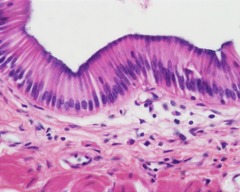
location of nonciliated simple columnar epithelium
lining of most of digestive tract
Function of nonciliated simple columnar epithelium
absorption and section; secretion of mucin
ciliated simple columnar epithelium
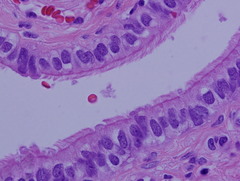
cilated simple columnar epithelium function
Secretion of mucin and movement of mucus along surface of epithelium by the cilia
location of ciliated simple columnar epithelium
fallopian tubes
function of cilia
longer than microvilli
involved in movement of materials
function of Microvilli
increase surface area for absorption
Pseudostratified ciliated columnar ET

pseudostratified ciliated columnar ET function
protection and secretion of mucin and movement of mucus across surface by ciliary action
Location of pseudo stratified ciliated columnar ET
trachea
Keratinized stratified squamous ET

function of keratinized stratified squamous epithelium
Protection of underlying tissue
location of keratinized stratified squamous epithelium
Epidermis of skin
non-keratinized stratified squamous epithelium

Function of non-keratinized stratified squamous
protection of underlying tissue
Location of non-keratinized stratified squamous epithelium
esophagus
stratified cuboidal epithelium tissue
exocrine ducts

Stratified columnar ET
found in male urethra
Transitional ET

Transitional ET function
distention and relaxation to accommodate urine volume in bladder
Location of transitional ET
Parts of kidney, lining of urinary bladder
Connective tissue types
Embryonic, connective tissue proper, cartilage, bone, fluid
extracellular matrix
fibers- collagen, elastic, reticular
ground substance- solid, semisolid, watery
Mesenchyme
Tissue that creates other tissues
Found throughout body of embryo, fetus, and adults
Has spicuoles.
Mucous C.T. (Wharton's Jelly)
found in umbilical cord of fetus
Areolar CT

areolar CT function
protects, cushions, and insulates
location of areolar CT
Papillary layer of dermis
Adipose CT

adipose connective tissue function
Stores energy; insulates, cushions, and protects
reticular connective tissue

reticular cT function
provides support for spleen, lymph nodes, thymus, bone marrow
location of reticular connective tissue
spleen, lymph nodes, bone marrow
dense regular connective tissue

function of dense regular connective tissue
attaches muscles to bones or to muscles; attaches bones to bones; withstands great tensile stress when pulling force is applied in one direction
location of regular dense connective tissue
tendons and ligaments
Dense Irregular CT

function of dense irregular CT
withstands tension exerted in many directions; provides structural strength
location of dense irregular CT
dermis
Elastic CT

elastic CT function
allows stretching of some organs
elastic CT location
walls of elastic arteries (such as aorta), trachea, vocal cords
cells of connective tissue
fibroblasts, adipocytes, mesenchymal cells, macrophages
Loose connective tissues
areolar, adipose, reticular
dense connective tissues
dense regular, dense irregular, elastic
Supporting CT
bone and cartilage
compact bone CT

function of compact bone
protection and support; stores calcium and phosphorous
location of compact bone
bones in body
Cancellous bone

function of cancellous bone
site of hematopoiesis
red bone marrow, where red blood cells are made
location of cancellous bone
bones in body
hyaline cartilage
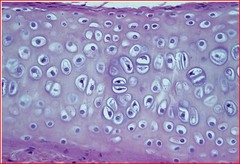
hyaline cartilage function
supports and reinforces; serves as resilient cushion; resists compressive stress
location of hyaline cartilage
trachea
elastic cartilage

function of elastic cartilage
maintains the shape of a structure while allowing great flexibility
location of elastic cartilage
epiglottis
Fibrocartilage

fibrocartilage function
resists compression and absorbs shock
fibrocartilage location
intervertebral disks, menisci of knee joints
Fluid CT: Blood
transport O2 and CO2
within blood vessels
Fluid CT: Lymph
contained in lymphatic system