pro-social behaviour in response to social influence
 Call Kai
 Learn
Learn Practice Test
 Spaced Repetition
 Match
Match Flashcards
 Knowt Play
1/26

There's no tags or description
Looks like no tags are added yet.
Name | Mastery | Learn | Test | Matching | Spaced | Call with Kai | Chat |
|---|
No analytics yet
Send a link to your students to track their progress
27 Terms
Prosocial Relationships
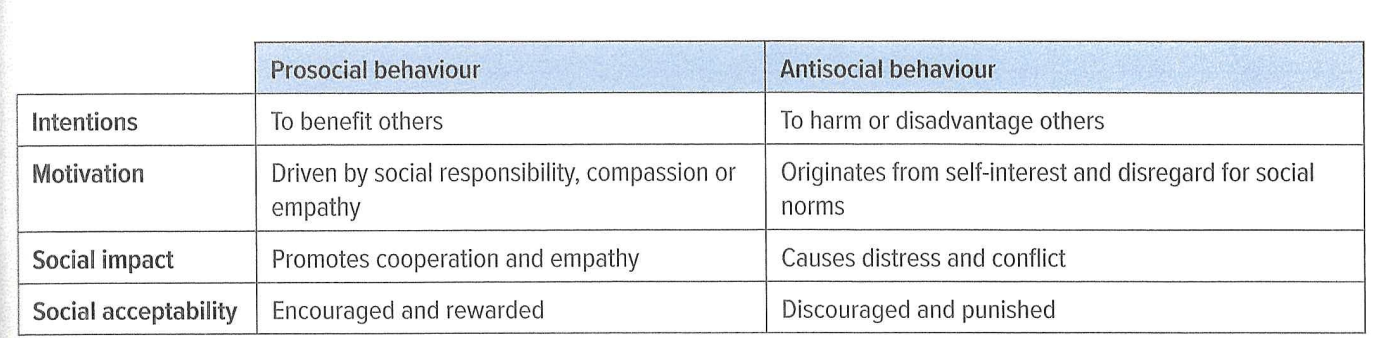
•Usually voluntary and unpaid.
•Promotes social acceptance.
•Benefits society and its members
•Driven by altruism or egoism
•Examples:
oCharity
oHelping those in need
oRescue
oSacrifice
oSharing
oSympathy
Helping as an Example of Prosocial Behaviour
•voluntary actions that benefit others.
•WHY people help others:
1.People are more likely to help others they find similar to themselves (especially close relatives) to strengthen the gene pool and increase the chances that future generations will survive.
2.Helping others can be for altruistic reasons (e.g. feeling empathy for another person).
3.Personal benefits (e.g. increase in own positive mood, self-image, help is reciprocated in the future).
4.Helping behaviour can be taught to young children and reinforced throughout childhood.
Factors influencing social behaviour: Reciprocity Principle
•Social norm where a person feels obligated to return the favour to a person that does something for them.
Reciprocity concerning the exchange of helpful behaviour between people is related to altruism
Factors influencing social behaviour: Social Responsibility
•Theory that individuals are accountable for acting in a way that benefits society.
•Individuals with a higher level of social responsibility preform more pro-social behaviours than those with lower levels of social responsibility.
Factors influencing social behaviour: Personal Characteristics
•Empathy: ability to sense and share the thoughts or feelings of another person.
•Mood: when individuals experience a low mood, they are less likely to help others.
•Competence: Positive correlation between the competence someone feels, and the way they positively impact others.
•Altruism: help others without expecting any personal reward.
Personal Characteristics Examples
•Empathy: Individuals that can empathise with an individual in distress are more likely to act prosocially in response because they can view the perspective of the other person.
•Mood: When in a good mood, they carry out pro-social behaviours to maintain the ’feel-good / do good effect’.
•Competence: An individual who believes they have the ability to help others is more likely to do so.
•Altruism: Positive correlation between empathy and altruism (empathy-altruism hypothesis).
Antisocial Relationships
•Antisocial behaviours
•Behaviours that harms society and its members by intentionally violating the rights of others.
•Examples:
•Graffiti - tagging
•Stealing
•Abuse
•Queue jumping
•Pushing & shoving through a crowd
•Road rage
•Bullying
•The purposeful use of a difference in power to REPEATEDLY cause physical, psychological OR social harm.
•Can occur through social media apps, online or in person.
Factors Influencing Antisocial Behaviours: Audience Inhibition
•Failure to intervene in an emergency in the presence of others due to fear of being negatively judged.
example: •Not wanting to look ‘stupid’.
Factors Influencing Antisocial Behaviours: Social Influence
•When a bystander (person present at an event, but not taking part) is unsure of how to behave in an emergency, they will look to fellow bystanders for cues on how to act.
example:•Explains why inactive bystanders inhibit the helping of others and believe that if others are not intervening in this situation, then it must not be an emergency.
Factors Influencing Antisocial Behaviours: Diffusion of Responsibility
•A reduction in personal responsibility when in a group, resulting in the individual being less likely to act.
example: Kitty Grenovese
Factors Influencing Antisocial Behaviours: cost-benefit analysis
•The psychological process of weighing up the benefit of performing a behaviour, with the potential cost of the behaviour.
example: •The bystander may feel embarrassed if they misinterpreted the situation as an emergency and intervened.
•Putting themselves at risk to help someone else is also a cost to consider.
•The bystander may feel guilty or ashamed for not helping.
Group-think
•Group members conform to make unanimous decisions without using critical reasoning.
example:
•May develop harmful stereotypes (in-group / out-group).
•May cause antisocial behaviour when group members unquestioningly follow orders from a leader that involve physically and/or psychologically harming others.
Antisocial behaviour:
behaviour that harms society and its members by intentionally violating the rights of others.
Bystander:
a person who is present at an event but does not take part.
Bystander effect:
the phenomenon whereby bystanders fail to help someone in need due to the presence of others.
Audience inhibition:
the failure to intervene in an emergency in the presence of others due to fear of being negatively judged.
Diffusion of responsibility:
a reduction in personal responsibility when in a group, resulting in an individual being less likely to act.
Cost-benefit analysis:
the psychological process of weighing up the benefit of performing a behaviour, with the potential cost of the behaviour.
(Latané and Darley, 1968)
Aim To observe the behaviour of bystanders in an emergency
Altruism
Helping others without expecting any personal reward is identified as altruism. Altruistic behaviour is unselfish and may result in the person doing the helping putting themselves at risk or paying some sort of cost.
Empathy
Empathy is the ability to sense and understand the thoughts or feelings of another person.
Competence
There is a positive correlation between the competence someone feels, and the way they positively impact others. An individual who believes they can help others is more likely to do so.
Mood
When an individual is experiencing a low mood, they are less likely to help others.
Empathy-altruism hypothesis:
the idea that the more empathy is felt by an individual, the more likely it is that the individual will display altruistic behaviour.