kinetics and rate
 Call Kai
 Learn
Learn Practice Test
 Spaced Repetition
 Match
Match Flashcards
 Knowt Play
1/9

There's no tags or description
Looks like no tags are added yet.
Name | Mastery | Learn | Test | Matching | Spaced | Call with Kai | Chat |
|---|
No analytics yet
Send a link to your students to track their progress
10 Terms
why is activation energy important?
activation energy must be overcome for reactants to turn into products
activation energy is always positive
what is reaction rate proportional to the concentration of?
proportional to concentration of the transition state at any given moment
a higher EA means it is harder to reach the TS, therefore there is a lower concentration of TS and the reaction is slower
what is the rate constant, k?
proportionality factor that quantifies the speed and direction of a chemical reaction
relates reaction rate to molar concentration
dependent on temperature
what is the reaction rate?
measured in M s-1
change in concentration of reactants or products per unit time
what is the arrhenius equation?
A also referred to as Arrhenius factor
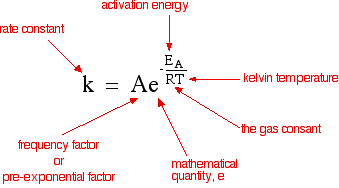
what does the arrhenius equation model?
models the dependence of a chemical reaction’s rate constant on temperature, activation energy and pre-exponential factor
what is the pre-exponential factor
the frequency of collisions with the correct orientation
what is the relationship between Ae, ΔG and rate constant?
inverse and exponential
a larger ΔG —> smaller k
what is the rate equation?
[A] and [B]: The molar concentrations of the reactants.
m and n: The reaction orders with respect to reactants A and B (e.g., 0 for no effect, 1 for directly proportional, or 2 for a squared relationship)
![<ul><li><p><span><strong>[A] and [B]</strong>: The molar concentrations of the reactants.</span></p></li><li><p><span><strong>m and n</strong>: The reaction orders with respect to reactants A and B (e.g., 0 for no effect, 1 for directly proportional, or 2 for a squared relationship)</span></p></li></ul><p></p>](https://assets.knowt.com/user-attachments/8d22ffe5-0782-4a99-8b44-e3678cc2652e.png)
what does the rate equation show?
links the reaction rate to reactant concentrations
determined experiementally
units depend on order of reaction