9 and 10 test AP Psych
 Call Kai
 Learn
Learn Practice Test
 Spaced Repetition
 Match
Match Flashcards
 Knowt Play
1/38

There's no tags or description
Looks like no tags are added yet.
Name | Mastery | Learn | Test | Matching | Spaced | Call with Kai | Chat |
|---|
No analytics yet
Send a link to your students to track their progress
39 Terms
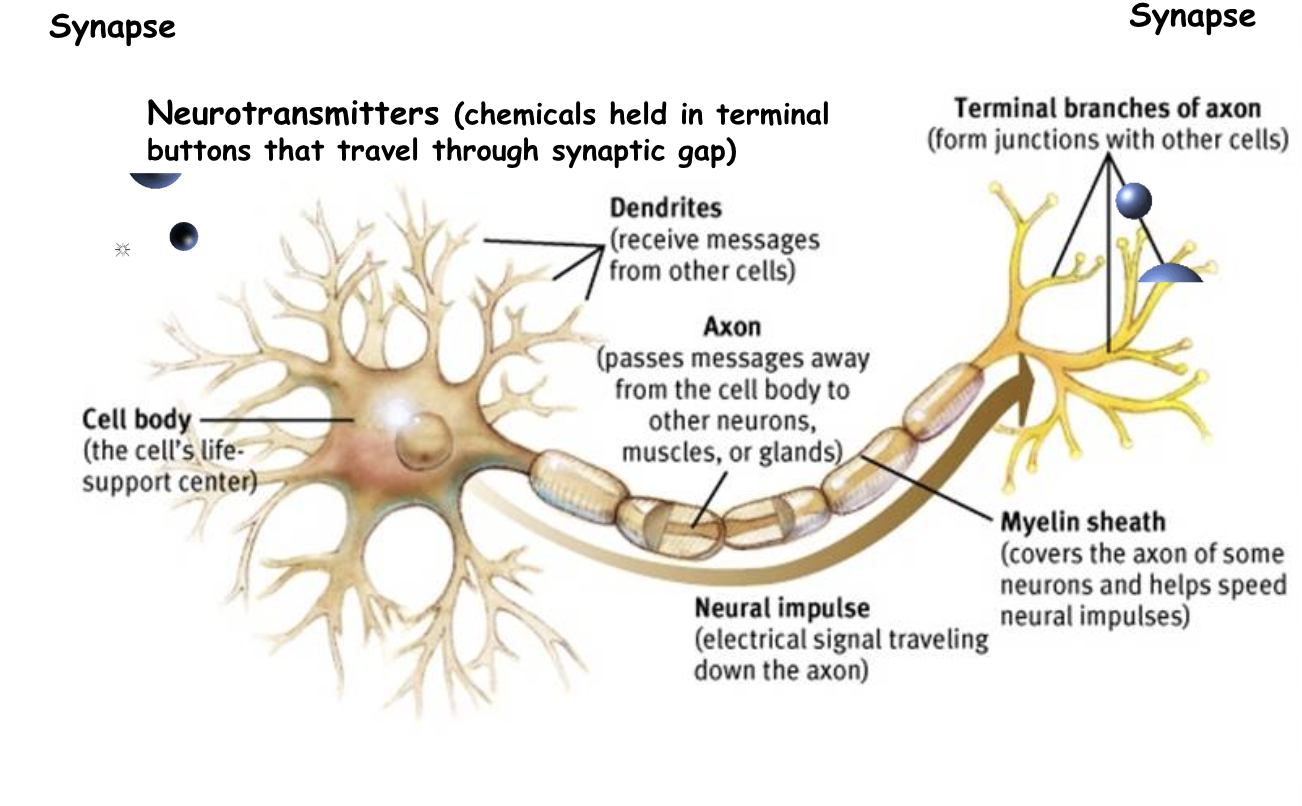
Neuron
Basic building block of the nervous system (nerve cell).
Dendrites
Neuron branches that receive chemical messages and conduct impulses toward the cell body.
Cell Body (Soma)
The cell's life-support center containing the nucleus.
Axon
Neuron extension that passes electrical messages away from soma to other neurons or muscles.
Myelin Sheath
Fatty tissue layer insulating the axon that speeds up neural impulse transmission.
Action Potential
A brief electrical charge (neural impulse) that travels down an axon.
Resting Potential
The negative-inside / positive-outside state of an inactive axon membrane.
-70 mv
Threshold
Minimum level of stimulation required to trigger a neural impulse.
-55mv
Refractory Period
Brief resting pause after a neuron fires during which another impulse cannot occur.
All-or-None Response
Principle that a neuron fires at full strength or not at all.
Synapse (Synaptic Gap)
Tiny fluid-filled gap between sending axon tip and receiving dendrite.
Neurotransmitters
Chemical messengers that cross synaptic gaps to bind to receiving receptor sites.
Reuptake
Reabsorption of excess neurotransmitters by the sending neuron.
Acetylcholine (ACh)
Neurotransmitter for muscle action, learning, memory; undersupply linked to Alzheimer's.
Dopamine
Neurotransmitter for movement, learning, attention; excess linked to schizophrenia, undersupply to Parkinson's.
Serotonin
Neurotransmitter affecting mood, hunger, sleep, arousal; undersupply linked to depression.
Norepinephrine
Neurotransmitter helping control alertness and arousal; undersupply can depress mood.
GABA
Major inhibitory neurotransmitter; undersupply linked to seizures, tremors, and insomnia.
Glutamate
Major excitatory neurotransmitter involved in memory; oversupply causes migraines or seizures.
Endorphins
Natural, opiate-like neurotransmitters linked to pain control and pleasure.
Agonist
Molecule that binds to a receptor site to stimulate or mimic a neurotransmitter's response.
Antagonist
Molecule that binds to receptor sites to block or inhibit a neurotransmitter's function.
Nervous System
The body's speedy, electrochemical communication network consisting of all nerve cells.
Central Nervous System (CNS)
The brain and spinal cord.
Peripheral Nervous System (PNS)
Sensory and motor neurons connecting the CNS to the rest of the body.
Nerves
Bundled axons forming neural cables connecting CNS with muscles, glands, and sense organs.
Sensory (Afferent) Neurons
Neurons carrying incoming information from sensory receptors to the CNS.
Motor (Efferent) Neurons
Neurons carrying outgoing information from the CNS to muscles and glands.
Interneurons
Neurons within brain and spinal cord that communicate between sensory inputs and motor outputs.
Somatic Nervous System
Division of PNS controlling voluntary movements of skeletal muscles.
Autonomic Nervous System
Division of PNS controlling involuntary muscle and gland activity of internal organs.
Sympathetic Nervous System
Division of ANS that arouses the body and mobilizes energy in stressful situations (fight-or-flight).
Parasympathetic Nervous System
Division of ANS that calms the body and conserves its energy (rest and digest).
Reflex
A simple, automatic response to a sensory stimulus.
Endocrine System
The body's slow chemical communication system; glands that secrete hormones into the bloodstream.
Hormones
Chemical messengers manufactured by endocrine glands that travel through the bloodstream.
Adrenal Glands
Endocrine glands above kidneys that secrete epinephrine and norepinephrine during stress.
Pituitary Gland
The master endocrine gland; controlled by hypothalamus, regulates growth and other glands.
Review This