Art History Midterm
0.0(0)
Studied by 2 people Call Kai
 Learn
Learn Practice Test
 Spaced Repetition
 Match
Match Flashcards
 Knowt Play
Card Sorting
1/34

Earn XP
Description and Tags
Last updated 5:21 PM on 2/21/23
Name | Mastery | Learn | Test | Matching | Spaced | Call with Kai | Chat |
|---|
No analytics yet
Send a link to your students to track their progress
35 Terms
1
New cards
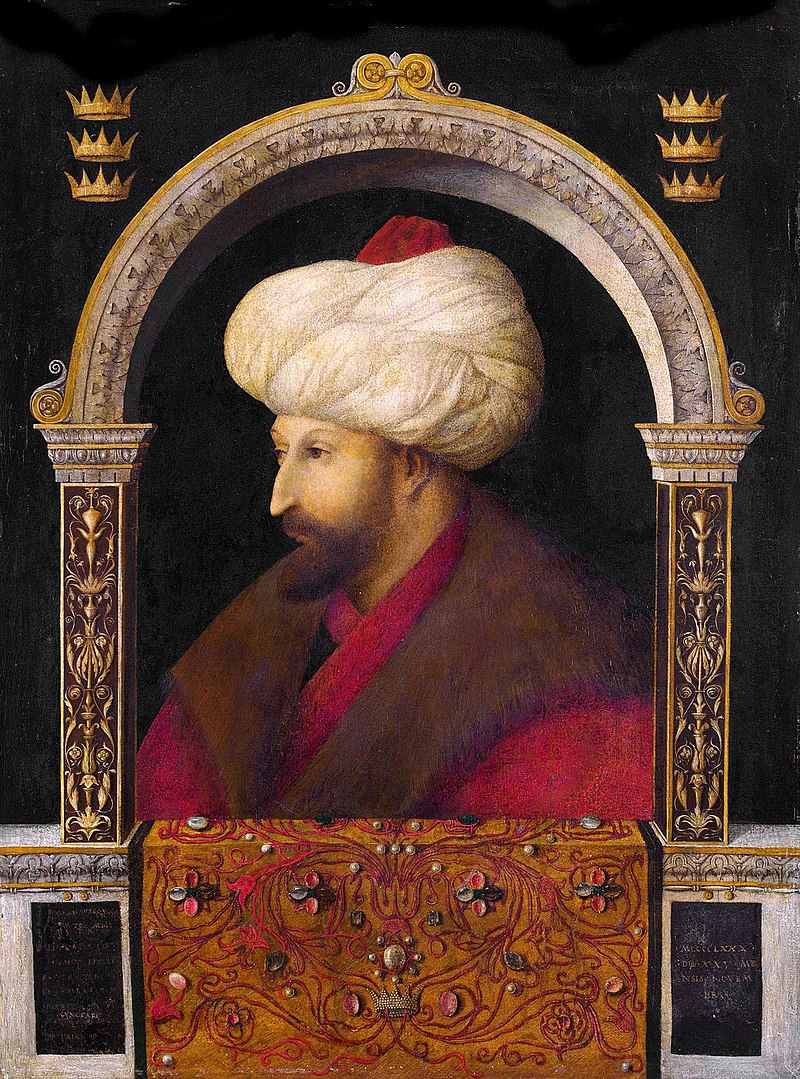
technique: oil (on canvas)
chronology: 1408, 15th century
art style, culture, or geographical area: Ottoman
context of production: Portrait of (the Ottoman Sultan) Mehmed II
how are figures represented: chiaroscuro
space: no perspective
* royal crowns imply 7th ruler of ottoman empire
* dynastic image — wealthy fabrics, jewels, ornate, turban
* center of composition
* Constantinople (Istanbul) - capital
* Artist from Republic of Venice, invited by Sultan (Gentile Bellini)
* Sultan enemy of many European powers but came in contact with Venice and invited artists because they heard they’re doing good art
* wanted Italian style portrait
* “Victor Orbis” (”Conqueror of the World”) — words on painting, in the black box on bottom corners
* Sultan ended Byzantine empire — consider himself conqueror
chronology: 1408, 15th century
art style, culture, or geographical area: Ottoman
context of production: Portrait of (the Ottoman Sultan) Mehmed II
how are figures represented: chiaroscuro
space: no perspective
* royal crowns imply 7th ruler of ottoman empire
* dynastic image — wealthy fabrics, jewels, ornate, turban
* center of composition
* Constantinople (Istanbul) - capital
* Artist from Republic of Venice, invited by Sultan (Gentile Bellini)
* Sultan enemy of many European powers but came in contact with Venice and invited artists because they heard they’re doing good art
* wanted Italian style portrait
* “Victor Orbis” (”Conqueror of the World”) — words on painting, in the black box on bottom corners
* Sultan ended Byzantine empire — consider himself conqueror
2
New cards
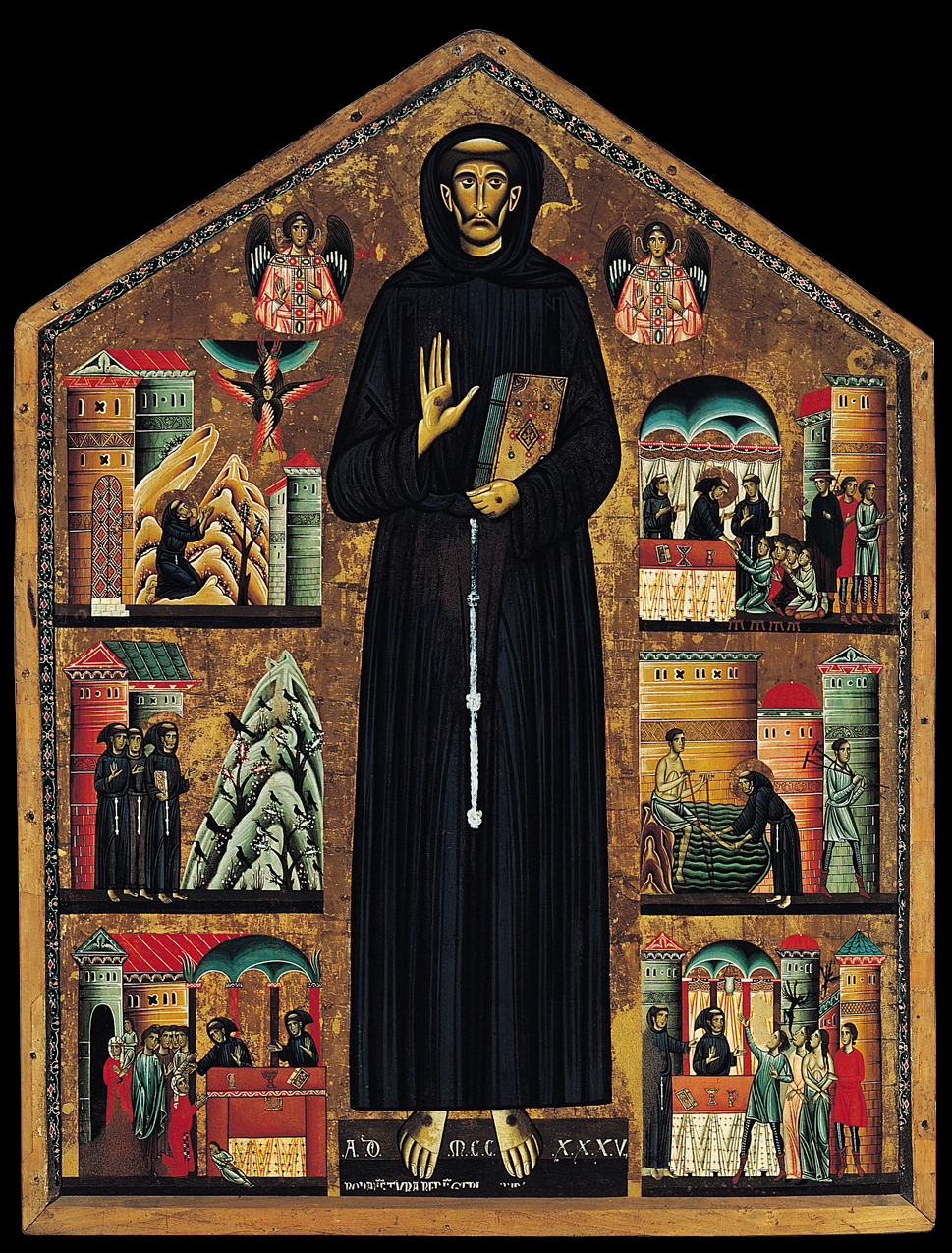
technique: tempera (on wood), Gold leaf, Life-size portrait
* tempera (water + pigments + egg yolk)
chronology: 13th Century
art style, culture, or geographical area: Late medieval Italy
context of production: Panel from the “Saint Francis Altarpiece,”
how are figures represented: frontal, elongated
space: no perspective
* late medieval panel
* life-size portrait
* triangular composition
* Byzantine Style (hierarchical and icon type, 2-D, architectural structure)
* lack of physical space, monk almost just floating in space
* life stories in square structured sections
* tempera (water + pigments + egg yolk)
chronology: 13th Century
art style, culture, or geographical area: Late medieval Italy
context of production: Panel from the “Saint Francis Altarpiece,”
how are figures represented: frontal, elongated
space: no perspective
* late medieval panel
* life-size portrait
* triangular composition
* Byzantine Style (hierarchical and icon type, 2-D, architectural structure)
* lack of physical space, monk almost just floating in space
* life stories in square structured sections
3
New cards
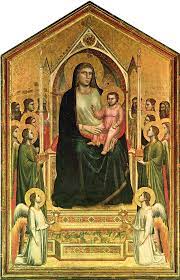
technique: tempera, gold leaf (show sacred context of work)
chronology: early 14th Century
art style, culture, or geographical area: Late medieval Italy
context of production: GIOTTO, “Madonna Enthroned,””
* altered byzantine style
* perspective with angels being hidden behind another — 3D
* **modeling** of the figures (look at the shaded areas on the faces, they give a sense of depth, the faces aren’t flat but are projecting)
* **sense of distance**, however, the angels are still of the same size (in reality, those that stand behind would look smaller) as in the Byzantine work.
* altered byzantine style
* abandoning hierarchical and icon type → showing more realistic and natural
* more three dimensional
* more architectural structure → show dimensional → show living in dimensional world with space
* shading - Chiaroscuro - 3D
chronology: early 14th Century
art style, culture, or geographical area: Late medieval Italy
context of production: GIOTTO, “Madonna Enthroned,””
* altered byzantine style
* perspective with angels being hidden behind another — 3D
* **modeling** of the figures (look at the shaded areas on the faces, they give a sense of depth, the faces aren’t flat but are projecting)
* **sense of distance**, however, the angels are still of the same size (in reality, those that stand behind would look smaller) as in the Byzantine work.
* altered byzantine style
* abandoning hierarchical and icon type → showing more realistic and natural
* more three dimensional
* more architectural structure → show dimensional → show living in dimensional world with space
* shading - Chiaroscuro - 3D
4
New cards
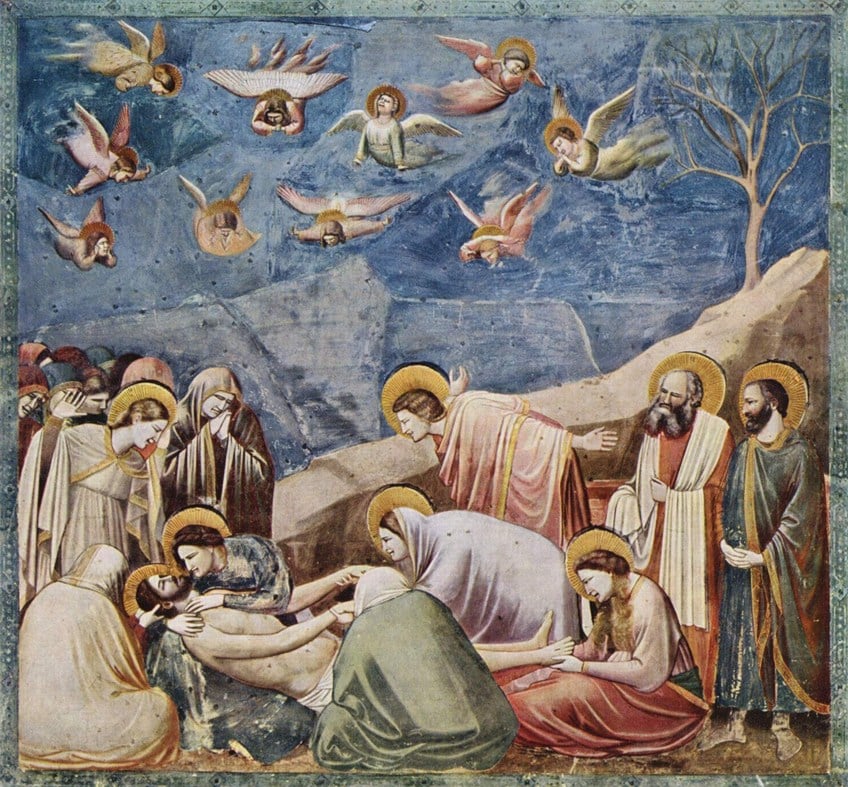
technique: fresco
chronology: early 14th Century
art style, culture, or geographical area: Late medieval Italy
context of production: GIOTTO, “Lamentation,” (Arena Chapel, Padua), Italy
how are figures represented: foreshortening, naturalism
* Lamentation — mourning over Christ's dead body
* movement, expression (angels bending, angel’s expression) — differentiate each person
* people mourning in variety of ways
* **Naturalism in art** – a style of painting that strives to depict accurately the natural world; “fidelity to nature.”
* blue background, tree, rock/hill
* controlled composition
* people off-center, Jesus off-center
* direction of people and hill/rock directs attention to Jesus
* **foreshortening — technique of depicting an object or human body in a picture so as to produce an illusion of projection or extension in space**
* viewer is part of the scene
* two people facing their backs against us
* use of light and shade
chronology: early 14th Century
art style, culture, or geographical area: Late medieval Italy
context of production: GIOTTO, “Lamentation,” (Arena Chapel, Padua), Italy
how are figures represented: foreshortening, naturalism
* Lamentation — mourning over Christ's dead body
* movement, expression (angels bending, angel’s expression) — differentiate each person
* people mourning in variety of ways
* **Naturalism in art** – a style of painting that strives to depict accurately the natural world; “fidelity to nature.”
* blue background, tree, rock/hill
* controlled composition
* people off-center, Jesus off-center
* direction of people and hill/rock directs attention to Jesus
* **foreshortening — technique of depicting an object or human body in a picture so as to produce an illusion of projection or extension in space**
* viewer is part of the scene
* two people facing their backs against us
* use of light and shade
5
New cards
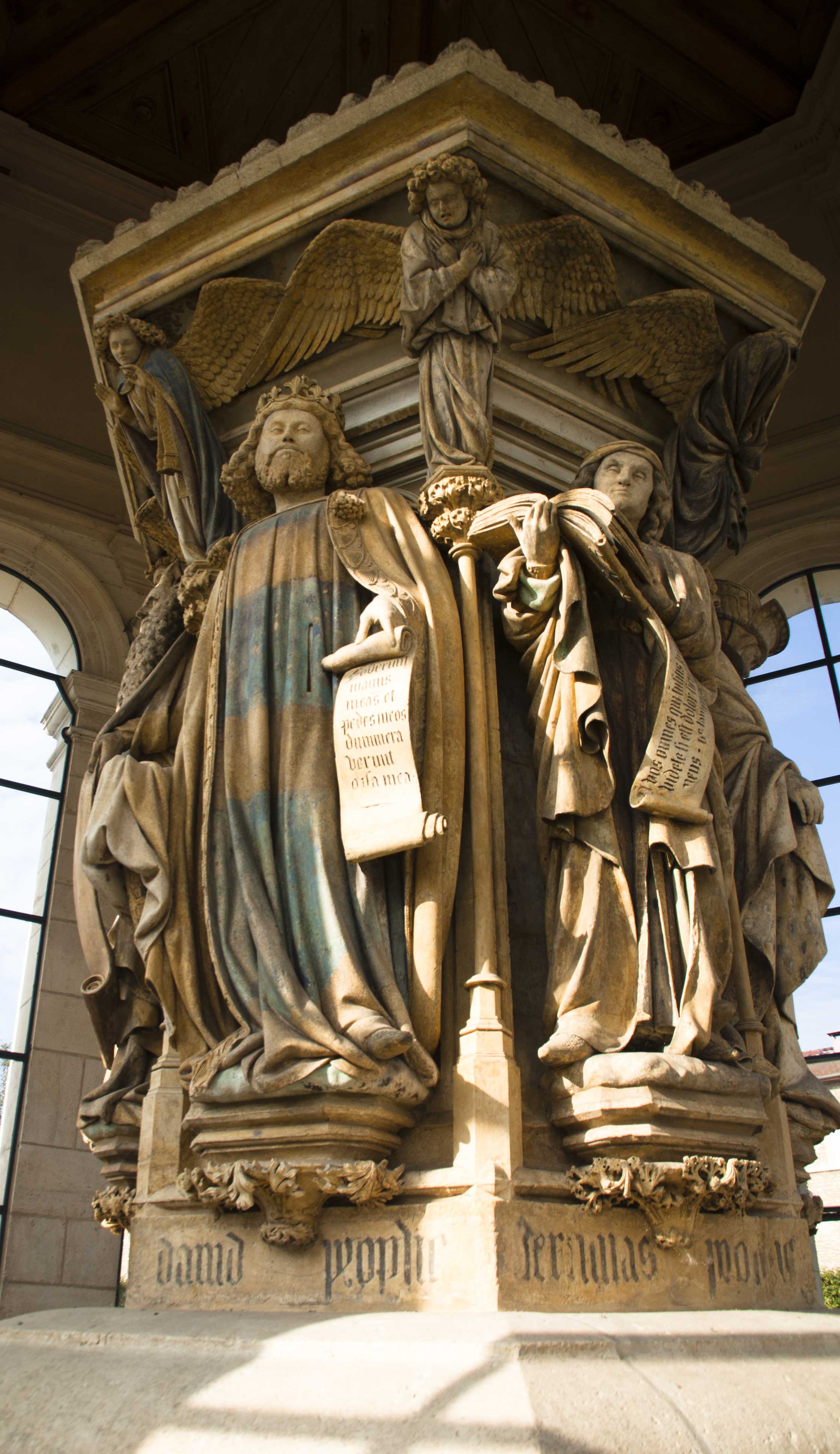
SLUTER, “Well of Moses,” \n France, ca. 1400. \n 15thC Northern Europe \n Mausoleum, monastery, \n naturalism
technique: mausoleum
chronology: 15th century
art style, culture, or geographical area: 15th C Northern Europe
context of production: montasery
how are figures represented: naturalism
**The Art of Burgundy and Flanders**
* Duchy of Burgundy
* The sculpture/well functioned as ”an engine in the center of the monastery”
* Philip the Bold (ca. 1363-1404 AD) — patron, wanted to go to heaven
* sponsor and endow monastery
* monks pray in cell with sculpture in there, pray for him and his family
* mausoleum for Duke and his family (put body there when he died)
* Chartreuse de Champmol (Charter house; top image), ca. 1400, Carthusian Monastery
* Well of Moses (bottom image) — represent prophets, realistic style
* each have different accessories, suggest who they are, looking in different directions, suppose to represent different things such as wisdom (power of God — had pair of horns)
* sculpture different to the usual identical sculptures
* Naturalism,
* Specificity, individualism
* Textures and the tangible
* Emotions
technique: mausoleum
chronology: 15th century
art style, culture, or geographical area: 15th C Northern Europe
context of production: montasery
how are figures represented: naturalism
**The Art of Burgundy and Flanders**
* Duchy of Burgundy
* The sculpture/well functioned as ”an engine in the center of the monastery”
* Philip the Bold (ca. 1363-1404 AD) — patron, wanted to go to heaven
* sponsor and endow monastery
* monks pray in cell with sculpture in there, pray for him and his family
* mausoleum for Duke and his family (put body there when he died)
* Chartreuse de Champmol (Charter house; top image), ca. 1400, Carthusian Monastery
* Well of Moses (bottom image) — represent prophets, realistic style
* each have different accessories, suggest who they are, looking in different directions, suppose to represent different things such as wisdom (power of God — had pair of horns)
* sculpture different to the usual identical sculptures
* Naturalism,
* Specificity, individualism
* Textures and the tangible
* Emotions
6
New cards
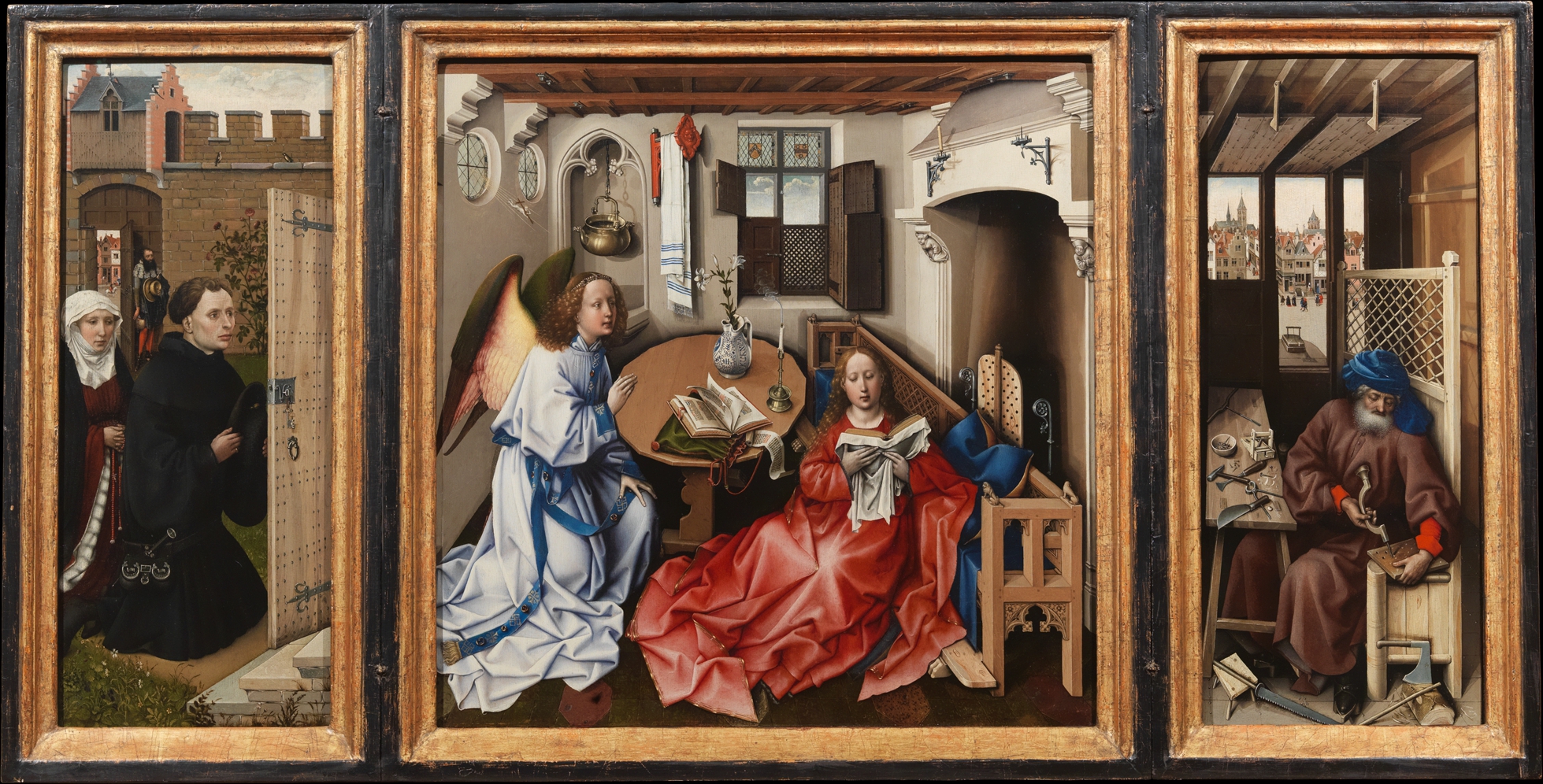
CAMPIN’s workshop, Annunciation Triptych (or “Merode Alterpiece” is fine as well) \n 15thC Northern Europe \n ca. 1430. Oil (on wood), altarpiece
how are figures represented: naturalism
space:
* Realism, careful observation of the natural world.
* Detail!
* Oil painting
* Secular and religious elements
* symbolism
* left panel depicts the donor and his wife; the central and most important panel shows the Annunciation itself, and its two main characters, Mary and Archangel Gabriel; the right panel portrays Joseph in his workshop.
* radical and new: domestic setting
how are figures represented: naturalism
space:
* Realism, careful observation of the natural world.
* Detail!
* Oil painting
* Secular and religious elements
* symbolism
* left panel depicts the donor and his wife; the central and most important panel shows the Annunciation itself, and its two main characters, Mary and Archangel Gabriel; the right panel portrays Joseph in his workshop.
* radical and new: domestic setting
7
New cards
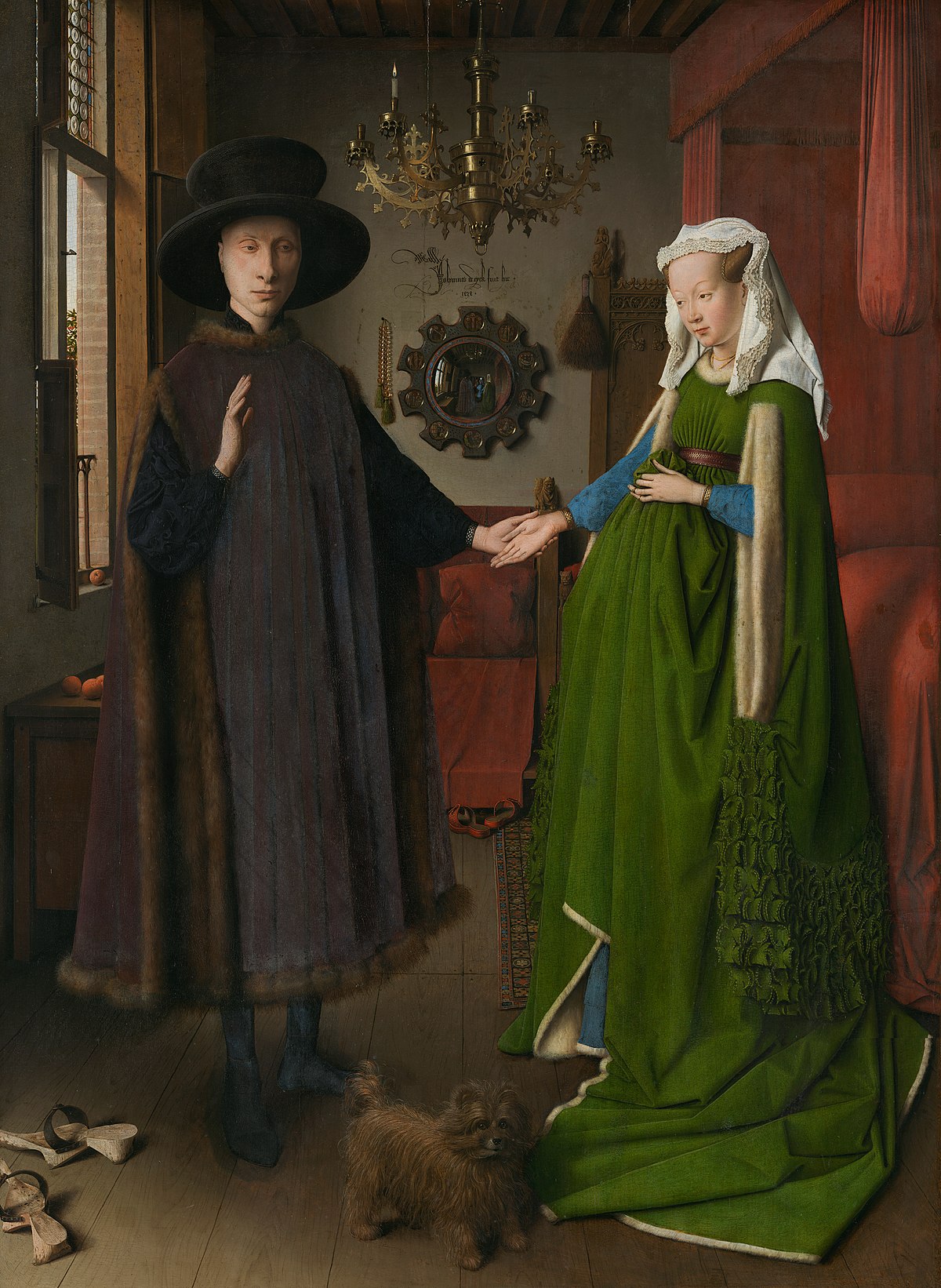
technique: oil on wood
chronology: ca. 1430
art style, culture, or geographical area: 15thC Northern Europe
context of production: JAN VAN EYCK, \\n “(Giovanni) Arnolfini
* The signature and date: "Johannes de Eyck fuit hic 1434” (Jan van Eyck was here)
* Giovanni Arnolfini, a prosperous Italian banker who had settled in Bruges, and his wife Giovanna Cenami, stand side by side in the bridal chamber, facing towards the viewer. The husband is holding out his wife's hand.
* symbols:
* oranges placed on the low table and the windowsill are a reminder of an original innocence, of an age before sin.
* apples: temptation of knowledge and the Fall
* small dog: fidelity and love
* marriage bed with red curtains: evokes the physical act of love which, according to Christian doctrine, is an essential part of the perfect union of man and wife
* perspective: practised perspective on a purely heuristic basis, unaware of the laws by which it was governed. In this picture, he uses the mirror precisely in order to explode the limits of the space to which his technique gives him access as soon as it threatens to limit him.
chronology: ca. 1430
art style, culture, or geographical area: 15thC Northern Europe
context of production: JAN VAN EYCK, \\n “(Giovanni) Arnolfini
* The signature and date: "Johannes de Eyck fuit hic 1434” (Jan van Eyck was here)
* Giovanni Arnolfini, a prosperous Italian banker who had settled in Bruges, and his wife Giovanna Cenami, stand side by side in the bridal chamber, facing towards the viewer. The husband is holding out his wife's hand.
* symbols:
* oranges placed on the low table and the windowsill are a reminder of an original innocence, of an age before sin.
* apples: temptation of knowledge and the Fall
* small dog: fidelity and love
* marriage bed with red curtains: evokes the physical act of love which, according to Christian doctrine, is an essential part of the perfect union of man and wife
* perspective: practised perspective on a purely heuristic basis, unaware of the laws by which it was governed. In this picture, he uses the mirror precisely in order to explode the limits of the space to which his technique gives him access as soon as it threatens to limit him.
8
New cards
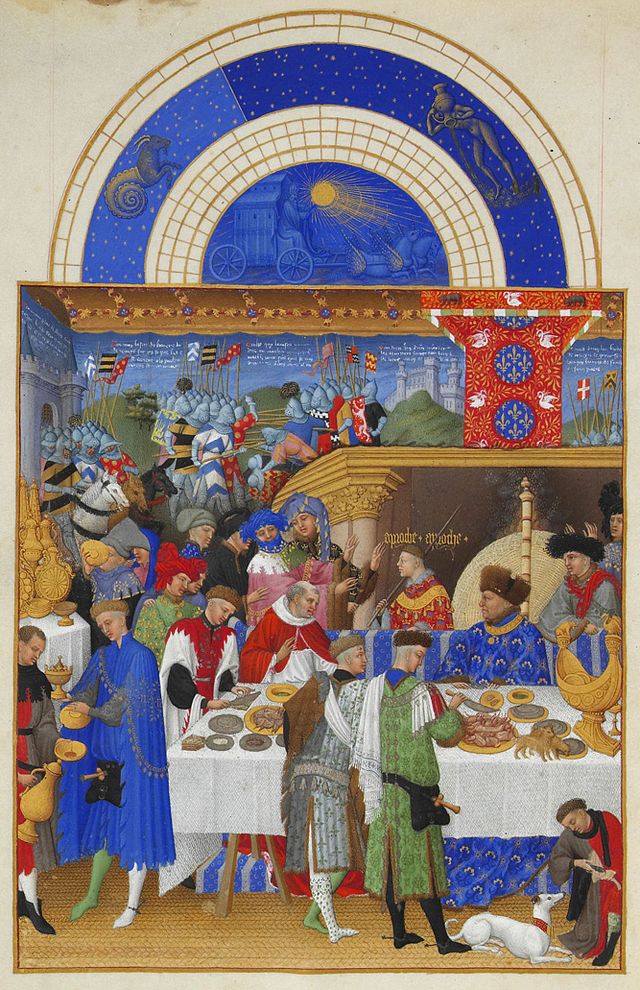
technique: manuscript page
chronology: ca. 1415
art style, culture, or geographical area: 15thC Northern Europe
context of production: LIMBOURG BROTHERS, “January,” from In the “Book of Hours”
**Very Sumptuous Hours**
* Early 15th century
* sponsored by Jean, duke of Berry
* manuscript - very popular form of art
* *Les Tres Riches Heures du Duc de Berry (The Very Reach Hours of Duke of Berry) ca. 1410*
* Book of Hours genre (private devotional volume that contained prayers often for each hour of the day + calendar with days of saints) most popular genre in 1400s Europe
* attention to detail, lots of decorative patterns
* Duke sitting at table and providing feast — show wealth of Duke (metaphorical)
* elongated and elegant figures
* lunette (half-moon shaped architectural space, variously filled with sculpture, painted, glazed, filled with recessed masonry, or void.)
chronology: ca. 1415
art style, culture, or geographical area: 15thC Northern Europe
context of production: LIMBOURG BROTHERS, “January,” from In the “Book of Hours”
**Very Sumptuous Hours**
* Early 15th century
* sponsored by Jean, duke of Berry
* manuscript - very popular form of art
* *Les Tres Riches Heures du Duc de Berry (The Very Reach Hours of Duke of Berry) ca. 1410*
* Book of Hours genre (private devotional volume that contained prayers often for each hour of the day + calendar with days of saints) most popular genre in 1400s Europe
* attention to detail, lots of decorative patterns
* Duke sitting at table and providing feast — show wealth of Duke (metaphorical)
* elongated and elegant figures
* lunette (half-moon shaped architectural space, variously filled with sculpture, painted, glazed, filled with recessed masonry, or void.)
9
New cards
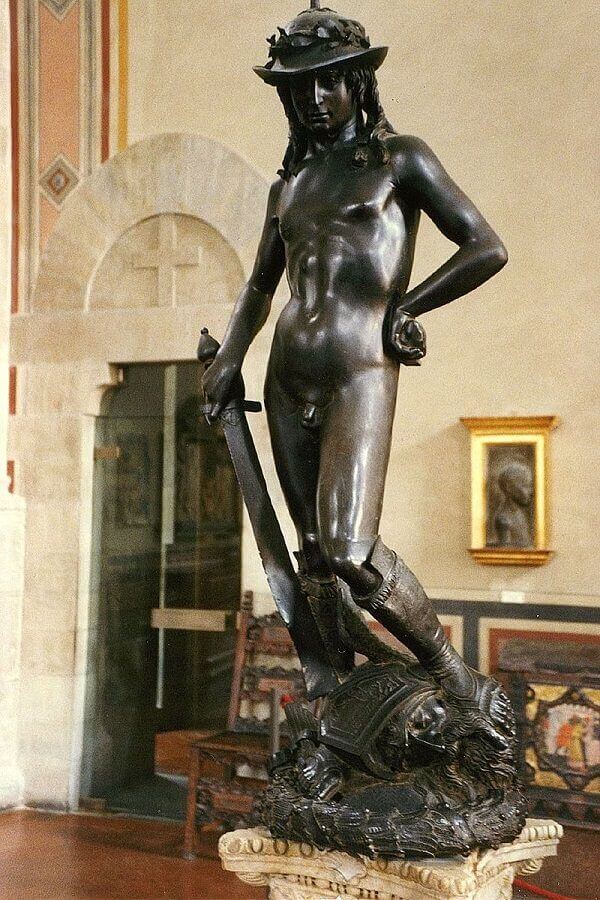
technique: bronze sculpture
chronology: 15th century
art style, culture, or geographical area: Early Renaissance Italy (or Quattrocento)
context of production: DONATELLO, “David,”
iconography:
how are figures represented: Freestanding nude, contrapposto
* **Florence, Quattrocento** (1*4*00 - 1500 AD): rebirth of the concepts of classical art
* humanism
* education
* civic pride and duty (city-states competing against each other)
* self-improvement and personal achievement
* vernacular literature/language: books printed in Italy
* interdisciplinary learning and the ‘Renaissance man’
* **promotion of arts** by the influential Florentine families → **The Medici**
* Attention to the human form including the return of classical nudity and **contrapposto** — influence of classical satues
* **contraposto:** The position of a standing human figure whose weight is unequally distributed between the two legs, resulting in a slight curvature of the body
* Discovery and codification of **linear** perspective to creation 3D illusion, usage of **aerial perspective** (important to classical painting)
* Paintings/architecture that **balanced symmetrical compositions**
* use of **chiaroscuro**
* **use of single light source** → greater realism
chronology: 15th century
art style, culture, or geographical area: Early Renaissance Italy (or Quattrocento)
context of production: DONATELLO, “David,”
iconography:
how are figures represented: Freestanding nude, contrapposto
* **Florence, Quattrocento** (1*4*00 - 1500 AD): rebirth of the concepts of classical art
* humanism
* education
* civic pride and duty (city-states competing against each other)
* self-improvement and personal achievement
* vernacular literature/language: books printed in Italy
* interdisciplinary learning and the ‘Renaissance man’
* **promotion of arts** by the influential Florentine families → **The Medici**
* Attention to the human form including the return of classical nudity and **contrapposto** — influence of classical satues
* **contraposto:** The position of a standing human figure whose weight is unequally distributed between the two legs, resulting in a slight curvature of the body
* Discovery and codification of **linear** perspective to creation 3D illusion, usage of **aerial perspective** (important to classical painting)
* Paintings/architecture that **balanced symmetrical compositions**
* use of **chiaroscuro**
* **use of single light source** → greater realism
10
New cards
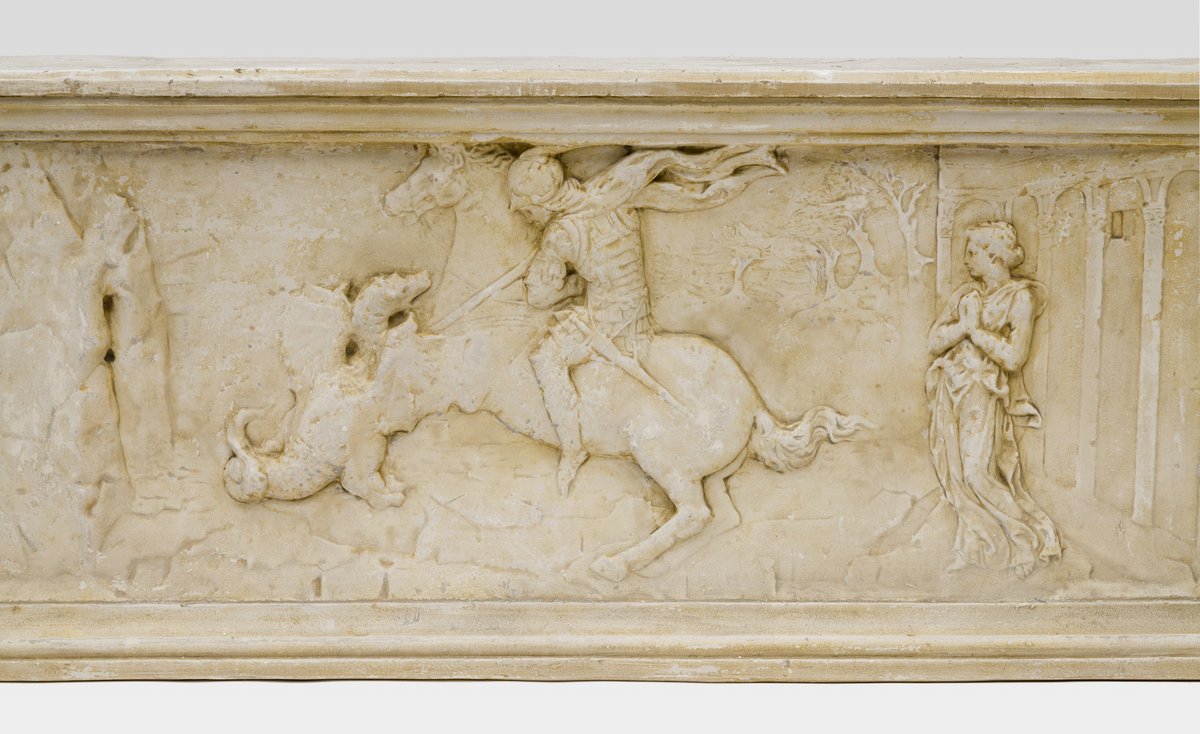
technique: marble
chronology: 15th century
art style, culture, or geographical area: Early Renaissance Italy (or Quattrocento)
context of production: Donatello, Saint George and the Dragon
how are figures represented:
* **atmospheric (or aerial) perspective**: details which are in the distance are blurrier and less detailed than those in the foreground.
* **relief (or relief sculpture)** - sculpture that projects in varying degrees from a two-dimensional background
chronology: 15th century
art style, culture, or geographical area: Early Renaissance Italy (or Quattrocento)
context of production: Donatello, Saint George and the Dragon
how are figures represented:
* **atmospheric (or aerial) perspective**: details which are in the distance are blurrier and less detailed than those in the foreground.
* **relief (or relief sculpture)** - sculpture that projects in varying degrees from a two-dimensional background
11
New cards
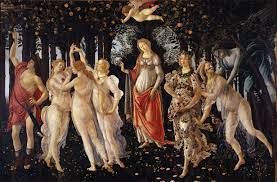
technique: Tempera (on wood)
chronology: ca. 1480
art style, culture, or geographical area: Early Renaissance Italy In (or Quattrocento)
context of production: Botticelli, Primavera in (Spring), Medici
how are figures represented: freestanding nude, contrapposto
* Zephyrus embraces a nymph named Chloris before taking her; she is then portrayed after her transformation into Flora, the spring goddess.
* centre of the painting is dominated by the goddess of love and beauty, Venus, chastely dressed and set slightly back from the others, and by a blindfolded Cupid, firing his arrow of love.
* painting is a celebration of love, peace, and prosperity.
* Florentine patron, Lorenzo de Medici, for the occasion of his wedding in 1482.
* The goddess of love Venus, The Three Graces, Cupid, Chloris by Zephyrus, Mercury
* sensuality, lyricism,
* “visual poetry,”
* Chivalric poetry
* Love stories inspired by classical mythology
chronology: ca. 1480
art style, culture, or geographical area: Early Renaissance Italy In (or Quattrocento)
context of production: Botticelli, Primavera in (Spring), Medici
how are figures represented: freestanding nude, contrapposto
* Zephyrus embraces a nymph named Chloris before taking her; she is then portrayed after her transformation into Flora, the spring goddess.
* centre of the painting is dominated by the goddess of love and beauty, Venus, chastely dressed and set slightly back from the others, and by a blindfolded Cupid, firing his arrow of love.
* painting is a celebration of love, peace, and prosperity.
* Florentine patron, Lorenzo de Medici, for the occasion of his wedding in 1482.
* The goddess of love Venus, The Three Graces, Cupid, Chloris by Zephyrus, Mercury
* sensuality, lyricism,
* “visual poetry,”
* Chivalric poetry
* Love stories inspired by classical mythology
12
New cards
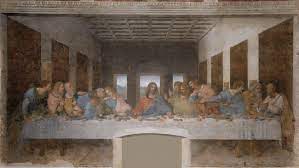
LEONARDO DA VINCI, “Last Supper,” ca. 1500. \n Oil and tempera (on plaster, àthis is quite an unusual technique!) \n High Renaissance Italy \n Linear perspective, vanishing point, chiaroscuro
technique: Oil and tempera (on plaster, this is quite an unusual technique!)
chronology: ca. 1500
art style, culture, or geographical area: High Renaissance Italy
how are figures represented: Linear perspective, vanishing point (point at which receding parallel lines seem to meet when represented in linear perspective), chiaroscuro
* commissioned by Ludovico Sforza for the refectory of a Milan church
* subject of the *Last Supper* is Christ’s final meal with his apostles before Judas identifies Christ to the authorities who arrest him
* Peter, who sits beside Judas, holds a knife in his right hand, foreshadowing that Peter will sever the ear of a soldier as he attempts to protect Christ from arrest.
* balanced composition is anchored by an equilateral triangle formed by Christ’s body. He sits below an arching pediment that, if completed, traces a circle. These ideal geometric forms refer to the renaissance interest in Neo-Platonism (humanist revival of Greek philosophy + Christian theology
technique: Oil and tempera (on plaster, this is quite an unusual technique!)
chronology: ca. 1500
art style, culture, or geographical area: High Renaissance Italy
how are figures represented: Linear perspective, vanishing point (point at which receding parallel lines seem to meet when represented in linear perspective), chiaroscuro
* commissioned by Ludovico Sforza for the refectory of a Milan church
* subject of the *Last Supper* is Christ’s final meal with his apostles before Judas identifies Christ to the authorities who arrest him
* Peter, who sits beside Judas, holds a knife in his right hand, foreshadowing that Peter will sever the ear of a soldier as he attempts to protect Christ from arrest.
* balanced composition is anchored by an equilateral triangle formed by Christ’s body. He sits below an arching pediment that, if completed, traces a circle. These ideal geometric forms refer to the renaissance interest in Neo-Platonism (humanist revival of Greek philosophy + Christian theology
13
New cards
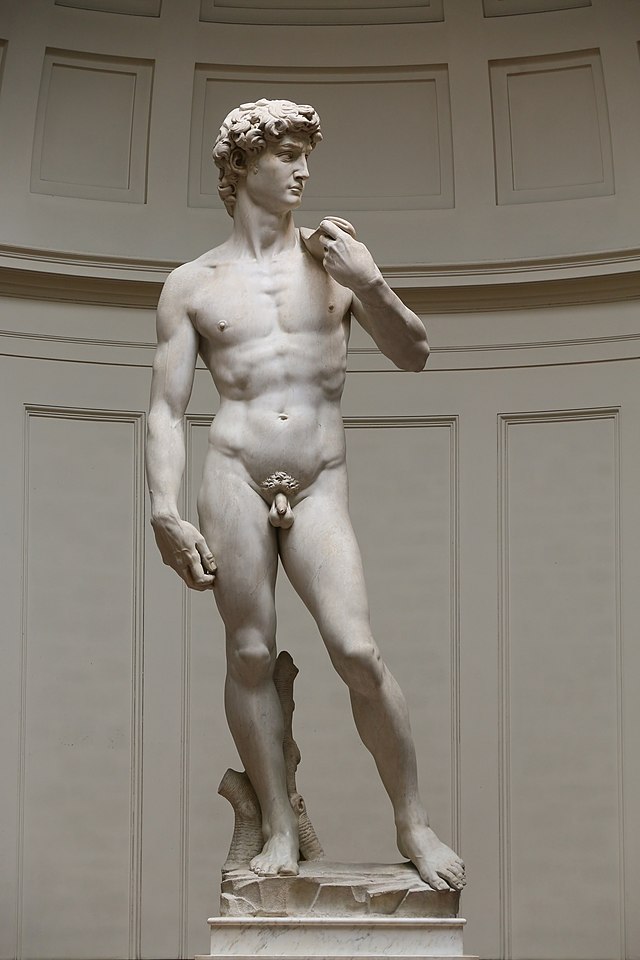
technique: marble sculpture
chronology: ca. 1500
art style, culture, or geographical area: High Renaissance Italy
context of production: MICHELANGELO, “David,”
how are figures represented: contrapposto
* Like the ancient Hellenistic and Roman sculptures who were masters at convincingly depicting the human anatomy, Michelangelo has depicted David so that his body responds to the stance he is in
* he colossal size is significant because it was the **first time that a large scale nude statue was made in the Renaissance since antiquity.**
* Michelangelo’s David became a civic symbol for Florence, even though it was ultimately a religious sculpture. The early 1500s was a time of turbulence between the city and its former ruling family, the Medici. Now, the Medici were seen as aggressors or tyrants and had been kicked out of Florence. **Florentines adopted the David as a symbol of their own struggle against the Medici,** and in 1504 they decided that Michelangelo’s creation was too good to place high up on the cathedral.
chronology: ca. 1500
art style, culture, or geographical area: High Renaissance Italy
context of production: MICHELANGELO, “David,”
how are figures represented: contrapposto
* Like the ancient Hellenistic and Roman sculptures who were masters at convincingly depicting the human anatomy, Michelangelo has depicted David so that his body responds to the stance he is in
* he colossal size is significant because it was the **first time that a large scale nude statue was made in the Renaissance since antiquity.**
* Michelangelo’s David became a civic symbol for Florence, even though it was ultimately a religious sculpture. The early 1500s was a time of turbulence between the city and its former ruling family, the Medici. Now, the Medici were seen as aggressors or tyrants and had been kicked out of Florence. **Florentines adopted the David as a symbol of their own struggle against the Medici,** and in 1504 they decided that Michelangelo’s creation was too good to place high up on the cathedral.
14
New cards
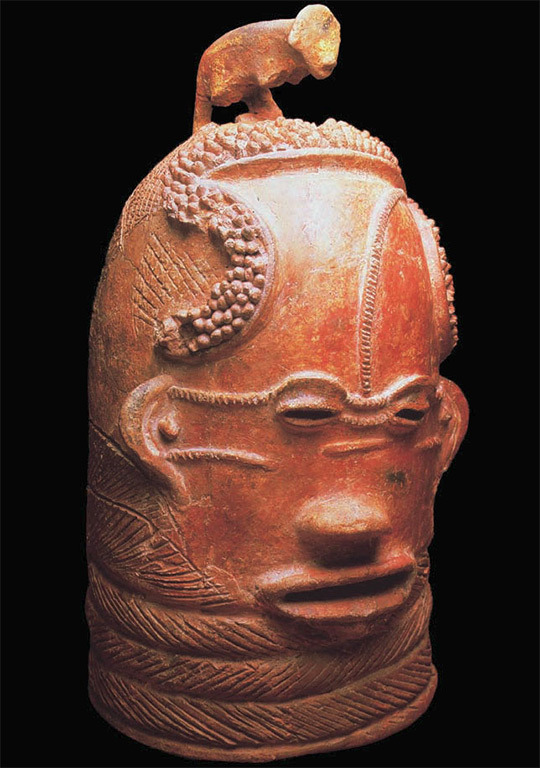
technique: Terracotta
chronology: ca. 500 AD
art style, culture, or geographical area: South Africa
context of production: Head (from Lydenburg), Scarification marks
chronology: ca. 500 AD
art style, culture, or geographical area: South Africa
context of production: Head (from Lydenburg), Scarification marks
15
New cards
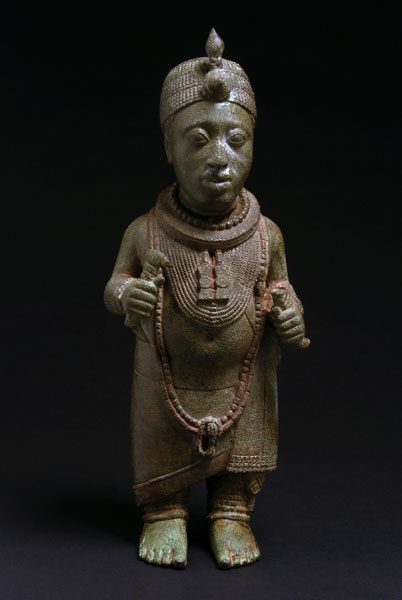
technique: Terracotta
chronology: 11/12thC
art style, culture, or geographical area: life culture, Nigeria/Africa
context of production: King (from Ita Yemoo)
how are figures represented: contrapposto
* Oni” king in Ife culture (part of Yoruba, SW Nigeria) Kings as important political, universal, spiritual rulers;
* suppose to be shown young
* necklaces to show high social status, septor — accessories of power
* round ornament suggesting crown
* each culture had own way of showing human form
chronology: 11/12thC
art style, culture, or geographical area: life culture, Nigeria/Africa
context of production: King (from Ita Yemoo)
how are figures represented: contrapposto
* Oni” king in Ife culture (part of Yoruba, SW Nigeria) Kings as important political, universal, spiritual rulers;
* suppose to be shown young
* necklaces to show high social status, septor — accessories of power
* round ornament suggesting crown
* each culture had own way of showing human form
16
New cards
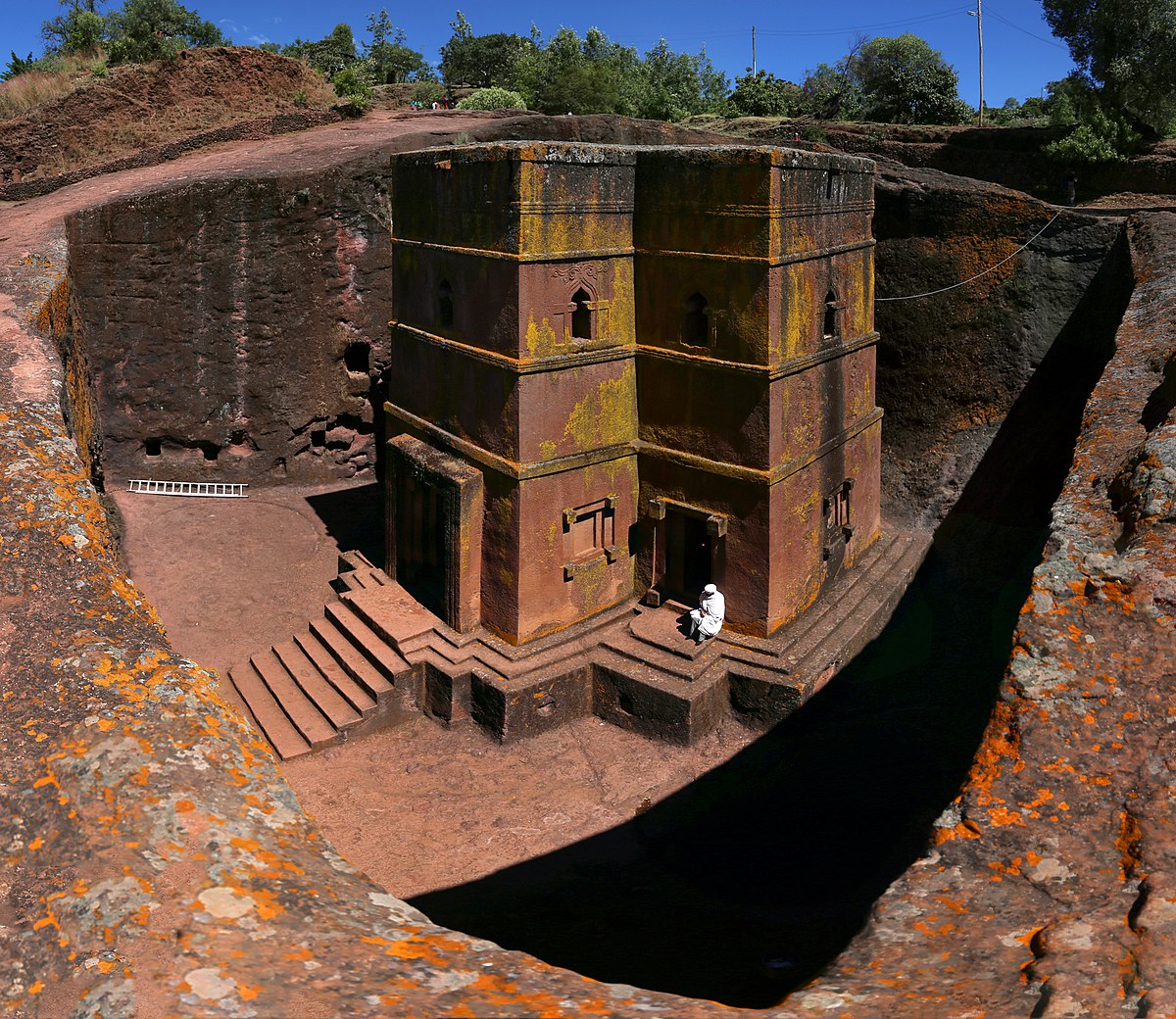
technique: church
chronology: 13thC
art style, culture, or geographical area: Christian Ethiopia/Africa
context of production: Church of Saint George, \\n Lalibela, Ethiopia
* Each layer of the building have distinct motifs, leading to the roof which is covered in intersecting crosses that lie within a bigger Greek cross.
* Christian king Lalibela sought to build a New Jerusalem in Ethiopia for pilgrims. The rock-cut church of Saint George emulates Byzantine models and has a Greek-cross plan and internal dome.
chronology: 13thC
art style, culture, or geographical area: Christian Ethiopia/Africa
context of production: Church of Saint George, \\n Lalibela, Ethiopia
* Each layer of the building have distinct motifs, leading to the roof which is covered in intersecting crosses that lie within a bigger Greek cross.
* Christian king Lalibela sought to build a New Jerusalem in Ethiopia for pilgrims. The rock-cut church of Saint George emulates Byzantine models and has a Greek-cross plan and internal dome.
17
New cards
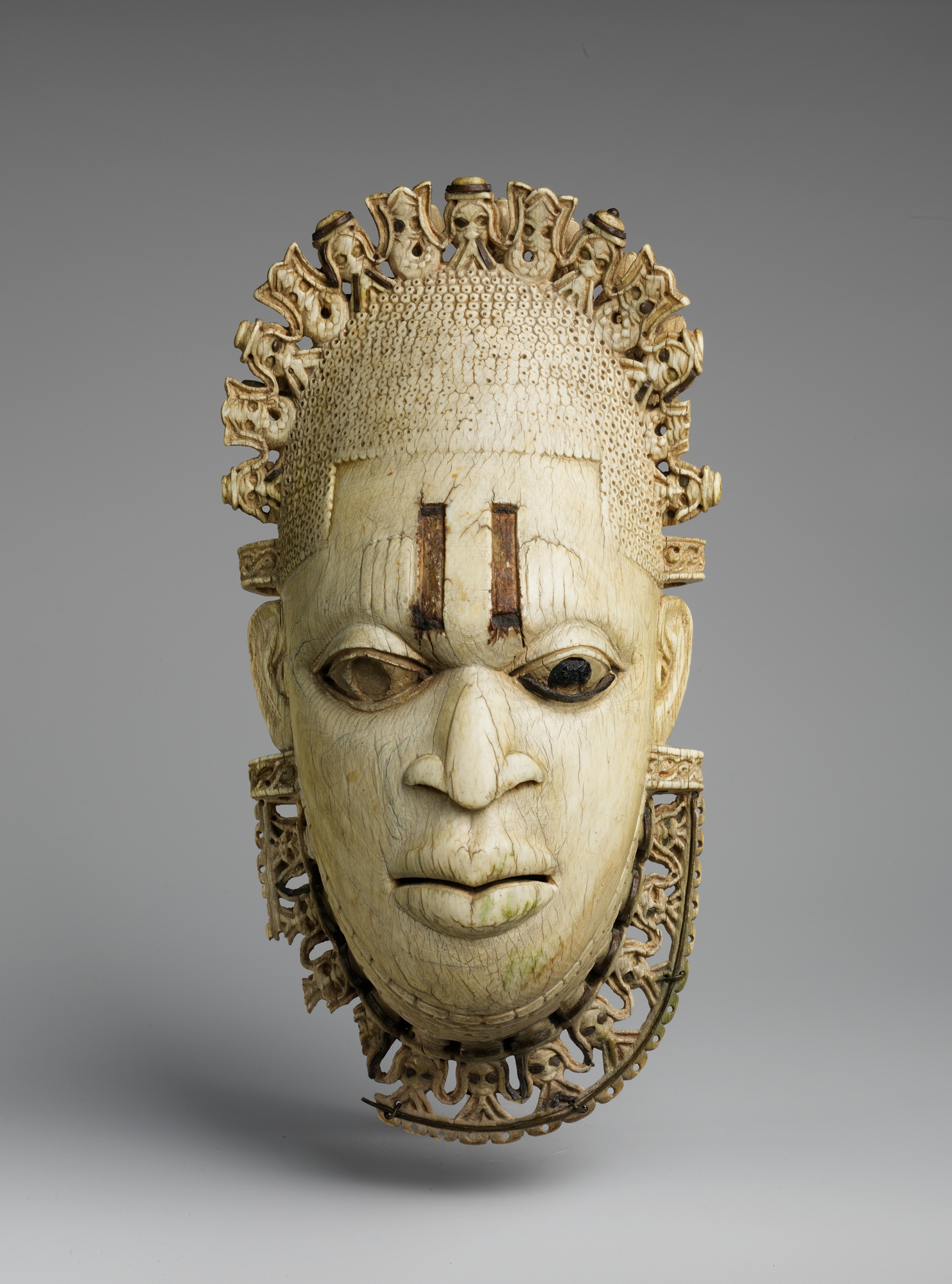
technique: ivory
chronology: 16th C AD
art style, culture, or geographical area: Kingdom of Benin, Nigeria/Africa
context of production: Naturalism, representation of mudfish, heads of Portuguese people
* **Kingdom of Benin (Nigeria, not Benin)**
* wealth contributed to by fertile land, in Niger region
* How do we know who the mask is of? How we know its Queen Mother India? king of benin kingdom still refers to ancestors
* ivory pendant mask
* Two vertical bars of inlaid iron between the eyes allude to medicine-filled incisions that were one source of Idia’s metaphysical power.
* naturalistic features, with graceful curves that echo the oval shape of the head. Four carved scarification marks, a number associated with females, indicate her gender.
* choker of coral beads and her hair is arranged in an elegant configuration that resembles a tiara
* intricately carved openwork designs are stylized mudfish alternating with the faces of Portuguese traders. Both motifs are associated with the Oba and his counterpart, the sea god, Olokun
* The mudfish is a creature that lives both on land and in water, and a symbol of the king’s dual nature as both human and divine.
* **ivory:** luxury good, ivory was Benin’s principal commercial commodity and helped to attract Portuguese traders who, in turn, brought wealth to the kingdom in the form of copper and coral
chronology: 16th C AD
art style, culture, or geographical area: Kingdom of Benin, Nigeria/Africa
context of production: Naturalism, representation of mudfish, heads of Portuguese people
* **Kingdom of Benin (Nigeria, not Benin)**
* wealth contributed to by fertile land, in Niger region
* How do we know who the mask is of? How we know its Queen Mother India? king of benin kingdom still refers to ancestors
* ivory pendant mask
* Two vertical bars of inlaid iron between the eyes allude to medicine-filled incisions that were one source of Idia’s metaphysical power.
* naturalistic features, with graceful curves that echo the oval shape of the head. Four carved scarification marks, a number associated with females, indicate her gender.
* choker of coral beads and her hair is arranged in an elegant configuration that resembles a tiara
* intricately carved openwork designs are stylized mudfish alternating with the faces of Portuguese traders. Both motifs are associated with the Oba and his counterpart, the sea god, Olokun
* The mudfish is a creature that lives both on land and in water, and a symbol of the king’s dual nature as both human and divine.
* **ivory:** luxury good, ivory was Benin’s principal commercial commodity and helped to attract Portuguese traders who, in turn, brought wealth to the kingdom in the form of copper and coral
18
New cards
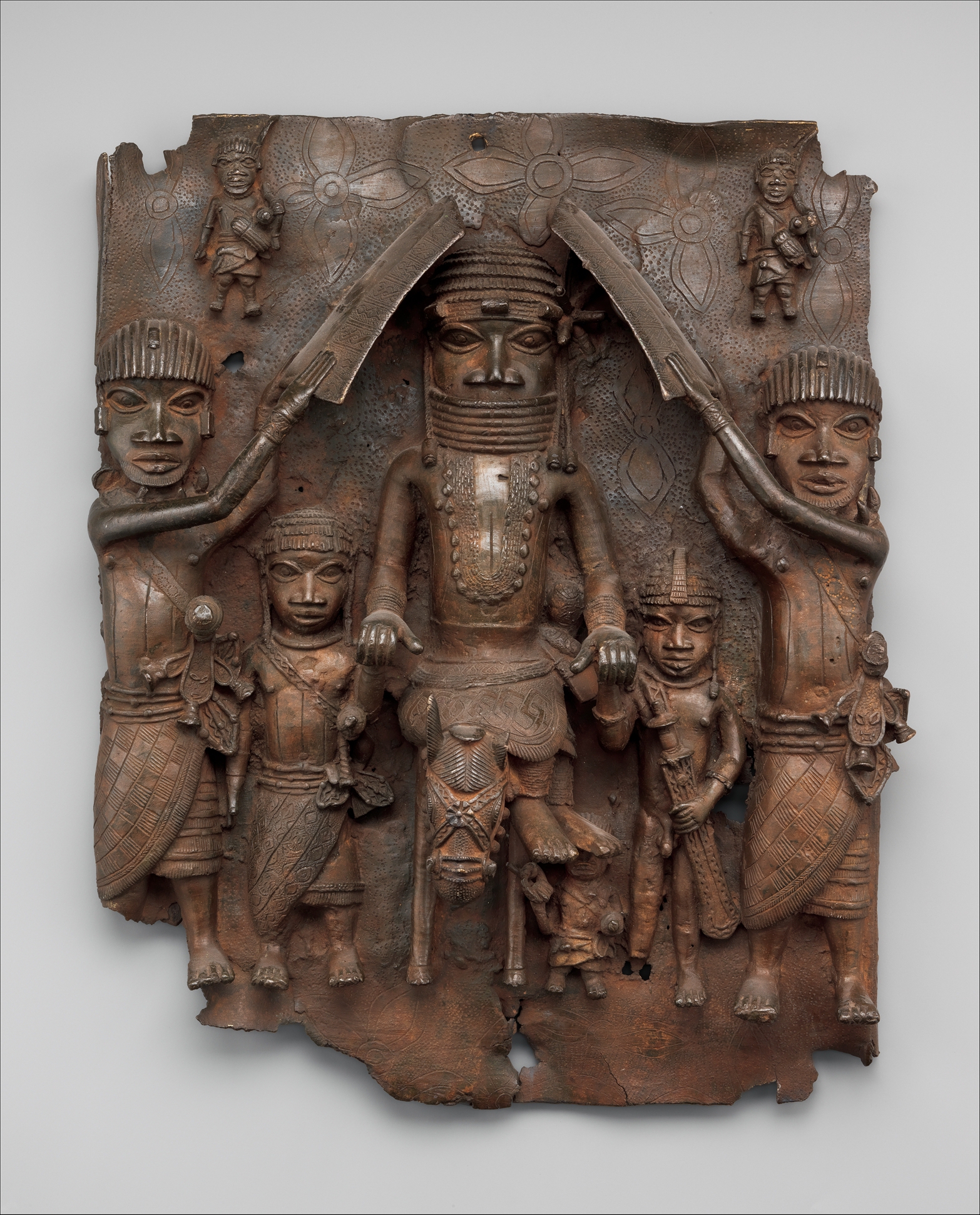
technique: brass
chronology: ca. 1600 AD
art style, culture, or geographical area: Kingdom of Benin, Nigeria/Africa
context of production: Hierarchy of scale(or representation), “Benin Bronzes”
* **Kingdom of Benin (Nigeria, not Benin)**
* Even more were involved as craftworkers producing splendid costumes and ritual paraphernalia for the king and chiefs, like those shown in many of the plaques, or as farmers supplying food for the feasts. Many of the plaques probably represent events or characters from these annual ceremonies, some of which the king of Benin still carries out today.
* procession, with a king or chief flanked by attendants who shade him from the sun with their shields.
* They are dressed in fine cloth worked in elaborate patterns, whose colorful appearance we can only now imagine.
* **hierarchy of representation:** Smaller figures, whose size as well as their scanty clothing shows their lesser importance, carry a ceremonial sword and the kind of circular box used to present gifts.
chronology: ca. 1600 AD
art style, culture, or geographical area: Kingdom of Benin, Nigeria/Africa
context of production: Hierarchy of scale(or representation), “Benin Bronzes”
* **Kingdom of Benin (Nigeria, not Benin)**
* Even more were involved as craftworkers producing splendid costumes and ritual paraphernalia for the king and chiefs, like those shown in many of the plaques, or as farmers supplying food for the feasts. Many of the plaques probably represent events or characters from these annual ceremonies, some of which the king of Benin still carries out today.
* procession, with a king or chief flanked by attendants who shade him from the sun with their shields.
* They are dressed in fine cloth worked in elaborate patterns, whose colorful appearance we can only now imagine.
* **hierarchy of representation:** Smaller figures, whose size as well as their scanty clothing shows their lesser importance, carry a ceremonial sword and the kind of circular box used to present gifts.
19
New cards
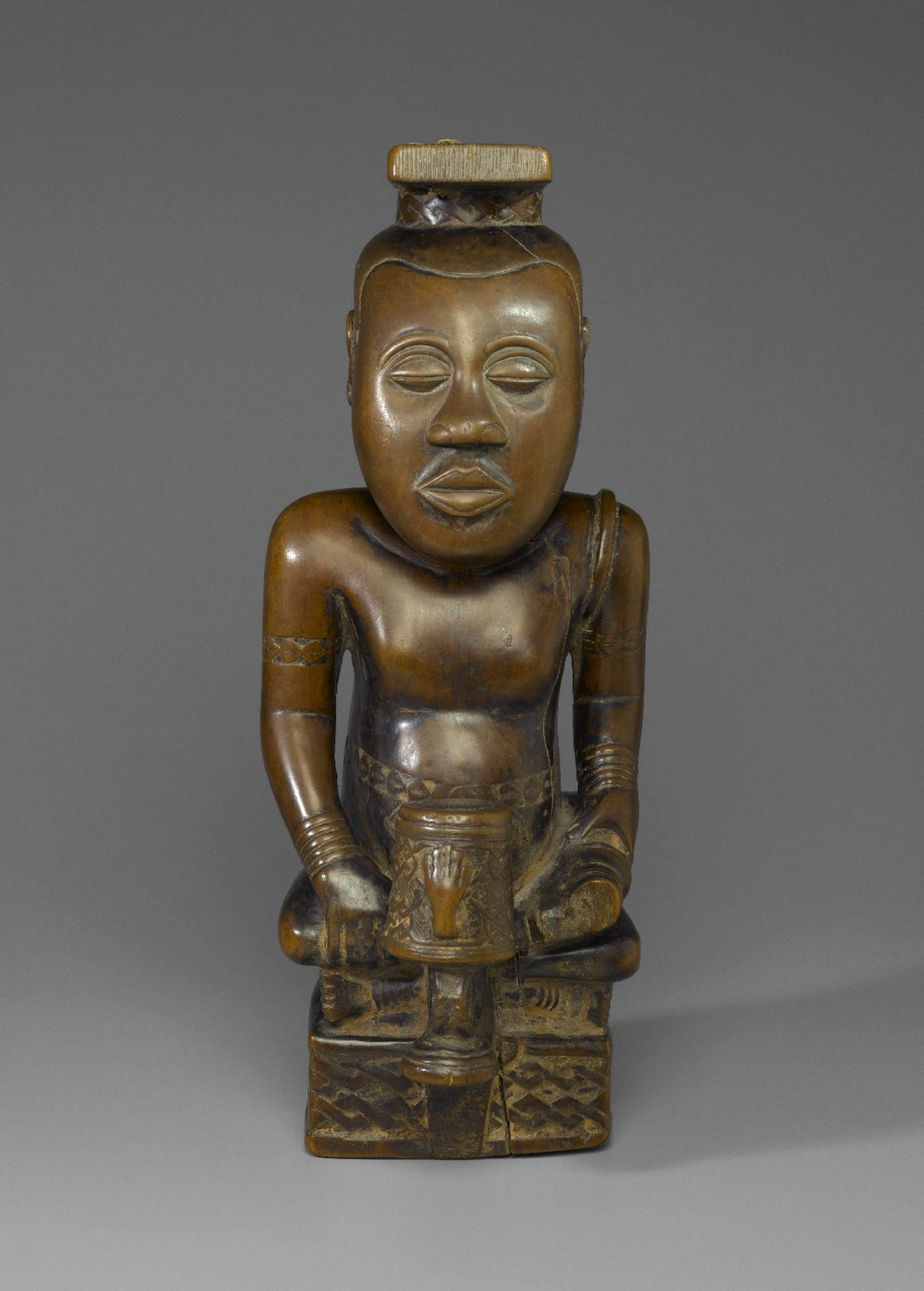
technique: wood
chronology: 18th C
art style, culture, or geographical area: Congo/Africa
context of production: (Ndop of the) Kuba King, figurative sculptures representing different kings (*nyim*) of the Kuba kingdom.
* Art from the Kuba Kingdom (Republic of Congo), 18thC
* Made out of wood (unique, because more perishable material)
* Ndop – royal portrait (usually seated figure) of the Kuba King
* Emblems of power, accessories
* recorded his reign for posterity and solidified his accomplishments amongst the pantheon of his predecessors
* Kuba artists emphasized the head because it was considered to be the seat of intelligence, a valued ideal.
* The *ibol* is a signifier that gives the *ndop* its particular identity, making it clear who the sculpture portrays and what reign it represents. A drum with a severed hand is the *ibol* for Mishe miShyaang maMbul’s reign, and that helps us identify the sculpture as his likeness.
chronology: 18th C
art style, culture, or geographical area: Congo/Africa
context of production: (Ndop of the) Kuba King, figurative sculptures representing different kings (*nyim*) of the Kuba kingdom.
* Art from the Kuba Kingdom (Republic of Congo), 18thC
* Made out of wood (unique, because more perishable material)
* Ndop – royal portrait (usually seated figure) of the Kuba King
* Emblems of power, accessories
* recorded his reign for posterity and solidified his accomplishments amongst the pantheon of his predecessors
* Kuba artists emphasized the head because it was considered to be the seat of intelligence, a valued ideal.
* The *ibol* is a signifier that gives the *ndop* its particular identity, making it clear who the sculpture portrays and what reign it represents. A drum with a severed hand is the *ibol* for Mishe miShyaang maMbul’s reign, and that helps us identify the sculpture as his likeness.
20
New cards
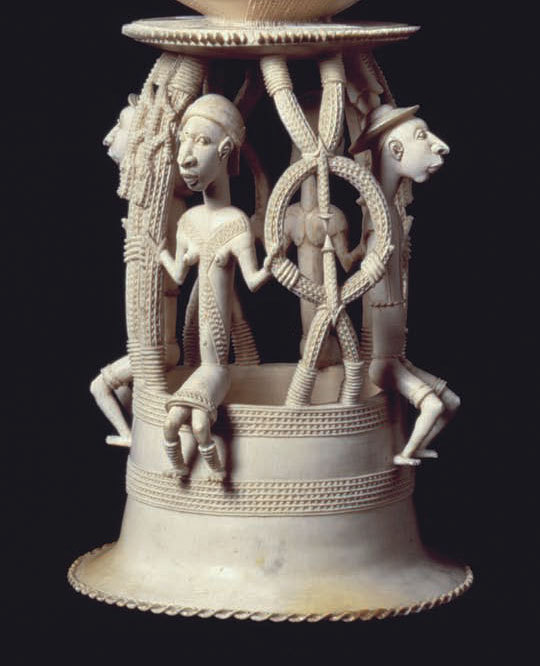
technique: ivory
chronology: Ca. 1500
art style, culture, or geographical area: Sierra Leone/Africa
context of production: Sapi-Portuguese Saltcellar, (“Master of the Symbolic Execution”)
* Sapi export items were all meticulously carved from elephant tusk ivory with refined detail and careful finish. Ivory was plentiful in those early days and was one of the coveted exports in early West and Central African trade with Europe.
* The Sapi export ivories, the earliest examples of African tourist art, are a fascinating hybrid art form.
* Identical large noses with flaring nostrils, as well as the conventions for rendering eyes and lips, characterize Sapi stone figures from the same region and period.
* Hybrid art form! / “Tourist art” / Prestige item
* Tourist for Portuguese
chronology: Ca. 1500
art style, culture, or geographical area: Sierra Leone/Africa
context of production: Sapi-Portuguese Saltcellar, (“Master of the Symbolic Execution”)
* Sapi export items were all meticulously carved from elephant tusk ivory with refined detail and careful finish. Ivory was plentiful in those early days and was one of the coveted exports in early West and Central African trade with Europe.
* The Sapi export ivories, the earliest examples of African tourist art, are a fascinating hybrid art form.
* Identical large noses with flaring nostrils, as well as the conventions for rendering eyes and lips, characterize Sapi stone figures from the same region and period.
* Hybrid art form! / “Tourist art” / Prestige item
* Tourist for Portuguese
21
New cards
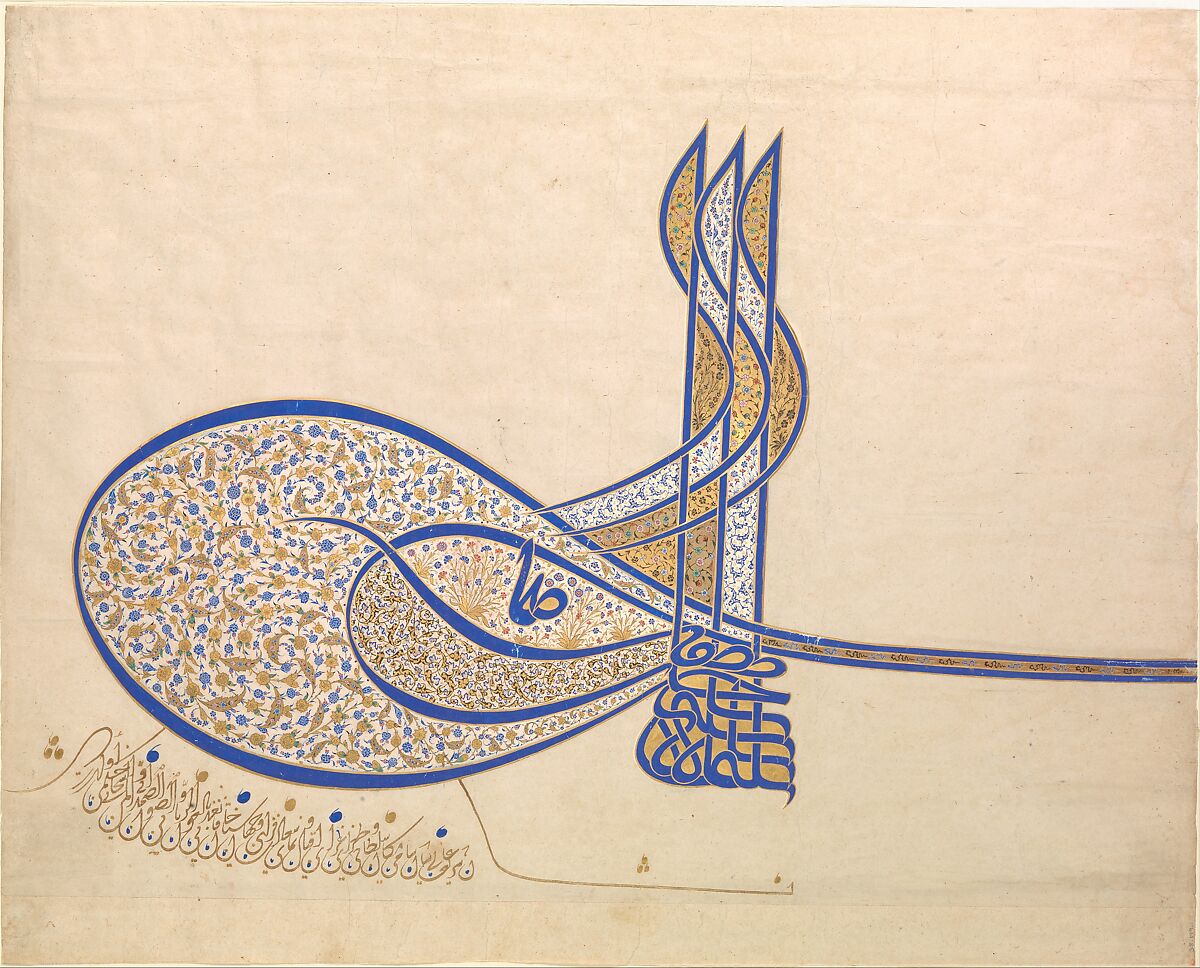
technique: paper (or ink, watercolor…on paper)
chronology: 16th C AD
art style, culture, or geographical area: Ottoman
context of production: Tughra (Official Signature) of Sultan Süleiman the Magnificent from Istanbul
* **Official Signature of Sultan Suleiman the Magnificent:**
* Golden age of Ottoman Empire especially with this Sultan bc of geographic area
* centralized bureaucracy, Istanbul — function of signature for asserting power
* signature function as something Sultan signs — workshop prepare signature (Sultan not sign himself)
* some responsible for parts of background, colors, details within signature
* very decorative with flowers, represented in ceramics and textiles (tile decoration in mosque, reproduced in signature)
* speaks to language itself, cannot be deciphered by everyone, more symbolic
* verticalness against usual horizontal of Arabic, similar to naturalistic flowers like stalks of flowers
* playfulness
* association with music
* **The Koran (Qu’ran):** the sacred book of Islam. It records Muhammad’s revelations that he received from God through Archangel Gabriel
* **Calligraphy:** art of hand-lettering
* **Aniconism:** related to the belief that is inappropriate to represent figures
chronology: 16th C AD
art style, culture, or geographical area: Ottoman
context of production: Tughra (Official Signature) of Sultan Süleiman the Magnificent from Istanbul
* **Official Signature of Sultan Suleiman the Magnificent:**
* Golden age of Ottoman Empire especially with this Sultan bc of geographic area
* centralized bureaucracy, Istanbul — function of signature for asserting power
* signature function as something Sultan signs — workshop prepare signature (Sultan not sign himself)
* some responsible for parts of background, colors, details within signature
* very decorative with flowers, represented in ceramics and textiles (tile decoration in mosque, reproduced in signature)
* speaks to language itself, cannot be deciphered by everyone, more symbolic
* verticalness against usual horizontal of Arabic, similar to naturalistic flowers like stalks of flowers
* playfulness
* association with music
* **The Koran (Qu’ran):** the sacred book of Islam. It records Muhammad’s revelations that he received from God through Archangel Gabriel
* **Calligraphy:** art of hand-lettering
* **Aniconism:** related to the belief that is inappropriate to represent figures
22
New cards
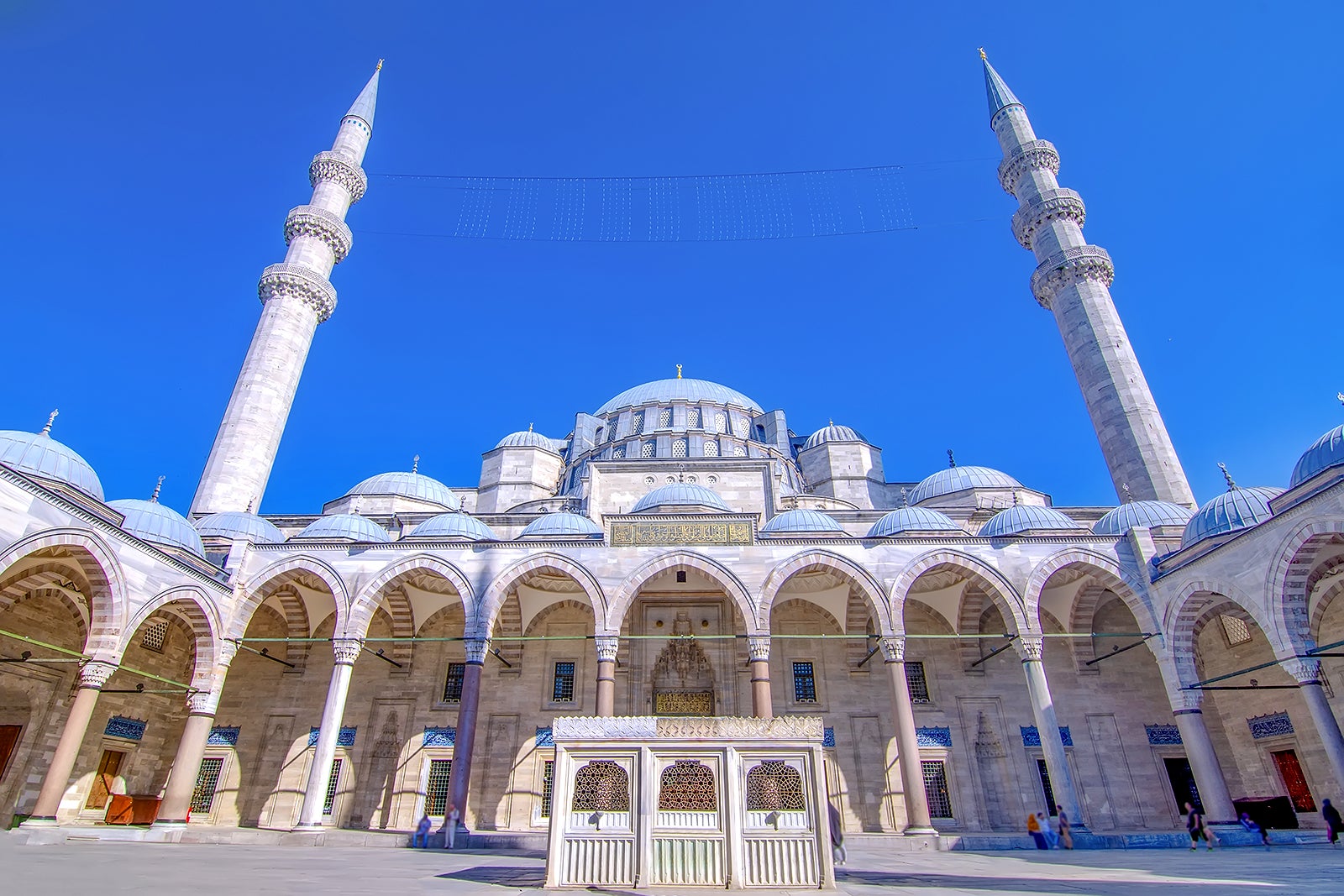
technique: stone
chronology: 16th C AD
art style, culture, or geographical area: Ottoman (Istanbul, Turkey)
context of production: Suleymaniye Mosque (or Mosque of Sultan Suleyman)
how are figures represented: Ottoman-style mosque, dome, pencil minarets
* was inspired by Byzantine buildings, such as Hagia Sophia)
* Main features: domes, semi-domes, pencil minarets
* hierarchy of domes
* main, largest dome = prayer hall
chronology: 16th C AD
art style, culture, or geographical area: Ottoman (Istanbul, Turkey)
context of production: Suleymaniye Mosque (or Mosque of Sultan Suleyman)
how are figures represented: Ottoman-style mosque, dome, pencil minarets
* was inspired by Byzantine buildings, such as Hagia Sophia)
* Main features: domes, semi-domes, pencil minarets
* hierarchy of domes
* main, largest dome = prayer hall
23
New cards
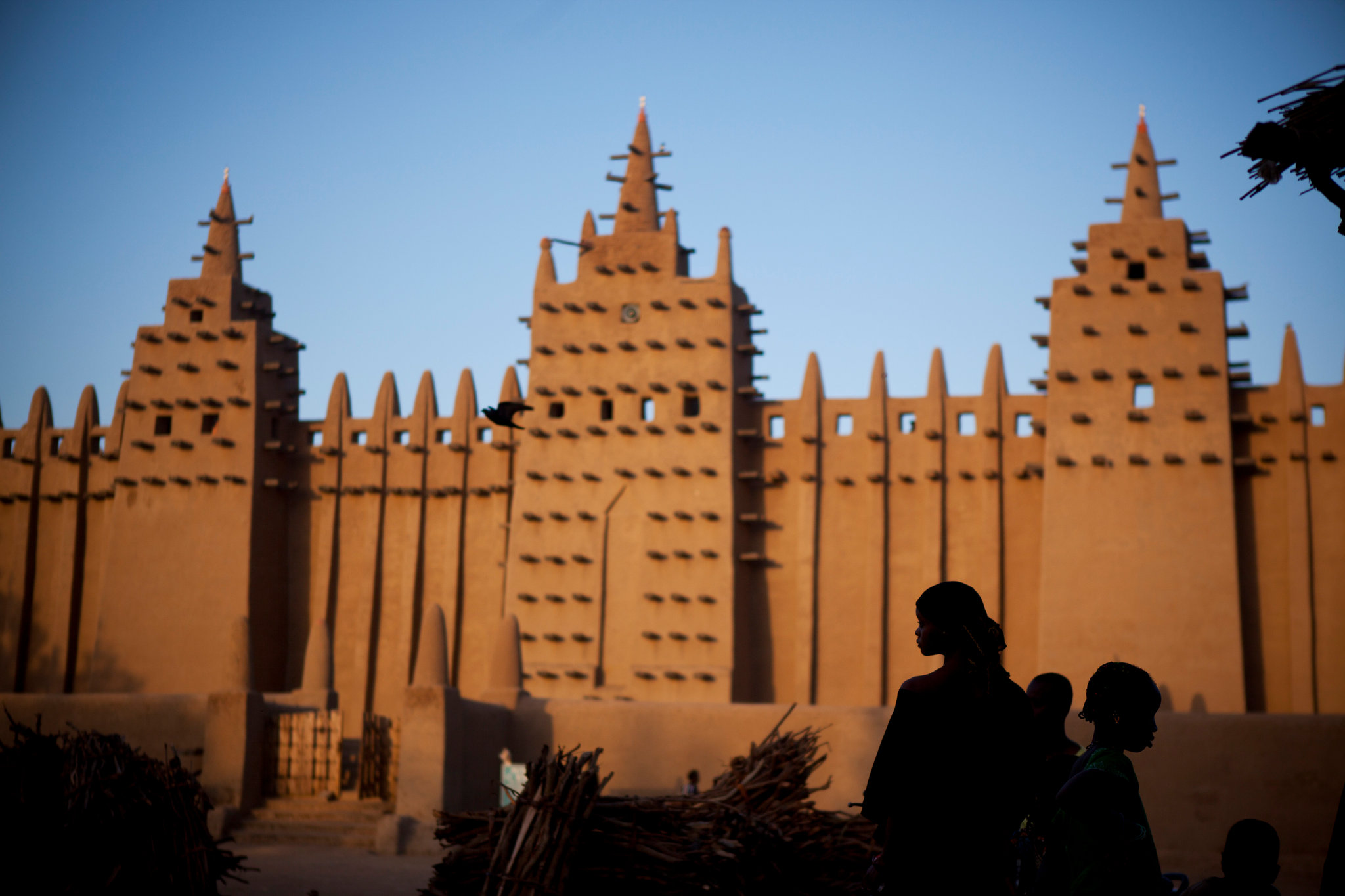
technique: adobe (sun-dried mud-brick) and wood
chronology: 13th C
art style, culture, or geographical area: Islamic Mali/Africa
context of production: Mosque of Djenne
* Aerial view of the Great Mosque of Djenne, Mali, 13thC reconstructed in the 20thC
* Islam
* adobe (sun-dried mud-brick) and wood
* Ostrich egg on tops of the minarets (fertility + purity symbol)
* it flourished as a great center of commerce, learning, and Islam
* An earthen roof covers the building, which is supported by monumental pillars.
* roof has several holes covered by terra-cotta lids (above), which provide its interior spaces with fresh air even during the hottest days
* Timber beams throughout the exterior are both decorative and structural. These elements also function as scaffolding for the re-plastering of the mosque during the annual festival of the *Crepissage*
chronology: 13th C
art style, culture, or geographical area: Islamic Mali/Africa
context of production: Mosque of Djenne
* Aerial view of the Great Mosque of Djenne, Mali, 13thC reconstructed in the 20thC
* Islam
* adobe (sun-dried mud-brick) and wood
* Ostrich egg on tops of the minarets (fertility + purity symbol)
* it flourished as a great center of commerce, learning, and Islam
* An earthen roof covers the building, which is supported by monumental pillars.
* roof has several holes covered by terra-cotta lids (above), which provide its interior spaces with fresh air even during the hottest days
* Timber beams throughout the exterior are both decorative and structural. These elements also function as scaffolding for the re-plastering of the mosque during the annual festival of the *Crepissage*
24
New cards
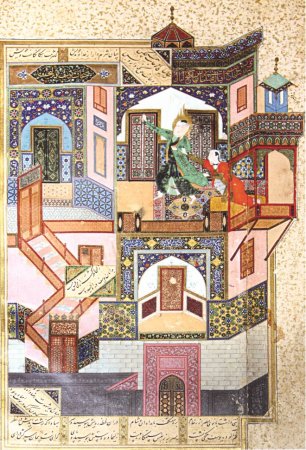
technique: Folio (=page) from an illustrated manuscript, Paper (ink, watercolor, and gold on paper)
chronology: Ca. 1500
art style, culture, or geographical area: Safavid (or Persian or 15/16th C Uzbekistan)
context of production: Behzād The Seduction of Yusuf (by Zuleyka)
how are figures represented: Calligraphy
* illustration on paper
* called folio — any one page of manuscript
* 1490 AD
* ink, opaque watercolor, gold on paper
* **Artist name:** Behzad (Kamal al-Behzad) from Herat (now Afghanistan)
* made in present-day Uzbekistan
* associated with power of Safavid Empire
* different ideas of space
* geometric, lots of patterns, calligraphy, naturalism, flowers — similar to Islamic architecture, vivid colors, detailed (different compared to Italian Renaissance)
* lack of chiaroscuro, see feet, not stable — almost floating figures
* hear about innovation from Italy of applying perspectives and chiaroscuro
* god sees everything — cannot escape eye of God (application of perspective, not for audience, for God)
* Story: woman and man (Zuleyka and Yosuf) — written in Quran and Book of Genesis
* Zuleyka, wife of Potifar, and Yosuf works for husband (Potifar)
* Seduction of Yusuf (by Zuleyka)
* Zuleyka’s richness shown through the various rooms, taking him through various rooms, showing her riches
* flame around Yusuf’s head — he is connected to divine and sacred
* longing of soul for the divine rather than sexual or physical love
chronology: Ca. 1500
art style, culture, or geographical area: Safavid (or Persian or 15/16th C Uzbekistan)
context of production: Behzād The Seduction of Yusuf (by Zuleyka)
how are figures represented: Calligraphy
* illustration on paper
* called folio — any one page of manuscript
* 1490 AD
* ink, opaque watercolor, gold on paper
* **Artist name:** Behzad (Kamal al-Behzad) from Herat (now Afghanistan)
* made in present-day Uzbekistan
* associated with power of Safavid Empire
* different ideas of space
* geometric, lots of patterns, calligraphy, naturalism, flowers — similar to Islamic architecture, vivid colors, detailed (different compared to Italian Renaissance)
* lack of chiaroscuro, see feet, not stable — almost floating figures
* hear about innovation from Italy of applying perspectives and chiaroscuro
* god sees everything — cannot escape eye of God (application of perspective, not for audience, for God)
* Story: woman and man (Zuleyka and Yosuf) — written in Quran and Book of Genesis
* Zuleyka, wife of Potifar, and Yosuf works for husband (Potifar)
* Seduction of Yusuf (by Zuleyka)
* Zuleyka’s richness shown through the various rooms, taking him through various rooms, showing her riches
* flame around Yusuf’s head — he is connected to divine and sacred
* longing of soul for the divine rather than sexual or physical love
25
New cards
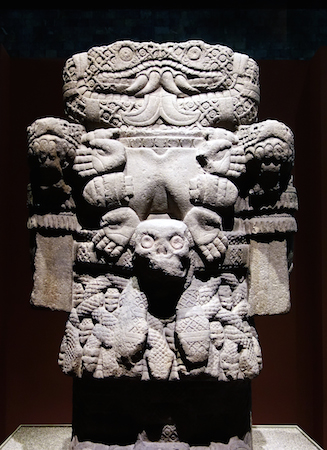
technique: basalt (or rock)
chronology: c. 1500,
art style, culture, or geographical area: AZTEC
context of production: Aztec Mother Deity (or Coatlicue)
how are figures represented: 10 ft high
* snakes form her entire skirt, as well as her belt and even her head. Coatlicue’s name literally means Snakes-Her-Skirt, so her clothing helps identify her
* snake belt ties at the waist to keep a skull “buckle” in place
* upper torso is exposed, and we can just make out her breasts and rolls in her abdomen. The rolls indicate she is a mother.
* Two enormous snakes curl upwards from her neck to face one another.
* bifurcated, or split, tongues curl downwards, and the resulting effect is that the snake heads and tongues appear to be a single, forward-facing serpent face
* Coatlicue has in fact been decapitated, and her snaky head represents the blood squirting from her severed neck.
* She is a freestanding sculpture (not attached to a block of stone) and is also carved from below. It is a very complex piece of art and required the work of very skilled artists.
* Her large feet are decorated with claws, her skirt is adorned with intertwined serpents (hence her name “snakes-her-skirt”).
* She also has a belt with snakes, a necklace with alternating, sacrificial hearts and hands, and a decapitated head composed of two serpents.
chronology: c. 1500,
art style, culture, or geographical area: AZTEC
context of production: Aztec Mother Deity (or Coatlicue)
how are figures represented: 10 ft high
* snakes form her entire skirt, as well as her belt and even her head. Coatlicue’s name literally means Snakes-Her-Skirt, so her clothing helps identify her
* snake belt ties at the waist to keep a skull “buckle” in place
* upper torso is exposed, and we can just make out her breasts and rolls in her abdomen. The rolls indicate she is a mother.
* Two enormous snakes curl upwards from her neck to face one another.
* bifurcated, or split, tongues curl downwards, and the resulting effect is that the snake heads and tongues appear to be a single, forward-facing serpent face
* Coatlicue has in fact been decapitated, and her snaky head represents the blood squirting from her severed neck.
* She is a freestanding sculpture (not attached to a block of stone) and is also carved from below. It is a very complex piece of art and required the work of very skilled artists.
* Her large feet are decorated with claws, her skirt is adorned with intertwined serpents (hence her name “snakes-her-skirt”).
* She also has a belt with snakes, a necklace with alternating, sacrificial hearts and hands, and a decapitated head composed of two serpents.
26
New cards
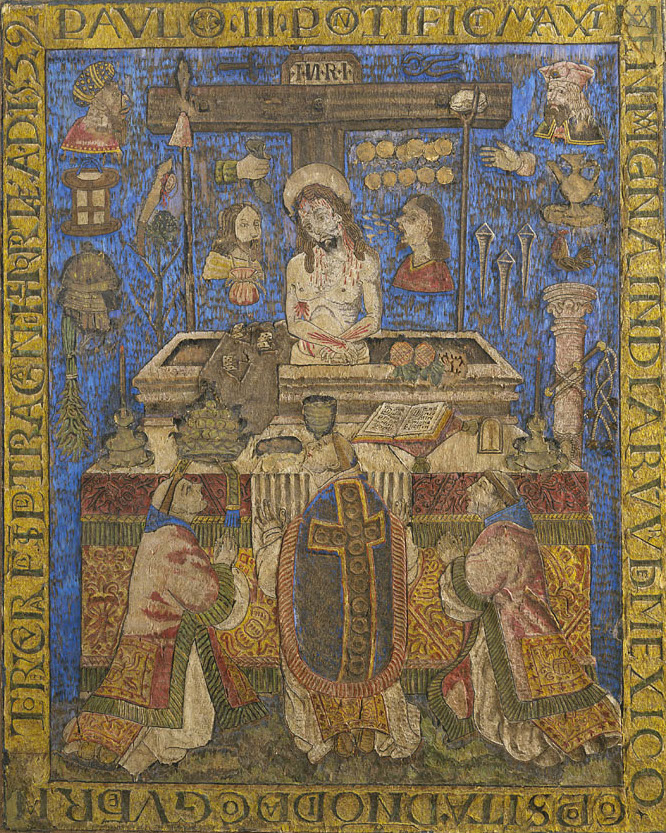
technique: feathers on wood,
chronology: 16th C AD
art style, culture, or geographical area: Aztec + Spanish (and Christian)
context of production: The Mass of St. Gregory
* Nahua noble and gobernador (governor) of Mexico City, Diego de Alvarado Huanitzin (nephew and son-in-law to Moctezuma II, the last Aztec ruler before Spanish colonial rule began in 1521), commissioned a featherwork for Pope Paul III showing the Mass of St. Gregory
* The featherwork represents the clash of different worlds—its technique is Mesoamerican, but the subject is European and Christian.
* Indigenous artists of early colonial Mexico learned about European artistic techniques and Christian subject matter in schools attached to conventos (missionary centers)
* The Mexica (more commonly known as the Aztecs), were among those groups who prized feathers. Through long-distance trade, the Aztecs acquired feathers from afar.
* As religious or devotional objects, iridescent featherworks like *The Mass of St. Gregory* seemed to communicate ideas about divine light.
* Even if the technique of using featherwork is inspired by native customs, the subject is religious and well in hand with Christian teaching. It shows the praying (6th-century) Pope St Gregory. He receives a vision of a crucified Christ.
* This work was made for Pope Paul III ca. 1540. We know it thanks to the inscription that runs on the border of the artwork. However, the artwork was commissioned by a native patron. Overall, fathers were highly prized by the natives and, after the conquest, also by the Europeans.
* **iridescent/shimmering quality, particularly, when exposed to light.**
chronology: 16th C AD
art style, culture, or geographical area: Aztec + Spanish (and Christian)
context of production: The Mass of St. Gregory
* Nahua noble and gobernador (governor) of Mexico City, Diego de Alvarado Huanitzin (nephew and son-in-law to Moctezuma II, the last Aztec ruler before Spanish colonial rule began in 1521), commissioned a featherwork for Pope Paul III showing the Mass of St. Gregory
* The featherwork represents the clash of different worlds—its technique is Mesoamerican, but the subject is European and Christian.
* Indigenous artists of early colonial Mexico learned about European artistic techniques and Christian subject matter in schools attached to conventos (missionary centers)
* The Mexica (more commonly known as the Aztecs), were among those groups who prized feathers. Through long-distance trade, the Aztecs acquired feathers from afar.
* As religious or devotional objects, iridescent featherworks like *The Mass of St. Gregory* seemed to communicate ideas about divine light.
* Even if the technique of using featherwork is inspired by native customs, the subject is religious and well in hand with Christian teaching. It shows the praying (6th-century) Pope St Gregory. He receives a vision of a crucified Christ.
* This work was made for Pope Paul III ca. 1540. We know it thanks to the inscription that runs on the border of the artwork. However, the artwork was commissioned by a native patron. Overall, fathers were highly prized by the natives and, after the conquest, also by the Europeans.
* **iridescent/shimmering quality, particularly, when exposed to light.**
27
New cards
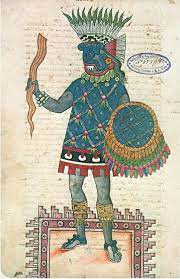
technique: Paper (pigment on paper)
chronology: ca. 1580
art style, culture, or geographical area: Aztec + Spanish
context of production: God of Rain/Crops - or Tlaloc from the Codex (Ixtilxochitl)
how are figures represented: Folio, codex, chiaroscuro, Tlaloc
* featherwork — indigenous to Aztec empire
* vibrant colors (blue and green) — Aztec
* shows learning from Spanish — chiaroscuro
* This image of the Tlaloc is a manuscript page taken from another colonial manuscript, the Codex Ixtilxochitl, made ca. 1580. **It is another example of the hybridity of subjects and techniques in the Spanish colony.**
* **Tlaloc was an Aztec god responsible for rain and crops.** Therefore, the subject of this folio page is definitely indigenous. He wears a blue google eye mask and a richly decorated feather headdress.
* **However, his position is inspired by Renaissance prints representing classical mythological gods** (just a reminder, the Renaissance is a time of a renewal of interest in the works of classical Antiquity: ancient Greece and Rome).
* The Aztec god spreads his hands in a similar way. The new colonial (and Christian-related) commissions produce artworks that describe the polytheistic beliefs of the native Aztec population but using pagan sources taken from classical Antiquity.
* **Tlaloc’s skin shows the use of chiaroscuro (contrasts of light and shade to give dimensionality to the body; you can see that with Tlaloc’s legs that have a different tonality),**
chronology: ca. 1580
art style, culture, or geographical area: Aztec + Spanish
context of production: God of Rain/Crops - or Tlaloc from the Codex (Ixtilxochitl)
how are figures represented: Folio, codex, chiaroscuro, Tlaloc
* featherwork — indigenous to Aztec empire
* vibrant colors (blue and green) — Aztec
* shows learning from Spanish — chiaroscuro
* This image of the Tlaloc is a manuscript page taken from another colonial manuscript, the Codex Ixtilxochitl, made ca. 1580. **It is another example of the hybridity of subjects and techniques in the Spanish colony.**
* **Tlaloc was an Aztec god responsible for rain and crops.** Therefore, the subject of this folio page is definitely indigenous. He wears a blue google eye mask and a richly decorated feather headdress.
* **However, his position is inspired by Renaissance prints representing classical mythological gods** (just a reminder, the Renaissance is a time of a renewal of interest in the works of classical Antiquity: ancient Greece and Rome).
* The Aztec god spreads his hands in a similar way. The new colonial (and Christian-related) commissions produce artworks that describe the polytheistic beliefs of the native Aztec population but using pagan sources taken from classical Antiquity.
* **Tlaloc’s skin shows the use of chiaroscuro (contrasts of light and shade to give dimensionality to the body; you can see that with Tlaloc’s legs that have a different tonality),**
28
New cards
The Byzantine Empire; ends in 1453
* Fall of Constantinople, (May 29, 1453), conquest of Constantinople by Sultan Mehmed II of the Ottoman Empire. The dwindling Byzantine Empire came to an end when the Ottomans breached Constantinople's ancient land wall after besieging the city for 55 days.
* Byzantium’s influence also continued to spread beyond its former cultural and geographic boundaries, in the architecture of the Ottomans, the icons of Russia, the paintings of Italy, and elsewhere.
* The Byzantine style rejected the realistic forms of classical Roman art in favour of highly stylised, flattened designs. At its peak, the era was defined by elongated figures with angular faces, positioned face-on against ornate, gold backgrounds.
* Byzantium’s influence also continued to spread beyond its former cultural and geographic boundaries, in the architecture of the Ottomans, the icons of Russia, the paintings of Italy, and elsewhere.
* The Byzantine style rejected the realistic forms of classical Roman art in favour of highly stylised, flattened designs. At its peak, the era was defined by elongated figures with angular faces, positioned face-on against ornate, gold backgrounds.
29
New cards
Renaissance, Humanism, “Renaissance man”
* Renaissance (time period associated with the “rebirth” or renewal of the interest in the classical worlds of ancient Greece and Rome, as well as with an increased interest in arts, literature, and humanistic values; 14-16th-C Europe) and the rejection of medieval artistic \n values.
* Interest in ideas related to **humanism, and** the increased importance of human;
* Increased focus on **education;** knowledge from the classical world is now more accessible to the public, it is also translated to Latin, and people study the classical world, math, philosophy, medicine, and the cultural heritage of Antiquity
* Influential **Italian families** promote arts and culture and give commissions to local artists
* People **think more “outside of the box,”** and they start to question common presumptions, as well as ideas related to religion or promoted by the Church.
* Creation of a **vernacular literature/language**
* Names of specific **artists** gradually become familiar to the public; before, in the Middle Ages, we dealt primarily with craftsmen who were trained in a specific guilt system (master, apprentices.., quality control, etc.), not with artists who were known for their individual skills and achievements
* The increased importance of **civic pride and duty,** belonging to one’s city-state.
* Interest in ideas related to **humanism, and** the increased importance of human;
* Increased focus on **education;** knowledge from the classical world is now more accessible to the public, it is also translated to Latin, and people study the classical world, math, philosophy, medicine, and the cultural heritage of Antiquity
* Influential **Italian families** promote arts and culture and give commissions to local artists
* People **think more “outside of the box,”** and they start to question common presumptions, as well as ideas related to religion or promoted by the Church.
* Creation of a **vernacular literature/language**
* Names of specific **artists** gradually become familiar to the public; before, in the Middle Ages, we dealt primarily with craftsmen who were trained in a specific guilt system (master, apprentices.., quality control, etc.), not with artists who were known for their individual skills and achievements
* The increased importance of **civic pride and duty,** belonging to one’s city-state.
30
New cards
Medium and Iconography
Medium: the material the artwork is made of
Iconography: Iconography (“writing of images” or study of images) — understand special meaning of artists, visual images and symbols used in a work of art or the study or interpretation of these
Iconography: Iconography (“writing of images” or study of images) — understand special meaning of artists, visual images and symbols used in a work of art or the study or interpretation of these
31
New cards
“Islamic” art
* structures to show power of Islam
* religion supports creation of work — Islamic art - floral motifs, geometric designs and calligraphy
* Islamic art can also include secular art — terrorities related to areas where majority Islam
* big commission of artwork by ruler
* Islamic art is the art related to the religion and culture of Islam and the Islamic Middle East.
* Islamic art does not only encompass religious art but also includes secular art. It is simply an art that is related to the territories associated with Islam, where the \n majority of people are Muslim. Consequently, Islamic art can be also made for Christian and Jews living in the Middle East, and some Islamic objects are also made for the Muslim communities by Christians and Jews.
* Those were western scholars who coined the name “Islamic” for this type of artistic \n production. However, artists from the Middle East and North Africa did not necessarily call themselves Islamic (but rather Syrian, Arab, Turkish etc.) and, again, their production can also include secular works, not only the religious ones.
* religion supports creation of work — Islamic art - floral motifs, geometric designs and calligraphy
* Islamic art can also include secular art — terrorities related to areas where majority Islam
* big commission of artwork by ruler
* Islamic art is the art related to the religion and culture of Islam and the Islamic Middle East.
* Islamic art does not only encompass religious art but also includes secular art. It is simply an art that is related to the territories associated with Islam, where the \n majority of people are Muslim. Consequently, Islamic art can be also made for Christian and Jews living in the Middle East, and some Islamic objects are also made for the Muslim communities by Christians and Jews.
* Those were western scholars who coined the name “Islamic” for this type of artistic \n production. However, artists from the Middle East and North Africa did not necessarily call themselves Islamic (but rather Syrian, Arab, Turkish etc.) and, again, their production can also include secular works, not only the religious ones.
32
New cards
Calligraphy
* Calligraphy: art of hand-lettering
33
New cards
Iconoclasm
* The Spanish conquest of the Aztec empire was considered “one of the most terrible iconoclastic campaigns in history”
* Iconoclasm = the destruction of current images or beliefs.
* Many Aztec buildings, paintings, manuscripts, and other forms of art were destroyed as to provide a new ground for the acceptance of Christianity.
* Iconoclasm = the destruction of current images or beliefs.
* Many Aztec buildings, paintings, manuscripts, and other forms of art were destroyed as to provide a new ground for the acceptance of Christianity.
34
New cards
hypostyle hall, Qibla, Mihrab, minaret
* flat roof and supported by columns, home of Muhammad→ model for mosque
* **hypostyle hall** — **interior space whose flat roof rests on pillars or columns.** The word means literally “under pillars,” and the design allows for the construction of large spaces—as in temples, palaces, or public buildings—without the need for arches.
* *qipla* wall — tell direction of prayer, direction of Mecca
* Mihrab — decorative wall with words of God, most decorated place, in middle of qipla wall
* **Minaret** — tower for calling for prayer
* **hypostyle hall** — **interior space whose flat roof rests on pillars or columns.** The word means literally “under pillars,” and the design allows for the construction of large spaces—as in temples, palaces, or public buildings—without the need for arches.
* *qipla* wall — tell direction of prayer, direction of Mecca
* Mihrab — decorative wall with words of God, most decorated place, in middle of qipla wall
* **Minaret** — tower for calling for prayer
35
New cards
Spanish colonization of the Aztec empire – ca. 1520
* **The Aztecs:**
* \`\`Their ethnic origin is the Nahua group.
* The Aztecs spoke the Nahuatl language. Some of the words from the Nahuatl language were adapted to English: chipotle is perhaps the best example!
* The Aztecs probably came from the north. In 1325, they settled down close to Lake Texcoco in a place that became their future capital, **Tenochtitlan – modern Mexico City**. In this migration, they were supposed to be led by their principal deity, called **Huitzilopochtli (god of war and sun).** Huitzilopochtli asked his people to settle down in a place where they will see an eagle eating a serpent and sitting on a cactus. This symbolic image is featured today on the Mexican flag; this location was the future \n Tenochtitlan (Mexico City).
* The name **‘Aztecs’** was only coined in the 19th century by Western scholars, such as Alexander von Humboldt. The name came from “Aztlan” which was the mythical home of the Aztecs. We could also call them Mexica, as this is how they called themselves. Mexica gave the name to the country of Mexico at its independence in 1821.
* During the 14th and 15th centuries, the Aztecs built up an **empire** in the region surrounding Tenochtitlan. Similar to earlier Mesoamerican cultures (such as Maya), constant warfare, the capture of **enemies,** and **ritual sacrifice** were considered essential elements to sustain the Aztec rule. The Aztecs were also taking tributes, particularly precious materials (such as jade and feathers) from conquered \n lands. Finally, in order to retain their power, they also allied with other people of the region (for instance, those living in Texcoco and Tlacopan).
* **Spanish Conquest:**
* The last Aztec ruler was Moctezuma II (1466-1520), (right image; Western source)
* The Spanish army of Hernan Cortés (left image) arrived in Tenochtitlan in 1519. Cortés was also supported by the local enemies of the Aztecs who were tired of paying tributes to the Aztec rulers.
* The city was officially defeated in 1521. At that time, the Aztec population was already depopulated due to the diseases related to the arrival of the Spanish. The inhabitants of Tenochtitlan also lacked fresh water.
* After 1535, the indigenous population became part of the Viceroyalty of Spain, and dependent upon the Kings of Spain until 1821.
* \`\`Their ethnic origin is the Nahua group.
* The Aztecs spoke the Nahuatl language. Some of the words from the Nahuatl language were adapted to English: chipotle is perhaps the best example!
* The Aztecs probably came from the north. In 1325, they settled down close to Lake Texcoco in a place that became their future capital, **Tenochtitlan – modern Mexico City**. In this migration, they were supposed to be led by their principal deity, called **Huitzilopochtli (god of war and sun).** Huitzilopochtli asked his people to settle down in a place where they will see an eagle eating a serpent and sitting on a cactus. This symbolic image is featured today on the Mexican flag; this location was the future \n Tenochtitlan (Mexico City).
* The name **‘Aztecs’** was only coined in the 19th century by Western scholars, such as Alexander von Humboldt. The name came from “Aztlan” which was the mythical home of the Aztecs. We could also call them Mexica, as this is how they called themselves. Mexica gave the name to the country of Mexico at its independence in 1821.
* During the 14th and 15th centuries, the Aztecs built up an **empire** in the region surrounding Tenochtitlan. Similar to earlier Mesoamerican cultures (such as Maya), constant warfare, the capture of **enemies,** and **ritual sacrifice** were considered essential elements to sustain the Aztec rule. The Aztecs were also taking tributes, particularly precious materials (such as jade and feathers) from conquered \n lands. Finally, in order to retain their power, they also allied with other people of the region (for instance, those living in Texcoco and Tlacopan).
* **Spanish Conquest:**
* The last Aztec ruler was Moctezuma II (1466-1520), (right image; Western source)
* The Spanish army of Hernan Cortés (left image) arrived in Tenochtitlan in 1519. Cortés was also supported by the local enemies of the Aztecs who were tired of paying tributes to the Aztec rulers.
* The city was officially defeated in 1521. At that time, the Aztec population was already depopulated due to the diseases related to the arrival of the Spanish. The inhabitants of Tenochtitlan also lacked fresh water.
* After 1535, the indigenous population became part of the Viceroyalty of Spain, and dependent upon the Kings of Spain until 1821.