phy unit 3 and 4
 Call Kai
 Learn
Learn Practice Test
 Spaced Repetition
 Match
Match Flashcards
 Knowt Play
1/70

There's no tags or description
Looks like no tags are added yet.
Name | Mastery | Learn | Test | Matching | Spaced | Call with Kai | Chat |
|---|
No analytics yet
Send a link to your students to track their progress
71 Terms
Kepler’s first law
all planets move about the sun in elliptical orbits with the sun as one of the foci
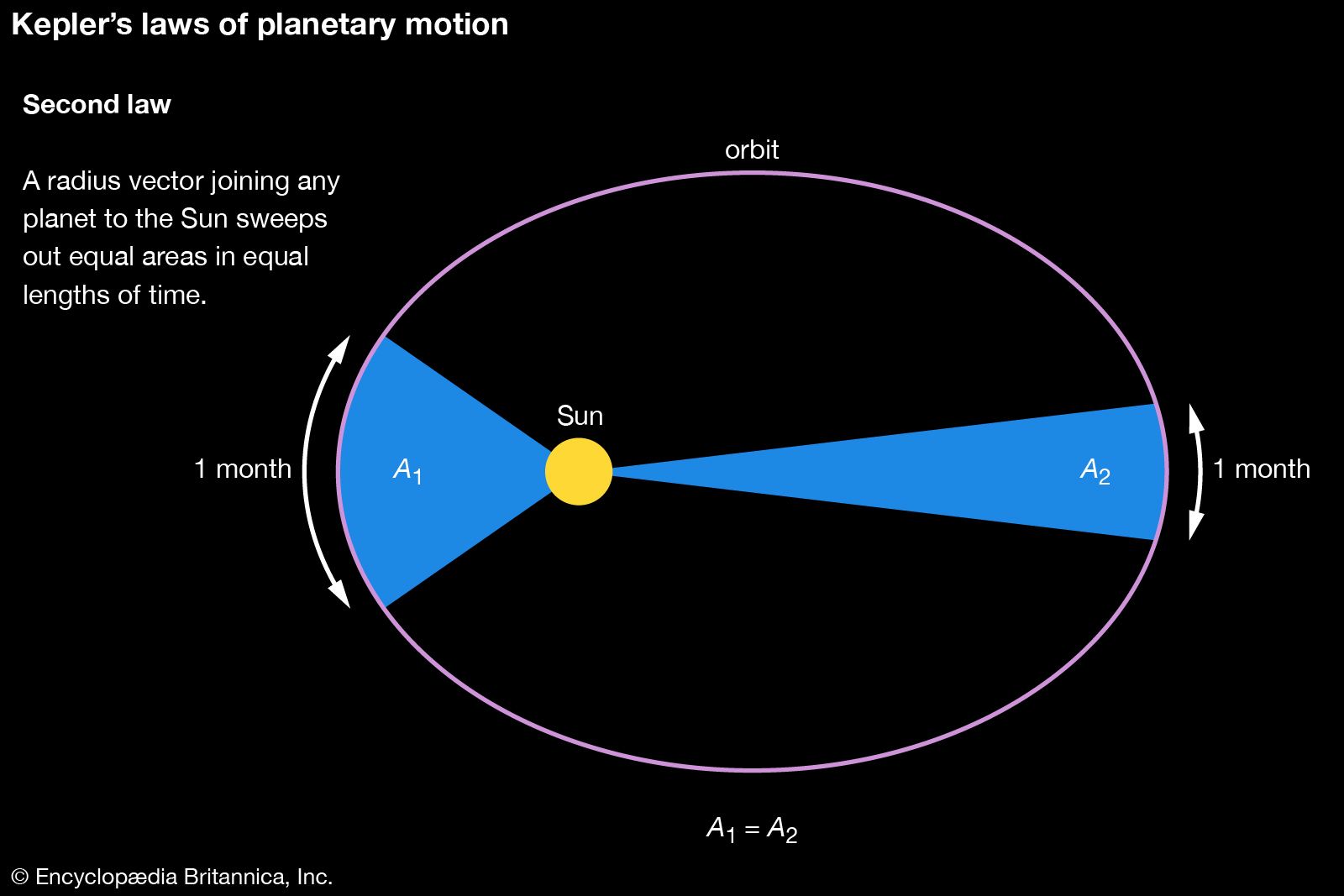
Kepler’s second law
a radius vector joining any planet to the sun sweeps out equal areas in equal lengths of time as the closer a planet the faster it moves and vice versa
Kepler’s third law
the square of the time it takes for a planet to complete an orbit of another body is directly proportional to the cube of the planet’s mean distance from the sun
Kepler’s third law equation
T²/r³=T²/r³ and T²/r³=4pi²/GM
electromagnetic wave
perpendicular electric and magnetic fields and do not need a medium, travelling at the speed of light in a vacuum
Einstein’s first postulate
the laws of physics are the same in all inertial frames of reference
Einstein’s second postulate
the speed of light in a vacuum is constant in all inertial frames of reference
black body
object that absorbs and emits all radiation that falls on it
double slit experiment
light is detected as individual photons but the overall pattern demonstrated diffraction, a property of waves. bright bands indication of constructive interference and dark banks indicated destructive interference.
increase temp impact on intensity
increase intensity and amplitude of wave
electron fall
emits photon
electron goes up
absorbs photon
Rutherford’s model
dense positively charged nucleus surrounded by orbiting neg. electrons
limitations of Rutherford’s model
charged particles radiate energy when they accelerate/orbit and thus should emit energy as they orbit nucleus eventually losing all energy and imploding, but doesn’t happen (why dont they spiral into nucleus
excited gas atoms emitted light in discrete lines not in continuous spectrum like expected (why electrons dont continuously emit energy and emission spectra only in discrete lines)
continuum expected spectra
all excited atoms where white light is diffracted through a prism
emission spectra (hot gas)
observed when light from excited atoms in gas state is diffracted through a prism and is unique for each atom
absorption spectra (cold gas)
weight is passed through cold gas and only specific wavelengths are absorbed and thus removed from the continuum
bohr model
electrons exist in fixed stationary states without emitting energy and electrostatic force pulls electron towards nucleus and e- intrinsic energy prevents from leaving state. electron absorb or emit photon with energy when change state
bohr model strengths and limitation
electrons dont emit energy in stable energy, thus dont continuously emit energy and wont spiral into nucleus
emission/absoprtion spectra explained by specific energies required to jump between energy levels
cannot accurately describe observation for multi-electron atoms, only predicted transitions for H (1-electron atom)
Lyman series
between n=1 and higher, ultraviolet light
Balmer series
between n=2 and higher, visible light
Paschen series
between n=3 and higher, infrared light
de Brogile
proposed that particles have an associated wavelength
fundamental particle split up
fermions - quarks and leptons
bosons - photon, gluon, w boson, z boson
+2/3 charge quarks
up, charge, top
-1/3 charge quarks
down, strange, bottom
trend as increase in flavour
increases in mass and decreases in stability thus less time alive and more likely to degrade down to 1st flavour
-1 charge leptons
electron, muon, tau
neutral charge neutrino
electron neutrino, muon neutrino, tau neutrino
baryon
made up of three quarks eg: proton uud, neutron udd
meson
made up of one quark and antiquark and charge must add up to an integer
antiparticles
anti up, anti down etc represented by dash and flipped charge (neg to pos) but no change in mass eg: anti proton -1 charge (2xantiup 1xantidown)
photon (gamma symbol)
carrier of electromagnetic force passed between particles
gluon
mediate strong force, glues everything together eg” gluon hold two up quark together
w± boson
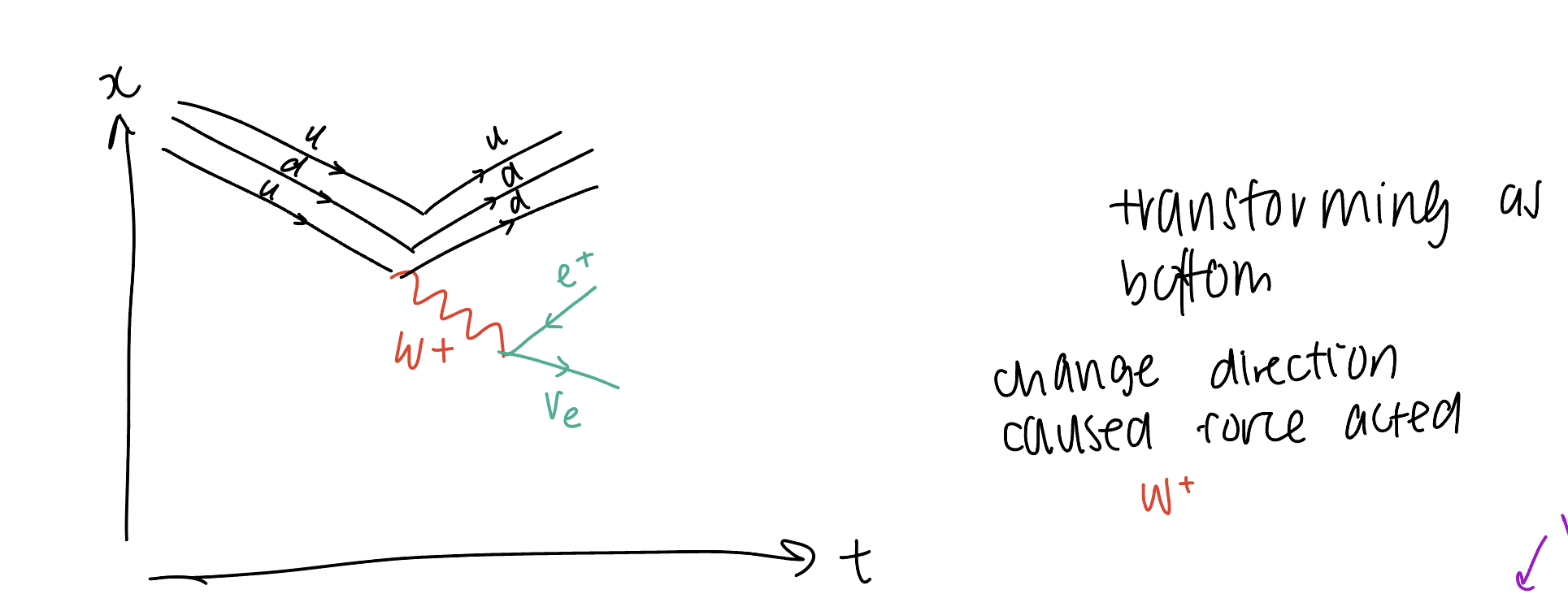
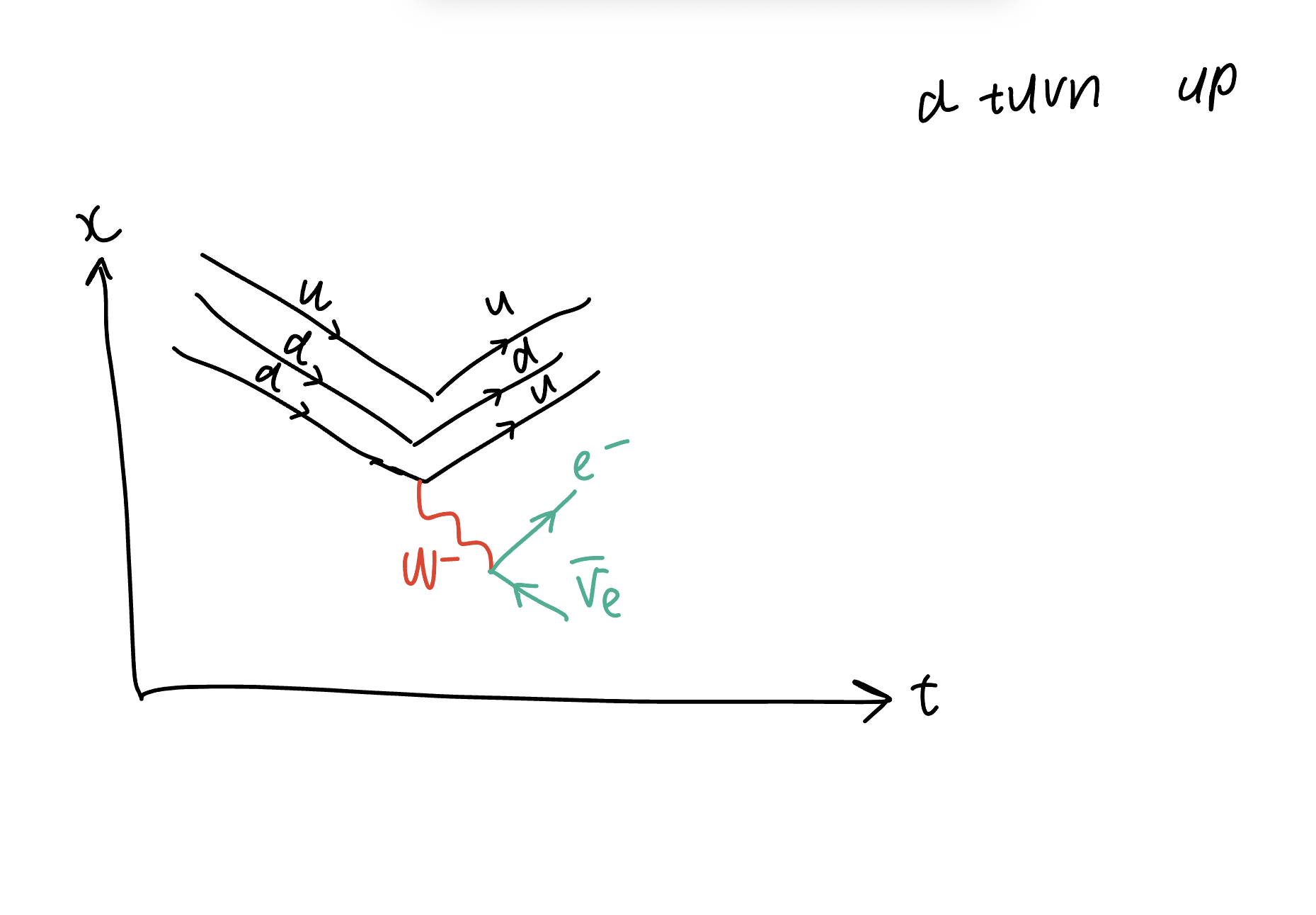
mediate weak nuclear force responsible for labour change like from u to d ± depend on beta decay
z boson
mediate weak nuclear force and charges
translational symmetry conserves
momentum
rotational symmetry conserves
angular momentum
time symmetry conserves
energy
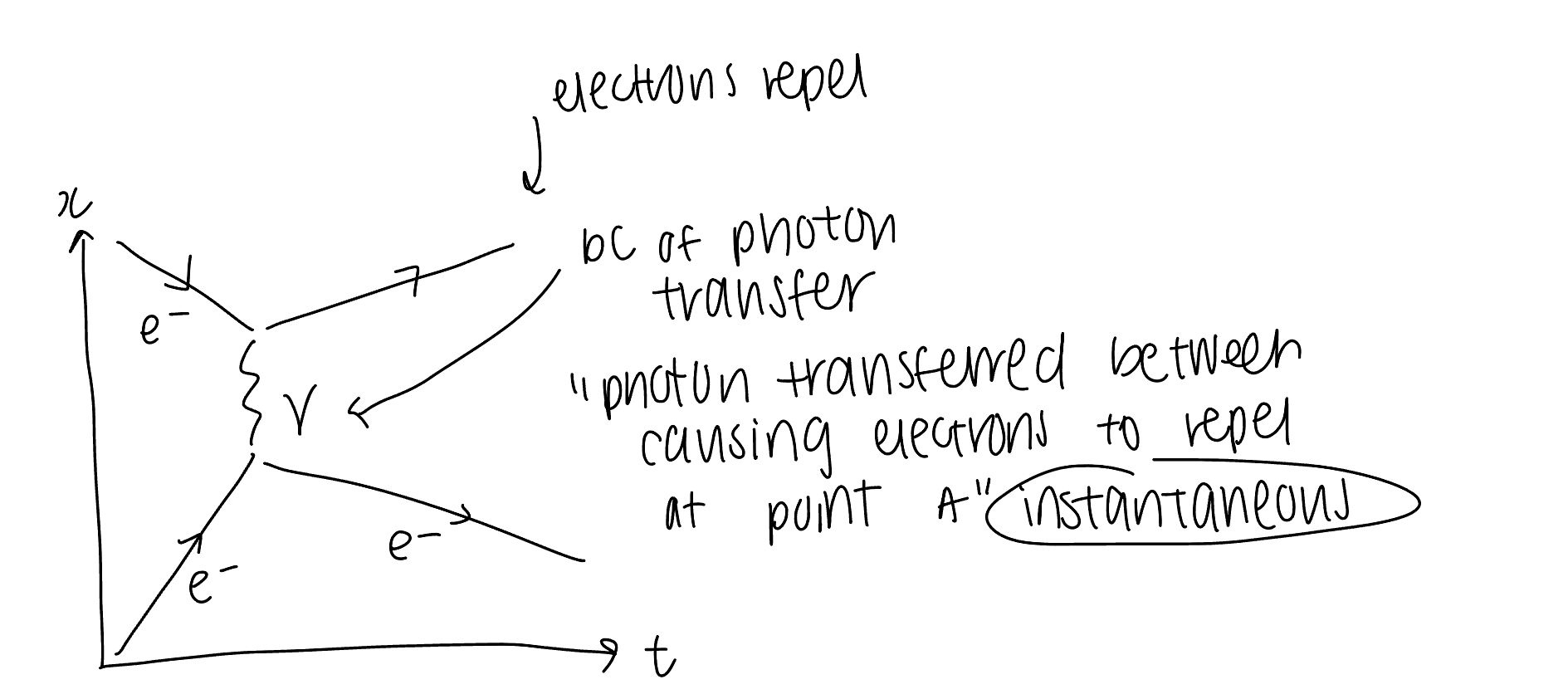
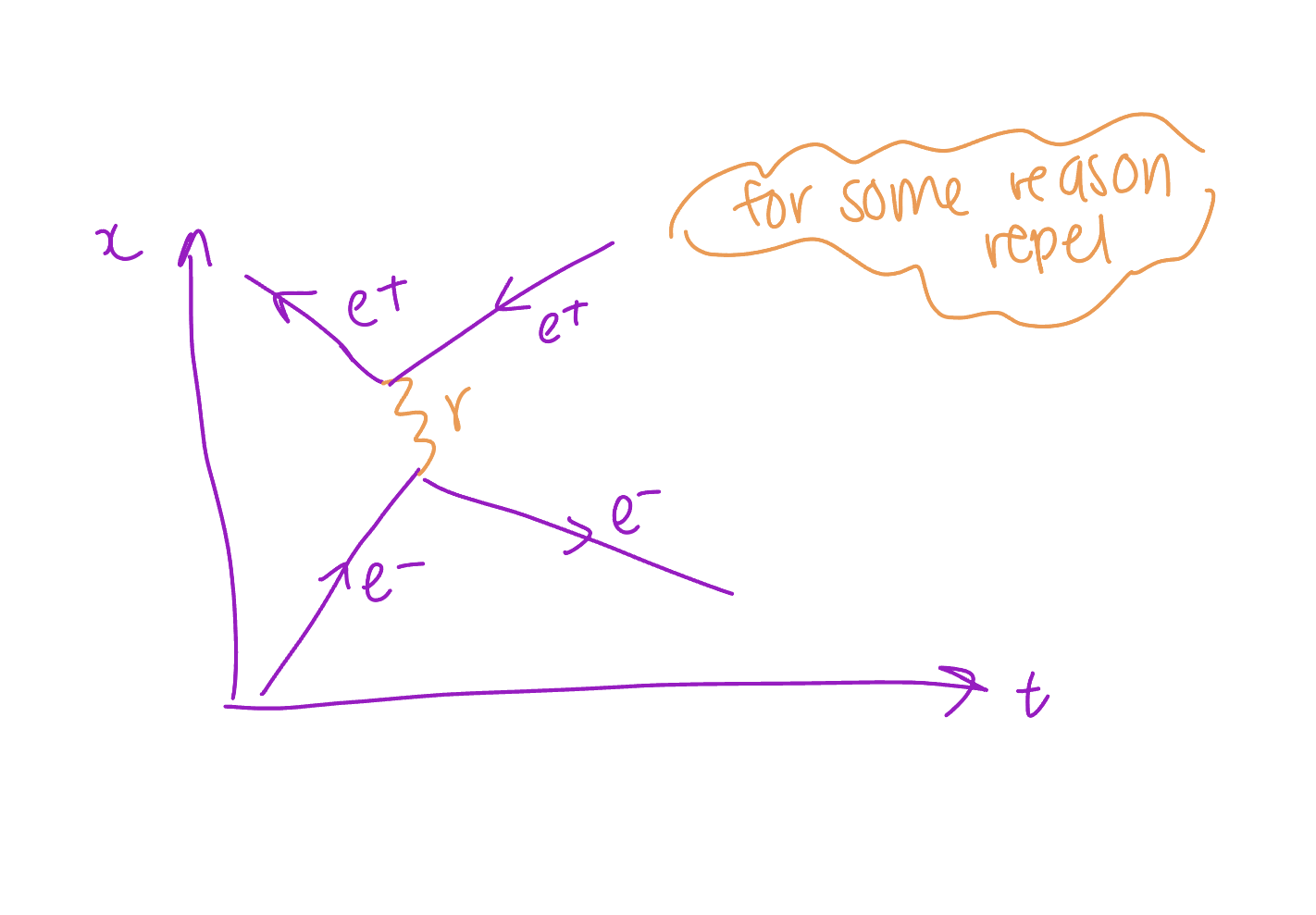
electron-electron Feynman diagram
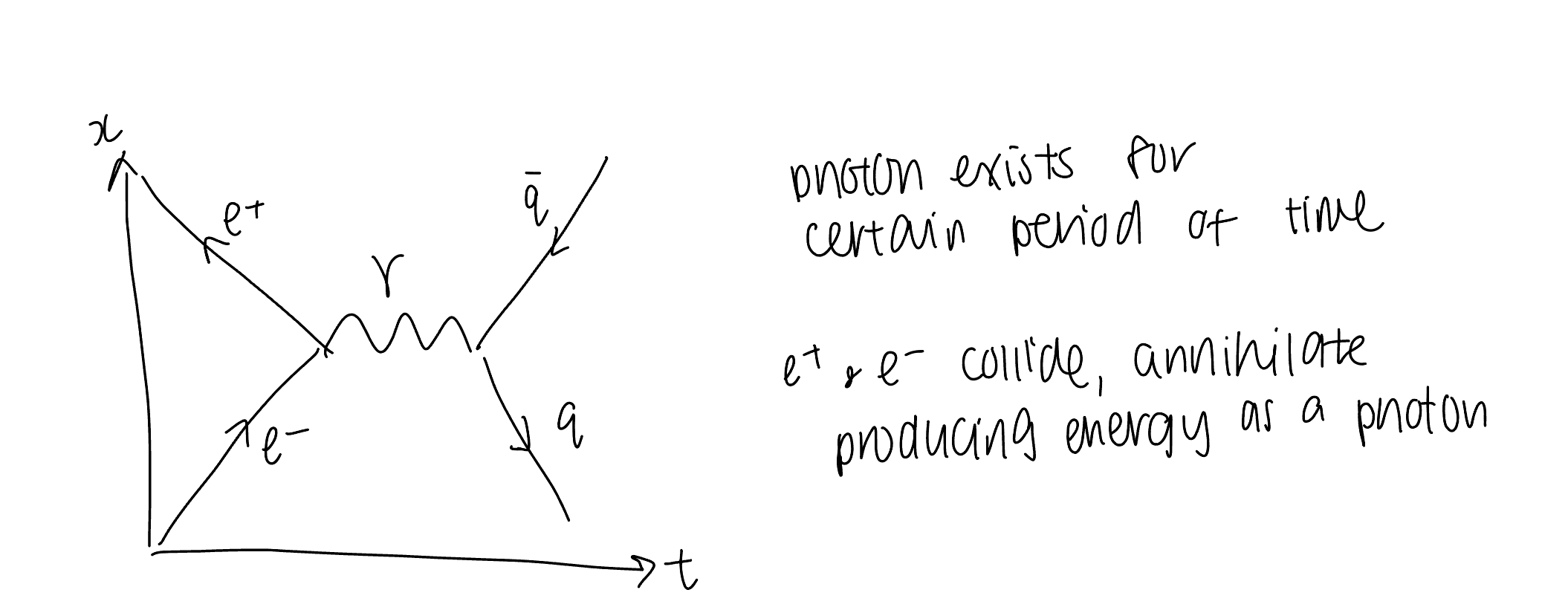
electron-positron Feynman diagram
proton-neutron beta pos. Feynman diagram
bha bha Feynman diagram
neutron-proton beta neg. Feynman diagram
flux density
flux/area
faraday’s law
a change in mag field through a region will produce an electric field
Lenz’s law
the direction of an induced electric current will oppose the change in circuit or mag field that produces it
explain why objects with mass cannot travel at the speed of light
due to relativistic momentum formula, if v=c the bottom of the fraction becomes 0 making momentum at c undefined and not possible. then W=F x s is the time derivative of momentum and if momentum is undefined at c, then F is also defined and thus work is also undefined and impossible to achieve
gravitational field
region of space around object within other objects with mass experience gravitational force of attraction
electric field
region of space around object within other objects with charge experience attractive or repulsive electrostatic force
field lines
indicate direction and strength - more lines=stronger
potential difference
change in substance’s electric potential energy
electric potential energy
property of charge experiencing electric field
zero magnetic flux
surface parallel to field lines
max magnetic flux
surface perpendicular to field lines
flux density
how much of magnetic field is pointing in perp direction to surface
electromotive force
diff in potential that gives a change in current=voltage
magnet moving towards solenoid
current induced to the left
magnet moving away from solenoid
current induced to the right
faraday’s law
change in flux produces emf
Lenz’s law
direction of induced current is opposite to what caused it
how is Lenz’s law match principle of conservation of energy
mechanical energy is converted into electrical energy to oppose charge
what is a transformer
two coils wrapped around soft iron core, AC is passed through primary coil and secondary coil steps up or down voltage
transformer formula
Vp/Vs=np/ns
ideal transformer formulas
P=VI, Pp=Ps, VpIp=VsIs
step up transformer
Vs>Vp, Ns>Np, current decreases
step down transformer
Vs<Vp, Ns<Np, current increases
how transformers work in terms of faraday’s
AC current in primary leads to change in mag field which leads to change in flux through secondary coil inducing EMF
electromagnetic radiation
energy transmitted at speed of light through oscillations in electric and magnetic fields
muon problem and why it suggests newtonian physics is incomplete
cosmic rays colliding with particles at earth’s upper atmosphere producing muons that are unstable with short lifetimes. newtonian physics predict that it will decay high in the atmosphere but muons are detected on earth’s surface suggesting incomplete at speeds close to light