Chapter 10: Special Driving Conditions
 Call Kai
 Learn
Learn Practice Test
 Spaced Repetition
 Match
Match Flashcards
 Knowt Play
1/12

There's no tags or description
Looks like no tags are added yet.
Name | Mastery | Learn | Test | Matching | Spaced | Call with Kai | Chat |
|---|
No analytics yet
Send a link to your students to track their progress
13 Terms
Special Driving Conditions
Why special conditions matter
Safe driving requires:
Full attention
Good judgment
Quick decision-making
Special conditions make driving more difficult and dangerous.
Situations requiring extra caution
Expressway driving
Night driving
Bad weather
Emergency situations
Key takeaway
Always stay alert and use your best judgment. Special driving conditions require extra attention, slower reactions, and careful decision-making.
Railroad Crossings
A place where a road and train tracks cross on the same level
Grade Crossings
What is a grade crossing?
A grade crossing is where train tracks and a roadway meet.
Treat it like an intersection.
Always expect a train when approaching a crossing.
Safety rules at all crossings
Never race a train.
Never drive around lowered gates.
Never stop on train tracks.
Stay in your lane and keep the same gear when crossing tracks.
Remember:
Trains can come from either direction.
Trains can run on any track.
Trains cannot stop quickly.
Active grade crossings (with lights/gates)
Have flashing red lights and/or crossing gates.
Stop and wait until:
Gates are completely raised.
Flashing lights stop.
It is illegal and dangerous to go around gates or cross while lights are flashing.
Passive grade crossings (no lights/gates)
Slow down and prepare to stop.
Look carefully for trains before crossing.
If there are multiple tracks:
Check all tracks in both directions before crossing.
Key takeaway
Always expect a train, never go around gates, never stop on tracks, and cross only when it is completely safe.
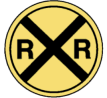
Railroad Crossing Warning Sign
COLOR: Yellow with black letters "RR" and "X" symbol.
MEANING: There is a railroad crossing ahead. Use caution, and be prepared to stop. If you are following a bus or truck approaching a railroad crossing, be careful. Most buses and some trucks must stop at railroad crossings. (See "Railroad Crossing Signals".)
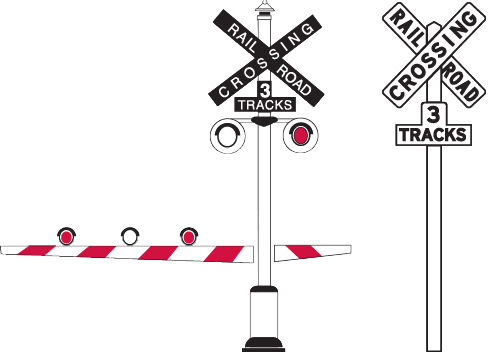
Railroad Crossing Signals
Flashing lights & crossing gates
Flashing red lights, bells, and lowered gates mean STOP.
Stop at least 15 feet (5 m) away from the tracks.
Do not cross until:
Lights stop flashing.
Bells stop ringing.
Gates are completely raised.
Never drive around or under a moving gate.
Crossbuck signs
A crossbuck sign is an “X” shaped sign that says “RAILROAD CROSSING.”
Treat it like a yield sign.
If multiple tracks exist, the sign shows the number of tracks.
Before crossing tracks
Look and listen for trains.
Do not cross if a train is close enough to be dangerous, even if:
There are no signals.
Signals are not working.
Only cross when you are sure your entire vehicle can clear all tracks.
Never stop your vehicle on the tracks.
If traffic blocks the other side, wait until there is enough space to fully cross.
Vehicles required to stop at railroad crossings
School buses (with or without passengers).
Passenger buses with people onboard.
Vehicles carrying explosives or flammable materials.
Key takeaway
Stop for railroad signals, yield at crossbuck signs, never cross unless your vehicle can fully clear the tracks, and always expect a train.

Pavement Markings
Railroad crossing pavement markings
Some railroad crossings do not have flashing lights or gates.
Pavement markings warn drivers that a grade crossing is ahead.
Markings usually include:
A large “X”
The letter “R” on both sides
Safety rules
Slow down and prepare to stop.
Stay behind the stop line while waiting for a train.
Do not cross until it is safe.
Key takeaway
Railroad pavement markings warn you of upcoming tracks—slow down, stop behind the line, and wait for trains to pass safely.
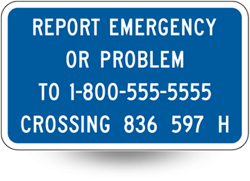
Stalling on Railroad Tracks
If your vehicle stalls on the tracks
GET OUT immediately!
Everyone must leave the vehicle (children, babies, elderly passengers, etc.).
Move away from the tracks even if you do not see a train.
Find the Emergency Notification System sign and call the number listed.
Report the stalled vehicle and location.
If a train is approaching
Move away from the tracks at a 45-degree angle.
Run toward the direction the train is coming from, but away from the tracks.
Do not run down the tracks in the same direction as the train.
You could be hit by debris when the train strikes your vehicle.
Key takeaway
If you stall on railroad tracks: Get out, move away, call for help, and run away from the tracks at a 45-degree angle toward the approaching train’s direction.
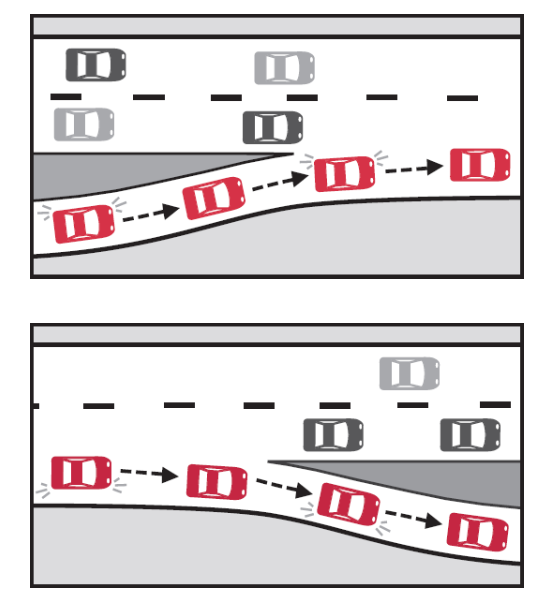
Expressway Driving
What is an expressway?
A divided highway where traffic travels in one direction with 2 or more lanes.
Drivers usually enter and exit using ramps.
Common speed limits:
55 mph normally.
Up to 65 mph in some rural areas.
Before entering an expressway
Plan your entrance and exit points ahead of time.
Know which lanes you need for entering and exiting.
If you miss your exit:
Stay on the expressway until the next exit.
Do not back up on ramps.
Do not cross the median.
Entering an expressway
Use the entrance ramp to accelerate to traffic speed.
Signal before merging.
Check traffic and look over your shoulder for vehicles.
If needed, slow down to merge safely.
If the entrance ramp is too short:
Stop and wait for a safe gap.
Enter and accelerate quickly.
Driving on an expressway
Signal every lane change.
Check your blind spot before changing lanes.
Make sure your signal turns off after changing lanes.
Watch for vehicles entering from ramps.
If possible, move out of the right lane near entrances to give merging traffic space.
Exiting an expressway
Check exit signs early and get into the correct lane.
Signal at least 100 feet before the exit ramp.
Slow down on the exit ramp.
Follow the lower speed limit on ramps.
After leaving an expressway
Check speed limit signs.
Adjust your speed because roads after expressways are usually slower than 55 mph.
Safety tips
Expressways require:
Faster thinking
Quick decisions
Good vehicle control
Take frequent rest stops on long trips.
Sunglasses can reduce glare and eye fatigue.
Key takeaway
Plan your route, merge safely, signal every move, check blind spots, maintain proper speed, and slow down when exiting the expressway.
Night Driving
Why night driving is dangerous
About 90% of driving decisions depend on vision.
Night driving reduces visibility, making it harder to see:
Road hazards
Pedestrians
Other vehicles
Vision at night can decrease with age.
Safe night driving
Drive slower at night than during the day.
Be extra careful on:
Unknown roads
Narrow roads
Roads with many curves
Drive within the range of your headlights:
Headlights allow you to see about 350 feet ahead.
Your speed should allow you to stop safely within that distance.
When to use headlights
Use headlights:
½ hour after sunset to ½ hour before sunrise.
When visibility is less than 1,000 feet.
When using windshield wipers for:
Rain
Snow
Sleet
During:
Dawn
Dusk
Fog
Remember:
Headlights help others see you.
Do not use parking lights or daytime running lights instead of headlights.
Using high beams
Use high beams carefully.
Switch to low beams:
Within 500 feet of an oncoming vehicle.
Within 200 feet of a vehicle ahead.
When approaching pedestrians.
Fog/driving lights must not create glare for others.
Handling headlight glare
If an oncoming driver does not dim their lights:
Flash your high beams briefly.
Return to low beams.
Avoid glare by:
Looking toward the right side of the road.
Using the road edge as a guide.
Use the rear-view mirror night setting to reduce glare from vehicles behind you.
Reduce distractions and glare
Turn off the inside roof light.
Dim dashboard lights.
Adjust sun visors if needed.
Keep windshield and headlights clean.
Key takeaway
Night driving requires slower speeds, proper headlight use, reduced glare, and extra attention because visibility is limited. Always drive at a speed that allows you to stop within your headlights’ range.
Driving in Rain, Fog, or Snow
Driving in bad weather
Rain, snow, ice, and wet leaves can make roads slippery.
Improve safety by:
Reducing speed
Increasing following distance
Being extra careful on:
Curves
Turns
Expressway ramps
Hydroplaning
Hydroplaning happens when tires ride on top of water, causing loss of traction and steering control.
More likely when:
Driving at high speeds.
Tires have worn tread.
Tires are not properly inflated.
To prevent it:
Drive slower in heavy rain.
Maintain tires with deep tread and proper pressure.
If your vehicle loses traction:
Slow down gradually.
Headlights in bad weather
Turn on headlights when using windshield wipers for:
Rain
Snow
Sleet
Fog
Daytime running lights do not replace headlights.
Use low beams in:
Rain
Fog
Snow
High beams reflect off rain/fog/snow and make visibility worse.
Safe driving in poor visibility
Reduce speed.
Signal turns earlier to warn others.
Brake earlier when stopping or slowing down.
Give other drivers more time to react.
Fog lights
Fog lights may be used in heavy fog or severe visibility conditions.
Front fog lights: amber or white.
Rear fog lights: red.
Turn fog lights off when visibility improves to avoid creating glare for other drivers.
Key takeaway
Slow down, increase following distance, use low beams, keep headlights on when required, and maintain good tires to stay safe in rain, fog, and snow.
How to Drive in Winter
Before winter weather
Winter is the most difficult season to drive because of:
Snow and ice
Reduced daylight
Prepare your vehicle:
Use good snow tires before the first storm.
Do not mix radial and non-radial tires.
Metal stud tires are allowed in NY only from October 16 – April 30.
Before driving in snow or ice
Avoid driving unless necessary.
Clear all snow and ice from:
Headlights
Back lights
Windshield wipers
Hood
Roof
Windows
Fill windshield washer fluid with a freezing-resistant solution.
Safe winter driving
Drive slowly.
Match the speed of traffic.
Do not drive faster just because your vehicle has:
Front-wheel drive
Four-wheel drive
These vehicles handle better but can still skid.
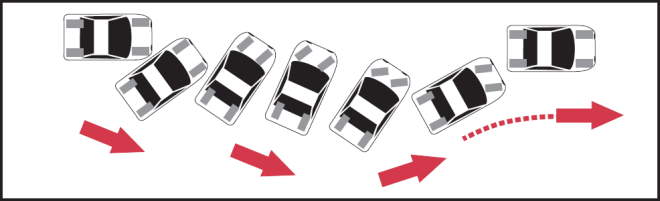
Recovering from a skid If rear wheels skid
Turn the steering wheel in the same direction the vehicle is sliding:
Sliding left → steer left.
Sliding right → steer right.
Continue adjusting until the vehicle is controlled.
Braking:
ABS brakes: Apply steady pressure.
No ABS: Pump brakes gently.
If front wheels skid
Remove your foot from the gas.
Shift to neutral or push in the clutch.
Do not steer immediately.
Wait for traction to return.
Then steer where you want to go and accelerate carefully.
Preventing skids
Brake:
Early
Slowly
Gently
Use steady brake pressure.
Keep wheels turning.
If wheels begin locking:
Reduce brake pressure.
Use a lower gear if needed.
Winter hazards
Bridges, ramps, and overpasses freeze first.
Slippery areas may remain even after snow is removed.
Key takeaway
Prepare your vehicle, drive slowly, avoid sudden movements, and know how to recover from skids. Even vehicles with better traction can lose control on ice and snow.
How to Avoid Collisions with Deer
When deer collisions are most common
October, November, and December have the most deer-vehicle collisions.
Deer are more active during breeding season.
Deer activity is highest at:
Dawn
Dusk
Deer often travel in groups → if you see one deer, expect more.
How to avoid hitting deer
Be extra careful during dawn and dusk because:
Visibility is lower.
Deer are more active.
Slow down when deer are near the road.
Be prepared because deer can:
Suddenly run onto the road.
Change direction quickly.
If one deer crosses the road:
Slow down.
Watch for additional deer following.
Deer crossing signs
Pay extra attention near deer crossing signs.
These signs are placed in areas with many previous deer collisions.
Warning other drivers
Use:
Emergency flashers
Headlight flashes
Warn other drivers when deer are near the roadway.
Key takeaway
Slow down at dawn and dusk, especially in October–December. If you see one deer, expect more, and always be alert near deer crossing areas.
Driving Emergencies
Emergency Situations – Key Notes & Takeaways General Rule
Do not panic.
Stay calm and think before acting.
Most emergencies give you a few seconds to react.
Tire Blowout
Hold the steering wheel tightly.
Slowly remove your foot from the gas pedal.
Do not brake until the vehicle is under control.
Pull off the road when safe.
Loss of a Wheel
Handle it like a tire blowout.
Slow down and leave the roadway.
Stop and check the vehicle.
Steering Failure
Slowly release the gas pedal.
Turn on emergency flashers.
Avoid using brakes suddenly.
Brake carefully once speed decreases.
Brake Failure
Pump the brake pedal to build pressure.
If brakes still fail:
Use emergency/parking brake gently.
Shift to a lower gear to slow down.
Headlight Failure
Use:
Emergency lights
Parking lights
Turn signals
Pull off the road safely if needed.
Get help if headlights dim or fail.
Stuck Gas Pedal
Try to free the pedal with your shoe.
If it stays stuck:
Shift into neutral.
Brake and pull off the road.
Do not turn off the ignition (you may lose steering control).
Running Off the Pavement
Do not suddenly swerve back onto the road.
Ease off the gas.
Brake gently.
Check traffic behind you.
Return to the pavement carefully when slower.
Vehicle Approaching Head-On in Your Lane
Slow down.
Move to the right side of the road.
Use your horn to warn the driver.
Do not move into the left lane.
Stalling on Railroad Tracks
If a train approaches:
Leave the vehicle immediately.
Move far away from tracks.
Run toward the direction the train is coming from at a 45-degree angle away from tracks.
Do not run down the tracks in the same direction as the train (debris risk).
Going Into Water
Release your seat belt.
Escape through a window (not the door).
If the car sinks:
Move to the back seat.
Use the air pocket.
Take a breath and escape through a window.
Fire
Pull off the road.
Turn off the ignition.
Get away from the vehicle.
Call the fire department.
Do not try to fight the fire yourself.
Blocked Vision
Open side window if needed to see.
Turn on emergency flashers.
Carefully pull off the road and stop.
Key takeaway
Stay calm, avoid sudden movements, control the vehicle safely, and get off the road when possible. In emergencies, your first priority is protecting yourself and others.