Forgetting: interference
 Call Kai
 Learn
Learn Practice Test
 Spaced Repetition
 Match
Match Flashcards
 Knowt Play
1/10

There's no tags or description
Looks like no tags are added yet.
Name | Mastery | Learn | Test | Matching | Spaced | Call with Kai | Chat |
|---|
No analytics yet
Send a link to your students to track their progress
11 Terms
Interference is a type of forgetting from which memory store?
LTM
What is a definition of interference?
Information in LTM becomes confused with or disrupted by other information during coding, which leads to inaccurate recall
What are the two different types of interference?
Retroactive & proactive interference:
Pro = Past affects the present
Retro = Recent affects the past
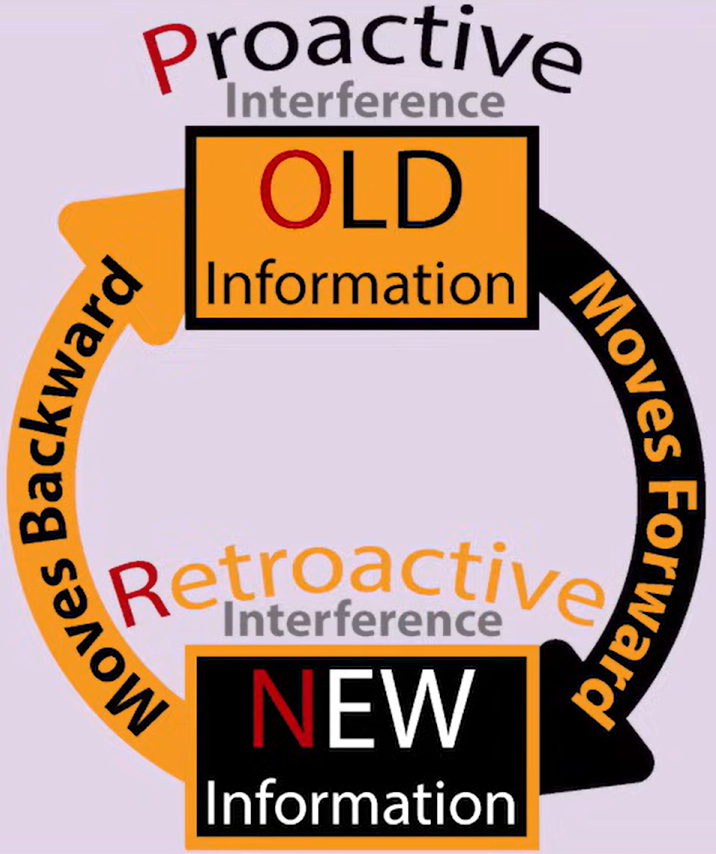
What is proactive interference?
Interference caused by information that has been stored previously interfering with an attempt to recall something new (i.e. old memories interfere with new memories)
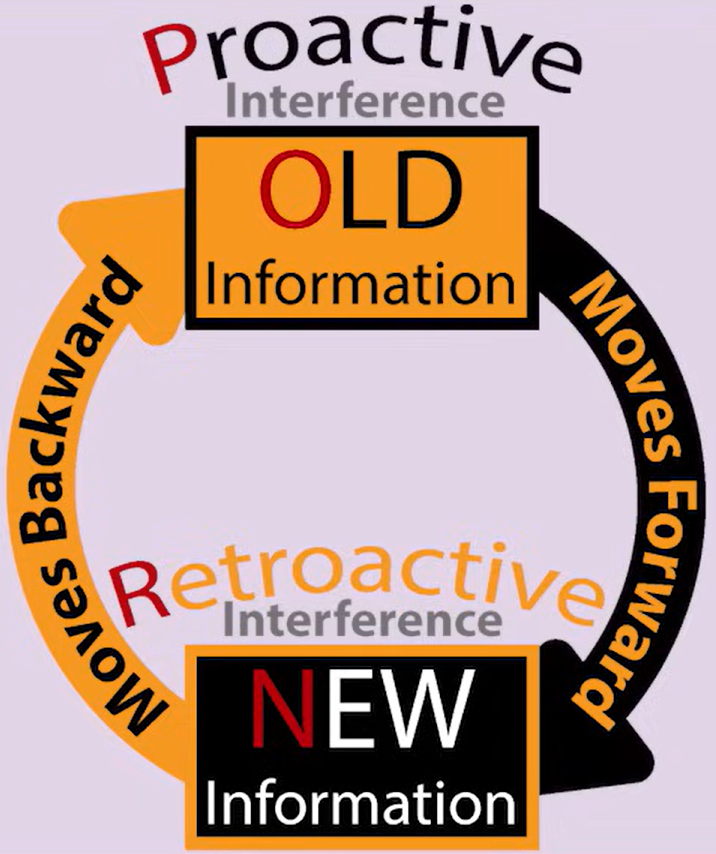
What is retroactive interference?
Interference caused when new information disrupts information stored previously (i.e. new memories interfere with old memories)
What is an example of proactive & retroactive interference?
Proactive interference: you keep typing your old password instead of your new one (old info interferes with new)
Retroactive interference: your new password makes you forget your old one (new info interferes with old)
Under what conditions is interference more likely?
When information is similar
Describe and evaluate interference as an explanation for forgetting (16 marks)
Write your AO1 paragraph
Interference is a type of forgetting from LTM. It is based on the idea that information in LTM becomes confused with or disrupted by other information during coding, leading to inaccurate recall. The more similar the items are, the more interference will occur. There are two types of interference which can cause forgetting: proactive & retroactive.
Proactive interference works forwards in time & occurs when information stored previously interferes with an attempt to recall something new (old memories interfere with new memories). For example, typing in an old password instead of your new one.
Retroactive interference works backwards in time & occurs when new information disrupts information stored previously (new memories interfere with old memories). For example, a new password makes you forget your old one.
Describe and evaluate interference as an explanation for forgetting (16 marks)
Write your strength AO3 PEEL (Postman)
Point: One strength of interference theory is there is empirical evidence in support of retroactive interference.
Evidence: For example, in Postman’s study, both the control & experimental group memorised a list of paired words. However, the experimental group also memorised an additional list.
Explain: Results found the control group were more accurate when asked to recall the original list, suggesting retroactive interference had occurred.
Link: As such, this provides evidence for interference, suggesting that it is a valid explanation for forgetting.
Describe and evaluate interference as an explanation for forgetting (16 marks)
Write your strength AO3 PEEL (Baddeley & Hitch)
Point: One strength of interference theory is that some studies have high ecological validity.
Evidence: For example, Baddeley & Hitch’s field experiment involved asking rugby players about matches they had played.
Explain: Results found that the number of intervening games was the only significant predictor for forgetting.
Link: Overall, this suggests interference theory can apply to at least some everyday situations, increasing its external validity.
Describe and evaluate interference as an explanation for forgetting (16 marks)
Write your limitation AO3 PEEL (Goddon & Baddeley)
Point: One limitation of interference theory is there is more research evidence to suggest the reason we forget is due to context-dependent forgetting.
Evidence: For example, in Goddon & Baddeley’s study, deep sea divers were asked to learn words on land & then recall them either in the same environment or in the sea.
Explain: Result found those who recalled the words in the sea showed a 30% deficit, compared to those who recalled the words on land.
Link: As such, this suggests environmental cues affects memory & superior recall occurs when environmental conditions are similar for encoding & recall (Tulving’s encoding specificity principle).