Transport Across Membranes
 Studied by 0 people
 Call Kai
 Learn
Learn Practice Test
 Spaced Repetition
 Match
Match Flashcards
 Knowt Play
1/13

There's no tags or description
Looks like no tags are added yet.
Name | Mastery | Learn | Test | Matching | Spaced | Call with Kai |
|---|
No analytics yet
Send a link to your students to track their progress
14 Terms
Why can the lipid bilayer enable the cell or intracellular compartment to maintain a different environment to the outside?
Because it is an impermeable barrier to polar molecules
What are required to transport molecules across membranes?
Certain proteins
What are membrane transport proteins?
Specialised proteins that enable molecules to pass across membranes
What are the two factors that determine transport across the membrane?
Size of the molecule
Polarity and charge of molecule
What are the two types of membrane transport proteins?
Carrier (transporter) proteins and channel proteins
What is facilitated diffusion?
Carriers and channels enable facilitated diffusion (passive transport)
The concentration gradient determines the direction of flow
If it is an ion (and has a charge) then concentration and charge determine the direction of flow. This is called the electrochemical gradient (pumping of H+ into the intermembrane space generates an electrochemical gradient, H+ then flows through ATP synthase via facilitated diffusion)
What is active transport?
Pumping solutes across a membrane against their concentration gradient
Mediated solely by carriers
It requires energy: light energy (bacteria), energy release from electron transfer, ATP hydrolysis
Eukaryotes carry out active transport via two main mechanisms: coupled carriers (secondary active transport) & ATP driven pumps (primary active transport)
What are the different types of passive transport and active transport shown on a diagram?
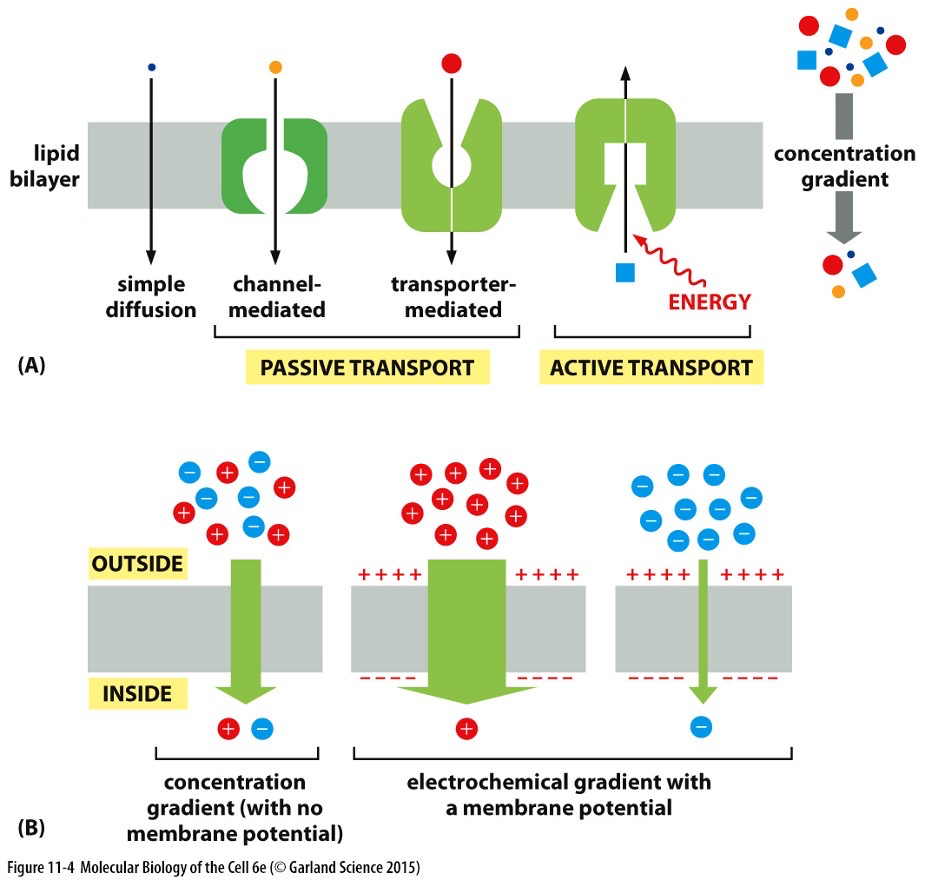
What are the two types of coupled carriers?
Symporters and antiporters
What are symporters?
They move two molecules in the same direction
What are antiporters?
They move two molecules in the opposite direction
What are channel proteins?
Channel proteins form pores across a membrane
Some are large (eg. Porins) and if they were on the plasma membrane then it would allow lots of things in and out (poor regulation)
Channels on the membrane are very narrow, highly selective pores that open and close are gated
They are specifically concerned with the transport of ions
Channels only participate in facilitated diffusion
What are the different types of gated channel proteins?
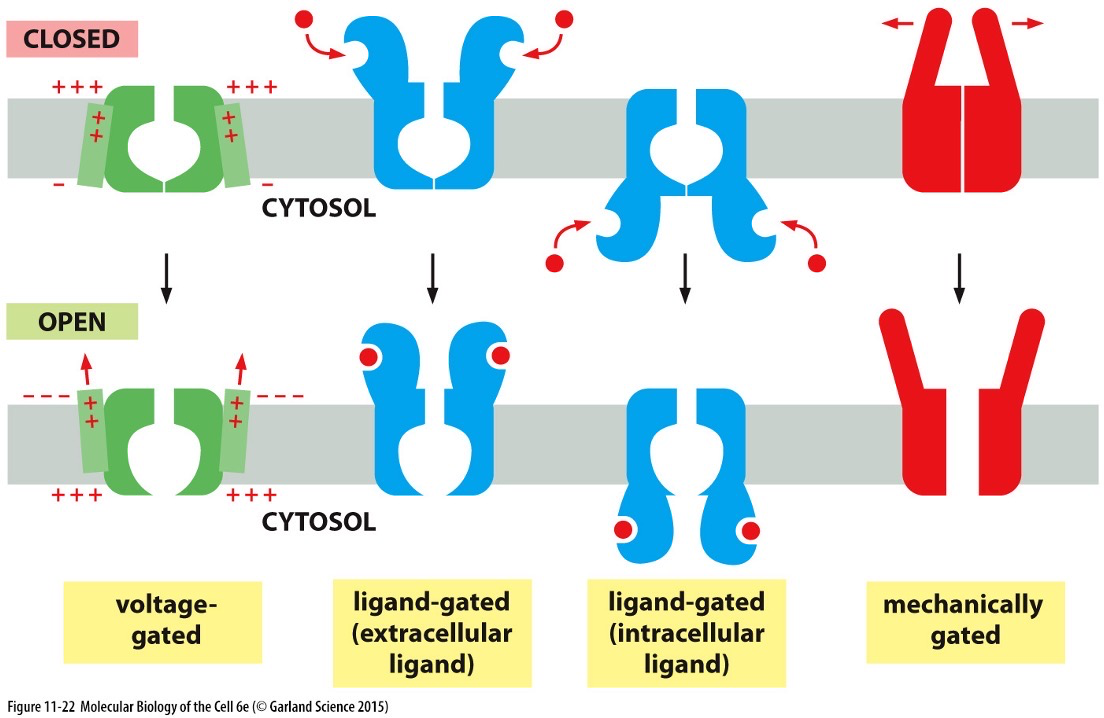
How do different molecules get transported across the membrane?
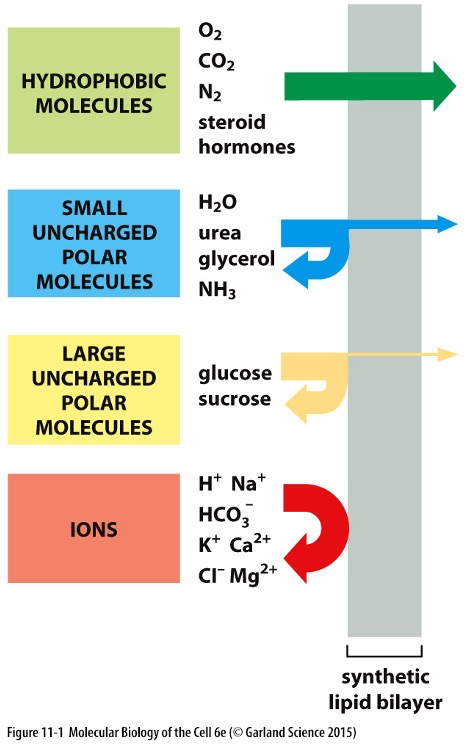
Non-polar = no problem. They dissolve in the bilayer and diffuse across
Small, no charge but polar = OK. It will be very slow to move across
Large, uncharged and polar = probably going to need a transporter of some sort
Ions = charged. Need specialised mechanism (same as charged, large and polar)
 Note
Note  Flashcards (355)