33 Disease of the Equine Nasal Passages and Paranasal Sinuses
 Call Kai
 Learn
Learn Practice Test
 Spaced Repetition
 Match
Match Flashcards
 Knowt Play
1/39

There's no tags or description
Looks like no tags are added yet.
Name | Mastery | Learn | Test | Matching | Spaced | Call with Kai | Chat |
|---|
No analytics yet
Send a link to your students to track their progress
40 Terms
a. dry mucous membranes from cold weather
d. guttural pouch mycosis
e. ethmoid hematoma
f. nasal polyps
Select which of the following causes of epistaxis in horses are normally UNILATERAL:
a. dry mucous membranes from cold weather
b. head trauma
c. exercise induced pulmonary hemorrhage (racehorses)
d. guttural pouch mycosis
e. ethmoid hematoma
f. nasal polyps
c. severe pleuropneumonia
d. clotting disorders
e. head trauma
f. exercise induced pulmonary hemorrhage
Select which of the following causes of epistaxis in horses are normally BILATERAL:
a. exertion
b. neoplasia
c. severe pleuropneumonia
d. clotting disorders
e. head trauma
f. exercise induced pulmonary hemorrhage
External nares (false nostril)
What is the first major site of upper airway resistance in horses?
Motor: facial n
Sensory: trigeminal n
What nerves innervate the external nares (nostrils) in horses
This is in the external nares in horses caused by a cyst in the false nostril
What is an atheroma or epidermal inclusion cysts?
Treatment is typically only cosmetic (must destroy lining with roaring bur or it will come back) and prognosis is excellent
What is good about atheromas aka epidermal inclusion cysts in horses in terms of treatment and prognosis?
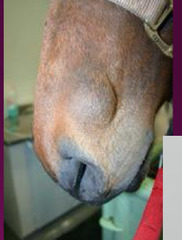
Atheroma or Epidermal Inclusion Cyst
What is this?
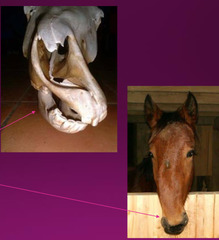
Wry nose (congenital)
What is this?
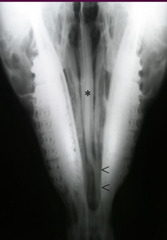
Nasal septum problem = thickening and malformation of the nasal septum
What is this?
Nasal septum has been resected (rostral section left to prevent collapse)
What is different here?
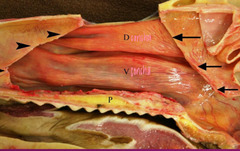
BLOODY
Why should you not do nasal septum resection in the field with horses?
Nasal polyp
What is this?
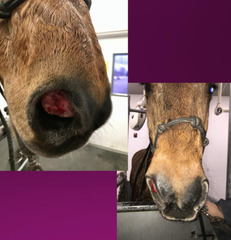
Nasal polyp
This is a pedunculated growth from the mucosa of the nasal cavity or septum in horses, causing a presentation of inspiratory dyspnea and discharge, which must be surgically excised
Progressive ethmoid hematoma
What is this?
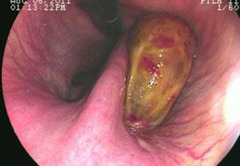
Progressive Ethmoid Hematoma
This slowly expanding non-neoplastic mass in horses originates from the submucosa of the *ethmoid labyrinth*, usually UNILATERAL
*Serosanguinous epistaxis discharge unilaterally*
What is the MOST COMMON CLINICAL SIGNS of progressive ethmoid hematomas in horses?
Progressive ethmoid hematoma
On endoscopy, you see this green to yellow, purple to red mass with a smooth surface. What is your first thought?
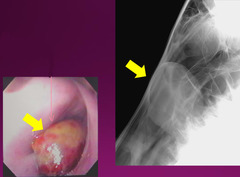
Treat with surgical excision of the mass and destruction of origin. But be careful because THESE BLEED A LOT
May also do transendoscopic laser or an intra-lesion formalin injection (but you're close to cribriform plate = dangerous)
How do you treat progressive ethmoid hematomas in horses and what do you have to keep in mind with this treatment?
BLUE = conchofrontal
YELLOW = rostral maxillary
ORANGE = caudal maxillary
What are the different colors telling you about paranasal sinuses in horses
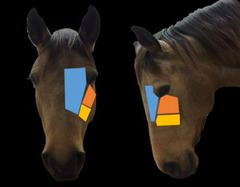
BLUE = conchofrontal
RED = all other sinuses
What is the difference between the blue and red paranasal sinuses in this picture?
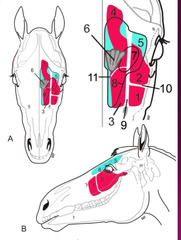
TRUE
TRUE OR FALSE: ALL compartments of the paranasal sinuses communicate either directly or indirectly in horses
Thru nasomaxillary opening
Where do all the paranasal sinuses drain eventually in horses?
PM 4 and M1 (08 and 09) = rostral maxillary sinus
M2 and M3 (10 and 11) = caudal maxillary sinus
What tooth roots in horses communicate with the sinuses?
Unilateral nasal discharge
What is the most common clinical sign of sinusitis in horses
Unilateral
Sinus problems and nasal cavity problems in horses normally have *unilateral or bilateral* nasal discharge?
Bilateral
Guttural pouch problems, nasopharynx or lung problems, and problems with BOTH paranasal sinuses in horses cause *unilateral or bilateral* discharge?
Sinusitis
You see a horse with unilateral nasal discharge. Endoscopy shows pus at the *nasomaxillary opening*, and radiographs show a fluid line. Thoughts?
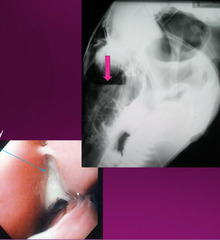
Sinusitis
Sinocentesis (culture and lavage), sinoscopy thru hole in sinus, and CT are all diagnostics for WHAT problem in horses?
Sinus trephination
What is this?
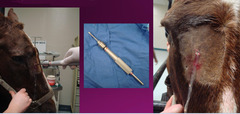
Treatment failure IS COMMON
What is the issue with treating sinusitis in horses (like with warm saline lavage or systemic antibiotics)?
Sinus cyst
What is this?
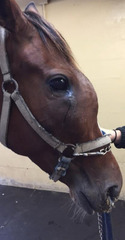
Sinus cyst
This fluid filled structure lined by epithelium in horses causes *facial deformation* (because the bone is so small and the structure is invasive) and unilateral mucoserous nasal discharge with NO ODOR
Radiographs
What is the best way to diagnose sinus cysts in horses to see the space it is occupying without bone destruction?
Squamous cell carcinoma
What is the most common sinus neoplasia in horses?
Biopsy and aspirate for cytology
How can you diagnose sinus neoplasia like squamous cell carcinoma in horses?
Euthanize (because the surgical margins are almost impossible to get due to its' finger like projections)
The typical treatment for sinus neoplasia in horses is to *euthanize or excise surgical margins*
Bone flap approach of the maxillary sinus, where the black lines are telling you where the bone is opened and cut, but pink is where the bone is broken and HINGED
When doing surgery of the sinuses, what is this approach? What do the lines mean?
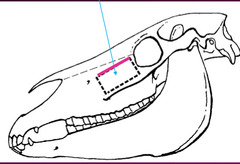
Bone flap creation
Mallet and osteotome, and oscillating saws are tools for what surgery in horses?
You need to carve it like a pumpkin, at an angle, so the bone doesn't fall back in when you replace it
What does it mean that you need to "bevel" a bone flap?
GOOD
Cosmesis is often *good or poor* for surgery of the sinuses?