12. Toric SCL Anatomy & Fitting - Contact Lenses I Summer 2026
 Call Kai
 Learn
Learn Practice Test
 Spaced Repetition
 Match
Match Flashcards
 Knowt Play
1/64

There's no tags or description
Looks like no tags are added yet.
Name | Mastery | Learn | Test | Matching | Spaced | Call with Kai | Chat |
|---|
No analytics yet
Send a link to your students to track their progress
65 Terms
Where back we put the toric correction in a RGP?
1) Back surface
2) Power Curve
Balancing the toxicity on the front and back surface of an RGP is called a ______ RGP
bitoric
What is the estimated prevalence of astigmatism?
40%
85% of patients (with cyl -0.75 to -1.75) preferred _____ over spherical soft lenses
toric soft lenses
Many patients prefer _____ over toric soft Cls
large diameter spherical RGPs
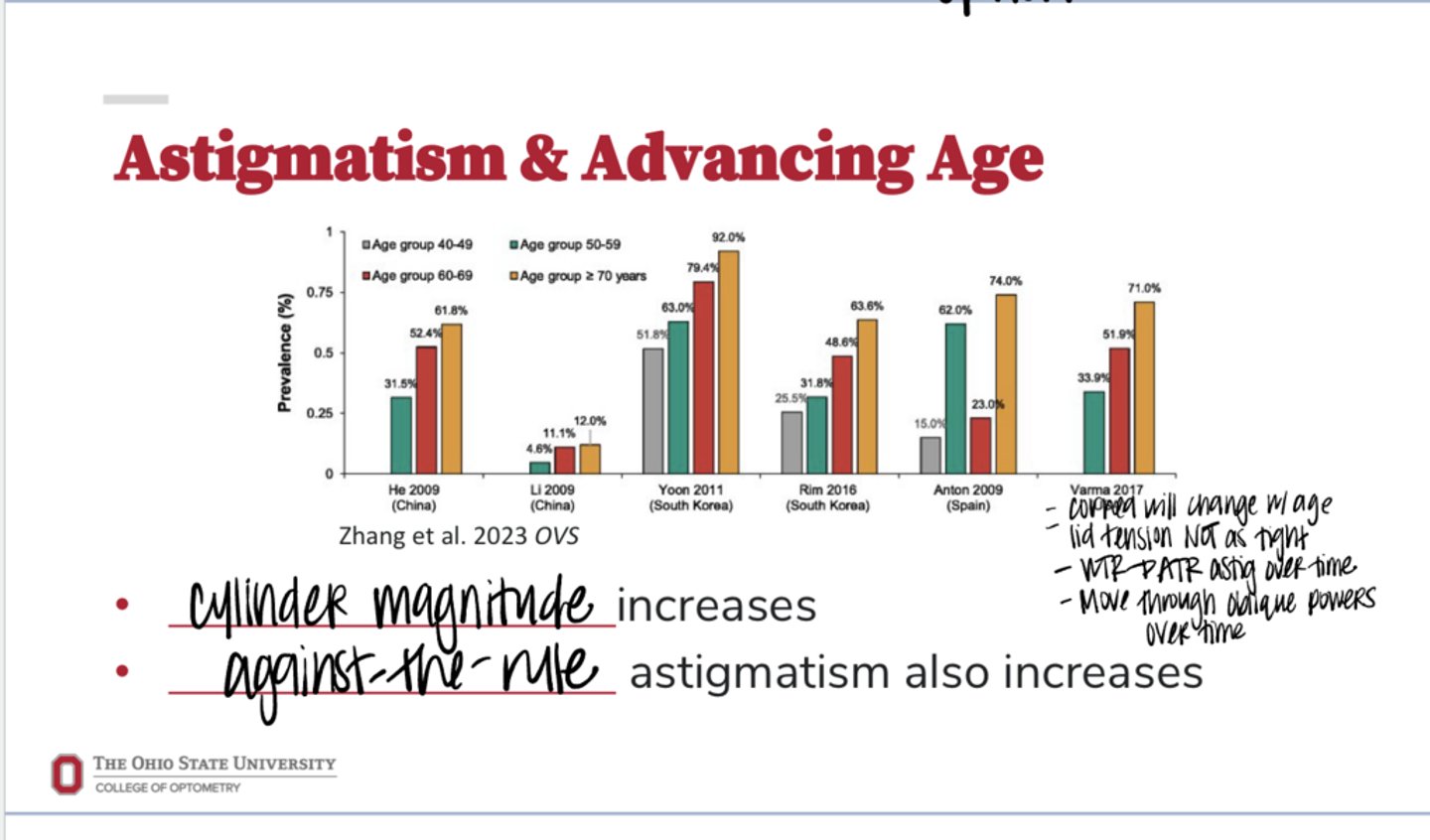
As age of a patient increases, cyl magnitude (increases/decreases)
increases
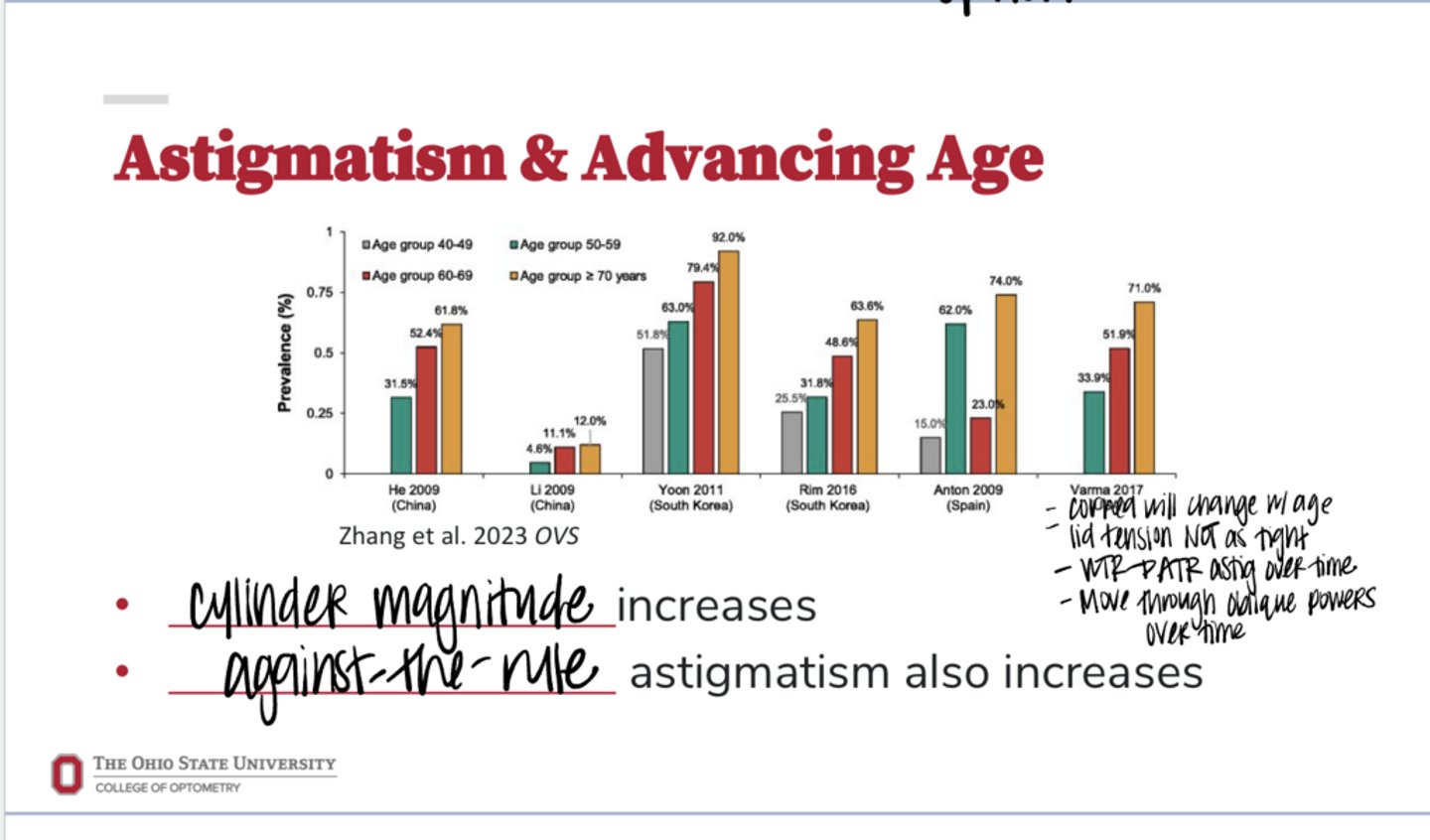
As age of a patient increases, (ATR/WTR) magnitude increases
ATR
Why do toric lenses need stabilization?
All contact lenses will rotate on the eye without stabilization
What are the causes of CLs rotation?
-surface tension/tear film quality
-back surface toricity
-lid/lens interaction
The back surface toricity of CLs will rotate to align with what?
with corneal toricity
What are the lid/lens interactions that may contribute to lens rotation?
-watermelon seed effect
-powers (thickness) in each meridian
-patient lid position (more under examination/fitting)
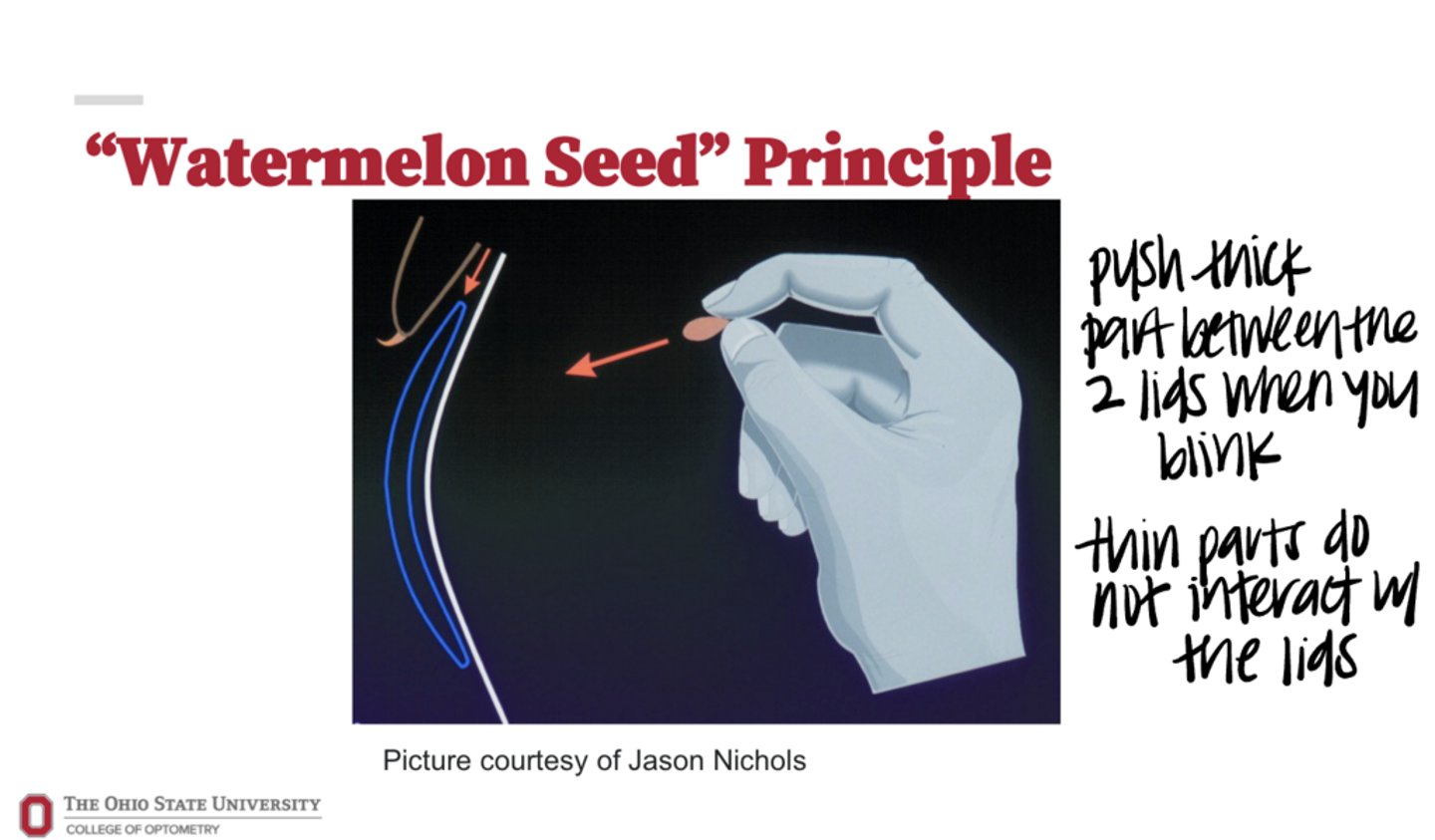
What is the "Watermelon Seed Principle" of CLs rotation & eyelid interaction?
-Eyelids adhere to lenses and cause both vertical movement and rotation
-The lids will push the thick part of the CLs between the 2 lids when patient blinks. This helps the thin parts of the lens NOT interact with the lids.
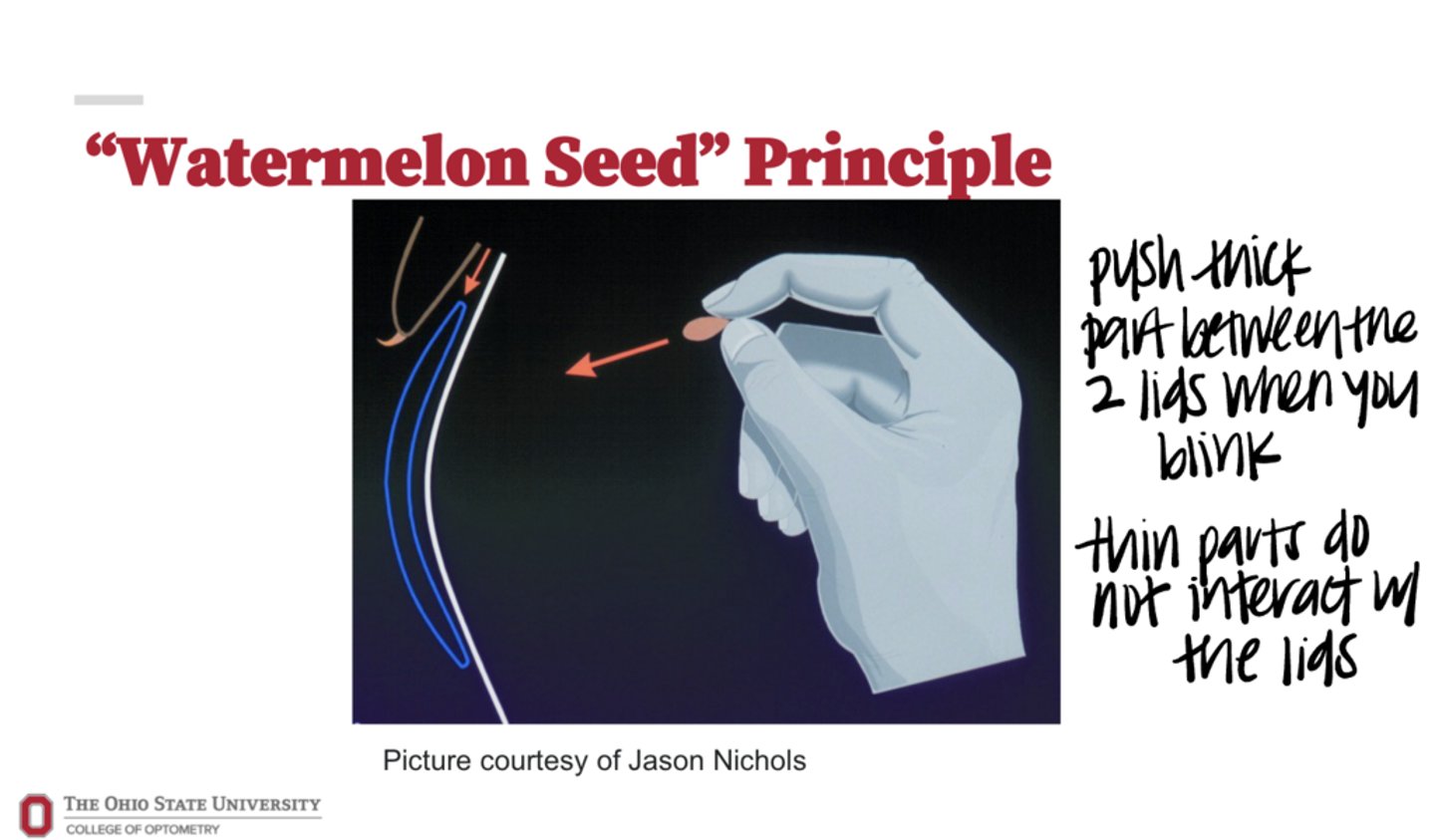
How do you DECREASE lid interaction d/t the Watermelon Seed Principle?
Need to thin and steepen peripheral/mid-peripheral areas
_____ alone (without other strategies) will affect lens rotation
Cylinder
What does cylinder in SCLs create?
Lens thickness variation -- both in toric power curve and toric BCR Cls
WTR CLs are thicker in the (Vertical/horizontal) meridian
Vertical
ATR CLs are thicker in the (Vertical/horizontal) meridian
horizontal
Where are oblique lenses thickest?
Asymmetric thickness
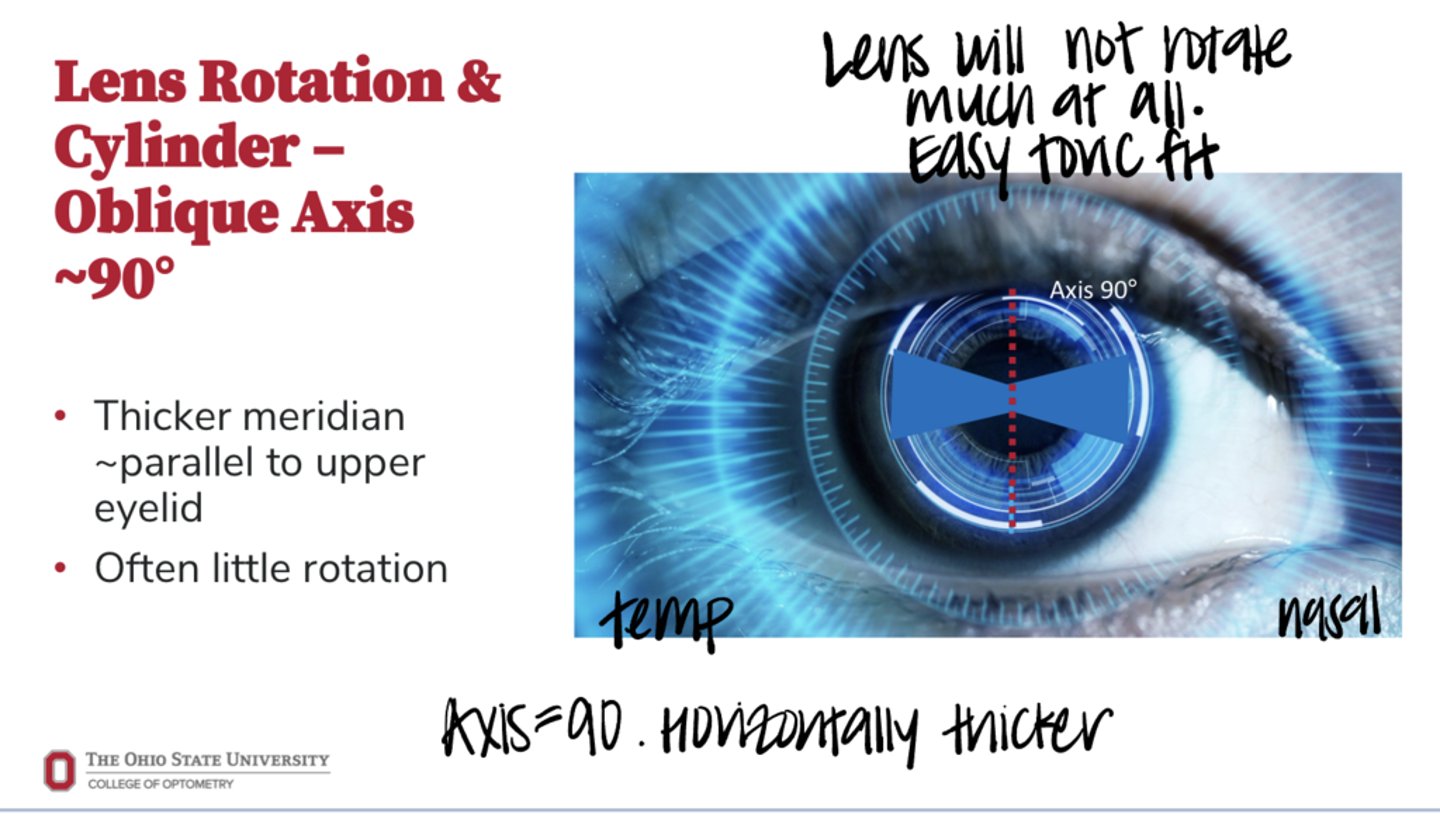
When a CLs has an oblique axis of 90º, the thicker meridian will be _____ to the upper eyelid
parallel
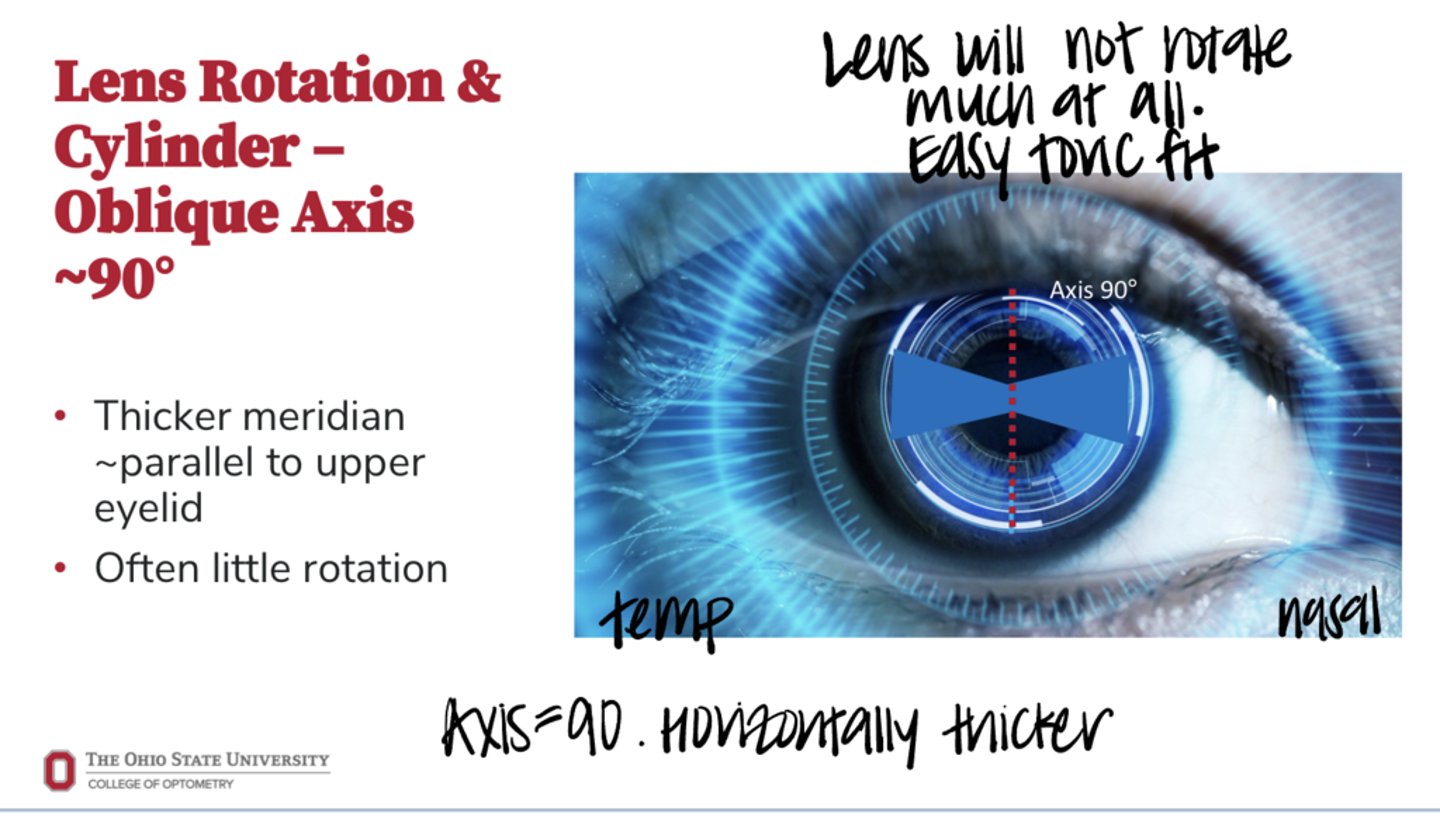
Describe the rotation of a 90º axis Cls?
often very little rotation
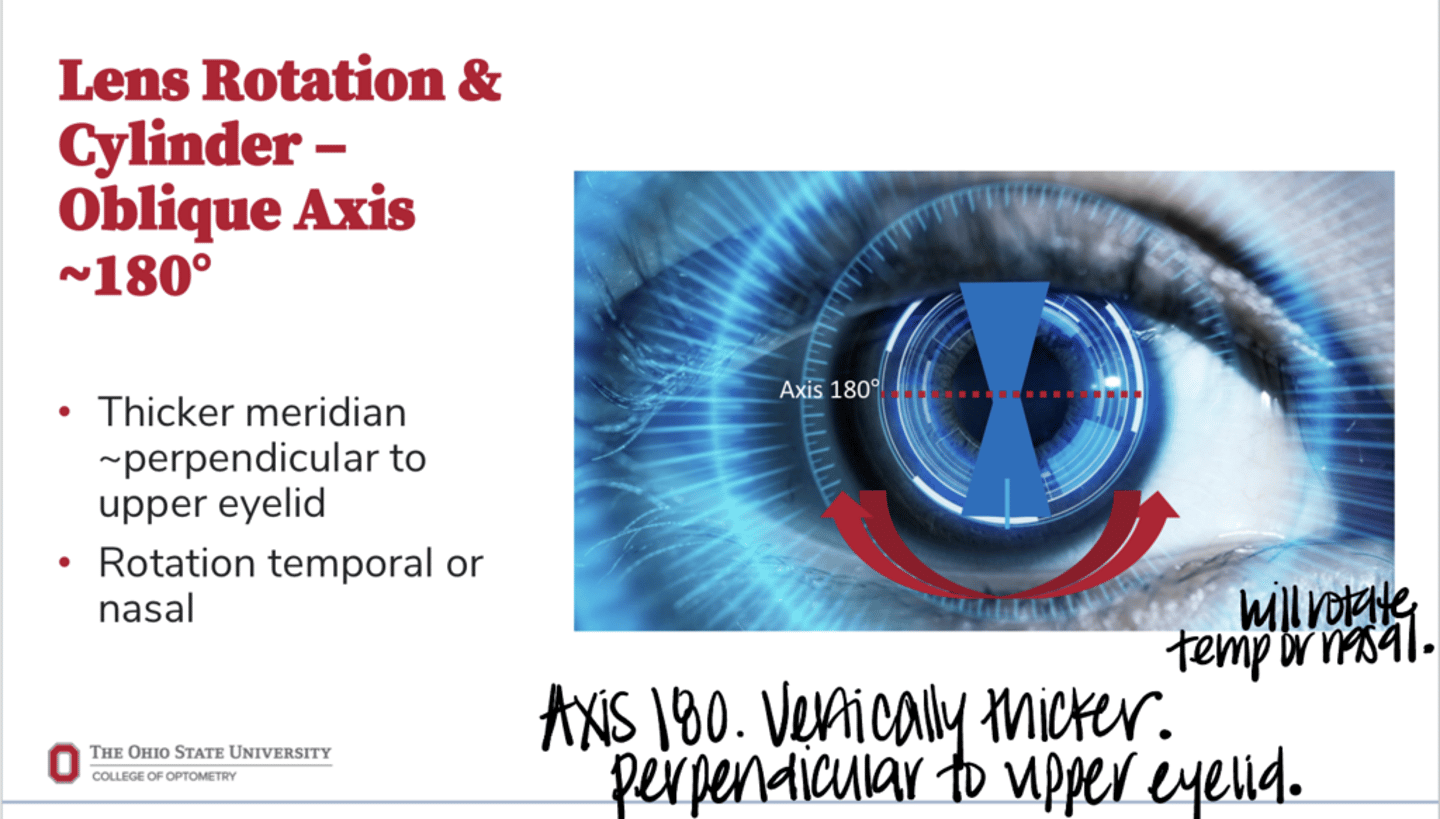
When a CLs has an axis of 180º, the thicker meridian will be _____ to the upper eyelid
perpendicular
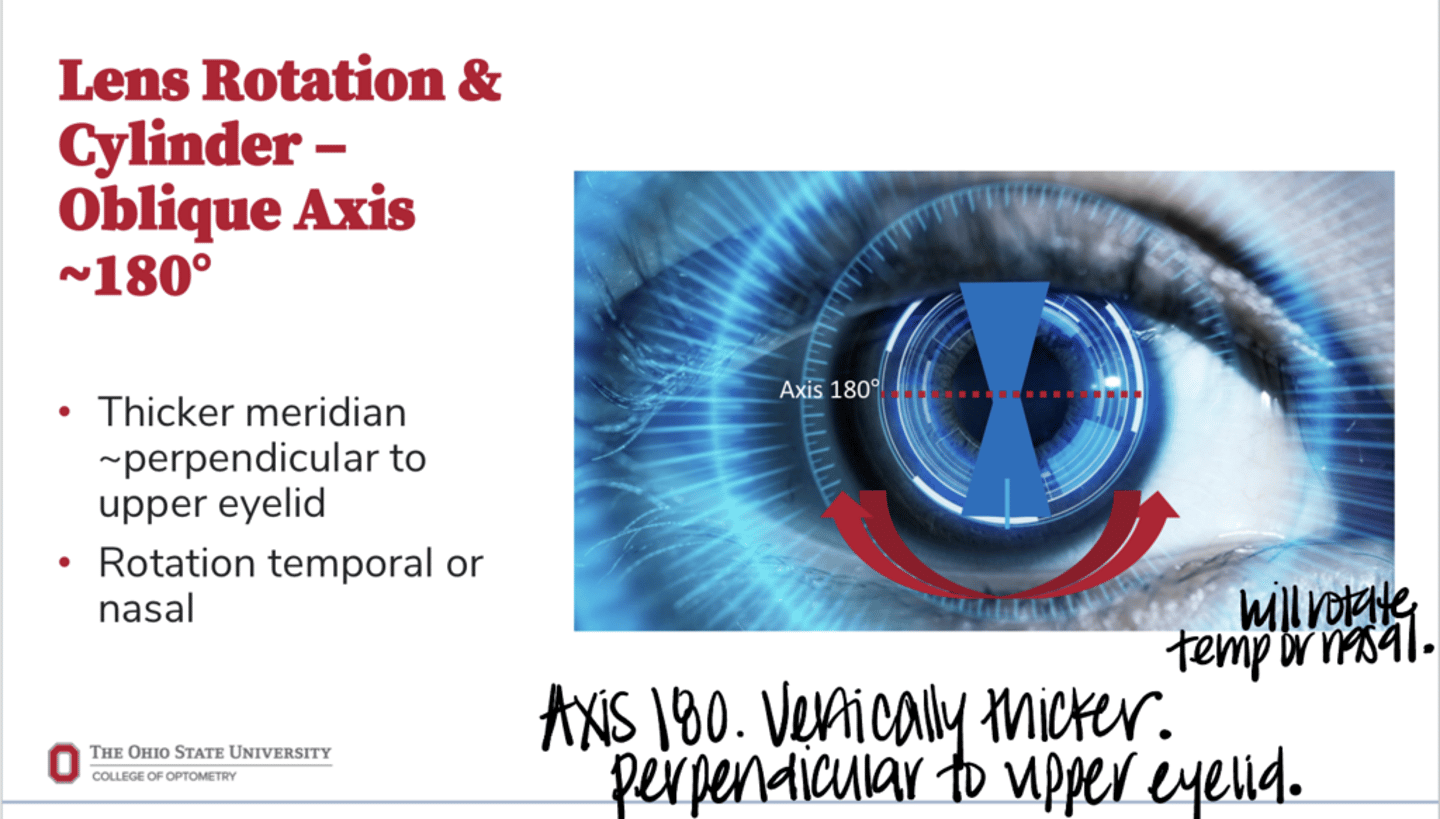
Describe the rotation of a 180º axis Cls?
Rotation temporal or nasal
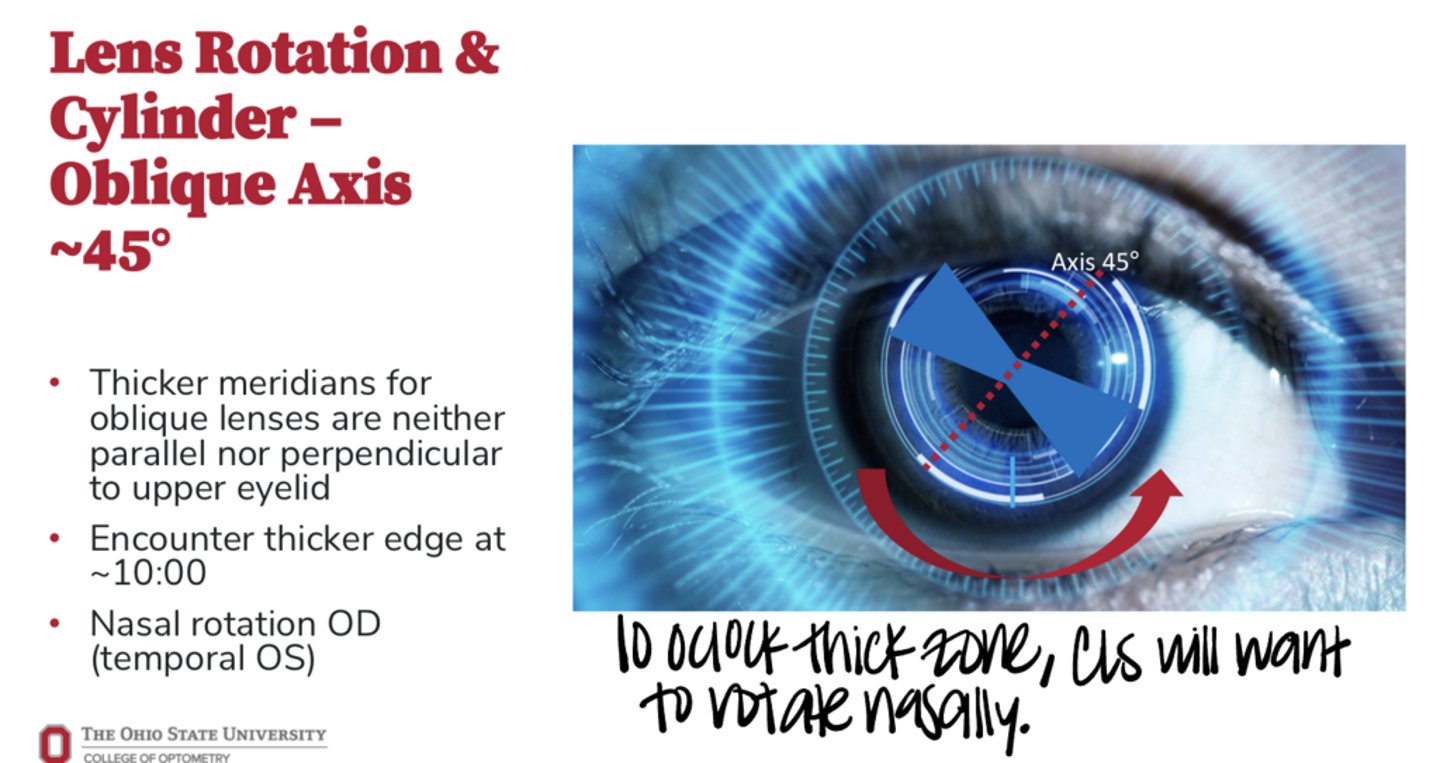
When a CLs has an oblique axis of 45º, the thicker meridian will be _____ to the upper eyelid
neither perpendicular or parallel
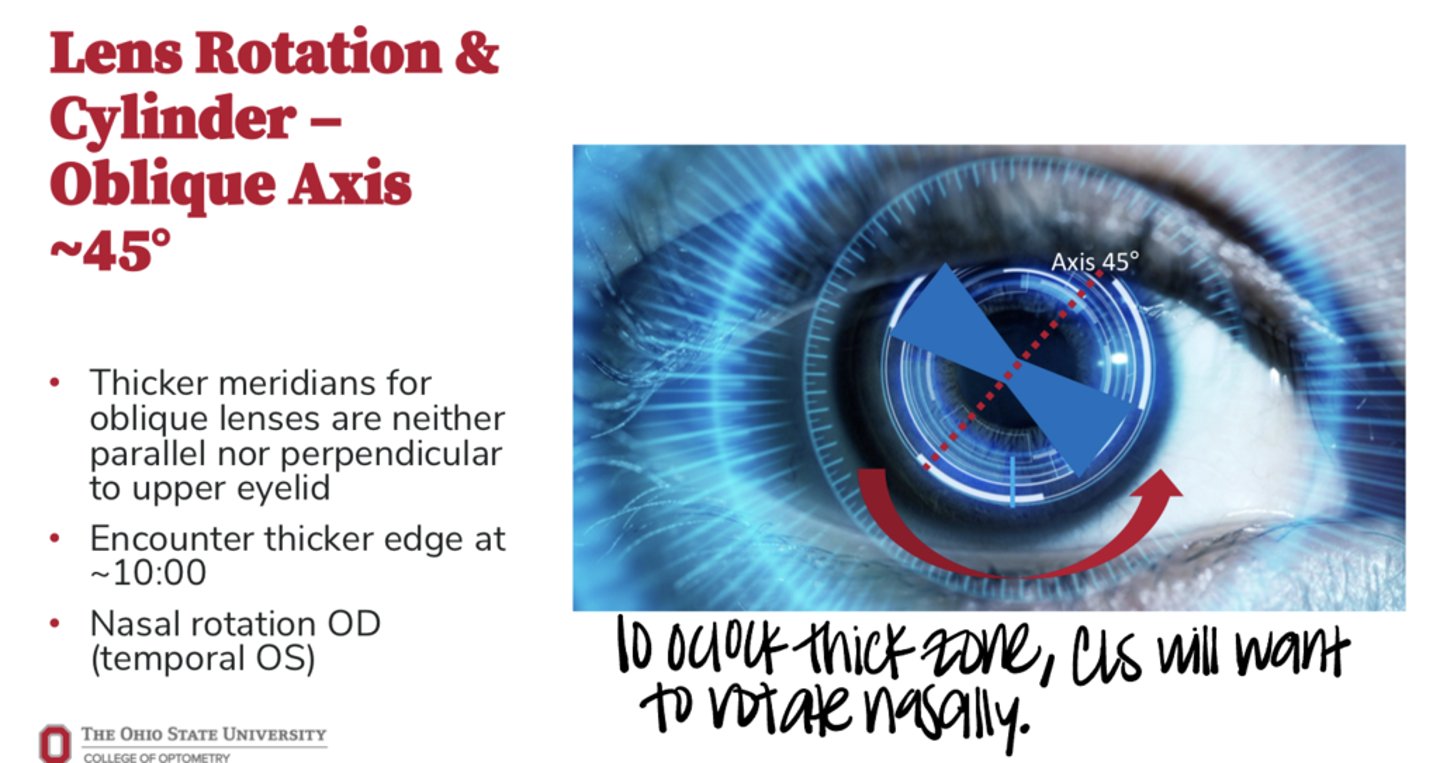
With a 45º oblique cyl axis Cls, where will the ticker edge encounter the upper lid?
at 10 ociock position
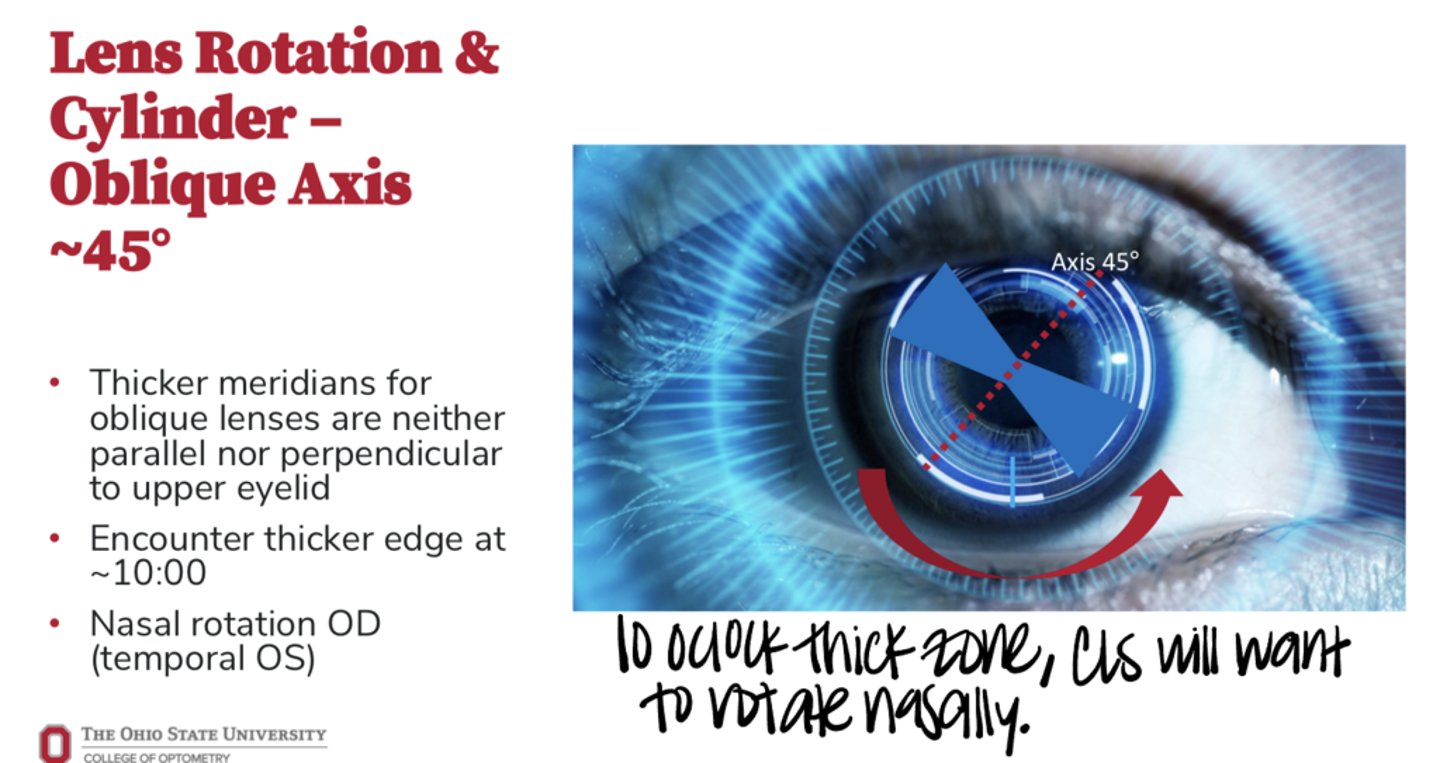
Describe the rotation of a 45º oblique axis Cls?
-Nasal rotation OD
-Temporal rotation OS
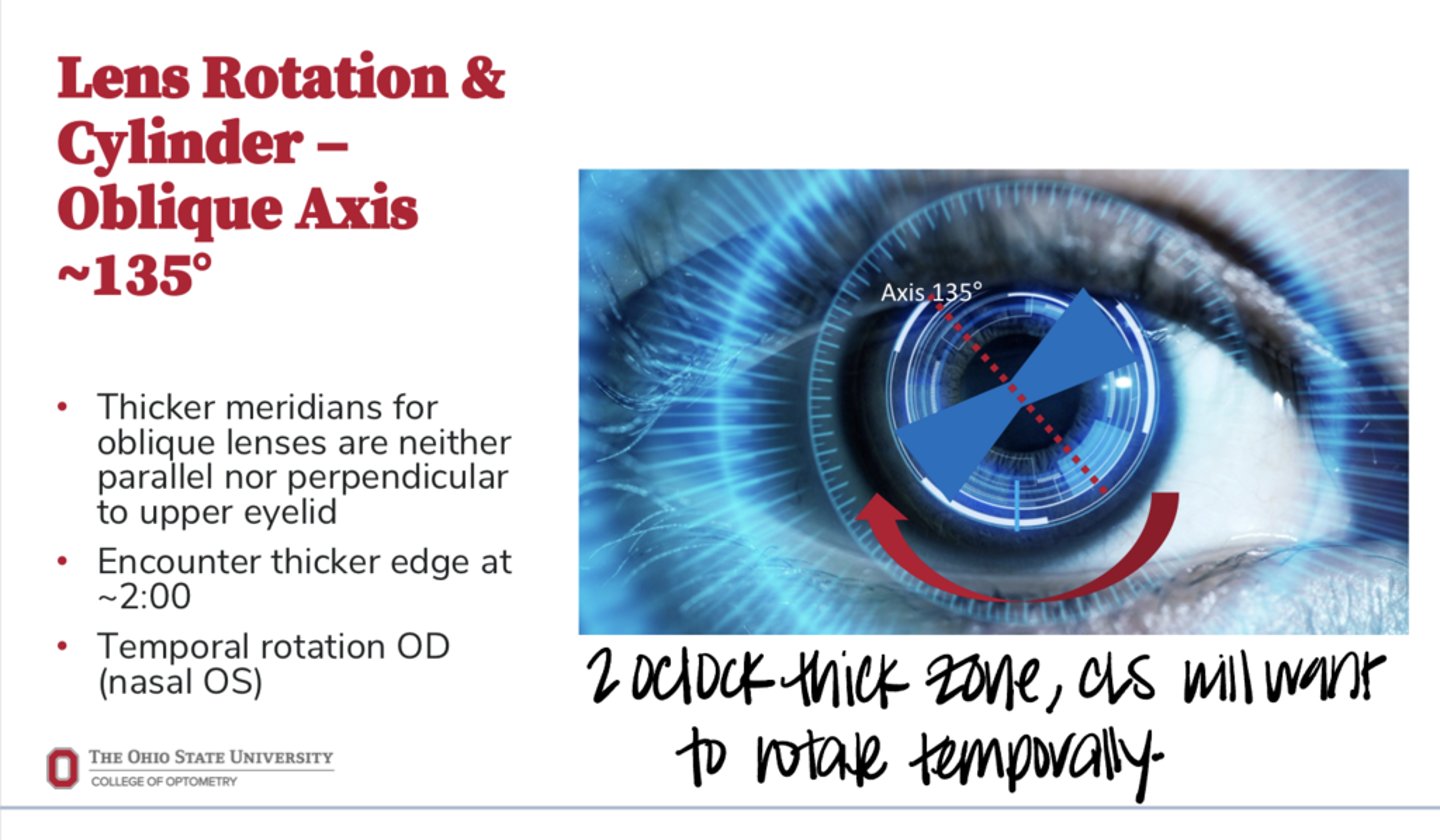
When a CLs has an oblique axis of 135º, the thicker meridian will be _____ to the upper eyelid
neither perpendicular or parallel
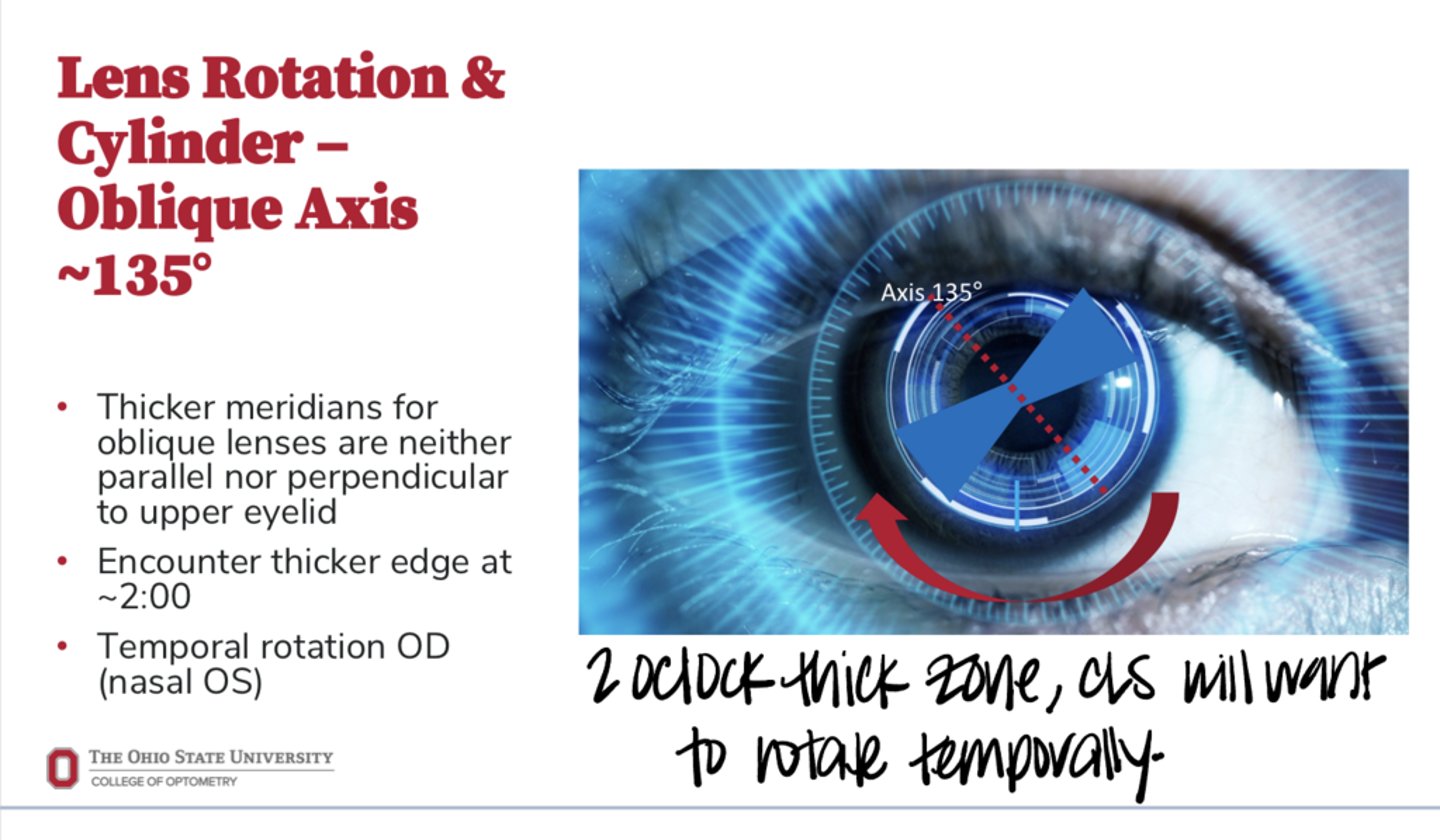
With a 135º oblique cyl axis Cls, where will the ticker edge encounter the upper lid?
at 2 ociock position
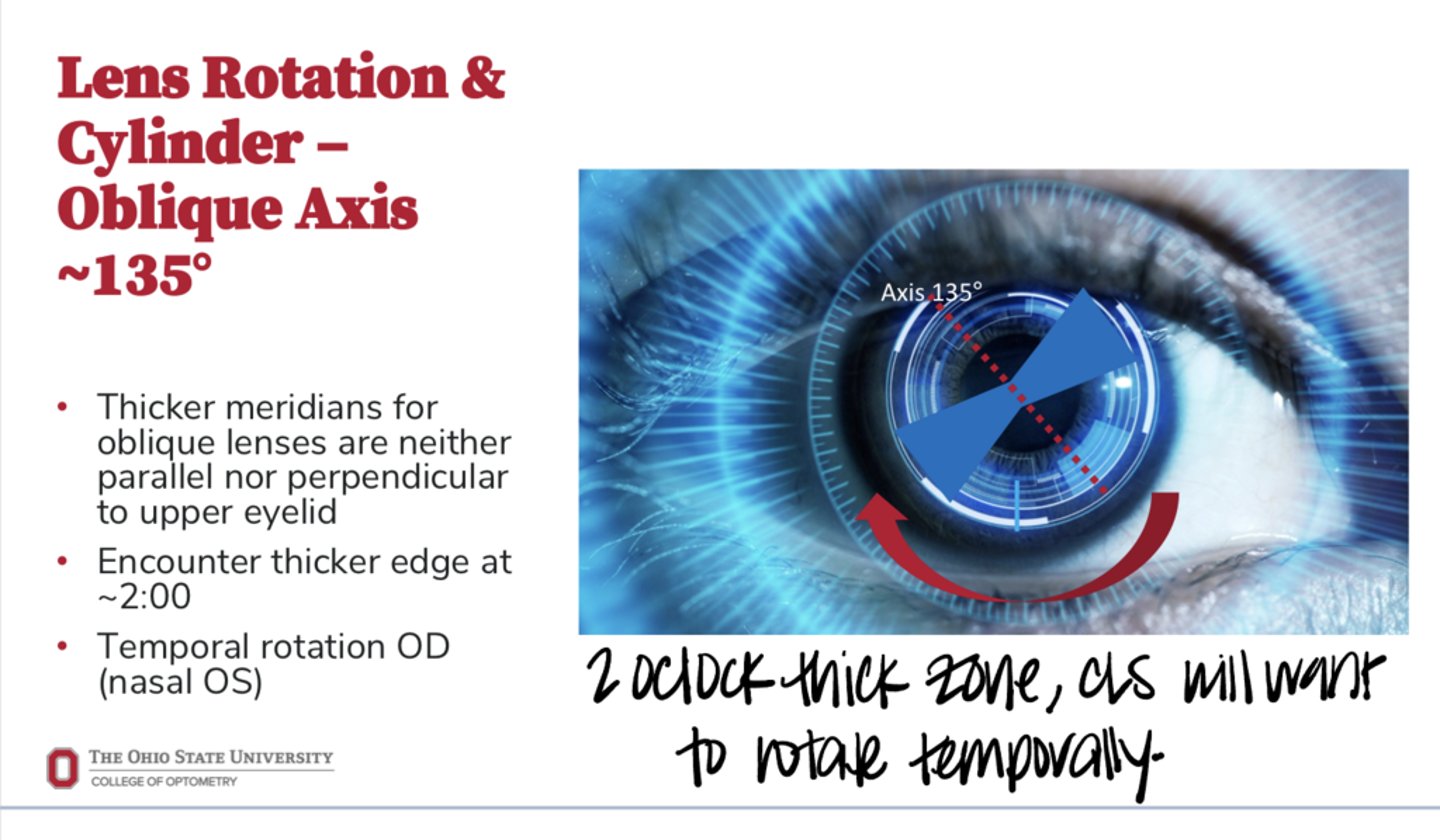
Describe the rotation of a 135º oblique axis Cls?
-Temporal rotation OD
-Nasal rotation OS
With an oblique axis CLs, the rotation will be ____ on the side with the _______ thickness
downward; greatest
An oblique Cls will have the least rotation when?
Within 20º of axis 90 or axis 180
What cyl location is MOST LIKELY to rotate on the eye?
Oblique axis
(higher/lower) cyl powers are more likely to rotate on the eye
Higher
All lenses with a toric BCR that touches the cornea will rotate to align how?
with corneal toricity
Toric SCLs will align with and conform to what?
the cornea
Do SCLs have a lacrimal lens?
No
Do you have to apply SAM FAP with a BCR change in a SCL?
No -- this is only for RGPs with a lacrimal lens
Toricity in a SCL is only where?
in the central optic zone
Why is toricity ONLY in the central optic zone of a SCL?
to reduce peripheral lens thickness and lid interaction
What is the typical BCR range of a Toric SCL?
8.4 to 8.9mm
Are Toric SCLs and spherical SCLs similar in BCRs?
Yes
Do toric SCLs usually come in MORE THAN ONE BCR option / brand?
No
What is the OAD range for Toric SCLs?
14.4 to 14.5 mm
The OAD for a toric SCL is about _____mm larger than a spherical SCL
1.0
True or False:
BCR is OFTEN toric in a toric SCL, but the exact values are not published
true
Multiple studies suggest that a ______ is more rotationally stable than spherical BCR
toric BCR
Toric SCLs are _____ than spherical lenses in order to improve stability
deeper
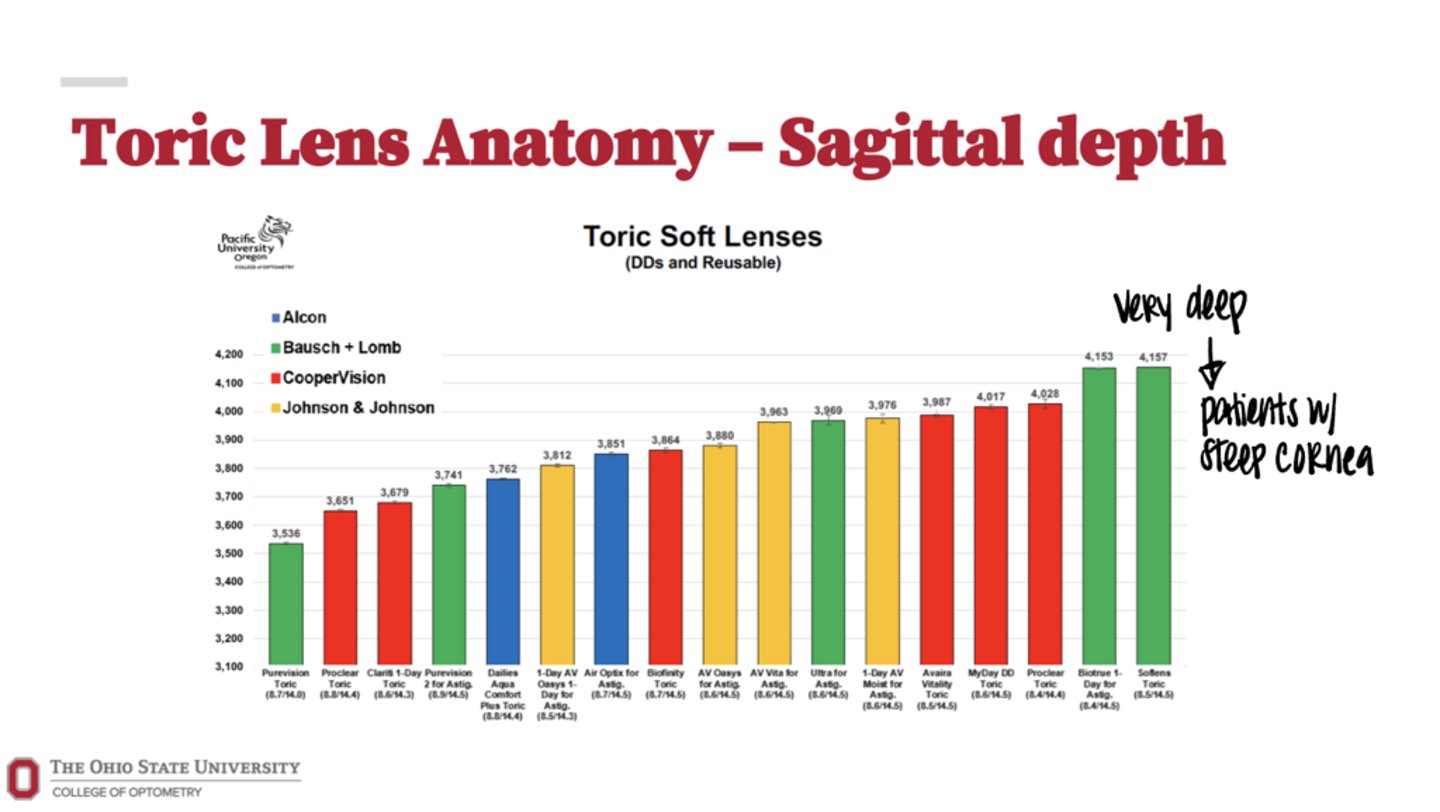
Toric Lens Anatomy -- Sagittal Depth (Pic)
Toric Lens Anatomy -- Sagittal Depth (Pic)
What are the 2 major front-surface strategies for toric lens stabilization?
1) Ballasted (prism or peri-)
2) Thin zones
True or False:
The strategy for toric lens stabilization varies by company
true
The back surface toricity of a SCL is often added to the ______
front surface toricity
When a toric SCL is NOT working for a patient d/t stabilization issues, the best strategy is usually to do what?
change stabilization strategy (company)
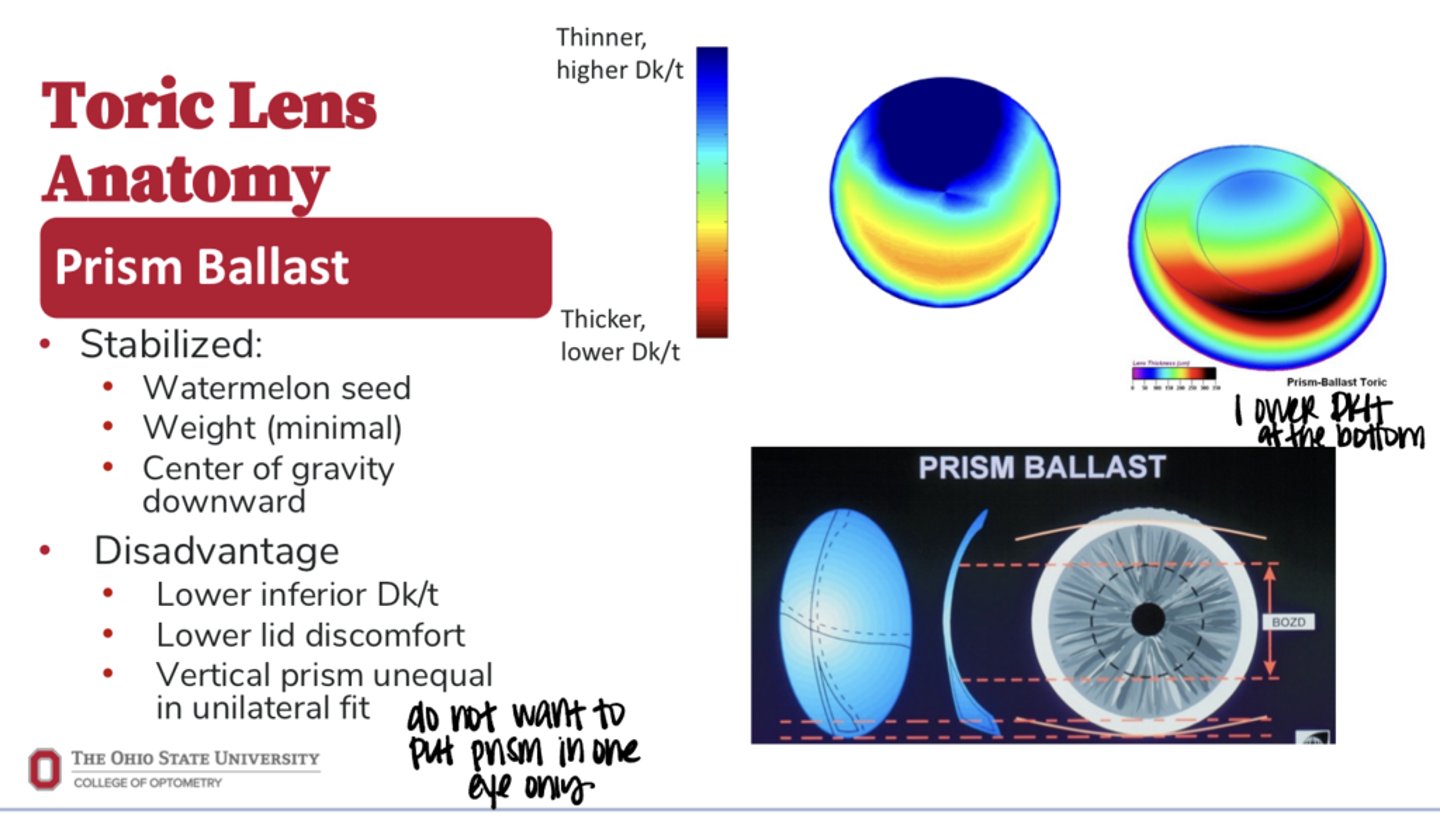
How are prism-ballast lenses stabilized?
-Watermelon Seed effect
-Weight (minimal)
-Center of gravity downward
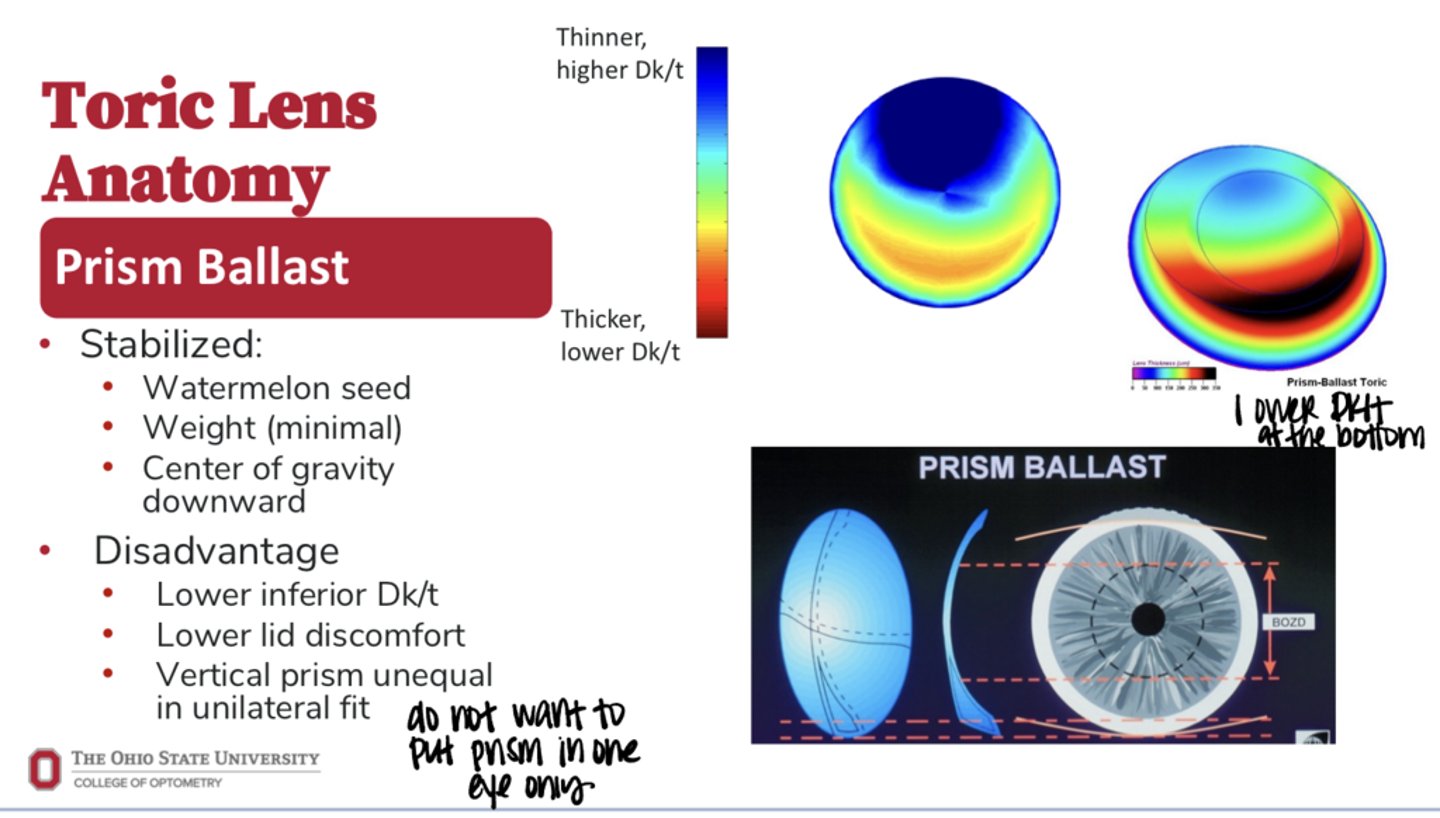
What are the disadvantages of prism-ballast lenses?
-Lower inferior Dk/t
-Lower lid discomfort
-Vertical prism will be unequal in a unilateral fit
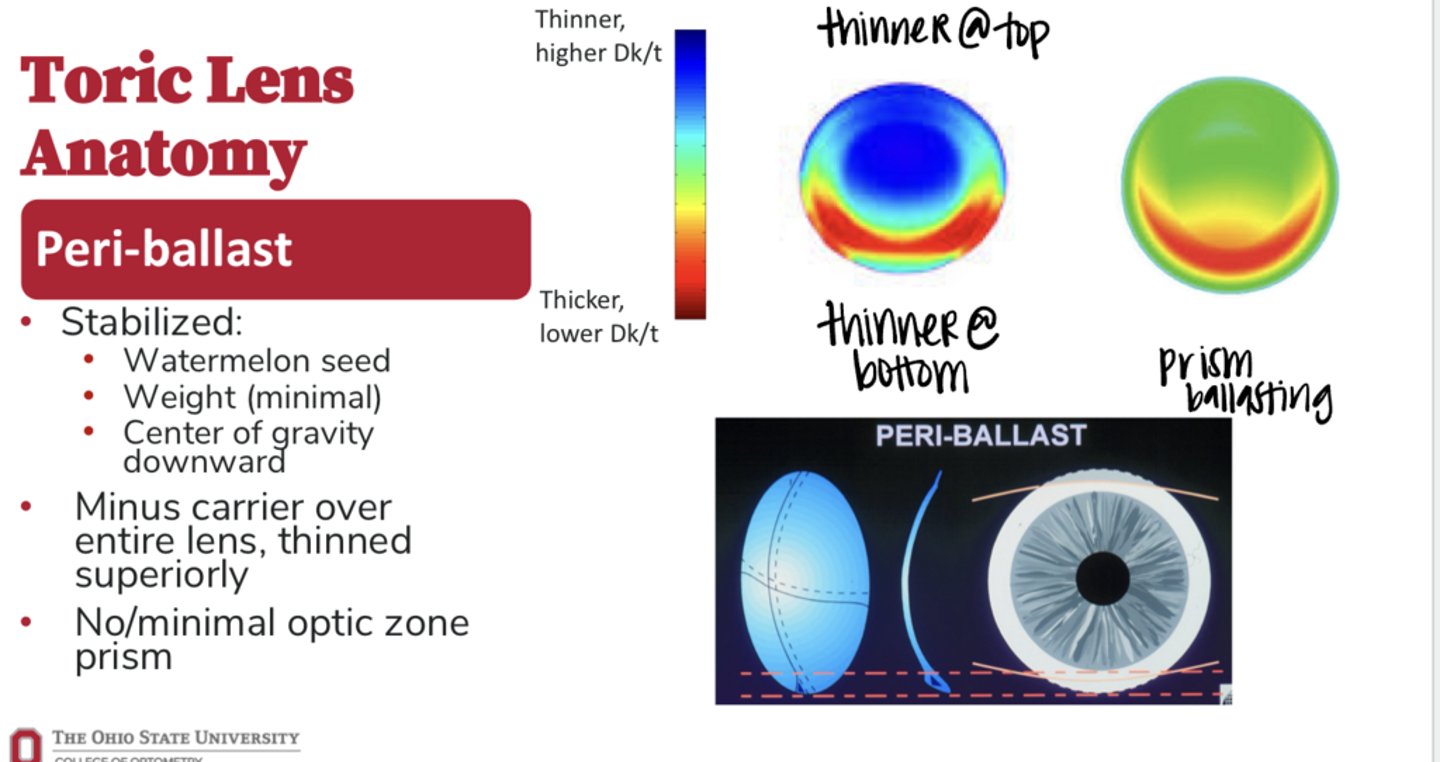
How are peri-ballast lenses stabilized?
-Watermelon Seed effect
-Weight (minimal)
-Center of gravity downward
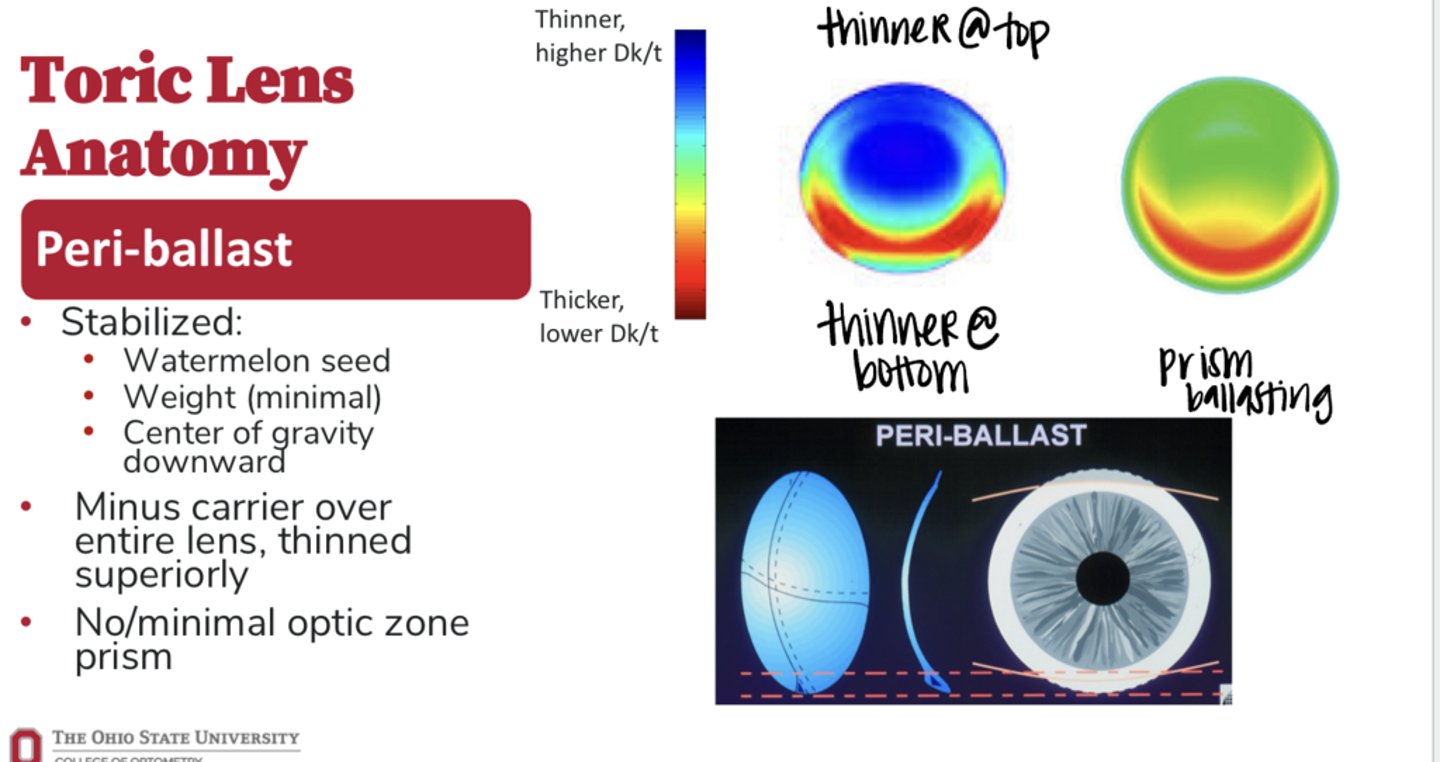
How do peri-ballast lenses work?
A minus carrier is used over the entire lens, the lens is then thinned superiorly
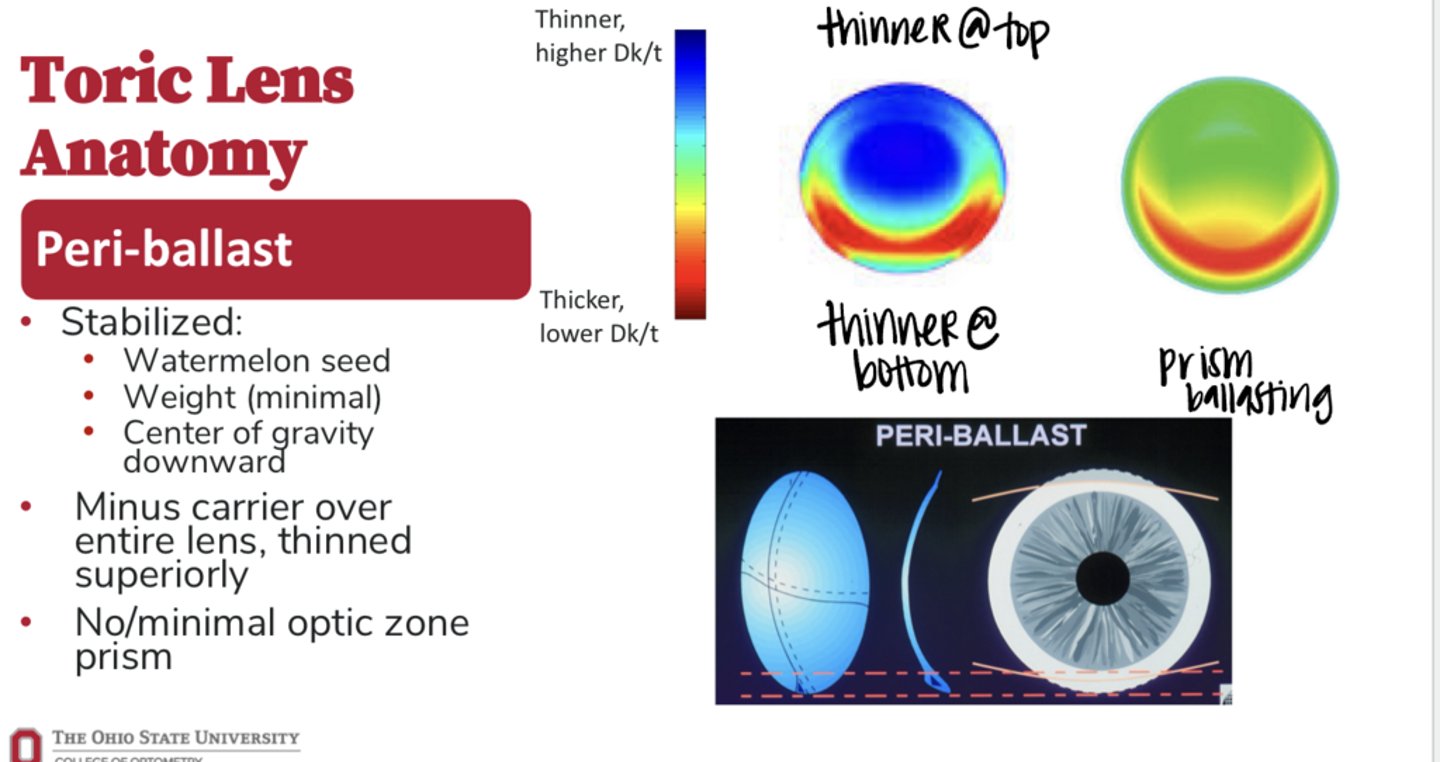
Is there any optic zone prism in a peri-ballast lens?
No
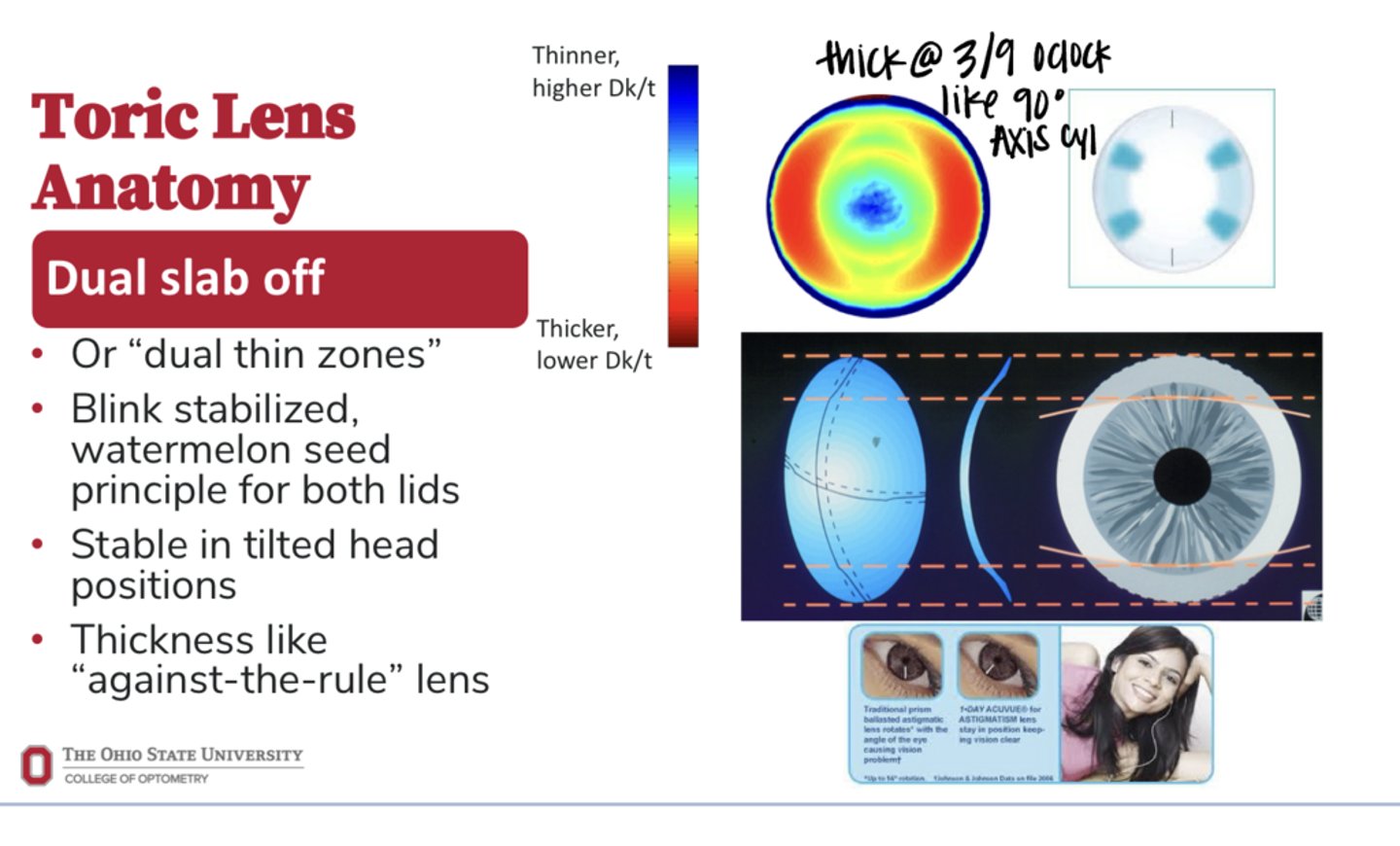
How do dual slab off Toric SCLs work?
Blink stabilized, watermelon seed principle for both lids
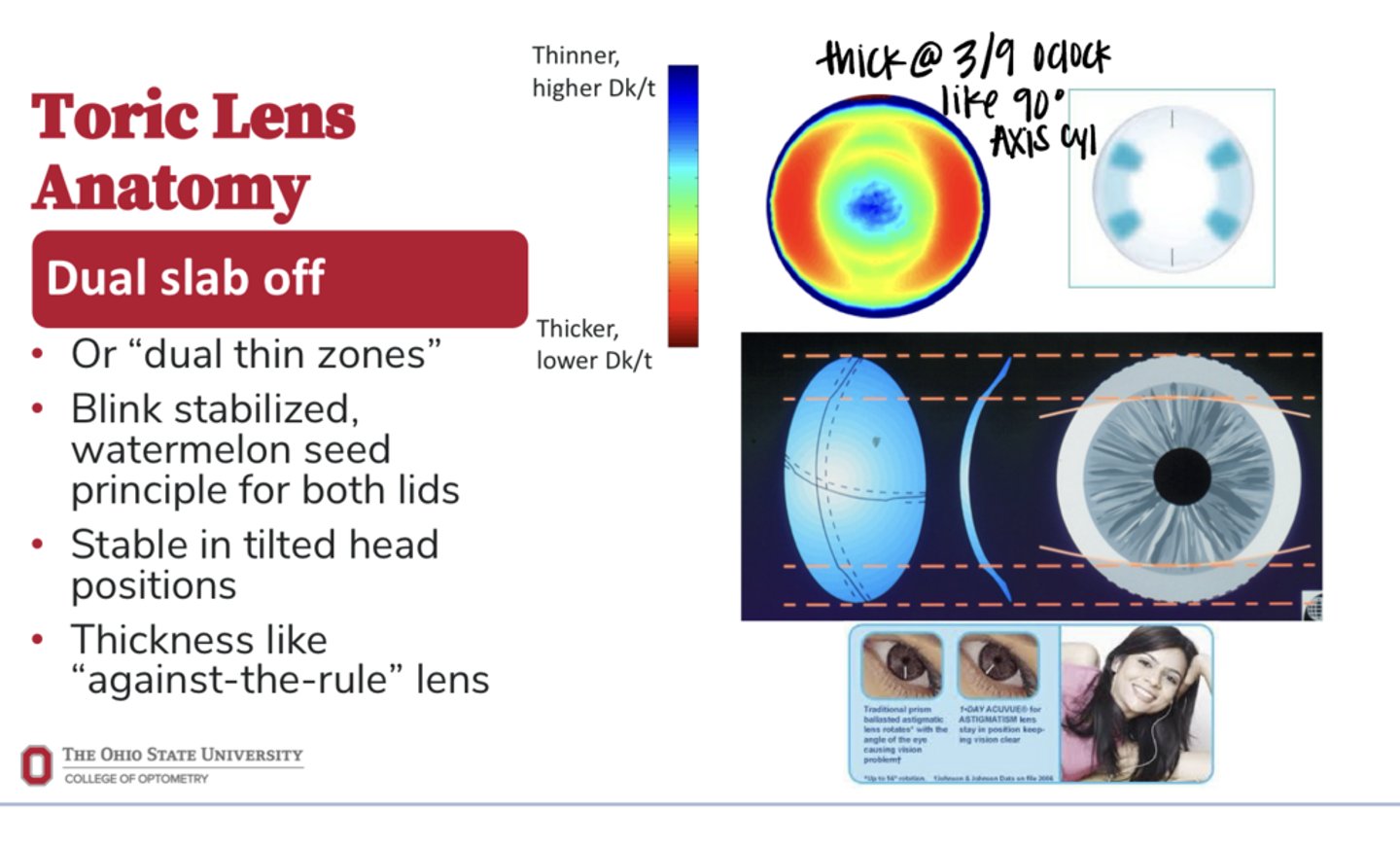
What is the dual slab off "claim to fame"?
Stable in tilted head position such as laying down
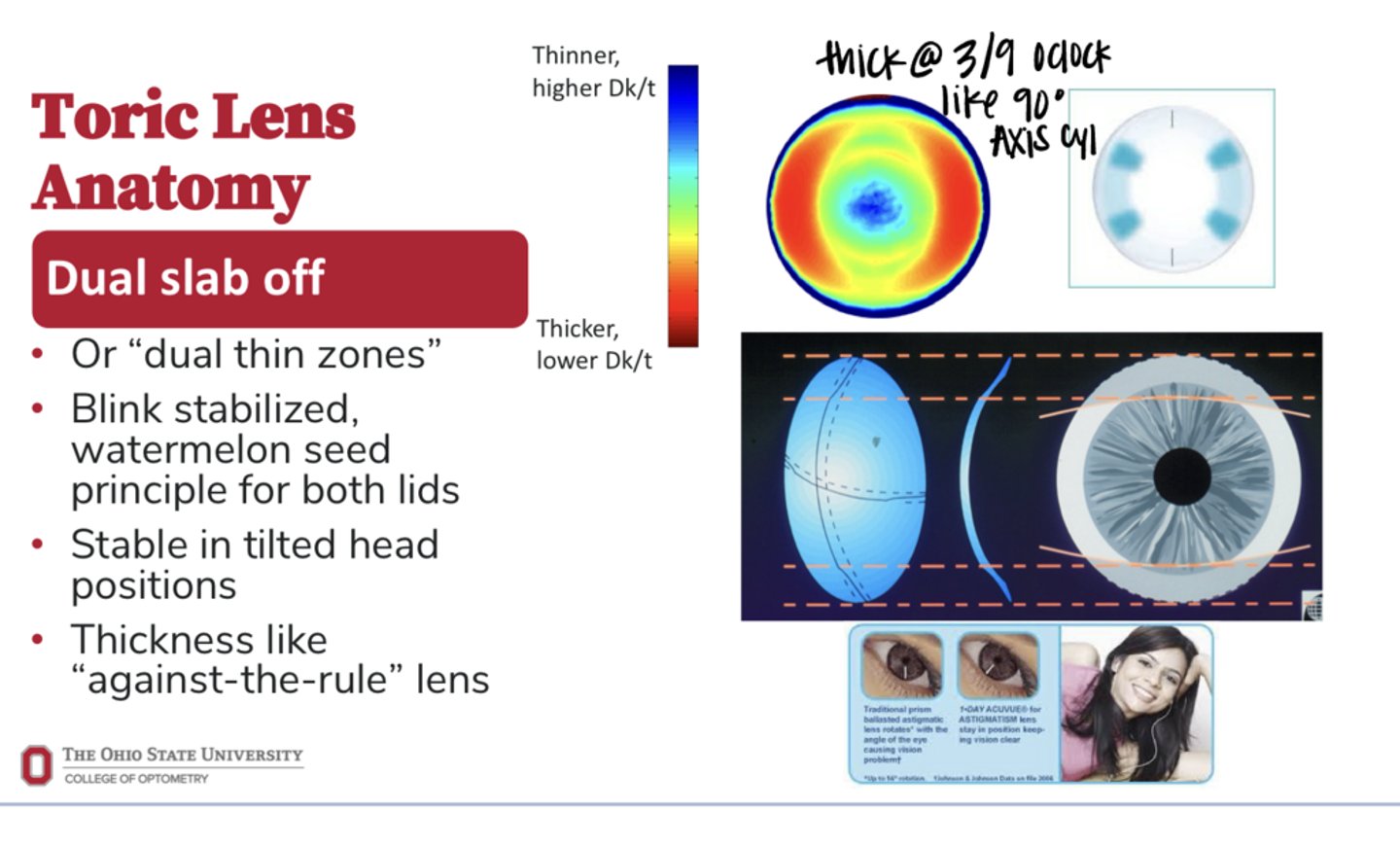
The thickness in dual slab off SCLs strategy is similar to an (ATR/WTR) lens
ATR
What are the OTHER not-yet marketed stabilization strategies for SCLs?
-truncation (not common)
-superior only lenticular, lid-attached
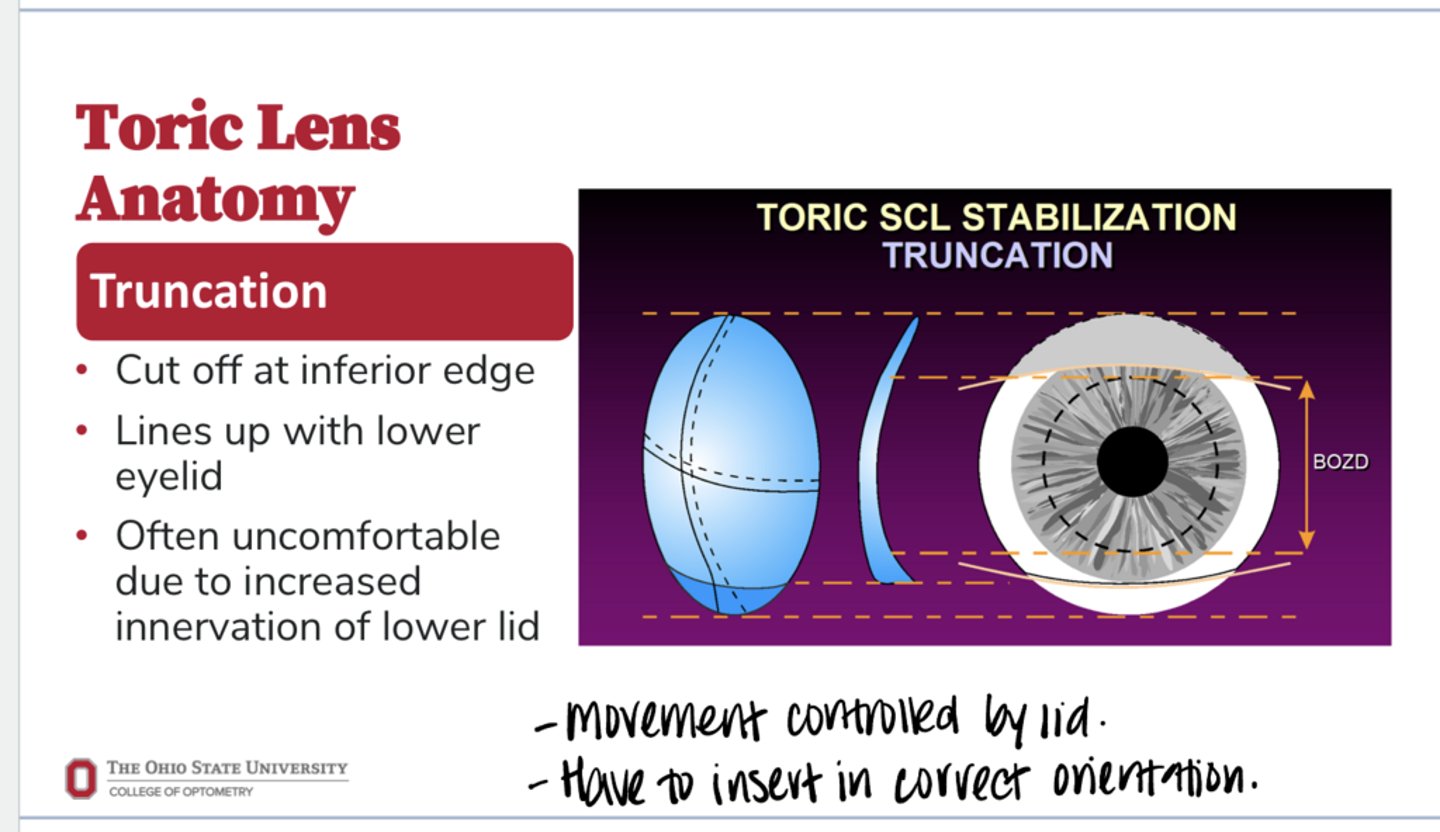
What is truncation strategy?
-cut off inferior edge of the lens
-the lens will line up with the lower lid
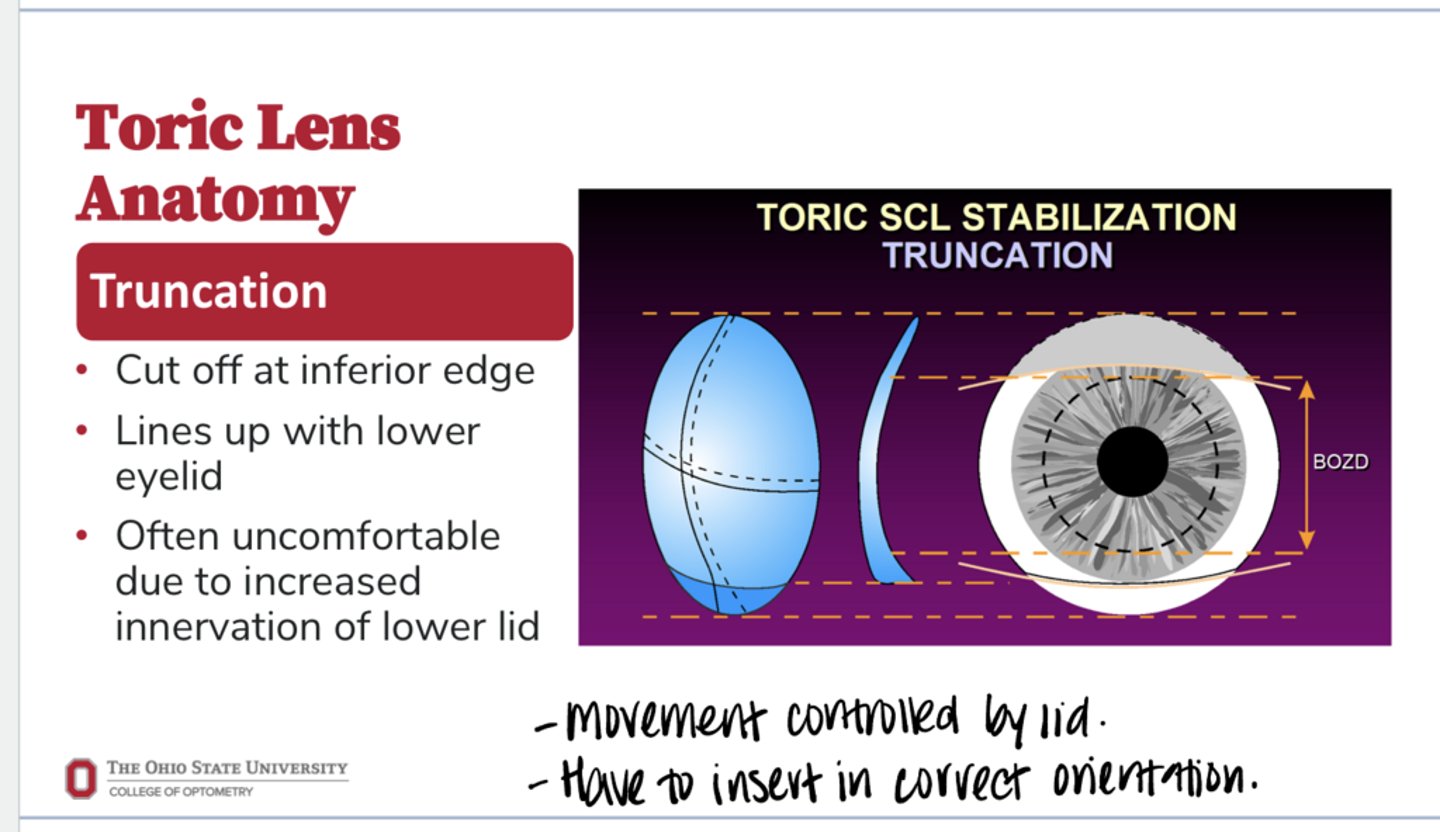
What are the disadvantages of the truncation strategy?
Often uncomfortable d/t increased innervation of the lower lid
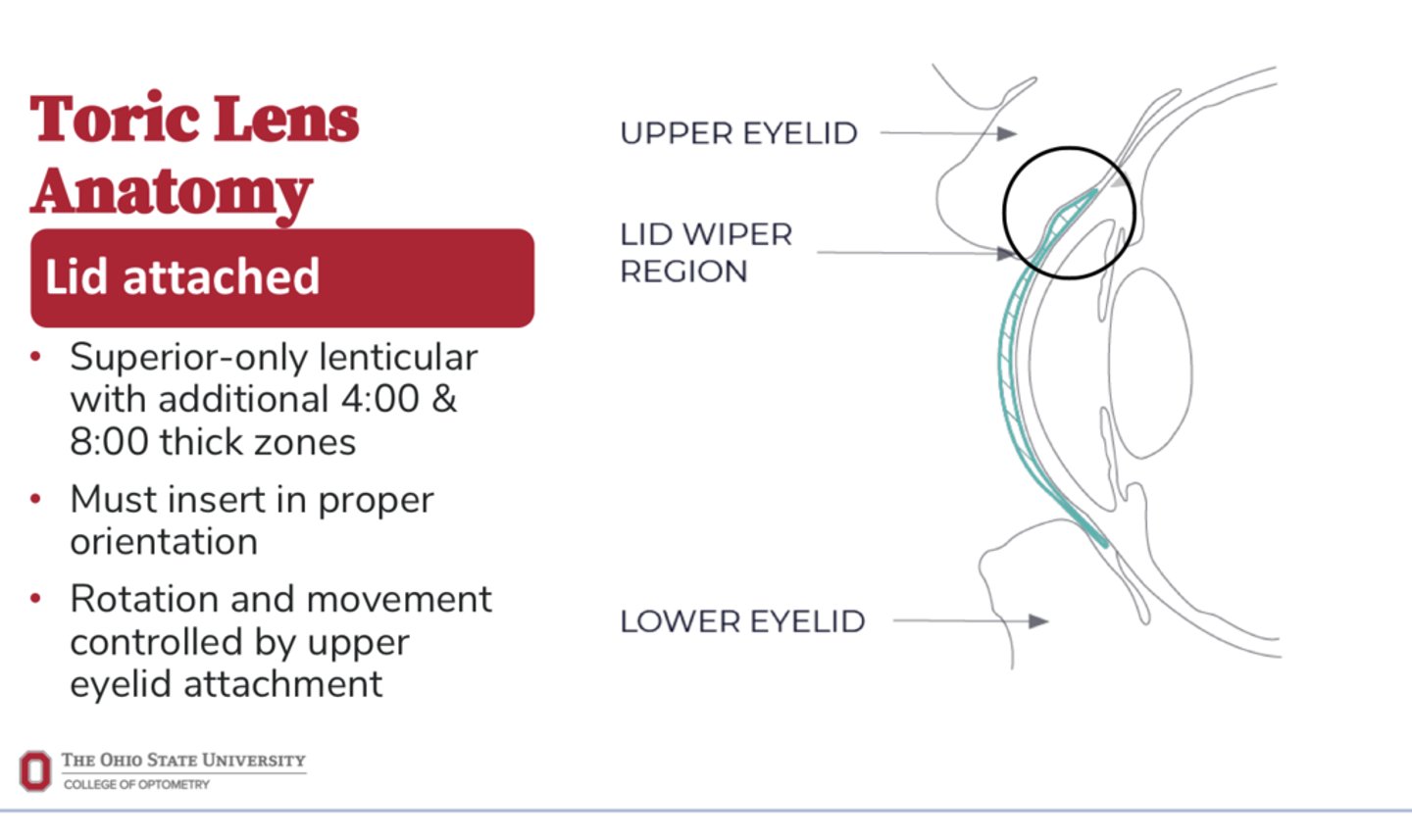
Describe a lid attached toric SCL fit strategy
-Superior only lenticular with additional 4 & 8 o'clock thick zones
-Movement of the lens is controlled by upper eyelid attachment
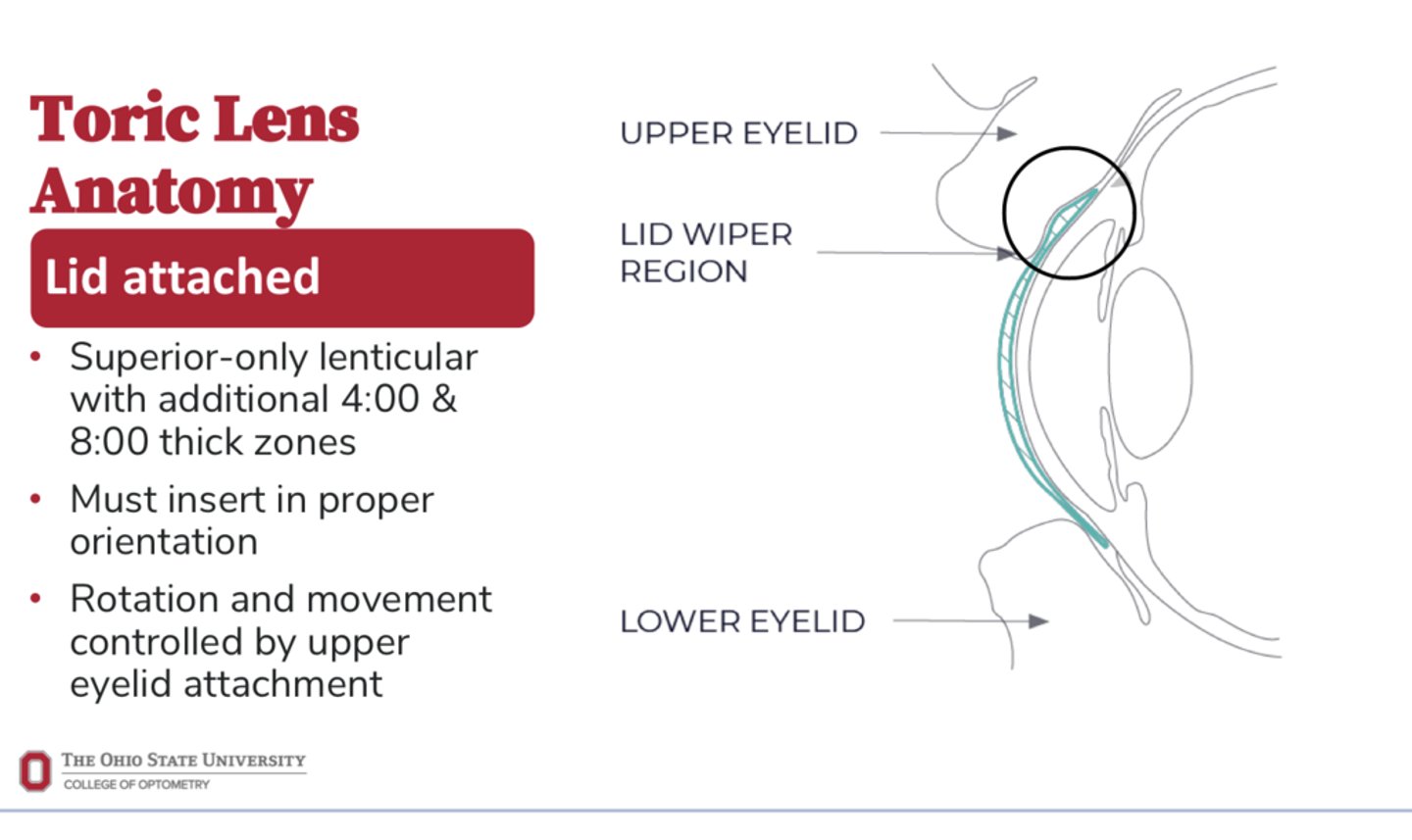
What is a disadvantage of a lid attached toric SCL fit?
must insert the CLs in the proper orientation
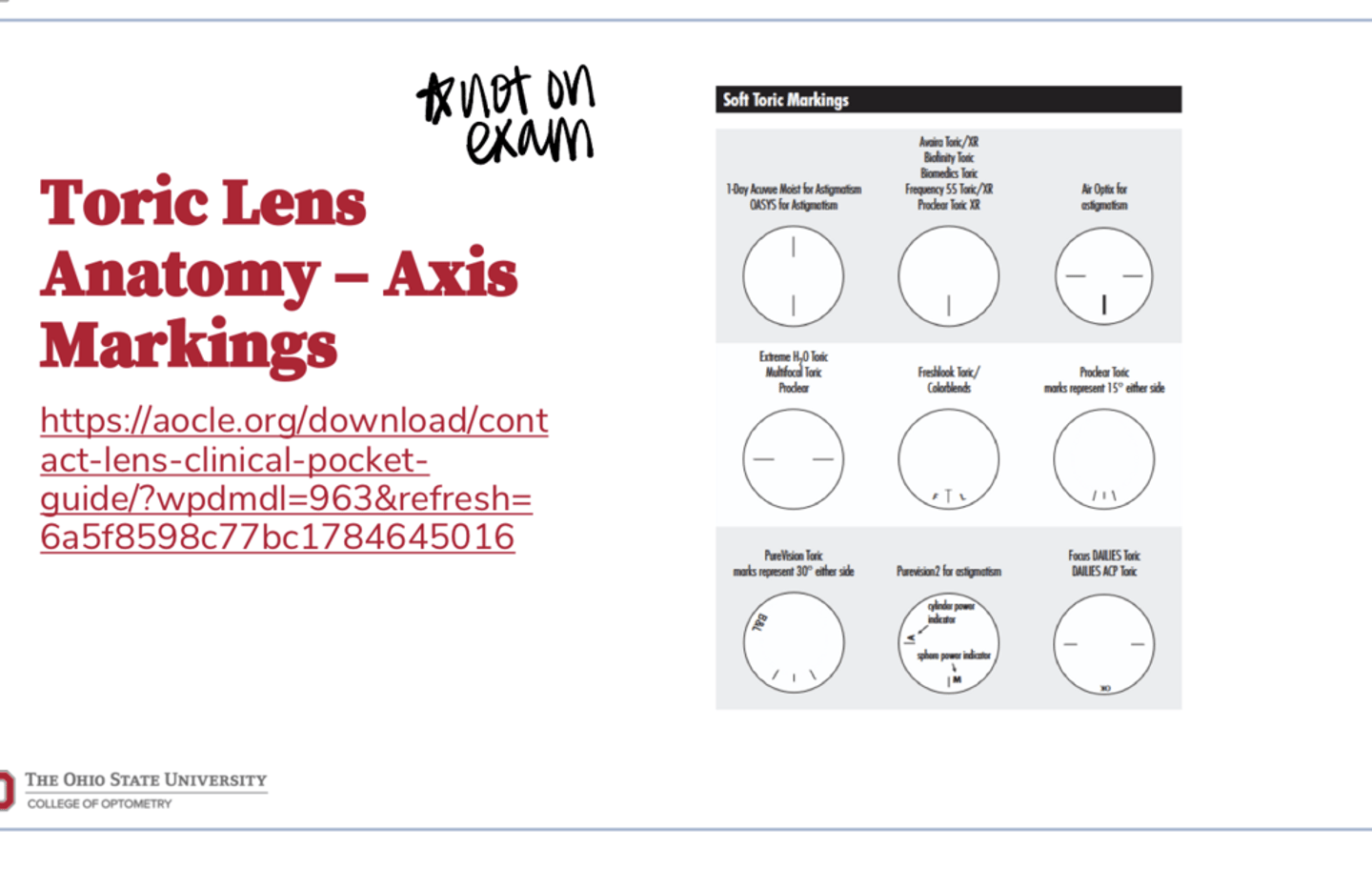
Toric Lens Anatomy -- Axis Markings (Pic)
Toric Lens Anatomy -- Axis Markings (Pic)