Peds and Neonates Exam 1
 Call Kai
 Learn
Learn Practice Test
 Spaced Repetition
 Match
Match Flashcards
 Knowt Play
1/171

There's no tags or description
Looks like no tags are added yet.
Name | Mastery | Learn | Test | Matching | Spaced | Call with Kai | Chat |
|---|
No analytics yet
Send a link to your students to track their progress
172 Terms
US population of Pediatrics
316 million pediatrics total;
Total birth age to age 19 is 26%;
Children under 1 account for 1 percent of US population but ~13% of all hospital stays, Children (0-17) are 18% of all stays;
Children deteriorate more rapidly due to less physiologic reserve
Most Common cause for Pediatric hospital admissions
Number one reason is for the Respiratory System;
Many others will likely require respiratory therapy;
Top three admission reasons are respiratory disease by principle diagnosis for pediatrics (pneumonia, bronchitis, asthma);
Top three for adults are mood/skin related;
Very/extremely preterm neonate age definiton
Moderate preterm neonate age definiton
32-36 weeks gestational age
Late preterm neonate age definition
34 0/7 to 36 6/7 weeks gestational age;
Full-term neonate age definition
38-42 gestational age;
Baby labeled as neonate for first full month of life
Infant age definition
1-12 months
Toddler age definition
12-36 months
Preschool-age child age definition
4-5 1/2 years
School-age child age definition
5 1/2- 12 years
Adolescent age definition
12-18 years
Adult age definition
>18 years
Important Pediatric growth and development info
Growth and Development start in the womb;
Growth and development are a Continous processes from conception to death;
-Requires essential elements to reach full potential (Family involvement, support, interaction with child (bonding);
Growth and Development proceed in an orderly process
This is a big ass baby
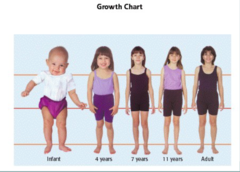
Five dimensions of Growth and Devlopment
Social;
Emotional;
Cognitive;
Physical;
Language
Rate of predictable growth stages
Different children pass through predictable growth stages at different rates;
All body systems do not develop at the same rate;
Development is cephalocaudal (head to tail) and Proximodistal (center-out)
Newborn reflexes
Must be lost before development can proceed;
Sucking;
Rooting (turn head to find nip/ 2 months);
Stepping (2 months);
Asymmetric neck reflex (5-7 months);
Grasping (palmar 5-6/Plantar 9-12);
Moro (startle) (2 months);
Growth and Development of a baby 0-1
Motor: Largely reflex
Fine motor: Keeps hands fisted; able to follow object to midline
Socialization:
Play: Enjoys watching face of primary caregiver, listening to soothing sounds
Growth and Development of a 2 month old infant
Motor: Holds head up when prone
Fine motor: has social smile
Socialization: makes cooing sounds; differentiates cry
Play: Enjoys bright-colored mobiles;
Growth and development of a 3 month old infant
Motor: Holds head and chest up when prone
Fine motor: follows object past midline
Socialization: laughs out loud
Play: spends time looking at hands or uses them as toy during the month (hand regard)
Growth and development of a 4 month old
Motor: Grasp, stepping, tonic neck reflexes are fading
Fine motor:
Socialization:
Play: Needs space to turn
Growth and development of a 5 month old
Motor: Turns front to back; no longer has head lag when pulled upright; bears partial weight on feet when held upright
Fine motor:
Socialization:
Play: Handles rattles well
Growth and development of a 6 month old
Motor: Turns both ways; Moro reflex fading
Fine motor: Uses palmar grasp
Socialization: may say vowel sounds (oh-oh)
Play: enjoys bathtub toys, rubber ring for teething
Growth and development of a 7 month old infant
Motor: Reaches out in anticipation of being picked up; first tooth (central incisor) erupts; sits unsteadily (needs support)
Fine motor: Transfers objects from hand to hand
Socialization: Shows beginning fear of strangers
Play: Likes objects that are good size for transferring
Growth and development of a 8 month old infant
Motor: Sits securely without support
Fine motor:
Socialization: Has peak fear of stranger (ability to tell known from unknown people)
Play: enjoys manipulation, rattles and toys of different textures
Growth and development of a 9 month old
Motor: Creeps or crawls (abdomen off floor)
Fine motor:
Socialization: says first word (dada, easier to say, also cooler than mom)
Play: needs space for creeping
Growth and development of a 10 month old
Motor: Pulls self to standing
Fine motor: Uses pincer grasp (thumb and finger) to pick up small objects
Socialization:
Play: plays games like patty-cake and peek-a-boo
Growth and development of a 11 month old
Motor: cruises (walks with support)
Fine motor:
Socialization:
Play: cruises
Growth and development of a 12 month old
Motor: stands alone; some infants take first nap
Fine motor: holds cup and spoon well; helps to dress (pushes arm into sleeve)
Socialization: says two words plus ma-ma and da-da
Play: likes toys that fit inside each other (pots and pans); nursery rhymes; will like pull toys as soon as walking
Physical milestones of infant
Birth to 6 months of age:
-150-210 grams (5-7 ounces) per week in weight;
-1 inch in length per months;
6-12 months of age:
-90-150 grams (3-5 ounces) per week on weight;
-1/2 pound per month
Barriers to good nutritional status in infants
poor muscle control needed for coordination of suck, swallow, and breathing;
Problems with aspiraiotn;
failure to thrive;
chronic respiratory problems;
Typical feed schedule is every 3-4 horus
Safe sleep practices of infants
No co-sleeping;
Use of sleep sack;
positioned supine;
bed is free from toys, pillows
Deformational plagiocephaly
physical condition whereby soft bones of the head become flat on the back of the head as a result of frequently laying supine for prolonged periods of time;
treated with frequent body positioning, supervised tummy time and helmet therapy for severe conditions;
Tummy time is essential for proper growth and development beginning on day one
Cognitive, sensory and langauge growth of infancy
2 months: Development of oral skills, cooing;
4 months: drooling, gumming behavior;
6 months: teeth begin to erupt, solid food introduction, babbling;
9 months: sound repetition
Motor growth of infancy
3 months: head control
6 months: sitting independently;
9 months: crawling;
12 months: walking
Growth and development of a 15 month toddler
Fine motor: Puts small pellets into small bottles. scribbles voluntarily with pencil or crayon, holds a spoon well but might still turn
Gross motor: walks alone well, can seat in chair, creep upstairs
Language: 4-6 words
Play: can stack 2 blocks, enjoys being read to; drops toys for adult to recover (exploring sense of permanence)
Growth and development of a 18 month toddler
Fine motor: no longer rotates spoon to bring it to mouth
Gross motor: can run and jump in place; can walk up and down stairs holding onto a person's hand or railing, typically places both feet on one step before advancing
Language: 7-20 words, uses jargoing names
Play: imitates house hold chores, dusting. parallel play (playing next but not with another child)
Growth and development of a 2 year old toddler
Fine motor: can open doors by turning door knobs, unscrew lids
Gross motor: walks up stairs alone still using both feet on same step at same time
Language: 50 words, 2 word sentences (noun-pronoun and verb) such as "daddy go, me come"
Play: parallel play evident
Growth and development of a 3 year old toddler
Fine motor: makes simple lines or strokes for crosses with pencil;
Gross motor: can jump down the stairs;
Language: verbal language increasing steadily. Knows full name. can name 1 color and hold up fingers to show age;
Play: spends time playing house. imitating parents actions; play is 'rough-housing' or active
Physical development of a toddler
Weight: 0.8 to 2.7 kg (4-6 pounds) per year;
Height:
-7.5 cm per year;
-Growth occurs in spurts;
-More growth in legs and trunk;
Growth cart is used to document growth so that a step-like pattern of growth can be seen
Independent walking of a toddler
1 year toddler can walk independent;
18 months attempt running, fall frequently;
2 years are walking well, mastering going up and down stairs, kicking a ball, run with fewer falls;
2.5 years can stand on one foot for a few seconds, and take a few steps on tip toe;
3 years of age: all of the mentioned skills are well-developed and smoothly completed
Cognitive, sensory, and language growth of a toddler
From 18 months to roughly 5 years of age children learn approx. 9 words a day; (63 words a week, 3,285 a year);
Exploration of environment can be hazardous:
-Choking hazards (pencils, crayons, lollipops shouldn't be in mouth while walking/playing)
Drowning in toddlers
Drowning is the leading cause of injury and death for toddlers; supervision is required around water, including bathtubs, pools, ponds, lakes, whirlpools, or the ocean;
-Swimming and water safety lessons started as early as possible
Developmental milestones of toddlers
2 years:
Fine: builds tower of 6-7 blocks;
Gross: runs well, kicks ball forward, goes up stairs one at time
3 years:
Fine: copies in a circle with crayon, can work with toys and moving parts;
Gross: climbs well, runs easily, uses stairs with one foot on each step
Growth and development of a 4 year old
Fine: Can do simple buttons
Gross: constantly in motion, jumps skips
Language: vocab of 1,500 words
Play: pretend is a major activity
Growth and development of a 5 year old
Fine: draws 6 part man, ties shoes;
Gross: throws overhand;
Vocab of 2,100 words;
Play: likes games with numbers/letters
Physical growth of a preschooler (3-5)
2-3 kg/year;
Height:
-Slower than toddler years;
-Occurs in spurts;
-Growth concentrated on long bones of the legs
Cognitive, sensory, and language growth of a preschooler
Inquisitive and interested in learning about individuals outside of the frailly (gender roles, norms);
Injury risk associated with exploring their environment:
-(accidental trauma);
Complex language and learning skills (1800 words in vocab);
Social growth of pre-schooler
Mastery and control of their environment;
Develops self-control behaviors;
Empathetic;
More fearful (view illness as punishment);
Engage in coop, imaginative, and symbolic play
Development of a 6 year old
Physical: A year of constant motion: skipping is a new skill, first molars erupt
Psychological: first-grade teacher becomes authority: adjustment to all day school may be difficult and lead to nervous manifestations of fingernail biting. Defines words by their use is to unlock a door, not a metal object;
Development of a 7 year old
Physical: Central incisors erupt: difference between sexes is apparent (video games vs dolls): spends time in quiet play;
Psychological: A quiet year, striving for perfection leads to this being an eraser year. Conservation (water from tall glass same as short wide glasses) is learned. Can tell time, make change
Development of a 8 year old
Physical: Coordination definitely improved; playing with gang becomes important; eyes become fully developed;
Psychosocial: "best friends" develop; whispering and giggling begin; can write as well as print; understands concepts of past, present, and future
Development of a 9 year old
Physical: all activities done with gang
Psychological: gang age; 9-year old club is formed to spit someone, secret codes; all boy or all girl; gangs disband and reform quickly;
Development of a 10 year old
Physical: coordination improves
Psychological: ready for camp away from home, collecting age; likes competition
Development of 11 year old
Physical: active but awkward and ungainly
Psychological: insecure with members of opposite sex, repeats off color jokes
Development of 12 year old
Physical: coordination improves even more
Psychological: a sense of humor is present, is social and cooperative
Development of Secondary Sex characteristics in Boys
9-11: Prepubertal weight gain occurs;
11-12:
-Sparse growth of straight downy, slightly pigmented hair at base of penis;
-Scrotum becoming textured, growth of penis and testis begin;
-Sebaceous gland secretion increases (incr. perspiration);
12-13:
-Pubic hair across pubis;
-Penis lengthens;
-Dramatic linear growth spurt;
-Breast enlargement occurs
Development of secondary sex characteristics in girls
9-11: Breasts: elevation of papilla with breast bud formation; areolar diameter enlarges;
11-12:
-Straight hair along the labia, vaginal epithelium becomes confines;
-pH of vaginal secretions acidic; slight mucous vaginal discharge present;
-Perspirations increases;
-dramatic growth spurt;
12-13
-Pubic hair grows darker, over entire pubis;
-breasts enlarge
-axillary hair present;
-Menarche occurs
Physical growth of school age middle childhood
Rates differ according to gender and ethnicity;
-Girls grow more rapidly
-Develop their secondary sexual characteristics from 9 to 13;
-Boys develop with a lag of 2 years;
Awareness of physical body changes
Cognitive, sensory, language growth of school age middle childhood
Find their place in world, explore future;
Engage in team play;
Seek acceptance;
Interested in collections:
-Awareness of physical and socioeconomic differences in peer group (non-adherence of medical plan/ victims of bullying)
Social growth of school age middle childhood
Desire success;
development of concrete thought processes (reasoning, fears, misconceptions);
longer separation form caregivers;
attentiveness;
understands morals and relationships
Sexual maturation in male adolescents
15: Growth spurt continues, axillary hair present; facial hair fine and downy; voice changes with annoying frequencies;
16: Adult genitalia: pubic hair abundant and curly; sperm production mature;
17: pubis hair may extend to medial aspect of thighs; some degree of facial acne, enlarged breast tissue fades;
18: end of skeletal growth
Sexual maturation in female adolescents
15: Pubis hair triangular in distribution; breast areola and papilla form secondary mound; menstruation is ovulatory (pregnancy possible);
16: Pubis hair may extend to medial aspect of thighs; may have some degree of acne;
17: end of skeletal growth
Physical growth of adolescents
Puberty begins (hormones influence growth);
-Increase in muscle mass;
-General body development (nutritional status);
-Reproductive system
Cognitive, social, and emotional growth of an adolescents
Establishment of sexual identity;
Development of romantic relationships;
Exploration with sexual activity;
Experimentation with recreational substances (tobacco, alcohol, weed)
Effect of hospitalization on growth and developmental needs
May experience lapses or regression of development:
-socialization may be limited (emotional);
Pain can impede childhood development
Supporting a the child and family's needs through family centered care
Address the child and family as a cohesive unit;
Communicate clearly and openly;
Engage the family in Childs medical care;
Incorporate family's beliefs and values into medical decision making;
Anatomic Differences of Airways
Natural and artificial airways are significantly smaller (more easily obstructed by secretions, blood, edema, and foreign bodies);
Increased resistance to flow (Poiseulle's Law)
"Resistance to flow varies inversely by the 4th power of the radius";
-Adult radius has a 2.4x resistance, Infant has a 16x resistance in airway
Difference of Lymphoid tissue and tongue
Lymph tissue and tongue proportionally large in infants and pediatrics
Difference of Larynx
Pediatric and infants larynx more anterior than adults;
Epiglottis is stiffer and "U" shaped
Level of Glottis at different ages
Adults C5-6;
Children C3-4;
Infants C1-2;
Difference in trachea
Infant trachea is funnel shaped (Narrowest at cricoid/below the vocal cords);
Adult is tubular shaped (narrowest at cords/glottis)
Indepth look of Infant/Toddler Trachea
Softer than adults;
Cartilage/rings not yet formed;
Succumbs to pressure;
Cricoid membrane small-to-nonexistent;
Collapses in response to negative pressure;
Shorter making accidental extubation or right main-stem intubation more likely
Level of Carina at different ages
Adults T-6;
Infants T-3
Implications for intubation
Infant occiput (back of skull) is proportionately larger than in adults;
May need "Sellick maneuver/cricoid pressure" and/or straight laryngoscope to improve visualization;
Right mainstem intubation more likely;
larger tongue and lymph tissue impinges on airway, trauma more likely;
Cuffed tubes and narrow airways increase resistance to flow, increase WOB, non-cuffed airways may be preferred;
More difficult to visualize epiglottis;
Shorter trachea makes tube misplacement more likely
Lung growth in peds
Continues postnatally until approximately 8-12 years of age;
Born with approx. 30-50 million alveoli;
Adults estimated 500 alveoli;
Number of alveoli increases 10-20 times between birth and adulthood;
Infant alveoli shallow, thicker membranes and no pores of khon
The physiologic differences of cartilage
Infant cartilage is very soft in comparison to adults;
Allows the thorax and trachea to collapse when negative intrathoracic pressure is present;
Causes retractions, stridor, "see-saw breathing"
Diaphragmatic breathing
Pediatric patients are dependent on diaphragmatic breathing;
Accessory muscles not efficient or strong;
Ribs more horizontal, don't increase thoracic size much;
large abdomen
Metabolic demand
Metabolic rate is higher in infants and children;
Metabolic rate peaks during growth spurts (0-18 months and puberty);
-Basal oxygen requirements for adults (3 ml oxygen/kg/min);
-Basal oxygen requirements for infants (6 ml oxygen/kg/min);
Pulmonary reserve in infants/peds
Infant and pediatric response to need for increased minute ventilation;
-Increase in respiratory rate (not as efficient as increase in Vt because deadspace has to be ventilated with each breath);
-Adults tend to increase Vt, which decreases the proportion of deadspace ventilation, and is more efficient;
-Adding mechanical deadspace has a much greater impact on breathing for infants and children;
Increase in negative inspiratory pressure during respiratory distress causes ribcage to collapse, further decreasing Vt in infants and small children
The addition of 10 mL of mechanical deadspace in both adults and infants
Adults: Adult weight 150 lbs x 1 ml/lbs = 150 ml anatomical Vd;
-10ml/150ml = 6-7% increase;
Infants: Infant weight 10 lbs x 1 ml/lbs = 10 ml anatomical Vd;
-10 ml/10 ml = 100% increase
RTs working in pediatrics
Pediatric patients have less cardiopulmonary reserve, they progress from slight distress to full blown code very quickly (need to respond quickly);
RTs should be able to assess the need for the patient to be transported to specialty pediatric hospitals;
Assumptions in Family-Centered care
Family is a constant in a child's life;
Illness can affect the entire family;
Respectful, trusting partnership between the child's family and healthcare professionals is important;
Decisions of plan of care is collaborative with child, family, and healthcare team
The Hospitalized Infant
Effect of hospitalization:
Disrupts normal routine:
-Fussiness;
-Feeding difficulties;
-Disrupted sleep;
Separation from familiar caregivers:
-Compromises trusting relationship building
Needs during hospitalization:
-Continuity of direct caregivers (RNs/RTs);
-Maintain similar schedule to home;
-Use of developmentally appropriate toys and comfort items;
-Family/caregiver participation in care;
-Safe Sleep practices
The Hospitalized Toddler
Effect of Hospitalization:
Frustration:
-Temper tantrums;
-Regression in skills that they have recently mastered, such as potty training;
Stranger Danger
Needs during hospitalization:
-Use of simple language when explaining care/procedures;
-Providing choices;
-Safe place to play;
-Use of simple language when explaining aspects of care or procedures
Phases of Separation between child and caregivers
Protests (clings to caregiver/ pulls away from stranger);
Despair (sad, lonely, doesnt engage in play);
Depression and Greif;
Detatchment
The Hospitalized School Age child
Effect of Hospitalization: Better able to adapt if family is not present;
-Fear (fitting in with peers);
Needs during hospitalization:
-Provide time to play/socialize
-Offer choices;
-Explain care
The hospitalized adolescent
Effect of hospitalization:
-Frustration (dependence on family/Separation);
-Fear (Illness/Hospitalization affecting identity);
Needs during hospitalization;
-Respect of privacy;
-Provide opportunities to ask questions;
-Enable patient to actively participate in care-based decisions;
-Visitation time with friends and family
Reaction to Hospitalization
-Loss of control/autonomy;
-disruption of routine;
-Physical stressors (pain, immobility, changes in diets, sleep deprivation);
-Environmental Stressors (unfamiliar surroundings, people, constant lights, other patients);
-Psychological Stressors (lack of privacy, inability to communicate/knowledge, severity of illness, Parental behavior);
-Social Stressors (disruption of family/school routines, friend/family relationships, financial impact)
Needs of the Family
Information (Diagnosis, Plan of Care, Discharge Goals);
Accommodations (Meals, showers, laundry facilities)'
Reassurance and support (caregivers that listen, resources for stress, anxiety);
Communication (speak at family's level of understanding/honesty (preserving hope)
Supporting Siblings
Factors influencing a siblings response to hospitalization:
-Age;
-Developmental level;
-Nature of Hospitalization;
Common Responses:
-Anger;
-Jealously;
-Sadness;
How to help:
-Staying in family home;
-Maintaining school schedules;
-Engage with child life assistance (have sibling ask questions/talk about feelings);
-Provide opportunities for sibling to assist with tasks
Child Life Specialists
Help families cope with medical experiences (hospitalizations, diagnoses, devices);
Activities used to help coping (preparation, education, animal-assisted therapy, memory-making);
Animal-Assisted therapy (reduces fear, facilitates recovery, improved mood and engagement with medical plan)
Safety First in Care
Do least painful and invasive procedures first;
Standard Precautions;
Prevent falls (lock wheels, bed rails up);
Prevent choking, strangulations of cords);
Always keep one hand in contact with infant when reaching behind;
Remove all wrappers, bags, vials and careful placement of oxygen tubing;
Restriants
Papoose (wraps);
Limb;
Jacket (wheelchair);
Elbow (infants/toddlers);
Mummy restraint (swaddling);
Manual restraints (giving oral/aerosol meds, MDI with mask, CPT);
Three variables that will affect FiO2 available in an oxygen enclosure
flowrate of oxygen;
volume of enclosure;
Seal (how well tucked/sealed up/often opened for care);
What FiO2 would you recommend an infant in an isolette also use a hood to prevent fluctuation in the amount of oxygen available to the infant
40% or greater
Documentation of Hypoxemia
Infant (>28 days old) and child:
-PaO2
Complications of excessive oxygen use
Retinopathy of Prematurity;
Hypoventilation (chronic lung disease involvement like CF and BPD);
Atelectasis;
Pulmonary Vasodilation
Nasal Oxygen
Nasal Catheter:
Suggested flow 0.2-1 LPM;
Approx. FiO2 .24-.35
Nasal Cannula:
Suggested Flow:
-Infant 0.2-2 LPM;
-Pediatric 0.5-4 LPM;
Approx. FiO2 0.21-0.5
Oxygen Masks
Simple Mask:
-Infant 5-8 LPM
-Pediatric 5-10 LPM
Approx. Flow: 0.35-0.5;
Partial Rebreather:
10-12 LPM;
Approx. Flow 0.6 and up;
Non-rebreather;
10-15 LPM;
Approx. 0.8 and up;
Air entrainment;
Total flow to exceed patient insp. flowrate;
0.24-0.5
LVN with mask or trach collar:
Total flow to exceed pt. insp flowrate;
0.21-1.0