Ch 6 Interactions Between Cells - Lecture cards.
 Call Kai
 Learn
Learn Practice Test
 Spaced Repetition
 Match
Match Flashcards
 Knowt Play
1/135

There's no tags or description
Looks like no tags are added yet.
Name | Mastery | Learn | Test | Matching | Spaced | Call with Kai | Chat |
|---|
No analytics yet
Send a link to your students to track their progress
136 Terms
What is diffusion?
The movement of molecules from an area of high concentration to an area of low concentration.
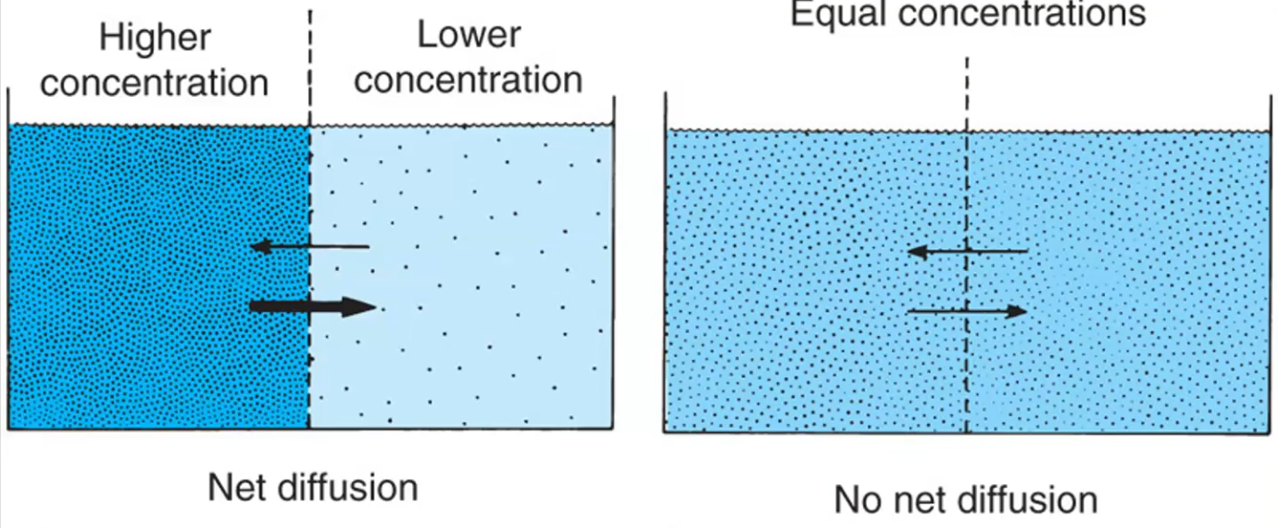
Does diffusion require energy?
No — diffusion is passive; no energy is needed.
What is the overall function of the plasma membrane?
It regulates what enters and exits the cell.
What direction is "net movement" in diffusion?
From the region of high concentration to the region of low concentration until equilibrium is reached.
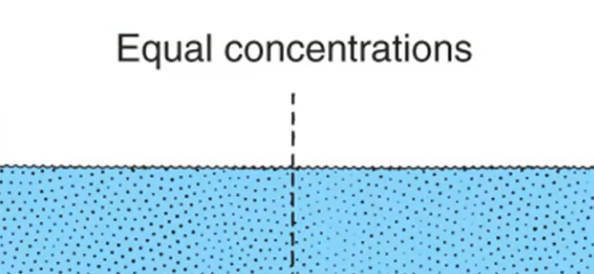
True or False: At equilibrium (equal concentrations), all molecular movement stops.
False — molecules continue moving in both directions equally; only the net movement stops.
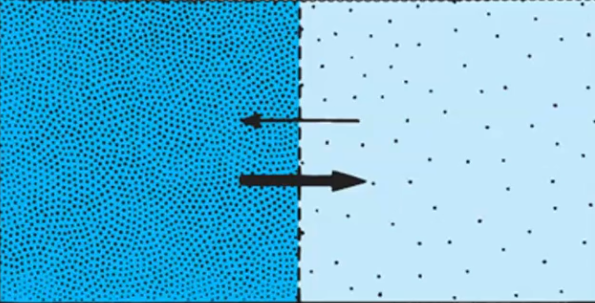
In a diffusion diagram, if the arrow pointing A→B is thicker/darker than B→A, what does this indicate?
More net movement is occurring from A to B — this is the direction of net diffusion.
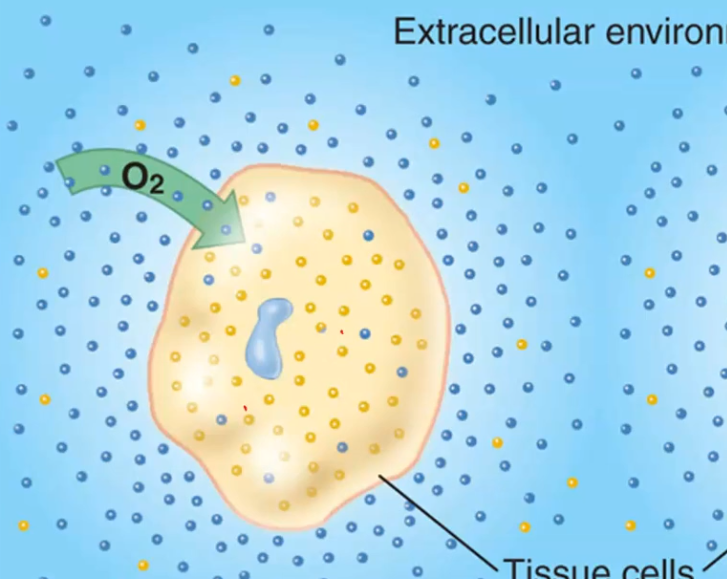
Why does O2 move into the cell?
Because O2 concentration is higher in the extracellular environment than inside the cell (high → low).
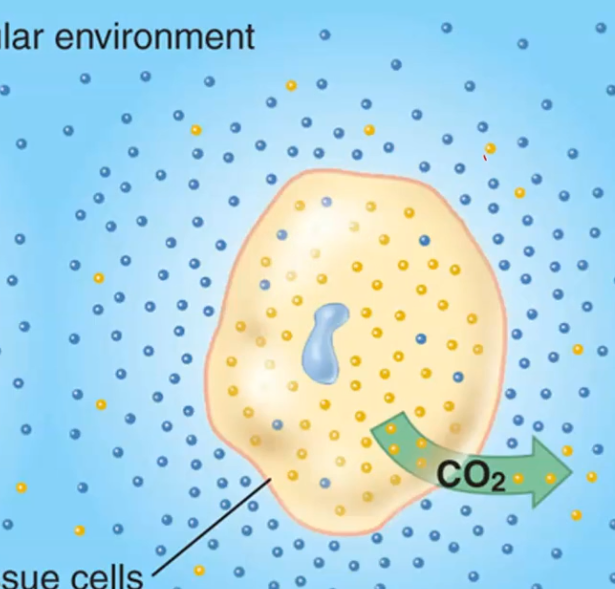
Why does CO2 move out of the cell?
Because CO2 concentration is higher inside the cell than in the extracellular environment (high → low).
What happens when a molecule has a concentration gradient favoring diffusion, but it's too large to pass through the membrane's pores?
The molecule cannot diffuse across, even though it "wants to" — the membrane physically blocks it, preventing movement despite the gradient.
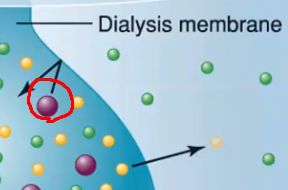
In the dialysis membrane example, why can't the protein exit the artificial cell even though its concentration is higher inside?
The protein molecule is too large to fit through the tiny holes of the dialysis membrane.
What are the factors that affect the rate of diffusion? (5)
Concentration gradient: bigger difference = faster diffusion
Membrane permeability: easier passage = faster diffusion
Temperature: more heat = faster molecule movement
Surface area: more membrane space = faster diffusion
Molecule size: smaller = faster diffusion
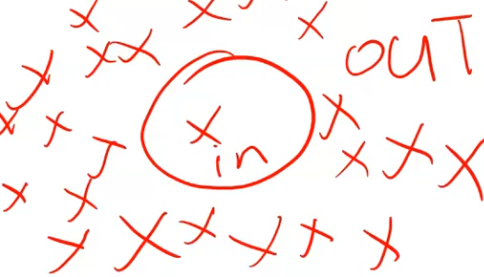
How does the magnitude (steepness) of a concentration gradient affect the rate of diffusion?
The steeper/larger the concentration gradient, the faster the rate of diffusion.
in this case, more X’s outside (steeper magnitude) = faster and higher rate of diffusion.
What are the three factors that affect diffusion rate that are independent of the cell?
Concentration gradient.
Temperature.
Size (of the molecule).
How does increasing temperature affect the rate of diffusion?
It increases the rate of diffusion.
What is the relationship between temperature and rate of diffusion?
Directly proportional — as temperature increases, diffusion rate increases; as temperature decreases, diffusion rate decreases.
How does the size of a molecule affect its rate of diffusion?
Inversely — the larger the molecule, the slower the rate of diffusion.
The smaller the molecule, the faster the rate of diffusion.
Why does molecule size affect the rate of diffusion?
Larger molecules interact more with their environment and generate more friction, which slows movement; smaller molecules generate less friction and move faster.
What are the two factors affecting diffusion rate that are controlled by the cell membrane (not cell-independent)?
Permeability of the membrane and surface area of the membrane.
What does it mean for a membrane to be "permeable" to a molecule?
It means the membrane allows that molecule to pass through it.
How does membrane permeability affect the rate of diffusion?
Directly — the more permeable the membrane is to a molecule, the faster the rate of diffusion; the less permeable, the slower the rate of diffusion.
How does surface area of the cell membrane affect the rate of diffusion?
Directly — the greater the surface area, the faster the rate of diffusion; the smaller the surface area, the slower the rate of diffusion.
In the columnar cell example, why does the cell with microvilli (Cell 2) have a faster rate of diffusion than the cell without microvilli (Cell 1)?
Microvilli increase the surface area of the cell membrane, and more membrane surface area allows molecules to diffuse in faster.
So technically the more surface area = the more space for diffusion = the higher rate of diffusion because more molecule can enter at a time
Summarize the 5 factors affecting rate of diffusion and their relationships:
Factor | Cell-dependent? | Relationship to diffusion rate |
|---|---|---|
Magnitude of concentration gradient | No | Gradient ↑ → Diffusion ↑ |
Temperature | No | Temp ↑ → Diffusion ↑ / Temp ↓ → Diffusion ↓ |
Size of molecule | No | Size ↑ → Diffusion ↓ (inverse — friction) |
Permeability of membrane | Yes | Permeability ↑ → Diffusion ↑ |
Surface area of membrane | Yes | Surface area ↑ → Diffusion ↑ (e.g., microvilli) |
What does it mean that the plasma membrane is "selectively permeable"?
It means the membrane allows certain molecules to cross while preventing others from crossing.
Is the plasma membrane a barrier to lipid molecules?
No — lipids can cross the membrane freely as long as there is a concentration gradient.
Is the plasma membrane a barrier to non-lipid molecules?
Yes, generally — unless the molecule meets two criteria: it is both small AND uncharged (no positive or negative charge).
What are the two main categories of movement across the plasma membrane?
Carrier-mediated transport and non-carrier mediated transport.
What is a "carrier" in the context of membrane transport?
A helper protein that allows molecules to cross the membrane.
Which molecules need a carrier to cross the membrane?
Molecules that are not permeable to the membrane (not a lipid, and not both small and uncharged).
Which molecules do NOT need a carrier to cross the membrane?
Molecules that are permeable to the membrane (lipids, or small uncharged molecules).
What is non-carrier mediated transport?
Movement of molecules across the membrane by diffusion, without needing a helper protein (carrier).
In the example where molecule X is a lipid with higher concentration outside the cell, which direction does it move and by what mechanism?
It moves into the cell (down its gradient) via simple diffusion, since lipids don't need a carrier to cross the membrane.
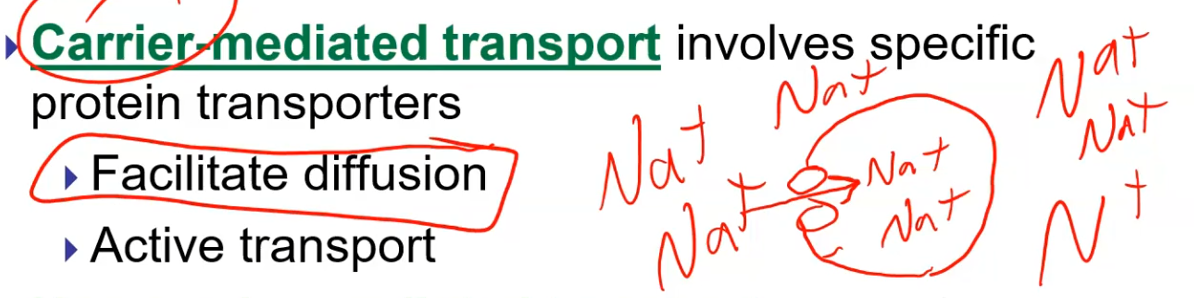
What is facilitated diffusion?
A type of carrier-mediated transport where a charged or non-permeable molecule moves across the membrane, down its concentration gradient, with the help of a specific transmembrane protein.
No energy required because it’s still going high → low.
What is active transport?
The movement of molecules against their concentration gradient (from low to high concentration), which requires energy in the form of ATP.
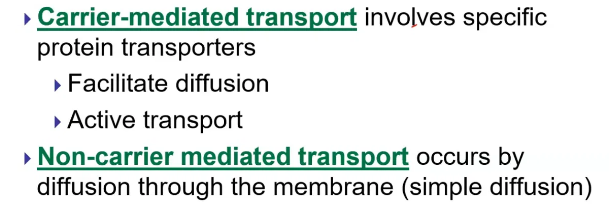
Is there always more sodium outside or inside the cell?
Always more sodium outside the cell than inside (memorize this fact).
Is there always more calcium outside or inside the cell?
Always more calcium outside the cell than inside (low concentration inside).
What is a "pump" in the context of membrane transport?
A carrier protein that moves a specific molecule against its concentration gradient (low to high), using energy (ATP).
Each molecule has its own pump.
Why does moving a molecule against its concentration gradient require energy, while moving it down the gradient does not?
Moving from high to low concentration is a passive/spontaneous process (no energy needed)
—
But moving from low to high concentration goes against the natural tendency of molecules, so energy (ATP) must be invested.
Under which broad category (carrier-mediated or non-carrier mediated) does active transport fall?
Carrier-mediated transport.
What's the difference between carrier-mediated and non-carrier mediated transport?
Carrier-mediated: (protein required)
Facilitate diffusion: (Occurs when a molecule isn't small or has a charge so it needs a protein carrier to cross the plasma membrane.
^ This requires a protein but no ATP.
Active transport: Active transport is when a molecule is going from low to high concentration using a protein (against the gradient) and to do that it requires ATP.
—
Non-carrier mediated:
Simple diffusion: Occurs when a molecule meets the requirements (small and uncharged, or is a lipid) so the plasma membrane isn’t a barrier to it.
What is osmosis?
The diffusion of water across a selectively permeable membrane, from high water concentration to low water concentration.
Where is water concentration lower — in areas with more solute or less solute?
Areas with more solute (solute takes up space, leaving less room for water).

What does it mean for a solute to be "osmotically active"?
If diffusion cannot occur across a semipermeable due to size or other factors, osmosis occurs until solutes are equal on both sides.
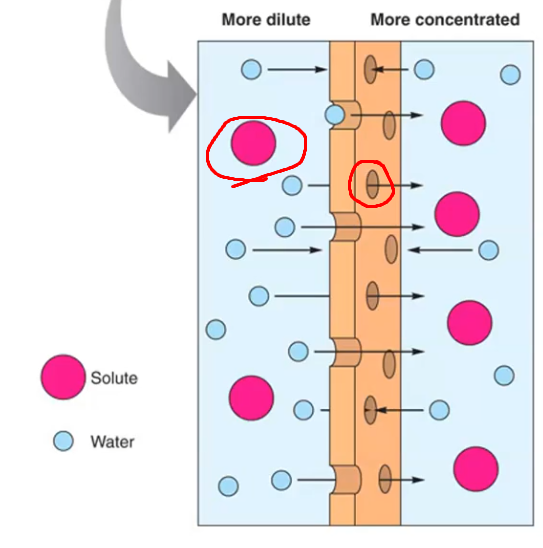
What is the key rule of thumb for predicting the direction of osmosis?
"Water follows solute" — water moves toward the side with more solute.
If there’s more solute on the right, water will go from left to right (osmosis)
When does net osmosis stop?
When the solute concentration becomes equal on both sides of the barrier.
Why can't water cross the plasma membrane directly on its own?
Because water is a polar molecule (has a charge), so the plasma membrane acts as a barrier to it.
How does water normally cross the plasma membrane if it's polar and can't cross directly?
Through water channels called aquaporins.
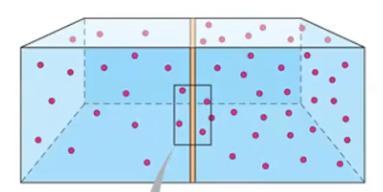
Which way does water go?
So the left side has more water because it has more room for water and less solute, the right side has more solute but has less room for water therefore less water, now first thing that will happen is diffusion will try to occur from right to left (solute) then if that doesn't happen osmosis will occur from left to right.
Remember water follows solute as in: water will go towards the side that has more solute.
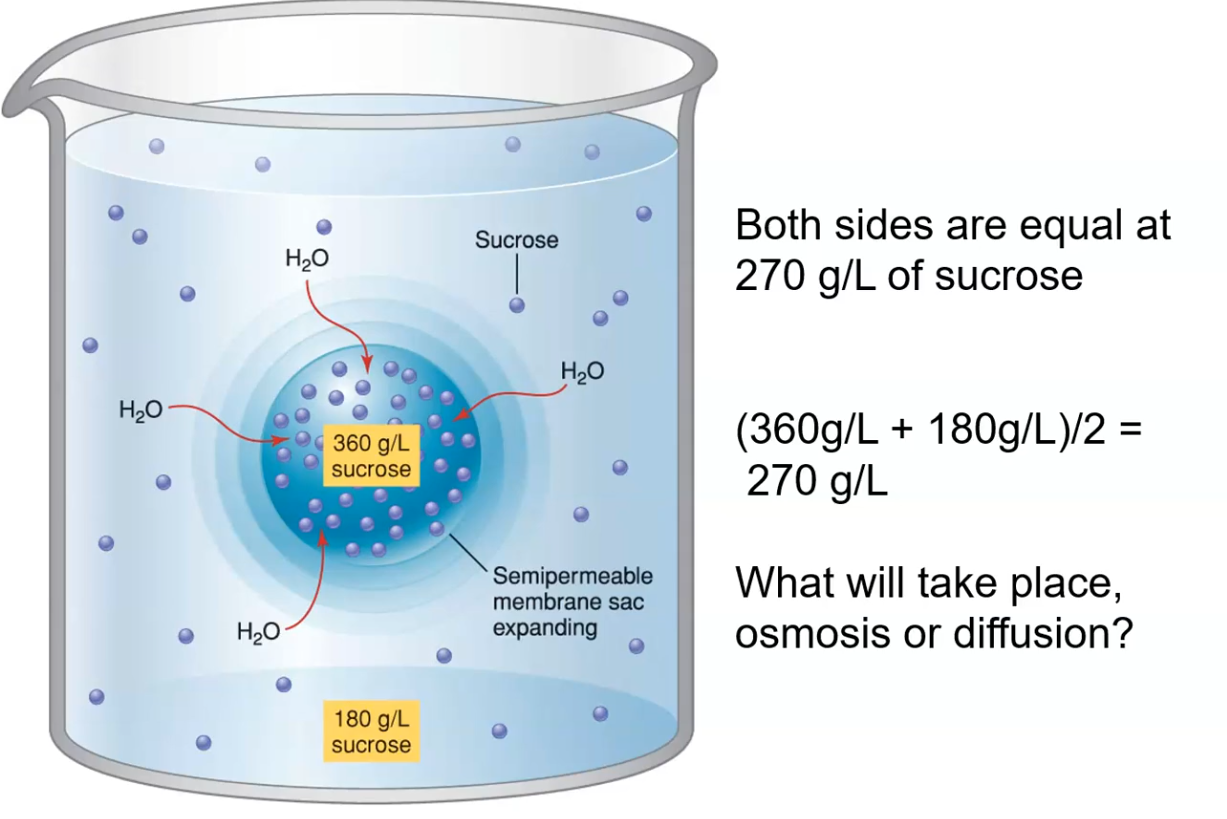
What happens when a sac with 360 g/L sucrose is placed in 180 g/L sucrose solution, separated by a semipermeable membrane?
Process: Osmosis (not diffusion — that's for solutes)
Direction: Water moves into the sac, from low sucrose (180 g/L) → high sucrose (360 g/L)
Why: Water moves toward the side with higher solute concentration to equalize it
Result: Both sides reach equilibrium at 270 g/L
Why sucrose can't move: Membrane pores are too small for sucrose molecules — only water is small enough to cross
When does water stop entering the cell in the sucrose/osmosis example?
When sucrose concentration becomes equal inside and outside the cell (equilibrium).
What is osmotic pressure?
The force that would need to be applied to stop osmosis from happening.
How bad water wants to move into a concentrated solution.
What is osmotic pressure proportional to?
Solute concentration — the more solute, the higher the osmotic pressure.
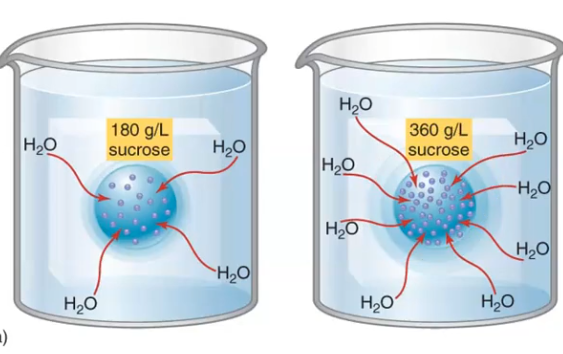
In the sucrose example (180 g/L vs. 360 g/L), which beaker has higher osmotic pressure, and why?
The 360 g/L beaker — it has a greater concentration gradient, so more water wants to enter to dilute it, requiring greater force to stop osmosis.
What is molecular weight?
The sum of the atomic weights of all atoms in a compound.

What is the molecular weight of glucose (C6 H12 O6)?
C6: 6 × 12 = 72
H12: 12 × 1 = 12 -→ 72 + 12 + 96 = 180 molecular weight.
O6: 6 × 16 = 96

Why is the molecular weight of sucrose 342 and not 360? (C6 H12 O6)
Sucrose is glucose + fructose joined by a dehydration reaction, which removes one water molecule (MW 18), so 180 + 180 − 18 = 342.
What is Avogadro's number?
6.02 × 10²³ =
How do you determine how many grams of a compound equal 1 mole?
Take the molecular weight of the compound and measure that same number out in grams.
How many grams of glucose equal 1 mole?
180 grams.
How many grams of sucrose equal 1 mole?
342 grams.

Can you calculate NaOH molecular weight for 1 mole?
The formula:
Molecular weight = Σ (atomic weight of each element × number of atoms of that element)
Na (sodium): 22.99 × 1 = 22.99
O (oxygen): 16.00 × 1 = 16.00
H (hydrogen): 1.01 × 1 = 1.01
Molecular weight = 22.99 + 16.00 + 1.01 = 40 (So 40 grams of NaOH = 1 mole).
What is molarity?
A measure of solute concentration — 1 molar solution (1.0M) = 1 mole of solute dissolved in a total of 1 liter of solution.
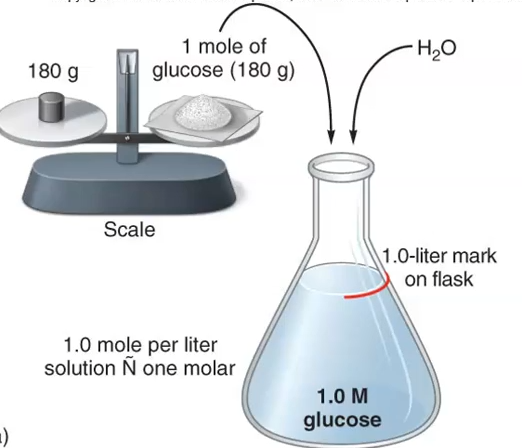
In a solution, what is the solute vs. the solvent?
Solute = sugar (the thing being dissolved)
Solvent = water (the thing doing the dissolving)
Solution = sugar water (the combined mixture of both)
How do you make a 1 molar (1.0M) glucose solution?
Add 180g of glucose (1 mole) to a flask, then add water only up to the 1-liter mark (not a full liter of water).
What is molality?
A measure where 1 molal solution (1.0m) = 1 mole of solute dissolved in exactly 1 liter (1 kg) of water/solvent.
How do you make a 1 molal glucose solution?
Add 180g of glucose (1 mole), then add a full 1 liter (1 kg) of water — regardless of the total final volume.
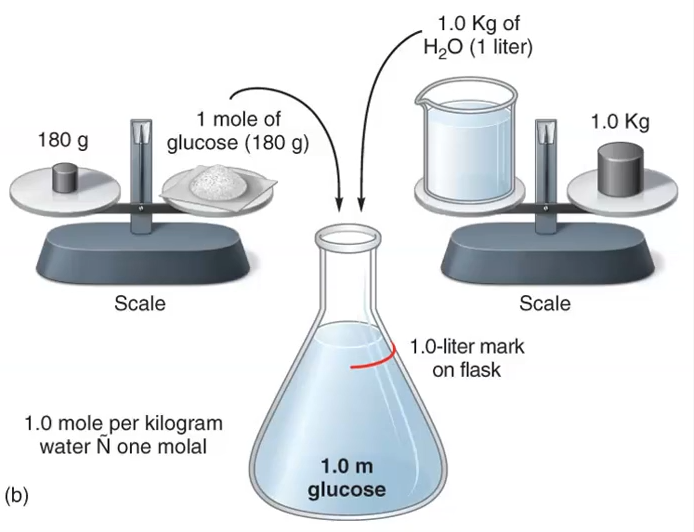
What is the key difference between molarity and molality in terms of how the solution is made?
Molarity: water is added only up to a total volume of 1 liter (exact water amount unknown).
Molality: exactly 1 liter (1 kg) of water is added regardless of total final volume (exact water amount known).
Why is molality preferred over molarity in biological/physiological systems?
Because molality tells you the exact water content of the solution, which is essential for understanding water movement (osmosis) — molarity does not specify exact water amount.
What is Osm (Osmolality)
the total molality of a solution; if there's more than one solute (or a solute that dissociates), it's the sum of all the individual molalities.
Basically amount of dissolved solutes in a solution.
How many Osm does 1.0m of glucose yield?
1.0 Osm (glucose doesn't dissociate).
How many Osm does 1.0m of NaCl yield, and why?
2.0 Osm — because NaCl dissociates in water into Na+ and Cl-, so 1m Na+ + 1m Cl- = 2 Osm.
How many Osm does 1.0m of maltose yield, and why?
1.0 Osm — maltose is two glucose molecules covalently bonded together, and covalently bonded molecules don't dissociate in water like NaCl does.
Why is osmolality good to know?
Knowing osmolality tells you freezing point and osmosis direction.
If a cell has 1.0 Osm and the surrounding beaker has 2.0 Osm, which direction does water move?
Water moves out of the cell and into the beaker (toward the higher solute/Osm concentration).
When does net osmosis stop between two compartments?
When the osmolality (Osm) becomes equal in both compartments.
How does osmolality affect the freezing point of a solution?
The more solute (higher Osm) a solution has, the lower (more depressed) its freezing point compared to pure water (0°C).
What is the freezing point depression per 1 Osm of solute?
-1.86°C per 1 Osm.
What is the formula relating osmolality to freezing point?
Osm × (-1.86) = freezing point of the solution.
What is the freezing point of a 1 molal NaCl solution, and why?
-3.72°C, because 1m NaCl = 2 Osm (dissociates into Na+ and Cl-), and 2 × -1.86 = -3.72°C.
Why does salt melt ice on roads?
Salt increases the solute concentration (Osm) of the water, which depresses its freezing point below 0°C, so ice melts at temperatures it normally wouldn't.
How is the osmolality of a solution experimentally determined?
By measuring its freezing point and using the formula Osm = freezing point ÷ (-1.86).
General algebra rule:
To solve for X:
If X is being added to something → subtract to undo it
If X is being subtracted → add to undo it
If X is being multiplied → divide to undo it
If X is being divided → multiply to undo it
Do that to both sides of =
What is the osmolality of blood plasma, and how is it calculated?
X * (-1.86) = freezing point
X * (-1.86) = -0.56
Solve for Osm — since Osm is being multiplied by -1.86, divide both sides by -1.86 (whatever you do to one side, you do to the other):
X = -1.86 / -0.56
Osm = 0.3
Since 1 Osm = 1,000 mOsm convert to:
0.3 Osm = 300 mOsm
What is the normal blood osmolality (memorize this number)?
300 mOsm (0.3 Osm).
What happens to blood osmolality during dehydration, and why?
Blood osmolality increases — losing water from the blood concentrates the remaining solutes.
What detects changes in blood osmolality, and where are they located?
Osmoreceptors, located in the hypothalamus.
What two things does the hypothalamus stimulate in response to rising blood osmolality (dehydration)?
ADH release (from the posterior pituitary) and thirst.
What effect does ADH have on the kidneys?
It causes the kidneys to conserve/retain water (decreased urine output).
Describe the two pathways activated by osmoreceptors in response to dehydration/increased plasma osmolality.
Pathway 1 — ADH (reduces further water loss):
Dehydration → Blood volume goes down
↑ Plasma osmolality detected by osmoreceptors (hypothalamus)
Hypothalamus → posterior pituitary releases ADH
ADH acts on kidneys → increases water reabsorption/retention
Result: decreased urine output (prevents further dehydration, but doesn't add new water)
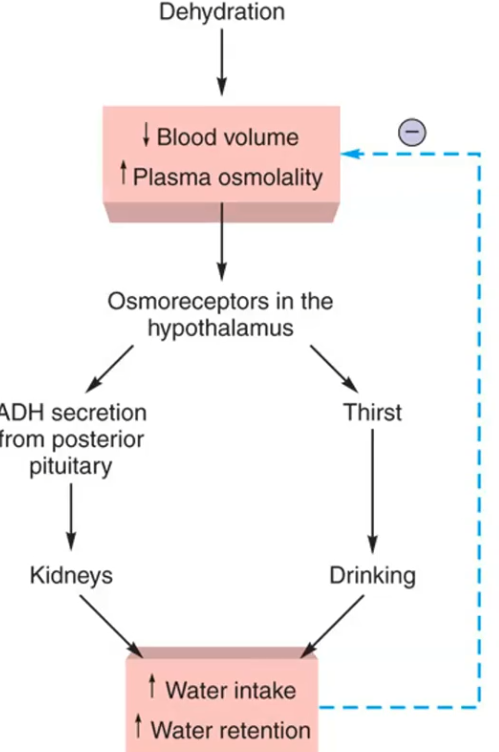
Is the regulation of blood osmolality an example of positive or negative feedback? Why?
Negative feedback — the response (water retention + drinking) brings osmolality back down toward the set point, opposing the initial change.
What is tonicity?
The ability of a solution to make water move into or out of a cell by osmosis; related to a solution's osmolarity (solute concentration).
water movement (osmosis) is completely based on the surrounding solution.

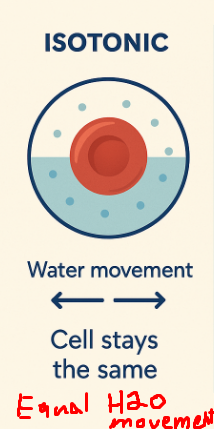
What does "isotonic" mean, and what happens to water movement? (beaker/cell)
Two compartments have the same solute concentration; no net osmosis occurs (water moves in and out equally).
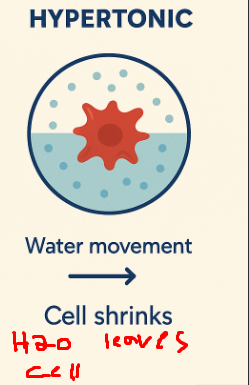
What does "hypertonic" mean? (beaker/cell)
A compartment has a higher solute concentration (higher Osm) relative to the other compartment.
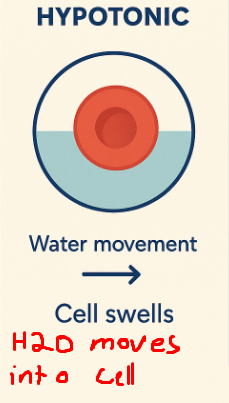
What does "hypotonic" mean (beaker/cell)?
A compartment has a lower solute concentration (lower Osm) relative to the other compartment.
Are isotonic, hypertonic, and hypotonic absolute or relative terms?
Relative — they describe solute concentration of one compartment compared to another, not a fixed value on their own.
If a cell has 300 mOsm and the surrounding beaker has 100 mOsm, how would you describe the cell and beaker?
The cell is hypertonic COMPARED to the beaker, and the beaker is hypotonic CMOPARED to the cell.
In terms of tonicity, which direction does water always move?
Water always moves toward the hypertonic side (higher solute concentration).
Water follows solute, moving to dilute the higher solute area.
What happens to red blood cells in an isotonic solution?
Red blood cells live and function normally in isotonic solutions.
(no shrinking or swelling).
What happens to red blood cells in a hypertonic solution?
Water exits the cell (moves toward the higher solute concentration outside), causing the cell to crenate (shrink).
What happens to red blood cells in a hypotonic solution?
Water enters the cell (moves toward the higher solute concentration inside), causing the cell to expand/swell.