Module 2 - Basic Chemistry, Water, pH Matter, Mass, and the Atom
 Call Kai
 Learn
Learn Practice Test
 Spaced Repetition
 Match
Match Flashcards
 Knowt Play
1/46

There's no tags or description
Looks like no tags are added yet.
Name | Mastery | Learn | Test | Matching | Spaced | Call with Kai | Chat |
|---|
No analytics yet
Send a link to your students to track their progress
47 Terms
Matter
Anything that takes up space and has mass.
Mass
measure of the quantity of matter in a given object.
Volume and density.
Democritus (400 BCE):
atoms are indivisible.
Cannot be broken down further.
Atoms:
the fundamental unit of matter
Protons:
component of the atom’s nucleus with a positive electrical charge.
Elements are defined by the number of protons.
Neutrons
component of the atom’s nucleus with no charge.
Isotopes are defined by number of neutrons
Electrons
component of the atom’s nucleus with no charge.
Isotopes are defined by number of neutrons
located some distance from atom nucleus and has a negative electrical charge
What is an element?
A substance that can not be reduced to a more simple set of components through chemical processes.
Elements are pure forms of chemicals consisting of a single type of atom
What are the four main elements that make up the human body?
Carbon
Oxygen
Nitrogen
Hydrogen
make up 96% of human body mass
atomic number
is the total number of protons in an atom's nucleus, dictating the element's identity.
atomic mass
is the weighted average mass of all naturally occurring isotopes of that element
What is an isotope?
a form of an element as defined by the number of neutrons contained in the nucleus.
Molecule
two or more atoms together.
Ex. O 2
Compound
two or more elements together
Ex. H2O
Atomic number:
number of protons in the atom’s nucleus.
Carbon = 6
Different elements have different proton numbers in their nucleus.
Element symbol:
abbreviation of element’s name.
Atomic mass:
combined mass of atom’s protons and neutrons.
Neutron = 1.
Proton = 0.99862349, 99.86% mass of neutrons.
Electron = 0.00054386734, 0.054% mass of neutrons
What makes a stable atom?
a balanced nucleus and a full outer electron shell.
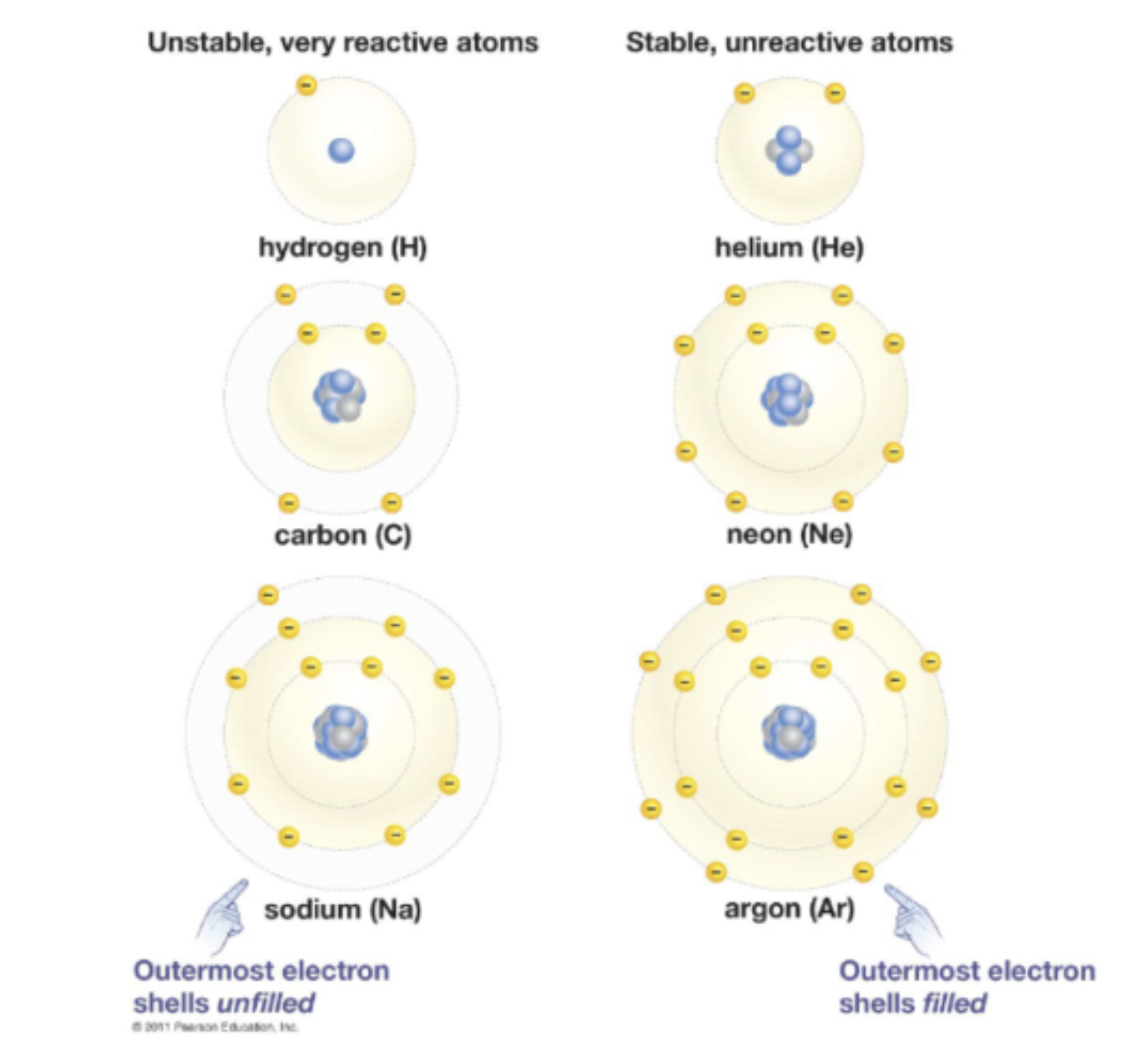
How many electrons are found in each electron shell (1st shell, 2nd shell, etc..).
Electrons (e- ) orbit the nucleus of the atom at different energy levels (shells).
Atoms with vacancies in their outermost (valence) electron shell are reactive, whereas atoms with full shells are passive
1st shell = 2 e-
2nd shell = 8 e-
3rd shell = 8 e-
Types of Chemical Bonding
Non-polar covalent bond
Polar covalent bond
Polarity
Covalent bonding
Non-polar covalent bond:
when a covalent bond results in a non-polar molecule.
Ex: Carbon dioxide = CO2
Polar covalent bond:
when a covalent bond results in a polar molecule
Ex: Water
Polarity
A difference in electrical charge on opposing ends of a molecule.
Covalent bonding:
when two atoms share pairs of electrons
Types of Chemical Bonding
Non-polar covalent bond:
Polar covalent bond:
Polarity
Covalent bonding:
Ionic bonding:
Cation
Anion
Hydrogen bonding
Ionic bonding:
when one atom donates an electron to another atom, resulting ions become linked by attraction of opposing charges.
Cation:
a positively charged ion.
Ex: Na+
Anion:
a negatively charged ion.
Ex: Cl-
Hydrogen bonding:
covalent bond between hydrogen atoms and an electronegative atom.
Bound by attraction of electrical charge.
Relatively weak bonds.
Polarity:
A difference in electrical charge on opposing ends of a molecule.
Covalent bonding:
when two atoms share pairs of electrons
Polar covalent bond:
when a covalent bond results in a polar molecule
Ex: Water
Non-polar covalent bond:
when a covalent bond results in a non-polar molecule.
Ex: Carbon dioxide = CO2
Summary of Molecule Bonding
Covalent bonding: a bond formed between two atoms that share electrons
Bond strength : strong.
Ionic bonding: a compound that is formed by the attraction of two oppositely charged ions
Bond strength: strong.
Hydrogen bonding: a bond formed between the slightly positively charged hydrogen atom and the slightly negatively charged region of another atom
Bond strength: weak
How does an atom become an ion?
Ion: a charged atom; the number of electrons does not equal the number of charges.
What is a polar molecule?
These molecules are hydrophilic (water-loving).
Partial charges work to pull apart ions
Know the properties of water: The Universal Solvent:
Water can dissolve more substances than any other liquid.
Solute: substance being dissolved to form a solution.
Solvent: substance that a solute is dissolved in to form a solution.
Aqueous solution = water is the solvent.
Solution: a liquid mixture of two or more substances.
The hydrogen bonds of water molecules pull other compounds apart
Vaporization
transformation from liquid to gas.
Fastest moving water molecules transform to a gaseous state.
Evaporative cooling
Sweat helps release internal body heat.
cooling of surface when liquid evaporates.
Hydrophilic (“water loving”):
compounds that will interact with water.
Ex. Sodium Chloride (NaCl).
Hydrophobic (“water fearing”):
compounds that do not interact with water.
Ex: Hydrocarbons (petroleum, oil) and lipids (fats).
Hydrophobic molecules help contain water
Cohesion
the tendency for like molecules to cling together due to attractive forces
Surface tension:
Water molecules are less attracted to air relative to each other and pack more tightly at interface
Acid:
substance that donates hydrogen ions in an aqueous solution.
Hydrogen ion = lone proton H +
Base:
substance that accepts hydrogen ions in an aqueous solution.
Hydroxide ion = Oxygen and Hydrogen OH -
Alkaline = basic solution
Buffers:
substances that mitigate changes in pH
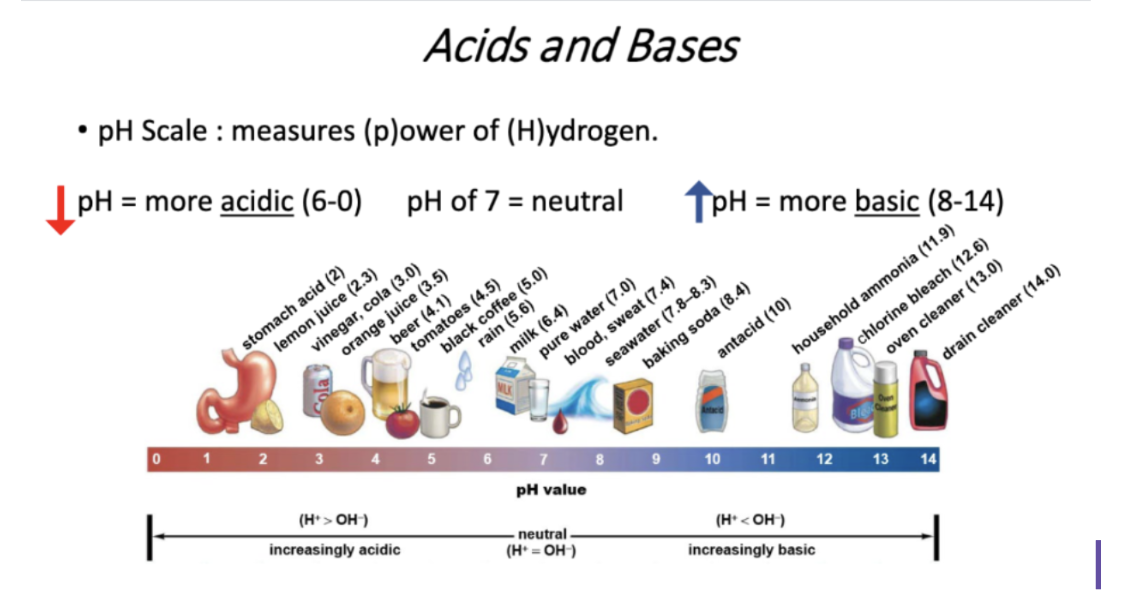
Where are acids and bases found on the pH scale? (Ex: is a solution with a pH of 12 an acidic solution or a basic solution?)