Paper and board forming processes
 Call Kai
 Learn
Learn Practice Test
 Spaced Repetition
 Match
Match Flashcards
 Knowt Play
1/5

Earn XP
Description and Tags
Name | Mastery | Learn | Test | Matching | Spaced | Call with Kai | Chat |
|---|
No analytics yet
Send a link to your students to track their progress
6 Terms
laser cutting use & process
Used for sign making, card designs, prototyping
How it works:
A focused laser beam melts, burns, or vaporises the material to cut through or engrave it
Laser cutting is typically used for metals, plastics, wood, boards, and other materials
laser cutting advantages & disadvantages
Advantages
Very precise and clean cuts
Repeated accuracy
Can cut a wide range of materials
Minimal material wastage
Disadvantages
Can be expensive for small-scale production
Heat-affected zone can deform certain materials
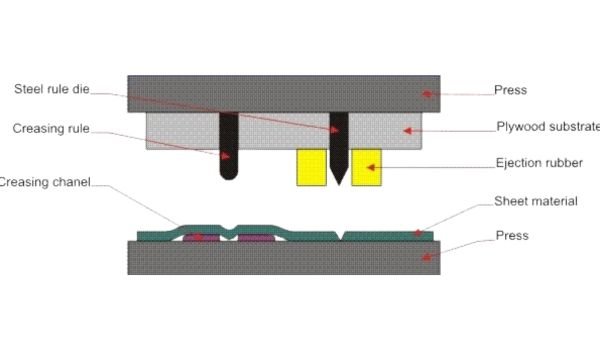
die cutting and creasing use & process
Used for pizza boxes, labels, brochures and custom cutouts
How it works:
Die cutting uses a sharp, custom-shaped steel dies to cut through materials
Creasing rules are used to indent where the material folds, without cutting through it
The die is pressed onto the material using a machine, cutting / creasing straight lines
die cutting and creasing advantages & disadvantages
Advantages
Accurate and precise cuts / creases
Can cut through multiple layers at once
Ideal for high-volume production
Prevents cracking of materials during folding
Improves the overall appearance of folded products
Disadvantages
Requires custom-made dies, which can be expensive
Not suitable for intricate designs or small runs
Not suitable for all materials
Requires precise die adjustment
bending uses & process
Used for cardboard
How it works:
Stamped out net is placed on the folding table
Bending involves applying force to a material to change its shape without breaking it
Machines like press brakes or rollers sometimes bend the material
bending advantages & disadvantages
Advantages
Can create complex shapes with minimal material wastage
Cost-effective for mass production
Requires less energy compared to other methods
Disadvantages
Can cause material deformation if not done correctly
Not suitable for very thick materials