Psych: Chapter 6- Learning
 Call Kai
 Learn
Learn Practice Test
 Spaced Repetition
 Match
Match Flashcards
 Knowt Play
1/35

There's no tags or description
Looks like no tags are added yet.
Name | Mastery | Learn | Test | Matching | Spaced | Call with Kai | Chat |
|---|
No analytics yet
Send a link to your students to track their progress
36 Terms
Learning:
A relatively permanent change in behavior brought about by experience.
Habituation:
The decrease in response to a stimulus that occurs after repeated presentations of the same stimulus.
What is an example of habituation?
A baby’s lack of response to an old toy.
What is classical conditioning?
Neutral stimulus comes to bring about a response after it is paired with a stimulus that naturally brings about that response.
Who studied classical conditioning?
Ivan Pavlov.
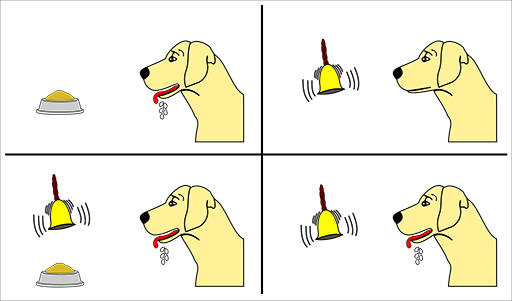
Neutral stimulus:
Before conditioning, does not naturally bring about the response of interest.
Unconditioned stimulus (UCS):
Naturally brings about a particular response without having been learned.
Unconditional response (UCR):
Natural and needs no training.
Conditioned stimulus (CS):
Neutral stimulus that has been paired with an unconditional stimulus.
Brings about a response formerly caused by the uncontrolled stimulus.
Conditioned response (CR):
After conditioning, follows a previously mutual stimulus.
Conditioned=
Conditioned= Learned.
Unconditioned= Not learned.
An unconditioned stimulus (UCS) leads to an _____________________.
Unconditional response (UCR).
(They’re not learned, they occur naturally).
During conditioning, a previously neutral stimulus is transformed into a ________________.
Conditioned stimulus.
A conditioned stimulus (CS) leads to a ________________.
Conditioned response (CR).
Consequence of learning.
Describe the “Little Albert” case study.
Who was it orchestrated by?
John B. Watson and Rosalie Rayner
They paired a loud noise with the presence of rats, which induced fear in the child.
Phobias:
Intense, irrational fears.
Extinction:
A basic phenomenon of learning that occurs when a previously conditioned response decreases in frequency and eventually disappears.
What needs to be done to produce extinction?
One needs to end the association between conditioned stimuli and unconditioned stimuli.
Spontaneous recovery:
The re-emergence of an extinguished conditioned response after a period of rest with no further conditioning.
Stimulus generalization:
A process in which after a stimulus has been conditioned to produce a particular response, stimuli that are similar to the original stimulus produce the same response.
The greater the similarity between two stimuli, the ________ the likelihood of of stimuli generalization.
Greater.
Stimulus discrimination:
The process that occurs if two stimuli are sufficiently distinct from one another that one evokes a conditioned response but the other does not; the ability to differentiate between stimuli.
What is an example of stimulus discrimination?
A dog running into the kitchen when he hears the can opener (used when feeding him dinner), but not the food processor although they sound the same.
Operant conditioning:
Learning in which a voluntary response is strengthened or weakened, depending on its favorable or unfavorable consequences.
Thorndike’s Law of Effect:
Responses that lead to satisfying consequences are more likely to be repeated.
Reinforcements:
The process by which a stimulus increases the probability that a preceding behavior will be repeated.
Reinforcer:
Any stimulus that increases the probability that a proceeding behavior will occur again.
Primary reinforce:
Satisfies some biological need and works naturally.
What is an example of a primary reinforce?
Food for hunger.
Secondary reinforce:
A stimulus that becomes reinforcing because of its association with a primary reinforcement.
What is an example of a secondary reinforcement?
Money—→ Food—→ Hunger.
Positive reinforcer:
A stimulus added to the environment that brings about an increase in a preceding resonse.
Negative reinforcer:
An unpleasant stimulus whose removal leads to an increase in the probability that a preceding response will be repeated in the future.
Punishment:
A stimulus that decreases the probability that a previous behavior will occur again.