Gas Exchange
 Call Kai
 Learn
Learn Practice Test
 Spaced Repetition
 Match
Match Flashcards
 Knowt Play
1/89

There's no tags or description
Looks like no tags are added yet.
Name | Mastery | Learn | Test | Matching | Spaced | Call with Kai | Chat |
|---|
No analytics yet
Send a link to your students to track their progress
90 Terms
give an example of materials that need to be exchanged between cells and their external environment
o2 co2 h20
Glucose
Na+/mg2+
Amino acids
Fatty acid
How do you work out a ratio in biology
The one on the right hand side must be on
Which of these cuboids is better adapted for gas exchange 1×1×8 or 2×4×1
Sa:vol = 4.25:1
3.5:1 the first as it is longer and thinner so a greater surface area to volume ratio
What does it mean if they give you a surface: volume ratio as one number e.g 6
It means they have done surface area divided by volume so it is just the number
Describe the relationship between size of an organism and surface area: volume and explain the impacts of this on an organism’s ability to carry out effective gas exchange
the larger an organism the smaller is SA:VOL ratio-makes gas exchange less efficient
The diffusion distance to cells in the centre of a larger organism is further from the exchange surface therefore diffusion would be too slow (long diffusion pathway)
Name the process by which oxygen reaches the cells inside the body of a flatworm
Diffusion NOT FACILITATED
The body of a flatworm is adapted for deficient gas exchange between the water and the cells inside the body, using the diagram, explain how two feature of the flatworm’s body allow efficient gas exchange (2)
It is small and thin/flat so has a large surface area to volume ratio
Its thin so has a short diffusion distance to cells in the centre of the organs so diffusion rate is quicker
Elephant seals live in cold water explain the advantage of a large size (2)
small surface area to volume ratio
So loses less heat to water maintaining a stable body temp
In an experiment suggest one practical advantage of measuring the masses of frog eggs, tadpoles and adults without measuring their volumes
more accurate
Cause less distress to animals
Easier Becuase you aren’t calculating using irregular shapes
Fewer measurement calculations
Give a few reasons why you may be unable to make collusions from a table of data
No info about all areas e.g one column is missing data, so you cannot compare all ages
No measure of statistical differences/ comparison of standard deviation
What is Fick’s law
Rate of diffusion is proportional to surface area x concentration gradient / diffusion distance
Of the three factors for ficks law which do you want to be large/small
Large- SA conc
Small- diffusion distance
Explain gas exchange in single celled organisms
Small so has a large : ratio and a short diffusion distance, therefore diffusion through surface is sufficient for efficient exchange of materials
What are the holes in insects called And their function
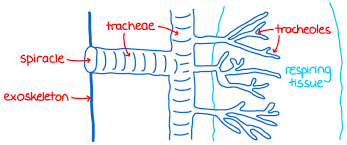
Spiracles- pores that can open and close when open water is lost but and to be open for oxygen to enter via diffusion
What are the 2 different tubes in insects and their function
Tracheae: strengthened by rings of chitin to stop them collapsing ighly branched heaping to increase SA:VL
Tracheoles: smaller tubes are close to individual issues: walls composed of single layer of cells (short diffusion distance) there are many tracheoles for large surface area (site of gas exchange)
What about the surface of insects is helpful
Waterproof outer surface - exoskeleton- reduce water los but no gas exchange
Give the two adaptations to Increase effectiveness of gas exchange in insects:
Ventilation (physical movement of air into the tracheal system from air) during flight, the abdominal muscle contracts, this forces the spiracles to open and close rapidly, forces more o2 into the tracheoles so leads to a steeper conc gradient
The ends of the tracheoles are filed with water
When at rest this is helpful Becuase the ends of the tracheoles have small volumes of fluid in them, this is needed to allow gases to dissolve. And therefore diffuse across the membrane
Insects in flight/active- during flight muscles contract faster and therefore the rate of respiration is the surrounding cels is higher. This can lead to the production of lactic acid (lactate) which lowers the water potential of the cells. This was out some o the water via osmosis, this is advantageous because it increases the SA of the tracheoles and the rate of gas diffusion (Becuase diffusion occurs more quickly in a gas than liquid)
When more oxygen is being used/co2 produced the fluid is drawn into the surrounding tissues further increasing the surface area available for gas exchange
Give three conflicts between gas exchange and conserving water in insects
there are hirs around the spiracles these trap moisture reducing the concentration gradient
Spiracles close to reduce water loss
Waterproof covering/exoskeleton
How is large surface area achieve in insects
Many tracheoles
How is contraction gradient achieved in insects(2)
ventilation of tracheoles maintains high oxygen concentration gradient in tracheoles
Aerobic respiration in mitochondria lowers oxygen concentration in cells
How is a short diffusion distance achieved in insects
ends of tracheoles and cels are next to each other walls of tracheoles are only one cel thick
What is an insects tracheal/ventilation system
The biological system with which it supplies and removes respiratory gases around its cells for efficient gas exchange to take place
How does air enter an insect
Through a series of external openings called spiracles
How are spiracles adapted to the often dry environment
Often lined with fine hair of bristles with are an adaptions to dry and dusty land these hairs help to trap humid air reducing the concentration gradient f water vapour which reduces water loss- preventing gas exchange helps to ensure that gas exchange surface remains moist
Why are the rings helpful
Made of chitin which is strong but light-weight so it keeps the airway open during body movements while allowing some flexibility
Without the movement and pressure change would compress the tubs and prevent gas exchange
What is the function of air sacs?
Air sacks help to ventilate the tracheal tubes when the insect is moving, the muscular contractions as well as typically compressing the tracheal tubes also compresses the air sacks , changing air pressure and facilitating ventilation- maintain conc gradient
An insect opens its spiracles at a lower frequency in very dry conditions- suggest one advantage of this
Less water loss
Abdominal pumping increases efficiency of gas exchange between the tracheoles and muscle tissue of the insect explain why- 2
More oxygen is forced into the insect- ventilating this maintains a steep concentration gradient
Abdominal pumping increases the efficiency of gas exchange between the tracheoles and muscle tissue of the insect, explain why- 3
Larger surface area to volume ratio so the rate of diffusion is faster
Shorter diffusion distance
If you get a graph and have to calculate the frequency of something per minute how do you do it
Find the time for 1 cycle - peak to peak and then divide 60 by that answer
The ends of the tracheoles connect directly with the insects muscle tissue and are filled with water, when flying water is absorbed into the muscle tissue. Removal of water from the tracheoles increases the rate of diffusion of oxygen between the tracheoles and muscle tissue suggest one reason why-1
Greater surface area expose to air
Gases can move/ diffuse faster in air than water
Explain why when put into pure co2 the rate of abdominal pumping in insects massively increases then decreases
Then when back into normal air it goes up high again
Increases due to higher co2 concentration/ lack of oxygen
Decreases due to lack of oxygen for aerobic respiration so lack of atp reduced muscle contraction
Increase as there is aa oxygen debt has to repay this and break down the lactate
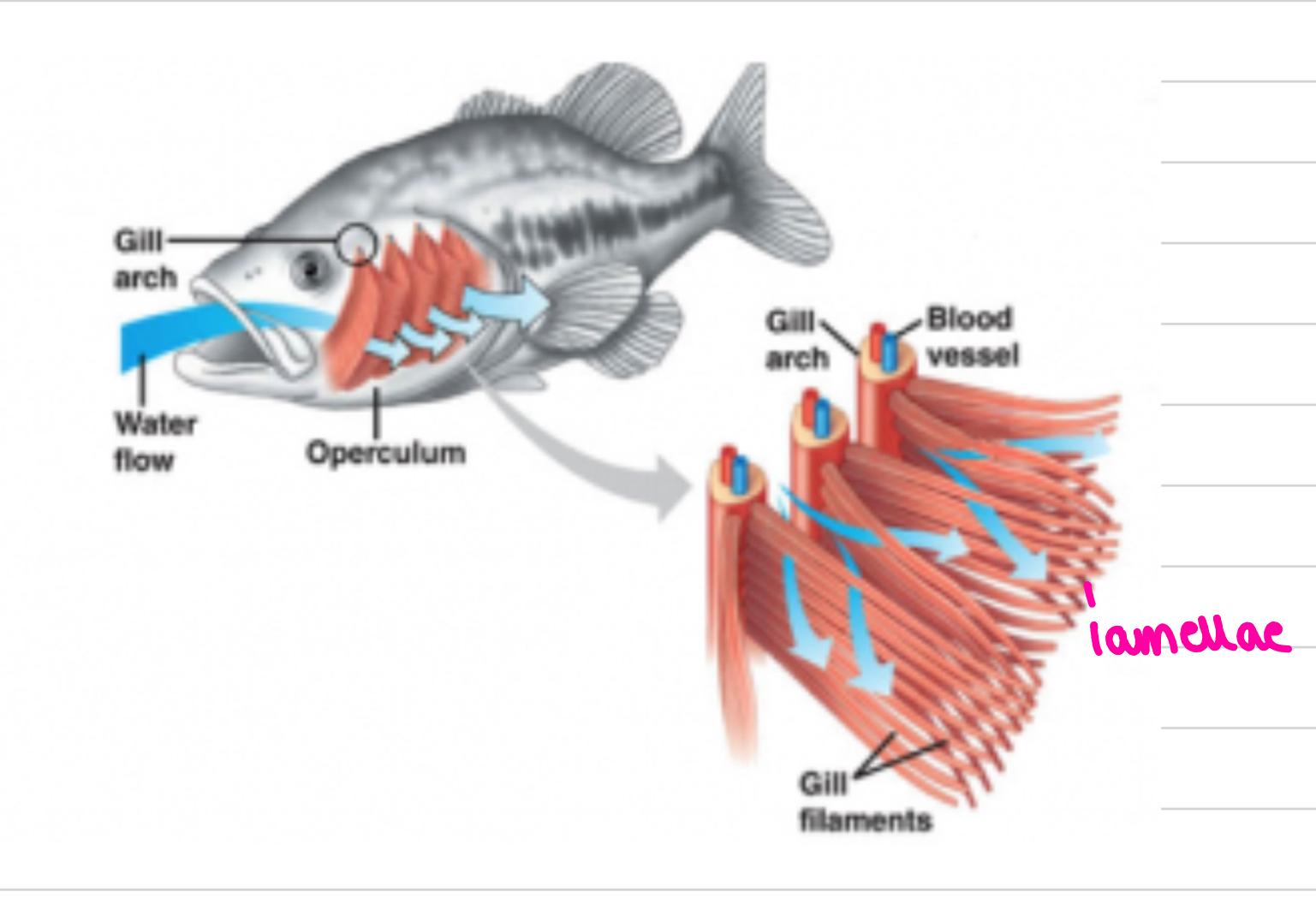
What is the operculum
Flap above the gills protects the delicate gills from external damage and is forced open by the pressure of water flowing over the gills
How are the gills ventilated
Water is continuously forced over the gills to ensure a steep concentration gradient
Explain why counter current is better than flowing in the same direction
The blood flow in the capillaries in the same direction as water, blood leaving the gills and returning to the body is only 50% saturated with oxygen, there is only a concentration gradient for oxygen from water to blood for part of the gill lamellae
Whereas the countercurrent flow maintains a concentration gradient over the full length of the gill almost all oxygen diffuses from the water to the blood.
Explain how the fish achieves a large surface area
Many filaments with many lamellae that increase surface area
Explain how the fish achieves a short diffusion distance
Short diffusion distance between water and blood due to the gill lamellae is made of a single layer of flattened epithelial cells
Explain how fish maintain a steep concentration gradient- 3
Ventilation of the gills water is continuously forced over the gills to ensure a steep concentration gradient for oxygen- replaces the water at the gills
Continuous circulation of blood to remove oxygen rich blood away from the gills
Water and blood flow in opposite direction/ counter-current flow
Describe the features of fish gills that give them a lage surface area- 2
Many filaments with many lamellae that increase surface area
Explain why as gill surface area increases so does swimming speed
Larger the sa more oxygen can get in so more oxygen can be supplied for more aerobic respiration.
Explain the advantage of counter-current flow -2
Maintains a concentration gradient across the full length of the gill so more oxygen will diffuse into the blood
explain how small young fish don’t have gills but still get enough oxygen- 2
Very large surface area to volume ratio/ short diffusion distance
Diffusion across body surface/ skin
Give the word and symbol equation for photosynthesis and how each thing comes in and is used
Carbon dioxide 6CO2 + water 6H20 = glucose c6h12o6 + oxygen 6o2
Diffuses into leaf via stomata, moves via osmosis from soil to root hair cells to xylem to leaves, glucose used to form other bio molecules or used in resp, oxygen by-product diffuse out of stomata when light intensity is high
give the description and function of the upper epidermis
layer of cells that secrete a waxy cuticle
reduces the evaporation from the upper part of the leaf
give the description and function of palisade mesophyll
layer of tightly packed palisade cells
carrier out the majority of photosynthesis
give the description and function of spongy mesophyll
cells arranged to leave air spaces
carrier out some photosynthesis. air spaces allow gases to diffuse easily to palisade cells
give the description and function of vascular bundle
xylem and phloem vessels
xylem- brings water and minerals to the leaf
phloem- transports sucrose
give the description and function of lower epidermis
single layer of cells with guard cells
allows easy diffusion of CO2 and controls water loss
a leaf is an organ what is an organ
a group of tissues e.g epidermal, palisade mesophyll
describe how carbon dioxide in the air outside a leaf reaches mesophyll cells inside the leaf- 3 marks
carbon dioxide diffuses in via stomata, opened by guard cells, diffuses through air spaces, down the diffusion gradient
what word do you use to describe closed guard cells and open guard cells
closed- flaccid
open- turgid
when are stomata open and closed
closed- darkness/ plant is water stressed
open- light/ plant is not water stressed
what is a xerophyte
plants adapted to live in dry environments
give 6 features of xerophytic plants and their explanation
round shape/leaves reduced spines
this reduces their surface area to volume ratio- less evaporation
rolled leaves (lower epidermis on the inside) - protecting them from wind ( increase wind means increase diffusion and evaporation) curl traps water reducing the concentration gradient
thick waxy cuticle- these are waterproof and reduce evaporation
reduced number of stomata- reduces places for water to evaporate from
sunken stomata- the sunken pits trap water reducing the concentration gradient of water between leaf and air. reduces evaporation of water from the leaf
hairs (usually on the lower epidermis)- trap water vapour- reducing the concentration gradient
suggest why pine trees have xerophytic adaptations on their leaves when alpine conditions are not desert like
lack of water and very cold so water freezes and lack of rain means they have to conserve water
give 3 rules for biological drawings
label lines in pencil with a ruler, with no arrow heads. label lines can’t cross and the end of the line should be within the layer to be labelled
writing is done in pen e.g title and labels
drawing must have titles and some form of scale/magnification must be given
why do we need to breathe?
supply oxygen for aerobic respiration, this provides ATP needed for active transport etc
remove carbon dioxide as this dissolved to produce carbonic acid, this lowers the pH of cells and blood normally 7.4 any variation can affect key enzyme activity
give adaptations of the alveolus and the surrounding capillaries- 8
capilary wall made of a single layer of flattened endothelial cells - short diffusion distance
alveoli wall made of a single layer of flattened epithelial cells- diffusion distance
many capillaries- large sa
many alveoli - large sa
circulation of blood maintains a low oxygen concentration in blood- concentration gradient
red blood cells are slightly smaller than the diameter of the capillary - this slows their movement so their is more time for diffusion
short diffusion distance as the red blood cells are against the walls of the capillary
ventilation of the lungs maintains a high oxygen concentration in alveoli
what does endothelial mean
capillary walls are made of endothelial cells
they are only found in a blood vessel
line inside the blood cell- within
are inhalation and exhalation active or passive
inhalation- active
ex- passive usually
explain inspiration-5
external intercostal muscles contract and pull rib cage up and out
diaphragm muscle contracts and flattens
increases volume of thorax
this decreases pressure in the thorax to below atmospheric pressure
air moves into lungs
explain the process of exhalation- 6
external intercostal muscles relax, rib cage moves down and in
intercoastal muscles only contract if forcing air out e.g exercising
diaphragm muscles relaxes ad diaphragm returns to domes position
decreases the volume of the thorax
this increases pressure in thorax to above atmospheric pressure
air moves out of lungs
explain breathing in terms of pressure- 3
air moves from an area area of higher pressure to an area of lower pressure.
this means that for air to move into the lungs, the air in the lungs must be lower than atmosperic pressure.
for air to be forced out of lungs the air pressure in the lungs must be higher than atomsopheric pressure,
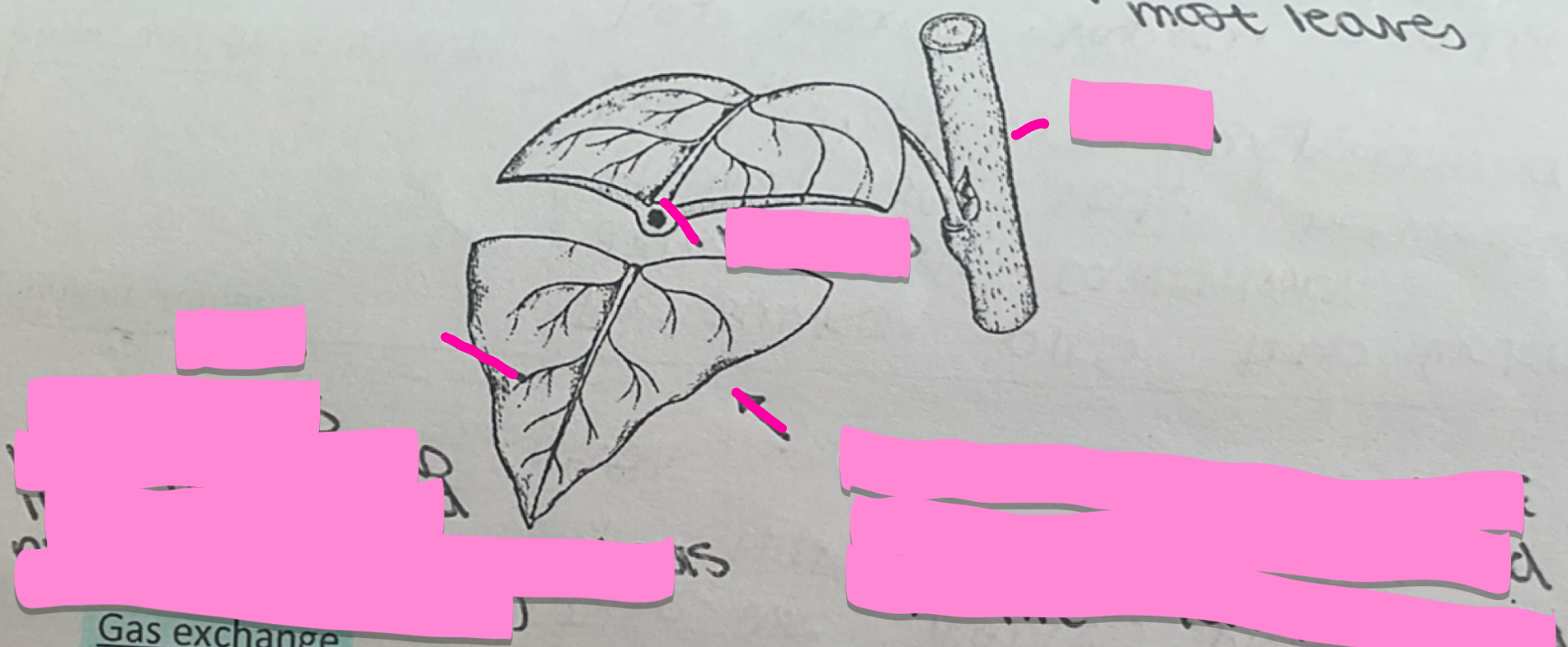
Label this leaf
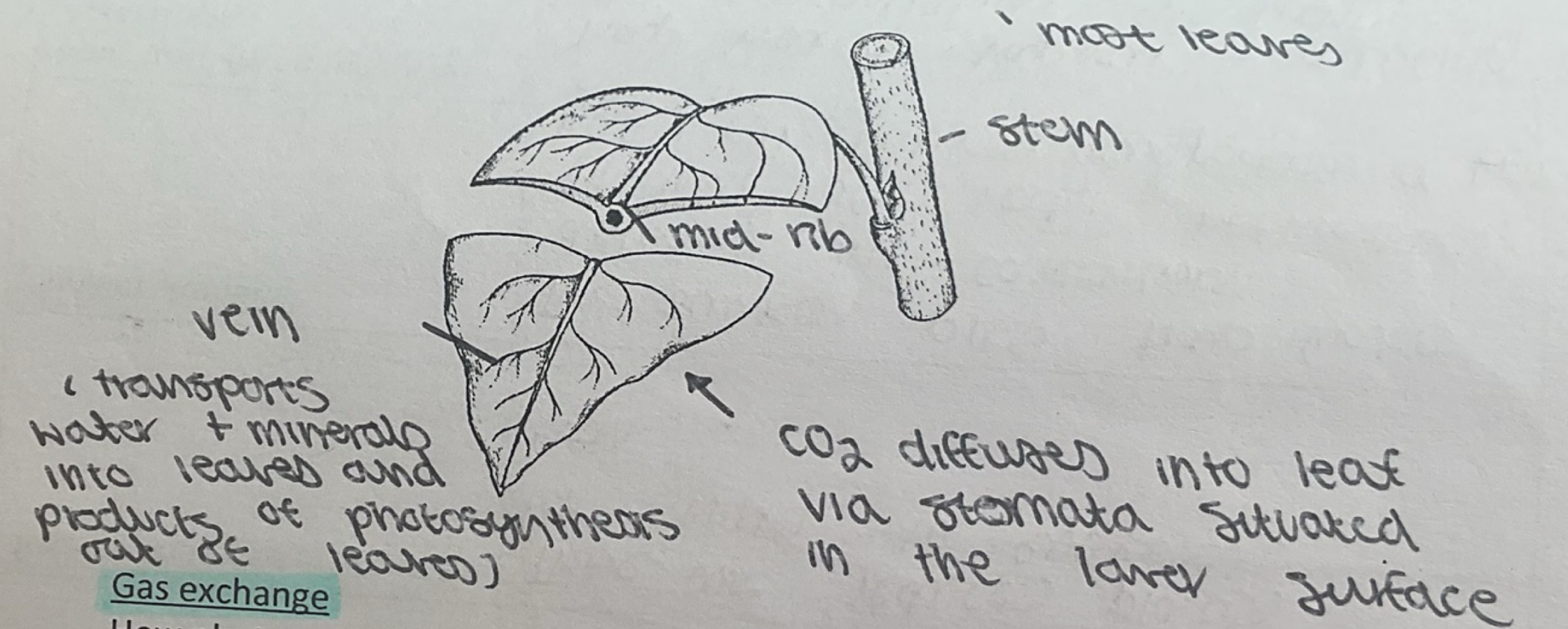
What type of leaf are most leaves
Broad leaf, dicotyledonous
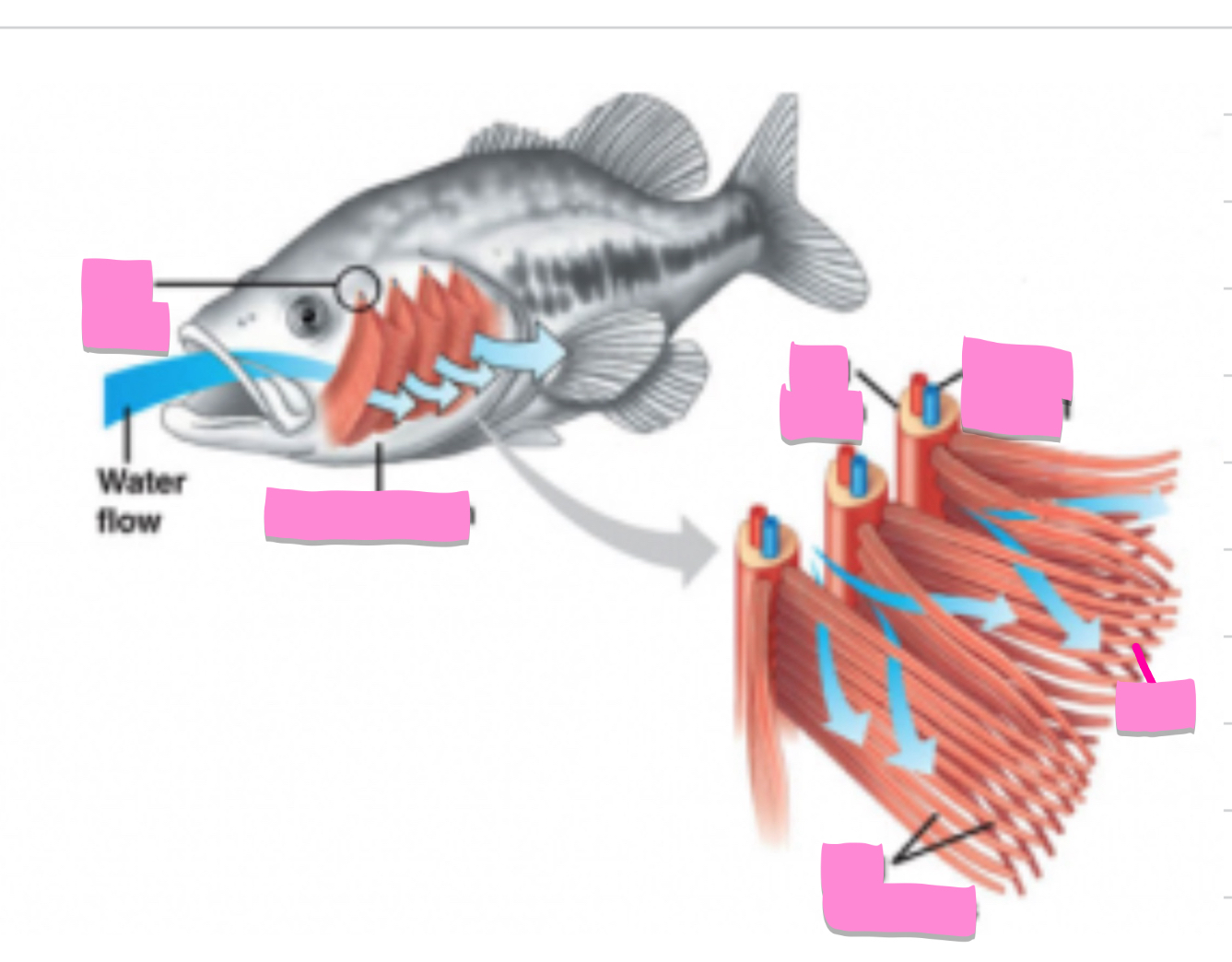
Label this fish system
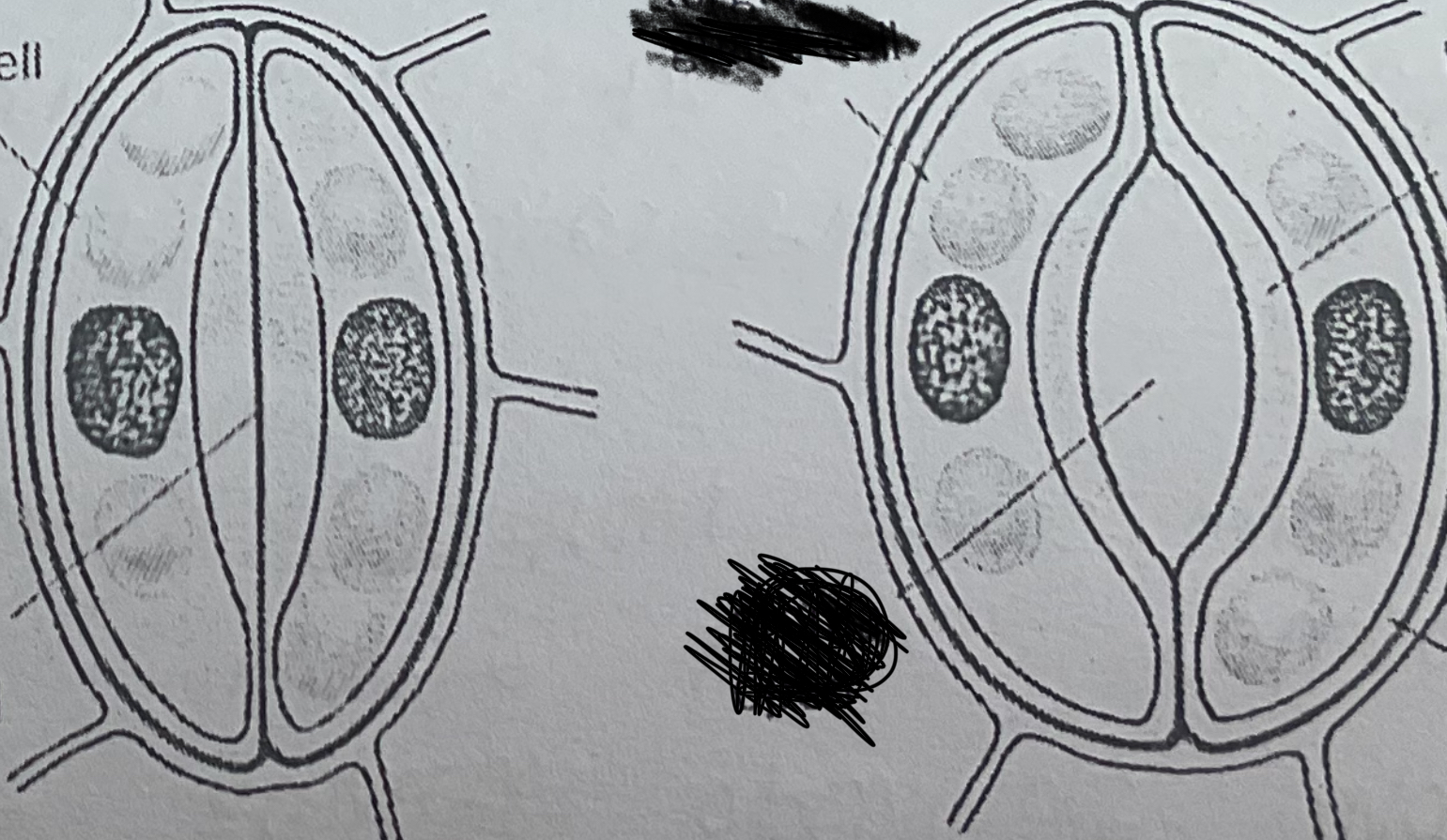
Which stoma is open
The one on the right is open
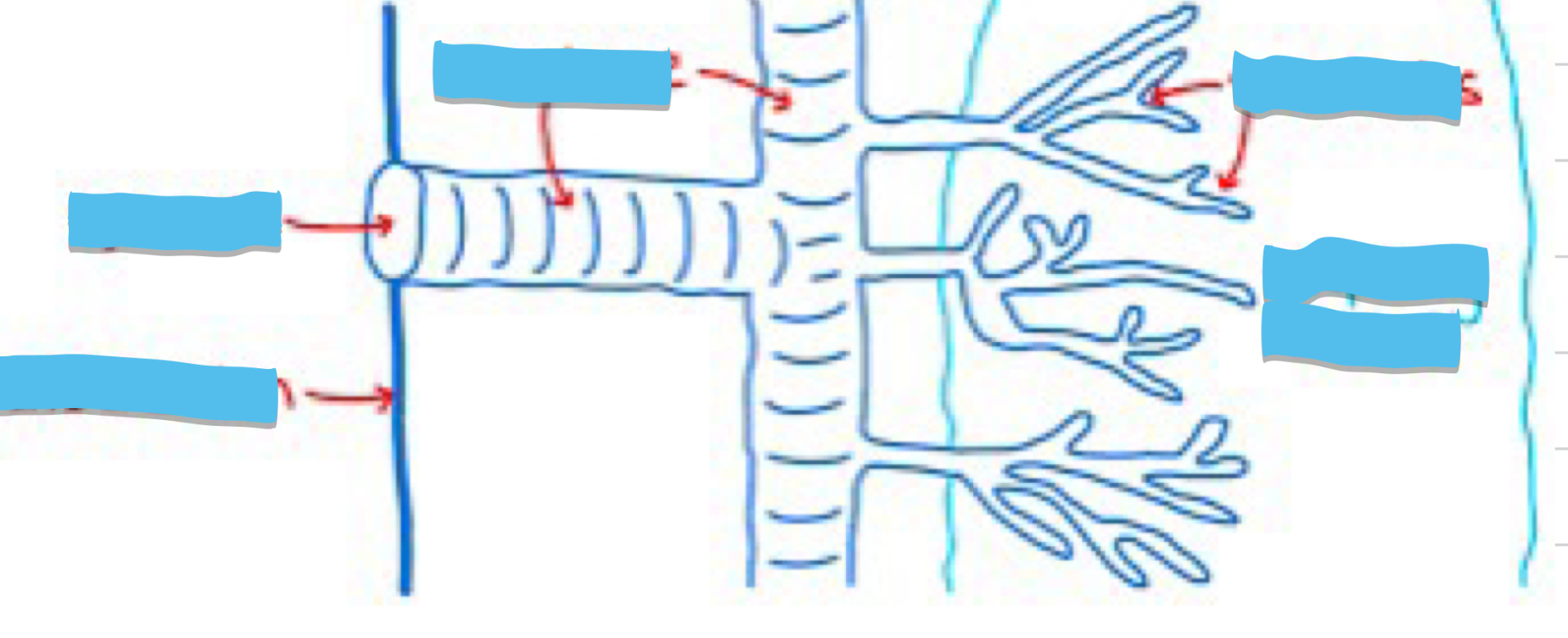
Label insect gas exchange
what is a name for the internal and external intercostal muscles
🙂 😉 ❤
antagonistic muscle pair
explain the process of breathing in
diaphragm muscle and shape- contracts and flattens
external intercoastal muscles- contract to lift rib cage
internal intercoastal muscles- relax
volume of thorax- increases
pressure of thorax compared to atmospheric air- lower
movement of air- into lungs , down the pressure gradient
explain breathing out
diaphragm muscle and shape- relaxes and rises
external intercoastal muscles- relax
internal intercoastal muscles- contract to lower ribcage (only during exercise really to force air out)
volume of thorax- decreases
pressure of thorax compared to atmospheric air- higher
movement of air- out of lungs , down the pressure gradient
define tidal volume
volume of air entering/ leaving lungs in one resting breath
define breathing rate
the number of breaths a person takes in one minute
how do you find pulmonary ventilation
tidal volume x breathing rate
if the volume in someones lungs when they have taken a breath is 3000cm3 and their tidal volume is 0.45dm3 find the remaining volume of air left in the lungs when they exhale
3000/1000= 3
3-0.45= 2.55dm3
how do you prove a correlation
a stats test
a positive correlation is shown on a graph of alcohol consumption against incidence of cancer per 1000 men, does one cause the other-3
there is a positive correlation but correlation doesn’t equal causation, could be due to other factors for example heavy drinkers tend to be heavy smokers
no stats test done so can’t say if the correlation is significant
if the stats test shows no correlation what does this mean
there is no significant association between the 2 factors
looking at the graph shown do you agree with the statement, playing wind instruments increases your vital capacity-3
yes becuase most players are above the correlation line but correlation does not equal causation thsi correlation way be due to another lifestyle factor e.g wind people are less likely to smoke.
insufficient evidence only 6 people have been sampled therefore difference may not be significant
2 of the dots are on or below the line showing not all wind players are above average
no stats done to show difference is significant
what is meant by the term risk factor
something that increases the chance of getting a disease
suggest some risk factors for lung disease
age
smoking
high fat/sugar diet
lack of exercise
dna- inherited genes
HPV
explain why figures for different organs may be given in per gram of tissue
allows comparison as organs differ in size
describe the part played by the diaphragm in causing air to enter the lungs during breathing-3
the diaphragm muscle contracts and flattens, volume in the thorax increases this causes the pressure to decrease below the pressure of atmospheric air causing air to move in down the pressure gradient
describe the path of oxygen from inside the alveolus to cell
through the epithelium of alveolus, through the capillary endothelium, through the blood plasm to cell a
explain one advantage of a biconcave disc over a spherical cell of the same volume in transporting oxygen-2
larger surface area to volume ration for diffusion
or
short diffusion distance to the centre of cell for diffusion
when a seal is diving underwater explain the advantage of blood continuing to flow to the lungs and a large reduction of blood flow to the diaphragm
some oxygen will still be in the lungs/ removal of co2 from blood
more blood available for other organs supply o2 and diaphragm muscles not contracting so doesn’t require as much oxygen
when asked to describe a curve what do you put in your answer
describe the gradient and shape and how it changes and put in values to show at which point this happens
if alveolar epithelium cells die they are replaced by non-specialised thickened tissue, explain why this reduces gas exchange-3
reduced surface area
increases distance for diffusion
reduced rate of gas exchange
when given s.d bar chart and information how do you evaluate the statement
give both for and against
take statement or evidence used that doesn’t exactly link
if s.d overlaps there is no significant difference
if they have made a statemnt or conclusion without data pick up on that
talk about means and differences on the graph
how would you calc pulmonary ventilation from a graph
the line should be a negative quadratic from 0 find the increase max in volume
for one up and down cycle and see how many seconds this is e.g 4 do 60/4 and this is 15 times other value by 15