Sediment transport and sedimentary structures - lecture 3
 Call Kai
 Learn
Learn Practice Test
 Spaced Repetition
 Match
Match Flashcards
 Knowt Play
1/54

There's no tags or description
Looks like no tags are added yet.
Name | Mastery | Learn | Test | Matching | Spaced | Call with Kai | Chat |
|---|
No analytics yet
Send a link to your students to track their progress
55 Terms
transport media gravity
rock falls, usually gravel
transport media water
most important, currents driven by gravity, tides, wind
transport media air
limited transport capacity due to low density
transport media ice
large transport capacity
transport media dense sediment and water mixtures
gravity-driven as debris flows and turbidity currents
Laminar flow
no mixing, high viscosity: ice, debris flows, lava
Turbulent flow
mixing, low viscosity: water, air
Transport particles in a fluid: bedload
rolling, low viscosity
Transport particles in a fluid: lighter bedload
saltation, middle viscosity
transport particles in a fluid: suspended load
suspension: high viscosity
Bernoulli’s equation
Total energy = kinetic energy + potential energy + pressure.
velocity (kinetic energy) increase over an object results in a pressure drop (lift force), because of conservation of total energy with potential energy remaining constant.
Stokes law
larger particles reach higher settling velocities
Normal grading
settling of sediement out of suspension in standing water, settling of sediment from decelerating flow
reverse grading (less common)
results from deposition with increasing flow velocity (or from kintetic sieving in grain flows0
Fining upward and coarsening upward
refer to grain size trends in a series of beds, caused by a series of depositional events.
Smooth boundary layer, bedform formation
thick viscous sublayer (low velocities) and/or small grain sized. All sediments are laying down fully within the viscous sublayer (current ripples)
rough boundary layer: bedform formation
thin viscous sublayer (high velocities) and/or large grain diameters the sediments cros the viscou sublayer (dunes)
The boundary layer within water
within the boundary layer the bottom flow velocities are lower and on top are higher. Above the boundary layer the flow is constant.
Turbulent sweeps
krachtige, neerwaartse bewegingen van wind of vloeistof in een turbulente grenslaag, these lead to local flow seperation

Avalanching
describes a sudden, massive downarde slide of material, it builds a slope of 30 degree, max angle possible.
Cross-lamination
a small-scale sedimentary structure featuring tiny inclined layers (foresets) that lie at an angle to the main horizontal bedding plane
Curren ripples and cross-lamination
the higher the flow velocity and duration the planar cross-laminnation will progress to a trough cross-lamination. So from straight crested beforms to sinuous crested bedforms
constraints on current ripple formation
Only in sand finer than 0.6 mm
on hydrodynamically smooth beds
formation independent of water depth
maximum height 40 mm, maxiumum wavelenght 500 mm
dunes
not just large ripples, contorlled by large-scale turbulenc in the whole flow, not just the boundary layer, controlled by water depth, can never be higher then the water depth. Current ripples ofter superimposed on dunes
Dunes and cross-bedding
formation by avalanching on lee slope. structure is cross-bdding. Depending on strenght of rollervortex: planar or trough cross-bedding. If very strong roller vortex: counter flow ripples.
constraints on dune formation
not in silt and very fine sand (<0.125 mm)
on hydrodynamically rough beds
formation dependent on water depth
height ranges from a few cm to over 10 m
wavelengths ranges from 60 cm to a few hundreds of metres
requires long flow events to build up.
Bars
Bars are larger than dunes. made up of large range of grain sizes. cross-lamination, cross-bedding and (larger scale) cross-stratification
plane bed
in coarser sands at low flow velocities, close to threshold of motion, insufficient for dunes to form (ripples do not form because of rough bed conditions). In very fine to coarse-grained sands at high flow velocities (ripples and dunes are washed out). Primary current lineation forms on (upper) plane bed at high flow velocities) sedimentary structure: planar lamination
Bedform stability…
lower flow regime: ripples, dunes, lower flat (plane bed
upper flow regime: upper flat(plane) bed, antidunes
antidunes are upstream migrating dunes that occur at high-energy flow conditions (are rarely preserved)
Waves
oscillatory motion in deep water, without net horizontal water movement
Breaking in shallow water creating horizontal movement of water
generated by wind or single events (tsunamis)
Wave ripples and wave ripple cross-lamination
formed in coarse silt an sand, symmetrical, few mm to few cm, overlapping laminae dipping in both directions
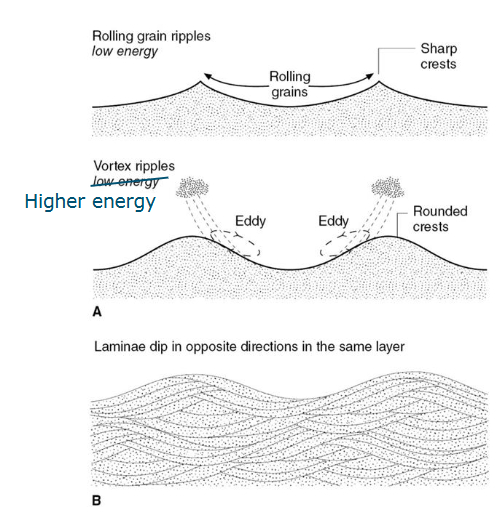
wave ripples
long, sinuous to straight crests, which may bifurcate
symmetrical in cross-section
laminae dip in both directions
Current ripples
short crests that ar very sinuous/curved
assymmetrical in cross-section
laminae dip consistently in one direction
sediment gravity flows
mixtures of sediment (detritus) and fluid (or air) moving under gravity
debris flows
dense, viscous mixtures of sediment and water, more sediment than water
turbidity currents
turbid mixtures of sediment temporarily suspended in water, more water than sediment
grain flow
avalanches of particales (usally well sorted) down a steep slope
debris flows
laminar flow, no or little sorting, varriable grain sizes
significant slope is needed
in arid areas (limited water) and on submarine slopes
deposits are typically matrix-supported gravels/conglomerates
chaotic fabric, hardly any structure; modderstroom!
trubidity currents
turbulent flow
always on submerged (submarine) slopes
driven by density differences
deposits a normally graded bed
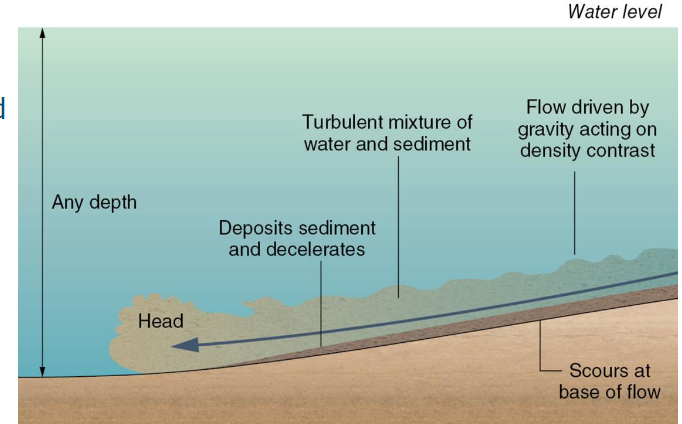
turbidites
are graded beds deposits by turbidity currents, differt types based on grain size
mudcracks
desiccation cracks form under subaerial conditions due to drying of cohesive material (clay)
spacing dependent on thickness of clay
taper downward in cross-section
detached edges may form mud-chips or mud-flakes in overlying deposits
erosional structures
large scale: channels
small scale: sole marks
scour marks: flue marks (turbulent eddies), obstacle scours, ridges and furrows (mm scale), gutter marks (cm scale)
tool marks: grooves and prod, skip, bounce marks

bed
unit of sediment which is generally uniform in character and contains no distinctive breaks
interbedded
alternations of thin layers of different lithologies
bed thickness
thin, medium, thick, very thick
cross-stratification
any layering oriented at an angle to the (depositoinal) horizontal (general term, independent of origin or scale)
cross-lamination
inclined strata formed by ripples, smaller then 30 mm height
cross-bedding
inclined stata formed by dunes, tens of cm to tens of m height
bed-set
single unit of cross-laminated, cross-bedded or cross-stratified sediment
coset
stack of multiple sets with the same type of structure
mixtures of sand and mud: flaser lamination
mostly sand
Mixtures of sand and mud: wavy lamination
half sand half mud
mixtures of sand and mud: lenticular lamination
mostly mud