MNO1706 Diversity
 Call Kai
 Learn
Learn Practice Test
 Spaced Repetition
 Match
Match Flashcards
 Knowt Play
1/20

There's no tags or description
Looks like no tags are added yet.
Name | Mastery | Learn | Test | Matching | Spaced | Call with Kai | Chat |
|---|
No analytics yet
Send a link to your students to track their progress
21 Terms
Diversity’s Positive Impact
1) Win the war for talent
2) Strengthen customer orientation
3) Increase employee satisfaction (decreased turnover and increased engagement)
4) Improve decision making
5) Enhance the company’s image (company reputation)
Types of Discrimination
1) Discriminatory Policies or Practices
2) Sexual Harassment
3) Intimidation
4) Mockery and Insults
5) Exclusion
6) Incivility
Discriminatory Policies or Practices
Actions taken by representatives of the organization that deny equal opportunity to perform or unequal rewards for performance.
Example: Older workers may be targeted for layoffs because they are highly paid and have lucrative benefits
Sexual Harassment
Unwanted sexual advances and other verbal or physical conduct of a sexual nature that create a hostile or offensive work environmentInt
Intimidation
Overt threats of bullying directed at members of specifics groups of employees
Example: African-American employees at companies have found nooses hanging over their works stations
Mockery and Insults
Jokes or negative stereotypes; sometimes the result of jokes taken too far
Exclusion
Exclusion of certain people from job opportunities, social events, discussions, or informal mentoring; can occur unintentionally
Incivility
Disrespectful treatment, including behaving in an aggressive manner, interrupting the person, or ignoring his or her opinions
Unconscious Bias
An automatic, unintentional judgment or stereotype that affects how we perceive others.
Surface-level diversity
Refers to easily visible, external human traits like age, gender, race, or visible disabilities.
Deep-level diversity
Refers to invisible traits that you cannot see just by looking at a person.
These characteristics include a person's values, personality, beliefs, skills, and thinking styles.
Can be ability as well (intellectual abilities)
Problems with pursuing diversity goals
1) Diversity is not a commonly understood goal
2) Resentment and frustration among “in-group” — Perceive unmeritocratic rise of the “out-group”
3) Overfocus on empowering “out-group” — Reverse Discrimination — Hiring females over much better male alternatives for the sake of diversity numbers
Can instead deepen divides if reasons are not communicated well & frustrations are not managed.
Diversity Management
Process and Programs by which managers make everyone more aware of and sensitive to the needs and differences of others.
Diversity is more successful when it is everyone’s business, not just for certain groups of employees
Ways to eliminate unconscious bias in workplace processes
1) Blind Resumes
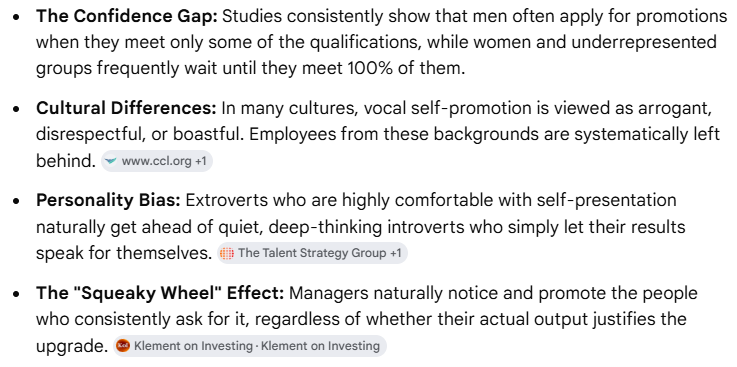
2) Eliminate self-nomination promotions
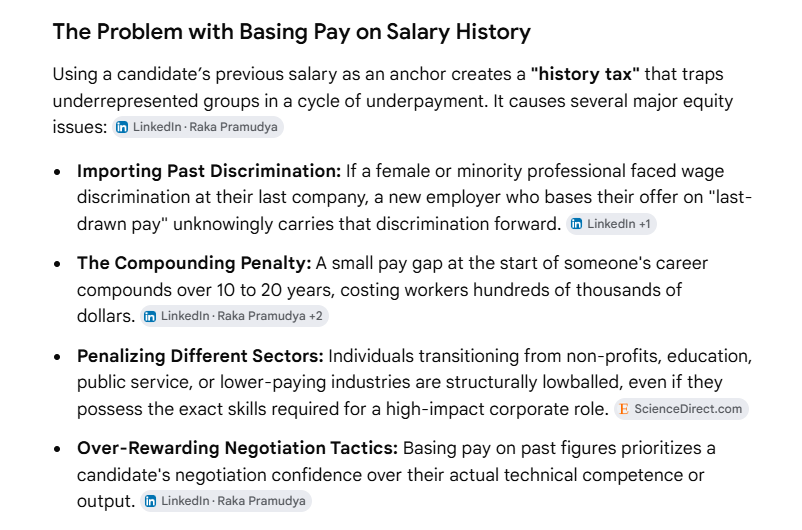
3) Anchoring salary based on job worth rather than previous salary
4) Compulsory workshops for all managers to address unconscious bias
Blind Resumes
The process of blanking out name & gender in viewing resumes for interview call up
Eliminate self-nomination promotions
Refers to removing systems where employees must formally apply to considered for an advancement. Instead of waiting for workers to pitch themselves, the company shifts the responsibility to data-driven talent tracking, automatic reviews, or manager-led identification.
Anchoring salary based on job worth rather than previous salary
Refers to pricing a job role according to its market value and internal impact, completely ignoring what the candidate earned in their past job
Compulsory workshops for all managers to address unconscious bias
Refers to mandatory training programs designed to help leadership teams recognize and mitigate their hidden, automatic stereotypes
Hofstede’s Cultural Dimensions Theory
A framework for cross-cultural communication developed by Dutch social psychologist Geert Hofstede. It shows how a society’s culture affects the values and behaviors of its people, particularly in the workplace.
Promote cultures in line with the local culture -> more employees who agree with the organisational culture -> stronger culture -> better performance
Similarity-attraction paradigm
A psychological theory stating that people are naturally drawn to, comfortable with, and trusting of others who share similar traits, backgrounds, or values.
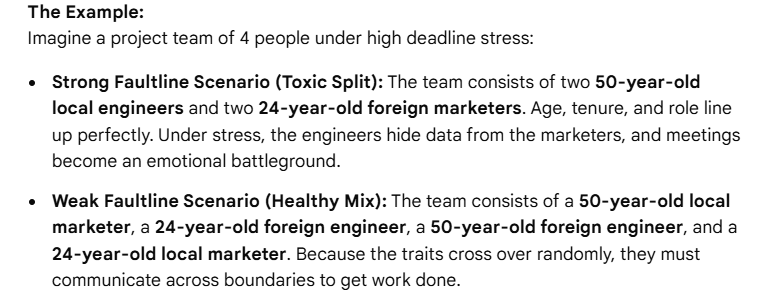
Faultline Theory
A management framework used to understand how individual differences within a team can align to split a group into distinct, conflicting sub-groups
Strong Faultlines: Attributes align perfectly, creating a highly destructive "us vs. them" dynamic.
Weak Faultlines (Better): Attributes are mixed randomly, forcing integration and preventing distinct cliques from forming.