AP Environmental Science Unit 1 (Module 3,4,5)
 Call Kai
 Learn
Learn Practice Test
 Spaced Repetition
 Match
Match Flashcards
 Knowt Play
1/60

There's no tags or description
Looks like no tags are added yet.
Name | Mastery | Learn | Test | Matching | Spaced | Call with Kai | Chat |
|---|
No analytics yet
Send a link to your students to track their progress
61 Terms
Scientists don’t categorize aquatic biomes based on what?
Aquatic organisms or species diversity.
What are the two categories of an aquatic biome?
Freshwater and marine biomes.

Freshwater biomes
categorized as streams, rivers, lakes, and ponds, or freshwater wetlands.
What are streams and rivers characterized as?
bodies of flowing water that can vary in size and habitat types, providing ecosystems for diverse organisms.
What is the difference between streams and rivers?
Streams are typically smaller and flow more rapidly than rivers, while rivers are larger and have a slower flow.
Littoral Zone
the shallow zone of soil and water in lakes and ponds near the shore where most algae and emergent plants such as cattails grow

Limnetic Zone
A zone of open water in lakes and ponds as deep as sunlight can penetrate

Inter title Zone
region of a shoreline that is between the high and low tide lines, characterized by varying levels of water exposure and distinct biological communities. often home to organisms adapted to fluctuating conditions.

Phytoplankton
Floating algae
Profundal Zone
A region water where sunlight does not reach, below the limnetic and profundal zones

Benthic Zone
The muddy bottom of a lake, pond, or ocean beneath the limnetic profundal zone

Oligotrophic
Describes a lake with a low level of phytoplankton due to low amounts of nutrients in the water

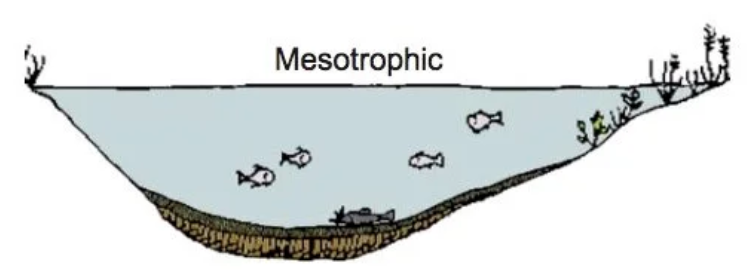
Mesotrophic
Describes a lake with a moderate level of nutrients/ fertility
Eutrophic
Describes a lake with a high level of fertility and nutrients

Freshwater Wetlands
An aquatic biome that is submerged or saturated by water for at least part if each year, but shallow enough to support emergent vegetation.

Estuary
An area along the coast where the fresh water of river mixes with salt water from the ocean
Salt Marsh
Found along the coast in temperate climates, a marsh continuously nonwoody emergent vegetation
What do both estuaries and salt marches provide?
important habitats for wildlife, help filter pollutants, and buffer shorelines against erosion.
Mangrove Swamps
A swamp that occurs along tropical and subtropical coasts and contain salt - tolerant trees with roots submerged in water
Coral Reef
represents Earth’s most diverse marine biome, & are found in warm, shallow waters beyond the shoreline in tropical regions

Coral Bleaching
A phenomenon in which algae inside corals die, causing the corals to turn white

Why do scientists believe the algae is dying?
due to rising sea temperatures, ocean acidification, and pollution, which stress the coral and lead to the expulsion of algae
Open Ocean
deep-ocean water, located away from the shoreline where sunlight for photosynthesis
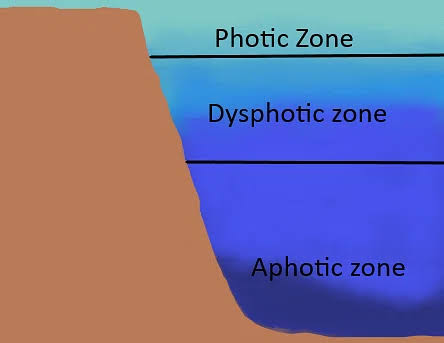
Photic Zone
The upper layer of ocean in the ocean that ocean that receives enough sunlight for photosynthesis

Aphotic Zone
The deeper layer of the ocean that lacks sufficient sunlight for photosynthesis, resulting in limited plant life.
Chemosynthesis
A process used by some bacteria to generate energy with methane and hydrogen sulfide
Biogeochemical Cycle
The movements of matter within and between ecosystems involving cycles of biological, geological, and chemical processes
Reservoirs
the components of the biogeochemical cycle that contain the matter, including air, water, soil, and organisms.
The Carbon Cycle
the movement of carbon around the biosphere among reservoir sources and sinks

What are the steps of the Carbon Cycle?
Photosynthesis
Respiration
Exchange
Sedimentation (Marine snow)
Burial
Extraction

What happens in the Carbon Cycle?
carbon is exchanged between the atmosphere, land, and ocean through processes such as photosynthesis, respiration, and decomposition, affecting climate and ecosystems.

Aerobic Respiration
the process by which cells convert glucose and oxygen into energy, carbon dioxide, and water
What happens when organisms die in the carbon cycle?
Decomposition releases carbon back into the atmosphere and soil, returning it to the carbon cycle.

Carbon Cycle Sedimentation
the process by which carbon is trapped in sediments or rocks over long periods, contributing to the geological carbon cycle.
Carbon Cycle Extraction
fossil fuels by humans - coal, oil, and natural gas as energy sources
Carbon Cycle Combustion
fossil fuels by humans - carbon by fires release carbon into the atmosphere as carbon dioxide (CO2) and other greenhouse gases.
Greenhouse Gases
Gases in Earth’s atmosphere that trap heat near the surface
Humans use to fossil fuels does what?
increase carbon dioxide
Global Warming
long-term increase in Earth's average surface temperature due to human activities, primarily the burning of fossil fuels, which elevate greenhouse gas levels.
Limiting Nutrient
a nutrient required for the growth of an organism but available in a lower quantity than other nutrients
Nitrogen Cycle
the movement of nitrogen around the biosphere among reservoir sources and sinks. As nitrogen moves through an ecosystem, it experiences many chemical transformations

Nitrogen Cycle Steps
Nitrogen Fixation
Nitrification
Assimilation
Mineralization
Denitrification

Nitrogen Fixation
the process that converts nitrogen gas in the atmosphere (N2) into forms of nitrogen that plants and algae can use

Nitrification
The conversion of ammonia (NH4+) into nitrite (NO2-) and then into nitrate (NO3-) conducted by specific bacteria

Nitrogen Cycle Assimilation
a process by which plants and algae incorporate nitrogen into their tissues. When herbivores feed on plants, some of the nitrogen is assimilated into their proteins and other biological molecules

Nitrogen Cycle Mineralization
the process by which fungal and bacteria decomposers break down the organic matter found in dead bodies and waste products and convert these organic compounds, such as inorganic ammonium (NH4+) also known as ammonification

Nitrogen Cycle Denitrification
the conversion of nitrate (NO3-) in a series of steps into gages nitrous oxide (N2O) and eventually, nitrogen gas (N2), which is emitted into the atmosphere

Anaerobic
An environment that lacks O2
Leaching
a process in which dissolved molecules are transported through the soil via groundwater
Phosphorus Cycle
The movement of phosphorus around the biosphere among reservoir sources and sinks

Phosphorus Cycle Steps
Assimilation
Mineralization
Sedimentation
Geologic & Uplift
Weathering
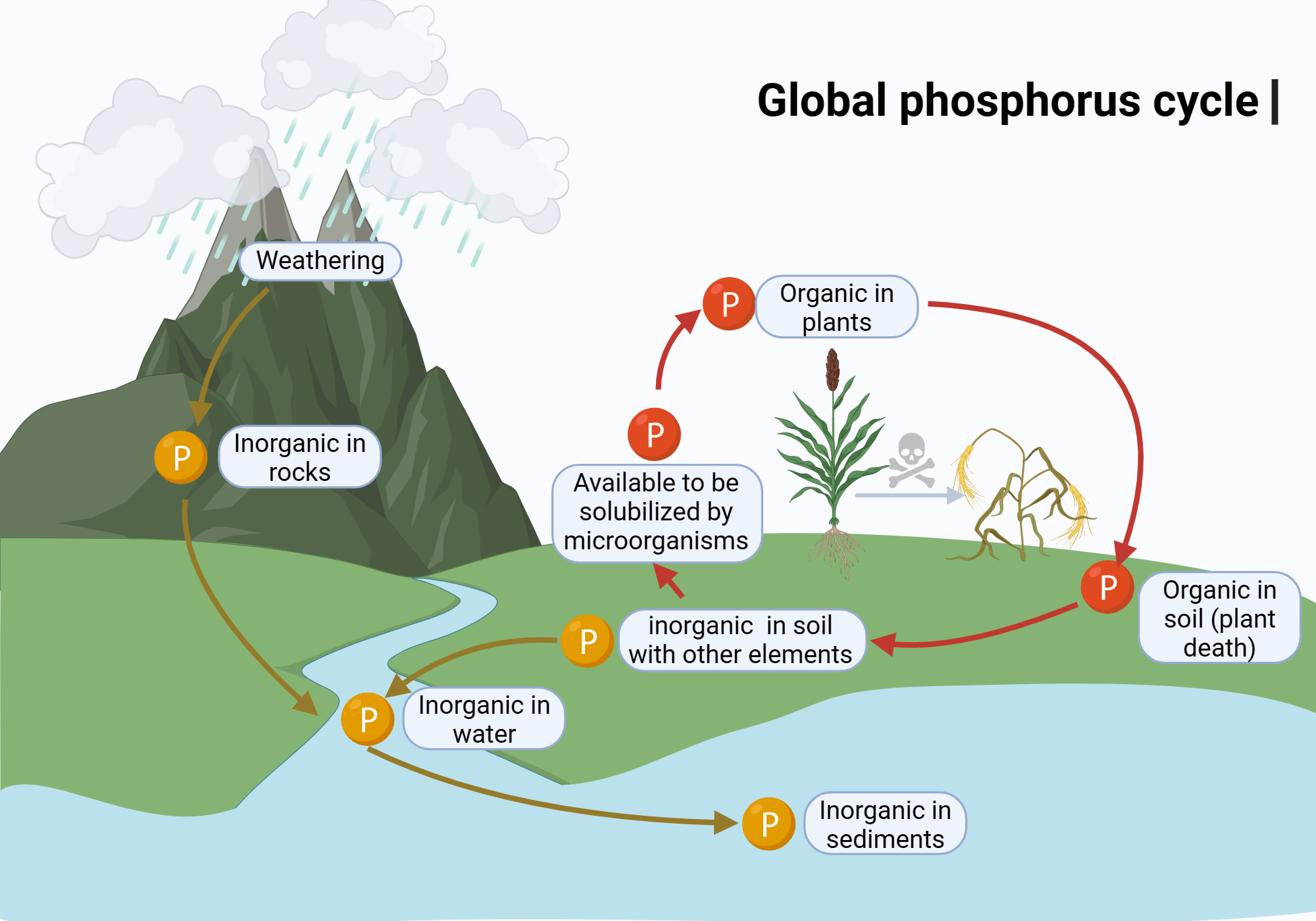
Phosphorus Cycle Assimilation & Mineralization
plants and animals on land and in water take up inorganic phosphate and assimilate the phosphorous into their tissues as organic phosphorus

Phosphorus Cycle Sedimentation, Geologic Uplift, and Weathering
The processes by which phosphorus is transformed from sediment into rock formations, uplifted to the surface, and released back into the soil and water systems through natural weathering.
Algal Bloom
a rapid increases in the algal population of waterway
Hypoxic
conditions occur in aquatic environments when oxygen levels are extremely low, often due to excessive nutrient pollution and algal blooms.
Dead Zone
when oxygen concentrations became so low that it kills fish and other aquatic animals, we refer to it as a dead zone in the water.
Hydrologic Cycle
the movement of water around the biosphere among reservoir sources and sinks
Transpiration
the release of water from leaves into the atmosphere during photosynthesis

Evapotranspiration
the combined amount of evaporation and transpiration

Runoff
water that moves across the land surface and into streams and rivers
How can you tell the difference between a freshwater zone and a salt water zone in a diagram?
freshwater zone has benthic zone and saltwater has a aphotic zone