Chapter 1-4: Acceleration due to Gravity, Force, Laws of Motion, Energy, Work, and Powerork a
 Call Kai
 Learn
Learn Practice Test
 Spaced Repetition
 Match
Match Flashcards
 Knowt Play
1/66

There's no tags or description
Looks like no tags are added yet.
Name | Mastery | Learn | Test | Matching | Spaced | Call with Kai | Chat |
|---|
No analytics yet
Send a link to your students to track their progress
67 Terms
ACCELERATION DUE TO GRAVITY
Aristotle
According to him, the heavier object fall faster than light objects in proportion to their weight. Objects fell to the ground because they wanted to return to their beginnings where they could be with other like objects.
Aristotle
According to him, the velocity of a body is INVERSELY proportional to the time it covers to travel certain weight.
Gallileo Galilei
According to him, if two objects of different weight are dropped from a height, both will hit the ground at the same time.
Vertical Motion
The concept of this is that no matter what the mass of the object is, as long as air resistance can be ignored, the acceleration due to gravity is the same for all objects at the same location on earth.
Acceleration due to gravity
It is represented by the symbol g.
Acceleration due to gravity
A vector quantity that both have magnitude and direction.
positive velocity
The direction up in gravity acceleration is equal to?
negative velocity
The direction down in gravity acceleration is equal to?
-9.80 m/s²
It is the equivalent of acceleration due to gravity on Earth.
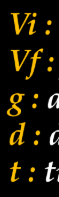
initial velocity, final velocity, gravity acceleration, displacement, time interval
List all the meaning of each symbol.
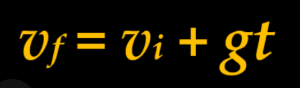
Final velocity
This formula is for
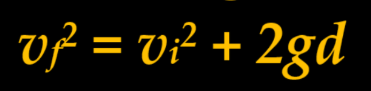
Final velocity
This formula is used when time is unknown. This formula is for?
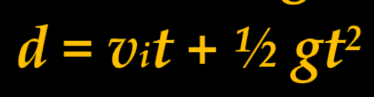
displacement
This formula is for?
TYPES OF FORCE
Sir Isaac Newton
He studied the cause of acceleration. He formulated the Three Laws of Motion.
Force
natural phenomenon
can be defined as push or pull
can be strong, moderate, weak
occurs when one subject touches one another.
Force
An example of this: coin flip. coin pushes downward on the hand.
Types of Forces
It includes:
Applied Force
Contact Force
Gravitational Force
Magnetic Force
Air Resistance Force
Tension Force
Electrical Force
Frictional Force
Applied Force
It is force exerted on an object by a person of another subject.
Contact Force
It is a type of force that require physical contact between the interacting object.
Gravitational Force
It is an attractive force exerted by a massive object like the Earth or Moon on another object towards itself.
Magnetic Force
It is opposite/attractive force whether it has the different poles = attract, same poles = repel. It acts on moving charges or magnetic materials.
Air Resistance Force
It is force that opposes the motion of an object through air.
Tension Force
It is the pulling force transmitted by means of a string, cable, etc.
Electrical Force
It is a non-contact interaction that has push or pull force between charged particles. It has an involvement of magnetic particles: positive and negative.
Frictional Force
It is the resistive force that must be overcome to equals relative motion.
Three Laws of Motion
Law of Inertia
Force = Mass x Acceleration
Action and Reaction
Law of Inertia
An object stays still if it is at rest, but an object in motion will be in motion unless an external force stops it. Example of this is a soccer ball running through a field in motion. Due to the friction of the grass, its motion is slows.
Force = Mass x Acceleration
The force on an object is equal to its mass multiplied by its acceleration.
F = ma
F = net force
m = mass
a = acceleration
This explains why massive objects require greater force to achieve the same acceleration of smaller objects.
Action and Reaction
For every action, there is an equal and opposite reaction. Force always occurs in pairs.
WORK AND ENERGY
Energy
It is important for us to do work
The work you do is dependent on the amount of this you have
We need more of this to compensate for the work we need to do
Work amount
More energy means more?
Work
It is the product of force exerted on an object and the distance the object moves in the direction of the force.
W=Fd
Work formula wherein W = work, F = force applied, d = distance object travels
Work
It is a vector quantity because it has both magnitude and direction.
Joule
It is the SI Unit of Work.
Newton
It is the SI Unit of Force.I
Meter
It is the SI unit of distance.
When object moves and it covers distance.
When does work happen?
POWER
Moving objects
It possess momentum and energy.
Energy
All objects regardless of their state of motion whether rest or moving possess a certain amount of ______.
Energy
It can be transformed from one form to another. In such transformations, it is still conserved.
Mechanical Energy
It is energy acquired by objects upon which work is done.
Potential, Kinetic
It is the 2 forms of Mechanical Energy.
Potential Energy
It is the energy possessed by objects at rest.
Gravitational Potential Energy, Elastic Potential Energy
2 kinds of potential energy
Gravitational potential energy
Energy possessed by an object because of its location or position.
Elastic Potential Energy
It is energy stored in a stretched or compressed elastic material such as spring.
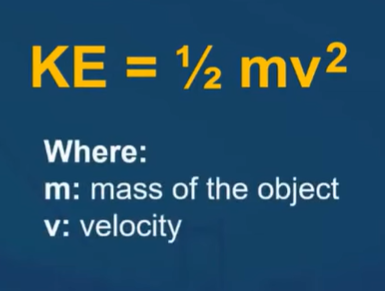
Kinetic Energy
It is energy possessed by an object by virtue of its motion.
Kinetic Energy
Examples of this are: a bullet in motion, rock falling off of a cliff.
Law of Conservation of Energy
It means energy can neither be created nor destroyed. It can only be transformed from one form to another.
Mechanical Energy
It is equal to the sum of potential energy and kinetic energy.
ME = PE + KE
Law of Conservation of Mechanical Energy
It states that in the absence of forces, the total amount of mechanical energy in a close system remains constant. It will not stop or accelerate unless external force acts upon it.
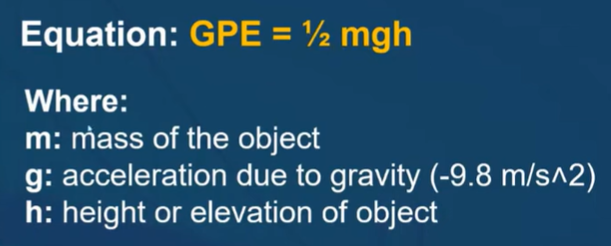
Gravitational Potential Energy
Energy an object posseses because of its position in a gravitational field.
Gravitational Potential Energy
This formula is for?
Kinetic Energy
This formula is for?
An object moves in the direction of the applied force
Work is said to be done when
0 Joule
Work done when a wall is pushed but does not move
Power
It is equal to work divided by time
Watt
It is the SI unit of power
Mass and height
Factors affecting potential energy
Chemical energy to kinetic energy
What energy transformation happens in a moving car
Kinetic energy quadruples
Effect on kinetic energy when speed is doubled
perpendicular
Work is zero when Force is ________ to displacement.