ACCT 2301 - Midterm Review
 Call Kai
 Learn
Learn Practice Test
 Spaced Repetition
 Match
Match Flashcards
 Knowt Play
1/53

Earn XP
Name | Mastery | Learn | Test | Matching | Spaced | Call with Kai | Chat |
|---|
No analytics yet
Send a link to your students to track their progress
54 Terms
the area of account aimed at serving the decision making needs of internal users is:
A. Financial accounting.
B. Managerial accounting.
C. External auditing.
D. SEC reporting
E. Bookkeeping
B. Managerial accounting.
Which of the following is NOT TRUE regarding a Certified Public Accountant?
A. Must meed education and experience requirments
B. Must pass an examination
C. Must exhibit ethical character
D. May also be a Certified Management Accountant
E. Cannot hold any certificate other than a CPA
E. Cannot hold any certificate other than a CPA
Which of the following factors is not a component of the fraud triangle?
A. Opportunity
B. Pressure
C. Rationalization
D. All of the above are components of the fraud triangle.
D. All of the above are components of the fraud triangle.
The Securities and Exchange Commission (SEC) has given the task of setting GAAP to the:
A. APB.
B. FASB.
C. AAA.
D. AICPA.
E. IASB.
B. FASB.
A partnership:
A. Is also called a sole proprietorship.
B. Has unlimited liability for its partners.
C. Has to have a written agreement in order to be legal.
D. Is a legal organization separate from its owners.
E. Has owners called shareholders.
B. Has unlimited liability for its partners.
If a company uses $1,300 of its cash to purchase supplies, the effect on the accounting equation would be:
A. Assets increase $1,300 and liabilities decrease $1,300.
B. One asset increases $1,300 and another asset decreases $1,300, causing
no effect.
C. Assets decrease $1,300 and equity decreases $1,300.
D. Assets decrease $1,300 and equity increases $1,300.
E. Assets increase $1,300 and liabilities increase $1,300.
B. One asset increases $1,300 and another asset decreases $1,300, causing
no effect.
If equity is $300,000 and liabilities are $192,000, then assets equal:
A. $108,000
B. $192,000
C. $300,000
D. $492,000
E. $792,000
D. $492,000
Outflows of cash and other resources to stockholders are:
A. Liabilities
B. Dividends
C. Expenses
D. Stock issuances
E. Revenues
B. Dividends
Assets created by selling goods and services on credit are:
A. Accounts payable
B. Accounts receivable
C. Liabilities
D. Expenses
E. Equity
B. Accounts receivable
The basic financial statements include all of the following except:
A. Balance Sheet
B. Income Statement
C. Statement of Retained Earnings
D. Statement of Cash Flows
E. Statement of Changes in Assets
E. Statement of Changes in Assets
Accounts payable appear on which of the following statements?
A. Balance Sheet
B. Income Statement
C. Statement of Retained Earnings
D. Statement of Cash Flows
E. Transaction statement
A. Balance Sheet
The accounting equation for Long Company shows an increase in its assets and an increase in its liabilities. Which of the following transactions could have caused that effect?
A. Cash was received from providing services to a customer
B. Cash was received a stockholder investment
C. Equipment was purchased on credit
D. Supplies were purchased for cash
E. Advertising expense for the month was paid in cash
C. Equipment was purchased on credit
Unearned revenues are generally:
A. Revenues that have been earned and received in cash.
B. Revenues that have been earned but not yet collected in cash.
C. Liabilities created when a customer pays in advance for products or services before the revenue is earned.
D. Recorded as an asset in the accounting records.
E. Increases to common stock.
C. Liabilities created when a customer pays in advance for products or services before the revenue is earned.
A company's ledger is:
A. A record containing increases and decreases in a specific asset, liability, equity, revenue, or expense item.
B. A journal in which transactions are first recorded.
C. A collection of documents that describe transactions and events entering the accounting process.
D. A list of all identification numbers used by the company.
E. A record containing all accounts and their balances used by the company.
E. A record containing all accounts and their balances used by the company.
A debit:
A. Always increases an account.
B. Is the right-hand side of a T-account.
C. Always decreases an account.
D. Is the left-hand side of a T-account.
E. Always increases liability accounts.
D. Is the left-hand side of a T-account.
A credit is used to record an increase in all of the following accounts except.
A. Accounts Payable
B. Service Revenue
C. Unearned Revenue
D. Wages Expense
E. Common Stock
D. Wages Expense
Identify the account below that is classified as an asset in a company's chart of accounts:
A. Accounts Receivable
B. Accounts Payable
C. Common Stock
D. Unearned Revenue
E. Service Revenue
A. Accounts Receivable
Which of the following is NOT an asset account:
A. Cash
B. Land
C. Services Revenue
D. Buildings
E. Equipment
C. Services Revenue
A business uses a credit to record:
A. An increase in an expense account.
B. A decrease in an asset account.
C. A decrease in an unearned revenue account.
D. A decrease in a revenue account.
E. A decrease in a common stock account.
B. A decrease in an asset account.
Gloria Catering provided $1,000 of catering services and billed its client for the amount owed. Determine the general journal entry that Gloria Catering will make to record this transaction. (debit first credit second.)
A. Unearned Catering Revenue
1,000
Catering Revenue
1,000
B. Catering Revenue
1,000
Accounts Receivable
1,000
C. Accounts Receivable
1,000
Unearned Catering Revenue
1,000
D. Accounts Receivable
1,000
Catering Revenue
1,000
E. Accounts Payable
1,000
Catering Revenue
1,000
D. Accounts Receivable
1,000
Catering Revenue
1,000
Russell Co. received a $400 utility bill for the current month's electricity. It is not due until the end of the next month which is when they intend to pay it. Which of the following general journal entries will Russell Co. make to record the receipt of the
bill?
A. Utilities Expense 400
Accounts Receivable 400
B. Cash 400
Utilities Expense 400
C. Utilities Expense 400
Accounts Payable 400
D. Accounts Payable 400
Utilities Expense 400
E. No journal entry is required.
C. Utilities Expense 400
Accounts Payable 400
exp: remember that with an Accounts Payable account, it is classified as a liability account, which means any increases to it are done through credit. Initially, I was confused by this because I thought it was similar to Accounts Receivable, and that a credit meant a decrease. However! Accounts Receivable is classified as an asset account, which means any increases are done through debit.
Smart Consulting, paid cash dividends of $2,000 to its common stockholders. Identify the general journal entry below that Smart Consulting will make to record the transaction. (debit first, credit second).
A. Dividends 2,000
Cash 2,000
B. Common Stock 2,000
Cash 2,000
C. Dividends 2,000
Common Stock 2,000
D. Cash 2,000
Common Stock 2,000
E. Cash 2,000
Dividends 2,000
A. Dividends 2,000
Cash 2,000
The process of transferring general journal entry information to the ledger is called:
A. Double-entry accounting.
B. Posting.
C. Balancing an account.
D. Journalizing.
E. Not required unless debits do not equal credits.
B. Posting.
While in the process of posting from the journal to the ledger, a company failed to post a $500 debit to the Equipment account. The effect of this error will be that:
A. The Equipment account balance will be overstated.
B. The trial balance will not balance.
C. The error will overstate the debits listed in the journal.
D. The total debits in the trial balance will be larger than the total credits.
E. The error will overstate the credits listed in the journal.
B. The trial balance will not balance.
Adjusting entries:
A. Affect only income statement accounts.
B. Affect only balance sheet accounts.
C. Affect both income statement and balance sheet accounts.
D. Affect cash accounts.
E. Affect only equity accounts.
C. Affect both income statement and balance sheet accounts.
Which of the following statements is incorrect?
A. Adjustments to prepaid expenses and unearned revenues involve previously recorded assets and liabilities.
B. Accrued expenses and accrued revenues involve assets and liabilities that had not previously been recorded.
C. Adjusting entries can be used to record both accrued expenses and accrued
revenues.
D. Prepaid expenses, depreciation, and unearned revenues often require adjusting entries to record the effects of the passage of time.
E. Adjusting entries affect only balance sheet accounts.
E. Adjusting entries affect only balance sheet accounts.
The periodic expense created by allocating the cost of plant and equipment to the periods in which they are used, representing the expense of using the assets, is called:
A. Accumulated depreciation.
B. A contra account.
C. The expense recognition (matching) principle.
D. Depreciation expense.
E. An accrued account.
D. Depreciation expense.
exp: Depreciation expense is the cost of an asset that has been depreciated for a single period, and shows how much of the asset's value has been used up in that year. Accumulated depreciation is the total amount of depreciation expense that has been allocated for an asset since the asset was put into use
If throughout an accounting period the fees for legal services paid in advance by clients are recorded in an account called Unearned Legal Fees, the end-of-period adjusting entry to record the portion of those fees that has been earned is:
A. Debit Cash and credit Legal Fees Earned.
B. Debit Cash and credit Unearned Legal Fees.
C. Debit Unearned Legal Fees and credit Legal Fees Earned.
D. Debit Legal Fees Earned and credit Unearned Legal Fees.
E. Debit Unearned Legal Fees and credit Accounts Receivable.
C. Debit Unearned Legal Fees and credit Legal Fees Earned.
exp: remember what type of account unearned revenues are. THEY ARE A LIABILITY. As we work off our “liability” we decrease it and increase our equity. It works similarly to our Accounts Payable account.
Three types of accounts it can be: Asset, Liability or Equity. If it is an asset account, debit means an increase while credit is a decrease. Liability and equity accounts, debit means decrease while credit is a increase.
Which of the following does not require an adjusting entry at year-end?
A. Accrued interest on notes payable.
B. Supplies used during the period.
C. Cash invested by stockholders.
D. Accrued wages.
E. Expired portion of prepaid insurance.
C. Cash invested by stockholders.
exp: what would be weird to report on the next years financials? Adjusting entries seek to recognize revenue in the period in which it was earned, rather than the period in which cash is received. We know that adjusting the supplies during the period is important for the next year because we used up some of those supplies during the current year, so reporting the same amount from the beginning for be misleading. Same goes for accrued interest on notes payable, accrued wages, and prepaid insurance.
On May 1, a two-year insurance policy was purchased for $18,000 with coverage to begin immediately. What is the amount of insurance expense that would appear on the company's income statement for the first year ended December 31?
A. $750.
B. $5,270.
C. $6,000.
D. $6,750.
E. $18,000.
C. $6,000.
exp: 24/18000 = 750
8 × 750 = 6,000
Fragmental Co. leased a portion of its store to another company for eight months beginning on October 1, at a monthly rate of $800. Fragmental collected the entire $6,400 cash on October 1 and recorded it as unearned revenue. Assuming adjusting entries are only made at year-end, the adjusting entry made by
Fragmental Co. on December 31 would be:
A. A debit to Rent Revenue and a credit to Cash for $2,400.
B. A debit to Rent Revenue and a credit to Unearned Rent for $2,400.
C. A debit to Cash and a credit to Rent Revenue for $6,400.
D. A debit to Unearned Rent and a credit to Rent Revenue for $2,400.
E. A debit to Unearned Rent and a credit to Rent Revenue for $4,000.
D. A debit to Unearned Rent and a credit to Rent Revenue for $2,400.
exp: Key word to this problem is the ADJUSTING part. At first, I was thinking in terms of just journal entries. Unearned Revenue is a liability account, and to adjust and account for us chipping away/using up a liability account we have to debit it. Rent Revenue is an equity account, and to adjust and account for us adding to our equity, we credit it.
A physical count of supplies on hand at the end of May for Masters, Inc. indicated $1,250 of supplies on hand. The general ledger balance before any adjustment is $2,100. What is the adjusting entry for office supplies that should be recorded on May 31?
A. Debit Supplies Expense $1,250 and credit Supplies $1,250.
B. Debit Prepaid Supplies $850 and credit Supplies Expense $850.
C. Debit Supplies Expense $1,250 and credit Supplies $2,100.
D. Debit Supplies $1,250 and credit Cash $1,250.
E. Debit Supplies Expense $850 and credit Supplies $850.
E. Debit Supplies Expense $850 and credit Supplies $850.
exp: We started with $2,100 worth of supplies. How do we adjust to get to just $1,250 worth of supplies? To adjust, we take those two values and find out how much supplies were used, and then add that to our Supplies Expense and subtract that from our overall Supplies.
The adjusted trial balance contains information pertaining to:
A. Asset accounts only.
B. Balance sheet accounts only.
C. Income statement accounts only.
D. All general ledger accounts.
E. Revenue accounts only.
D. All general ledger accounts.
On December 1, Milton Company borrowed $300,000, at 8% annual interest, from the Tennessee National Bank. Interest is paid when the loan matures one year from the issue date. What is the adjusting entry for accruing interest that Milton would
need to make on December 31, the calendar year-end?
A. debit Interest Payable, $2,000; credit Interest Expense, $2,000.
B. debit Interest Expense, $2,000; credit Interest Payable, $2,000.
C. debit Interest Expense, $2,000; credit Cash, $2,000.
D. debit Interest Expense, $4,000; credit Interest Payable, $4,000.
E. debit Interest Expense, $24,000; credit Interest Payable, $24,000.
B. debit Interest Expense, $2,000; credit Interest Payable, $2,000.
exp: Key word, adjusting. We are using up an expense and to adjust and account for that we need to add to our interest payable. As we go we accrue more interest, and more debt. As for the 2,000 we get that by 300,000 × 0.08 = 24,000 then 24,000/12 = 2,000
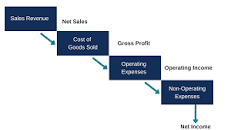
Which of the following statements regarding gross profit is not true?
A. Gross profit is also called gross margin.
B. Gross profit less other operating expenses equals income from operations.
C. Gross profit is not calculated on the multiple-step income statement.
D. Gross profit must cover all operating expenses to yield a return for the owner(s) of the business.
E. Gross profit equals net sales less cost of goods sold.
C. Gross profit is not calculated on the multiple-step income statement.
exp: Gross profit is the first section of a multi-step income statement, and it is obtained by deducting the cost of goods sold from the total sales.
Which of the following statements regarding merchandise inventory is not true?
A. Merchandise inventory is reported on the balance sheet as a current asset.
B. Merchandise inventory refers to products a company owns and intends to
sell.
C. Merchandise inventory may include the costs of freight-in and making them ready for sale.
D. Merchandise inventory appears on the balance sheet of a service company.
E. Purchasing merchandise inventory is part of the operating cycle for a
business.
D. Merchandise inventory appears on the balance sheet of a service company.
The amount recorded for merchandise inventory includes all of the following except:
A. Purchase discounts.
B. Returns and allowances.
C. Freight costs paid by the buyer.
D. Freight costs paid by the seller.
E. Trade Discounts
D. Freight costs paid by the seller.
A company purchased $1,800 of merchandise on July 5 with terms 2/10, n/30. On July 7, it returned $200 worth of merchandise. On July 8, it paid the full amount due. The amount of the cash paid on July 8 equals:
A. $200.
B. $1,564.
C. $1,568.
D. $1,600.
E. $1,800.
C. $1,568.
exp: 1600-32=1,568
A company purchased $1,800 of merchandise on July 5 with terms 2/10, n/30. On July 7, it returned $200 worth of merchandise. On July 12, it paid the full amount due. Assuming the company uses a perpetualinventory system, and records purchases using the gross method, the correct journal entry to record the payment on July 12 is:
A. Debit Merchandise Inventory $1,600; credit Cash $1,600.
B. Debit Cash $1,600; credit Accounts Payable $1,600.
C. Debit Accounts Payable $1,600; credit Merchandise Inventory $32; credit Cash $1,568.
D. Debit Accounts Payable $1,800; credit Cash $1,800.
E. Debit Accounts Payable $1,600; credit Cash $1,600.
C. Debit Accounts Payable $1,600; credit Merchandise Inventory $32; credit Cash $1,568.
Which of the following statements regarding sales returns and allowances is not true?
A. A reduction in the selling price because of damaged merchandise is included
in sales returns and allowances.
B. Sales returns and allowances do not have an impact on gross profit.
C. Sales returns and allowances are recorded in a separate contra-revenue
account.
D. Sales returns and allowances are rarely disclosed in published financial statements.
E. Sales returns and allowances are closed to the Income Summary account.
B. Sales returns and allowances do not have an impact on gross profit.
A debit to Sales Returns and Allowances and a credit to Accounts Receivable:
A. Reflects an increase in amount due from a customer.
B. Recognizes that a customer returned merchandise and/or received an allowance.
C. Records the cost side of a sales return.
D. Is recorded when a customer takes a discount.
E. Reflects a decrease in amount due to a supplier.
B. Recognizes that a customer returned merchandise and/or received an allowance.
Cushman Company had $800,000 in sales, sales discounts of $12,000, sales returns and allowances of $18,000, cost of goods sold of $380,000, and $275,000 in operating expenses. Gross profit equals:
A. $770,000.
B. $115,000.
C. $390,000.
D. $402,000.
E. $408,000.
C. $390,000.
exp: Net sale - discount - returns - COGs
800,000 - (12,000 + 18,000 + 380,000)
On March 12, Klein Company sold merchandise in the amount of $7,800 to Babson Company, with credit terms of 2/10, n/30. The cost of the items sold is $4,500. Klein uses the perpetual inventory system and the grossmethod of accounting for sales. The journal entry or entries that Klein will make on March 12 is (are):
A. Sales 7,800
Accounts receivable 7,800
B. Sales 7,800
Accounts receivable 7,800
Cost of goods sold 4,500
Merchandise Inventory 4,500
C. Accounts receivable 7,800
Sales 7,800
D. Accounts receivable 7,800
Sales 7,800
Cost of goods sold 4,500
Merchandise Inventory 4,500
E. Accounts receivable 4,500
Sales 4,500
D. Accounts receivable 7,800
Sales 7,800
Cost of goods sold 4,500
Merchandise Inventory 4,500
On March 12, Klein Company sold merchandise in the amount of $7,800 to Babson Company, with credit terms of 2/10, n/30. The cost of the items sold is $4,500. Klein uses the perpetual inventory system and the gross method of accounting for sales. On March 15, Babson returns some of the merchandise, which is not defective. The selling price of the returned merchandise is $600 and the cost of the merchandise returned is $350. The entry or entries that Klein must make on March 15 is (are):
A. Sales returns and allowances 600
Accounts receivable 600
Merchandise inventory 350
Cost of goods sold 350
B. Sales returns and allowances 600
Accounts receivable 600
C. Accounts receivable 600
Sales returns and allowances 600
D. Accounts receivable 600
Sales returns and allowances 600
Cost of goods sold 350
Merchandise inventory 350
E. Sales returns and allowances 350
Accounts receivable 350
A. Sales returns and allowances 600
Accounts receivable 600
Merchandise inventory 350
Cost of goods sold 350
Costs included in the Merchandise Inventory account can include all of the following except.
A. Invoice price minus any discount.
B. Transportation-in.
C. Storage.
D. Insurance.
E. Damaged inventory that cannot be sold.
C. Storage.
During a period of steadily rising costs, the inventory valuation method that yields the highest reported net income is:
A. Specific identification method.
B. Average cost method.
C. Weighted-average method.
D. FIFO method.
E. LIFO method.
D. FIFO method.
The inventory valuation method that has the advantages of assigning an amount to inventory on the balance sheet that approximates its current cost, and also mimics the actual flow of goods for most businesses is:
A. FIFO.
B. Weighted average.
C. LIFO.
D. Specific identification.
E. Lower of cost or market.
A. FIFO.
Which of the following inventory costing methods will always result in the same values for ending inventory and cost of goods sold regardless of whether a perpetual or periodic inventory system is used?
A. FIFO and LIFO
B. LIFO and weighted-average cost
C. Specific identification and FIFO
D. FIFO and weighted-average cost
E. LIFO and specific identification
C. Specific identification and FIFO
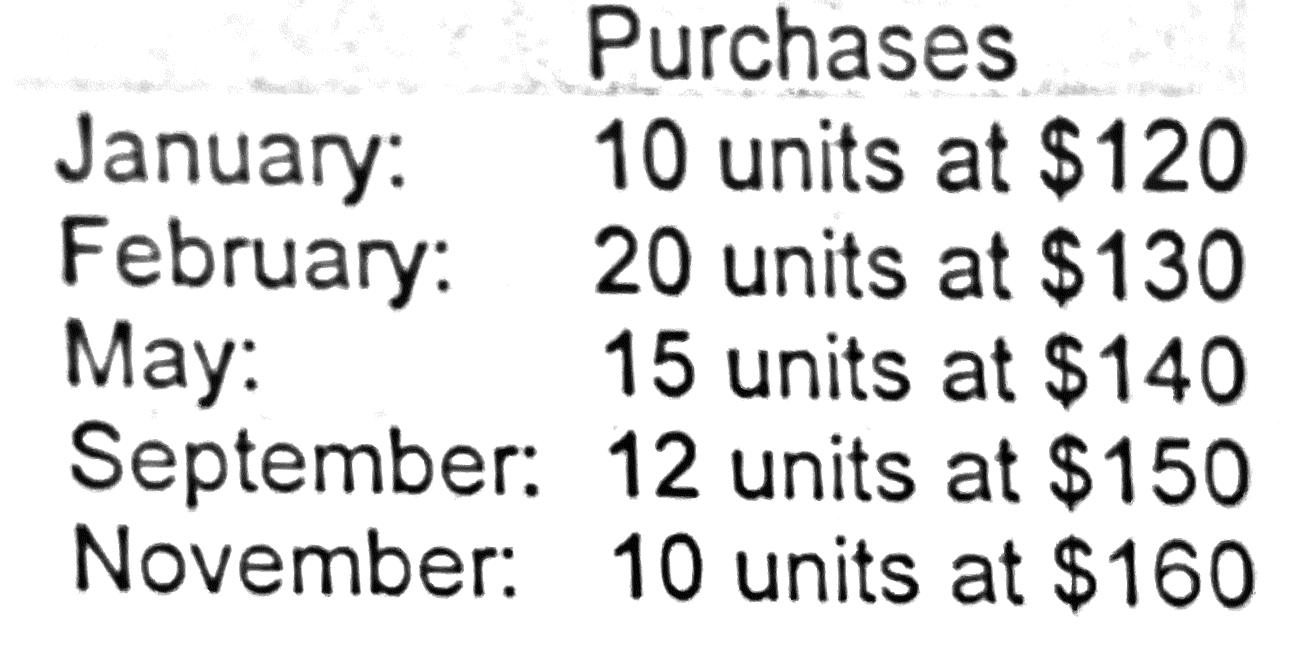
A company had the following purchases during its first year of operations:
On December 31, there were 26 units remaining in ending inventory. These 26 units consisted of 2 from January, 4 from February, 6 from May, 4 from September, and 10 from November. Using the specific identification method, what is the cost of the ending inventory?
A. $3,500.
B. $3,800.
C. $3,960.
D. $3,280.
E. $3,640.
B $3,800.
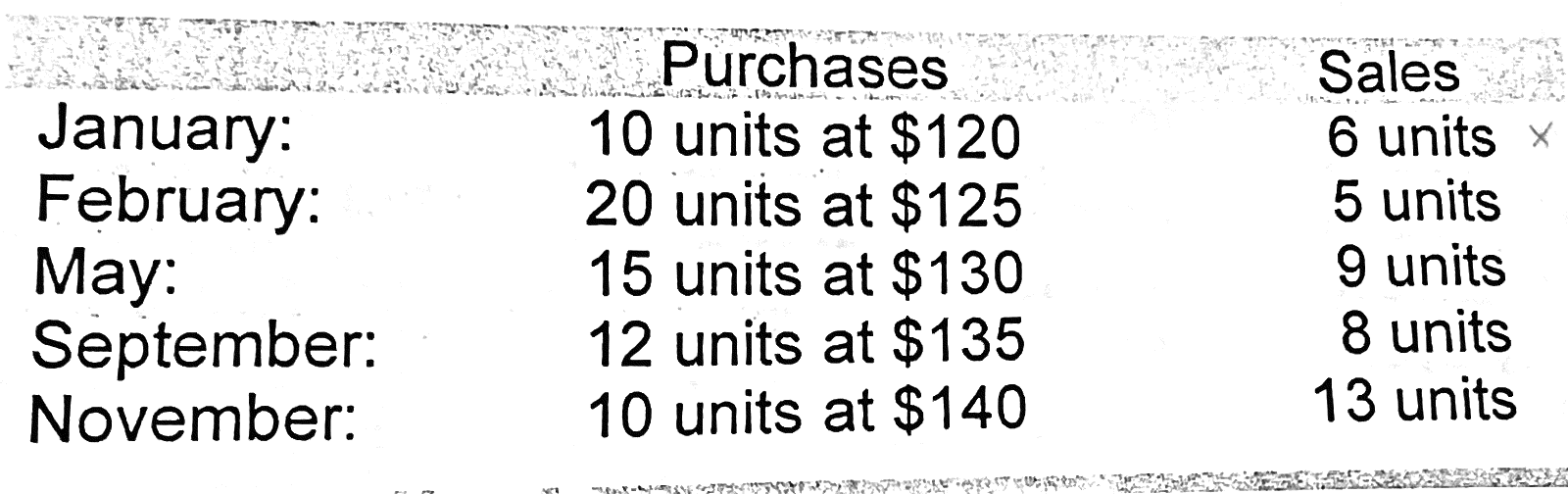
A company had the following purchases and sales during its first year of operations;
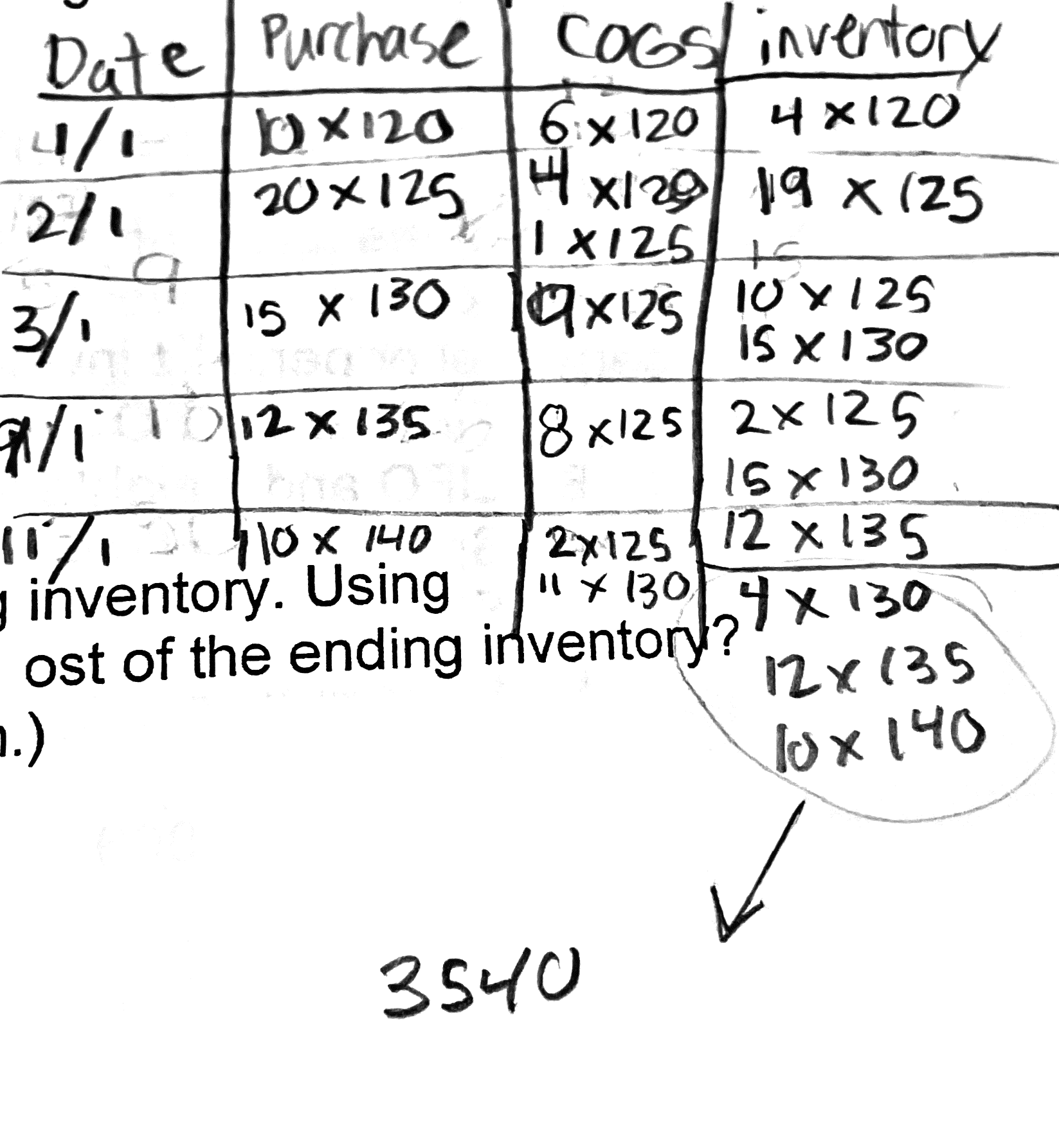
On December 31, there were 26 units remaining in ending inventory. Using the perpetual FIFO inventory costing method, what is the cost of the ending inventory?
(Assume all sales were made on the last day of the month.)
A. $3,405.
B. $3,200.
C. $3,365.
D. $3,540.
E. $3,270.
D. $3,540.
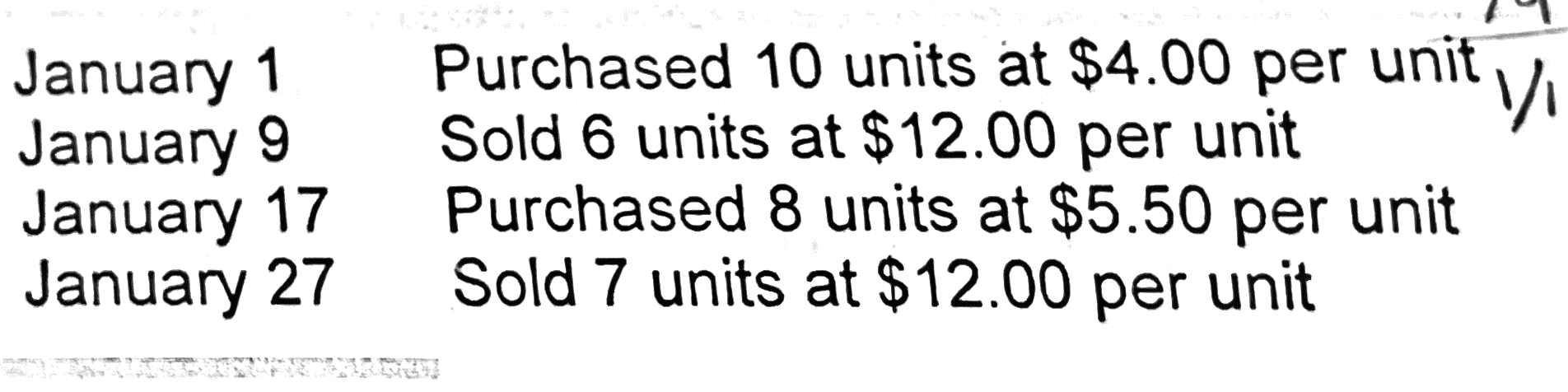
A company had the following purchases and sales during its first month of operations:
Using the perpetual weighted average method, what is the value of cost of goods sold? (Round weighted average costs per unit to 2 decimal places.)
A. $40.00.
B. $59.00.
C. $25.00.
D. $24.00.
E. $23.35.
B. $59.00.
exp: for weighted average method, we need to find what our new average COGS is. To do so, we take the average of the units divided by the average of the cost per unit.
Generally accepted accounting principles require that the inventory of a company be
reported at:
A. Market value.
B. Historical cost.
C. Lower of cost or market.
D. Replacement cost.
E. Retail value.
C. Lower of cost or market.
All of the following statements regarding the financial statement impact of inventory costing are true except.
A. When purchase prices are changing, the methods to assign inventory costs result in different amounts for cost of goods sold.
B. Inventory on the balance sheet approximates current cost when FIFO is used.
C. The weighted average method smooths out erratic changes in costs.
D. Selected costing method does not impact net income.
E. Cost of goods sold on the income statement approximates current cost when LIFO is used.
D. Selected costing method does not impact net income.
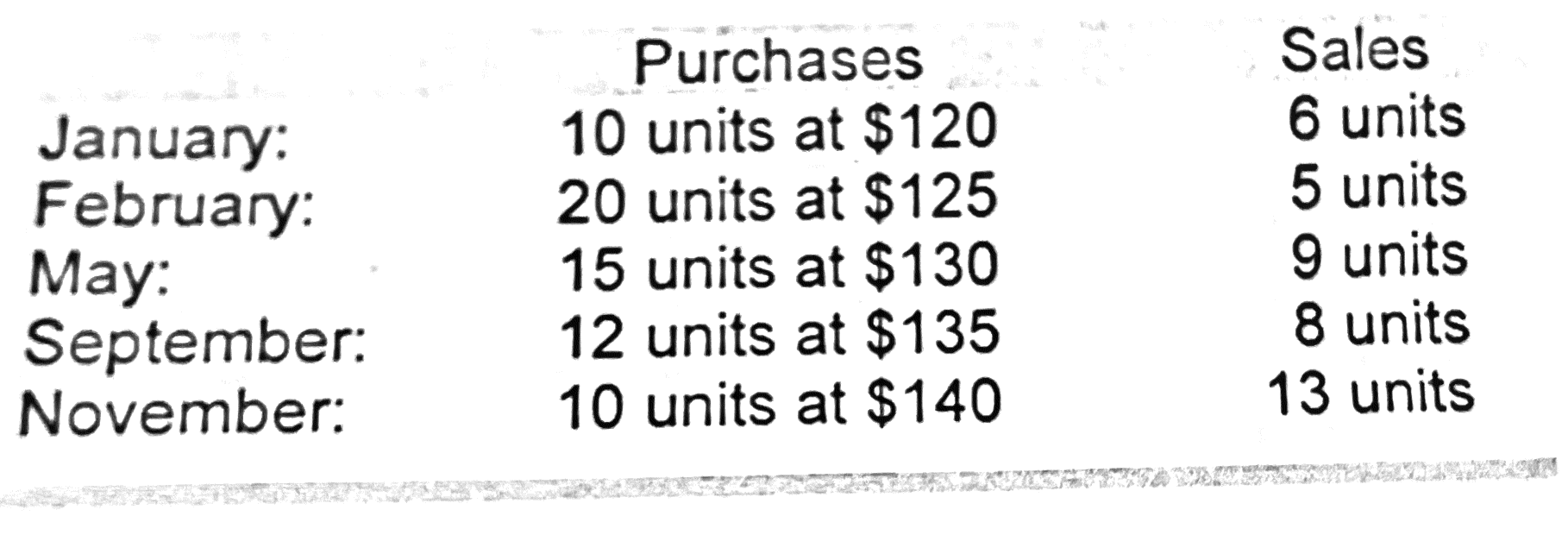
A company had the following purchases and sales during its first year of operations:
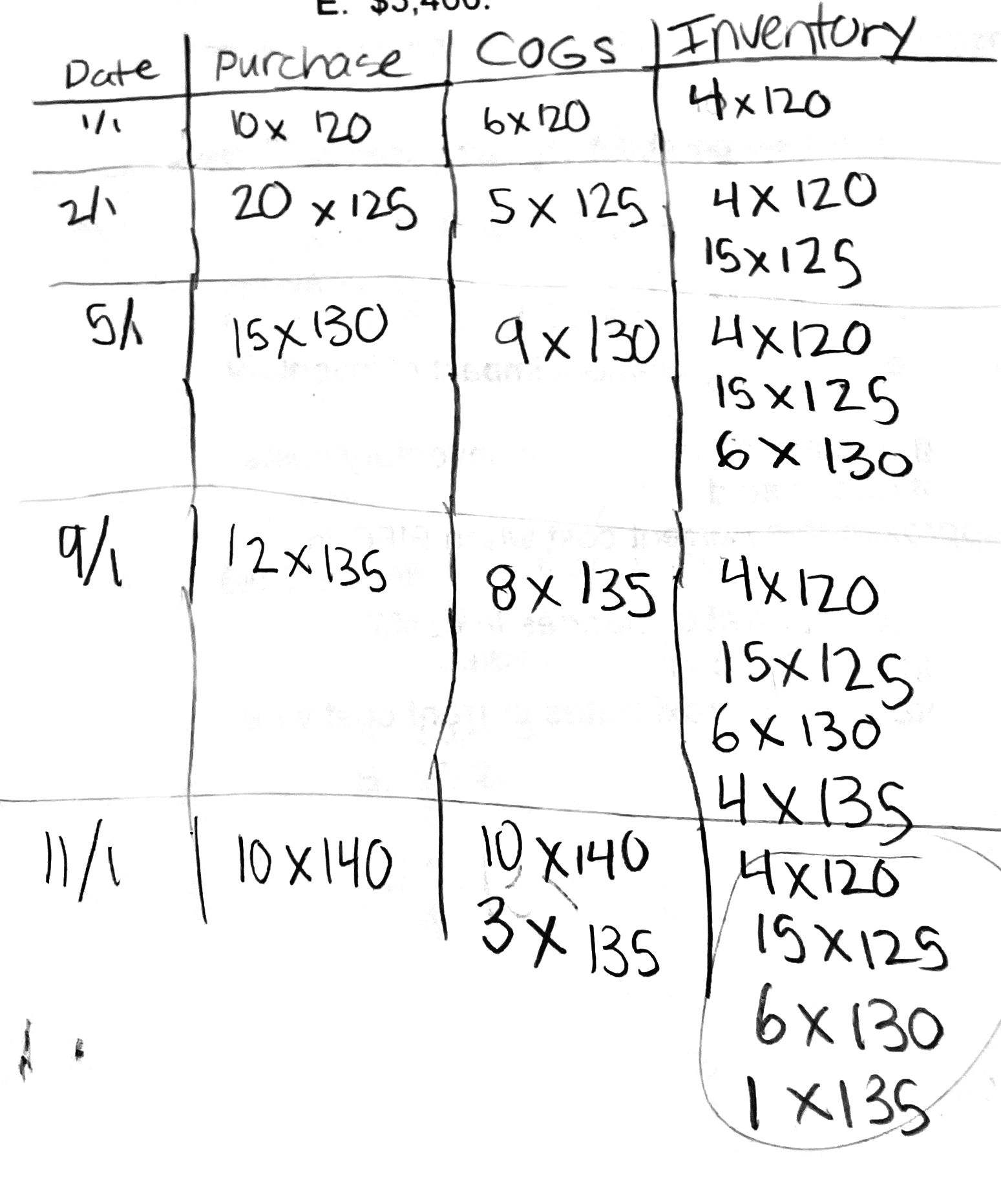
On December 31, there were 26 units remaining in ending inventory. Using the perpetual LIFO inventory costing method, what is the cost of the ending inventory? (Assume all sales were made on the last day of the month.)
A. $3,405.
B. $3,270.
Ć. $3,200.
D. $3,364.
E. $5,400.
B. $3,270.