Chap 14C - O&C Eu
 Call Kai
 Learn
Learn Practice Test
 Spaced Repetition
 Match
Match Flashcards
 Knowt Play
1/9

There's no tags or description
Looks like no tags are added yet.
Name | Mastery | Learn | Test | Matching | Spaced | Call with Kai | Chat |
|---|
No analytics yet
Send a link to your students to track their progress
10 Terms
Describe STF + its 2 types
Bind to specific non-coding DNA sequences known as control elements to regulate the rate of transcription
2 types of STF :
One group binds to the proximal control element, located near the promoter
Another group of STF (activators or repressors) binds specifically to the distal control elements (enhancers or silencers)
Describe activators
Are proteins that increase / upregulate the rate of transcription by binding to enhancers -> facilitate assembly and correct positioning of transcription initiation complex on promoter
Describe function of activators (DNA bending proteins)
Trigger DNA looping mechanisms with the help of DNA bending proteins
This brings the activator close to the promoter to interact with the transcription initiation complex
The interaction will upregulate the activity of RNA polymerase to increase the rate of transcription of amylase gene to produce more protein
Describe repressors
Proteins which interfere with transcription initiation or reduce the rate of transcription when bound to silencers
Describe functions of repressors
Repressor can also block the binding of an activator protein to the enhancer sequence
Repressor can bind to and mask the activation domain of an activator protein to prevent it from interacting with the transcription initiation complex
Repressor can also package whole regions of the eukaryotic chromatin into heterochromatin that is normally resistant to transcription
Repressor can also recruit histone deacetylases to the promoter for histone modifications to condense the chromatin at the promoter region, making it less accessible
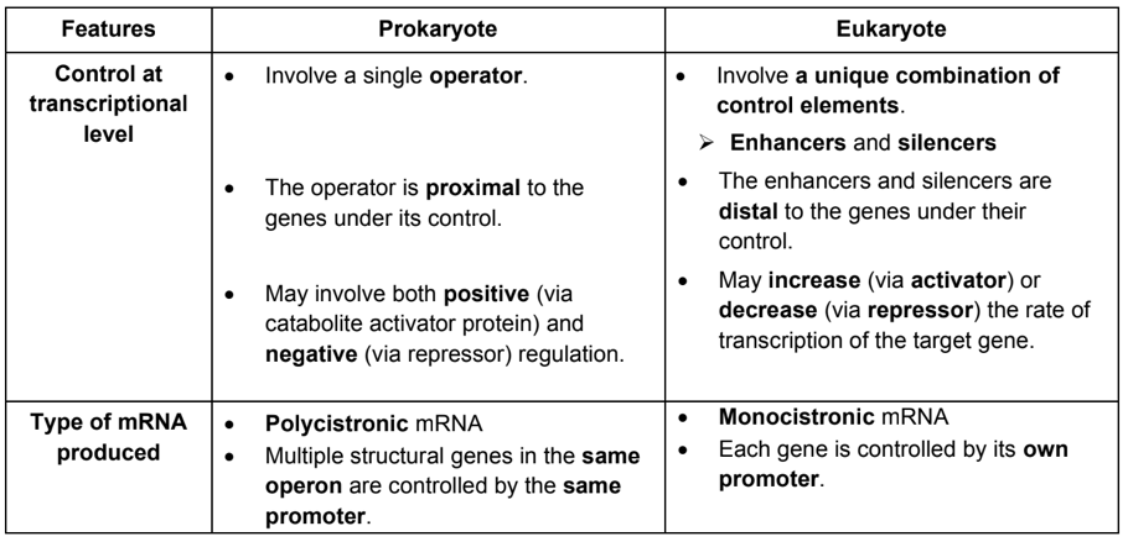
Compare control at transcriptional level + type of mRNA produced for pro vs eu
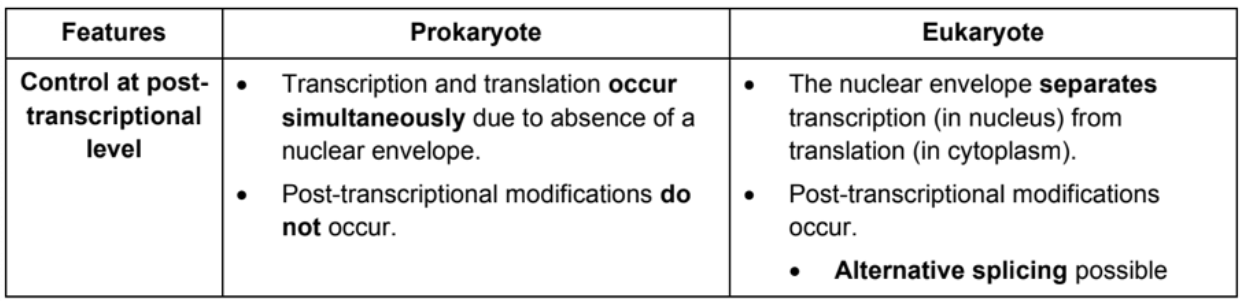
Compare control at post-transcriptional level pro VS eu
Describe half-life of RNA
The more stable (longer half-life) an mRNA is, the longer it remains in the cytoplasm and the more times it can serve as a template for the translation of more proteins
By modulating the half-life of specific mRNA transcripts, cells can adjust the abundance of corresponding proteins -> enables cells to rapidly adapt to new stimuli and maintain homeostasis
Half life influenced by:
Presence of 5’ cap
Shields the mRNA against degradation by 5’ exonucleases
Presence 3’ poly-A tail
Acts as a buffer against degradation by 3’ exonucleases
Reduced poly-A tail decrease half-life of mRNA -> reduce time mRNA has to be translated -> reduce amount of polypeptides produced
Binding of inhibitors which slow down degradation of mature mRNA by exonucleases in the cytoplasm
NOTE: Even though 5’ capping and 3’ polyadenylation occur during PTCM, , their effects in terms of regulation of gene expression are seen at the translational level
Describe translation initiation regulation
Sequence-specific RNA binding proteins (translational repressors) bind to the 5’ UTR of mRNA and prevent ribosome binding and formation of translational initiation complex
Sometimes, a RNA molecule complementary to the 5’ UTR regulates translation initiation by binding to the 5’ UTR to block the binding to ribosomes
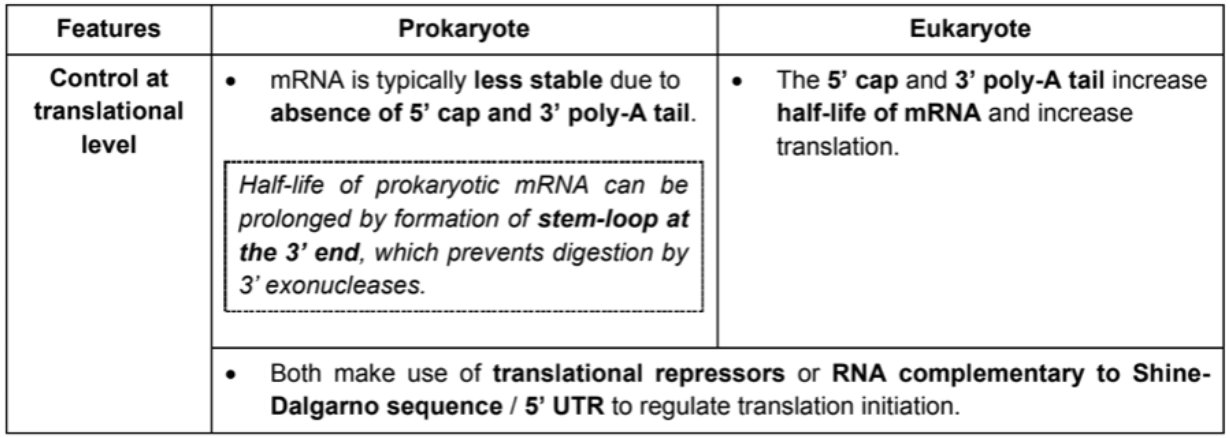
Compare control at translational level pro VS eu