Chem 352, wk4-5, Polar Pi bonds
 Call Kai
 Learn
Learn Practice Test
 Spaced Repetition
 Match
Match Flashcards
 Knowt Play
1/14

There's no tags or description
Looks like no tags are added yet.
Name | Mastery | Learn | Test | Matching | Spaced | Call with Kai | Chat |
|---|
No analytics yet
Send a link to your students to track their progress
15 Terms
polar pi bond
such as C=O or N=C were the carbon is electron poor and the electronegative atom is electron rich
a nucleophile comes in and attacks the carbon electrophile
1) nuc addition 2) proton transfer
Oxidation State
OIL RIG = oxidation is loss of electrons, reduction is gain
o.s = valence e - owned e
C owns one e- from a c-c bond
C own zero e- from a bond with a more electronegative atom (O)
C owns two e- from a bond with a less electronegative atom (H)
Reduction of carbonyls
reduce aldehyde to make 1 degree alcohol
reduce ketone to make 2 degree alcohol
using NaBH4 or LiAlH4
LiAlH4 can reduce
aldehydes, ketones, esters and carboxylic acids because it is more electronegative
NaBH4 can reduce
aldehydes and ketones, but not esters and carboxylic acids
Why can’t NaH be used to reduce things?
NaH is a strong base but a poor nuc
cant be used for addition, makes enolates instead
Organometallic Reagents
organolithium, gringards, lithiumdicuperates
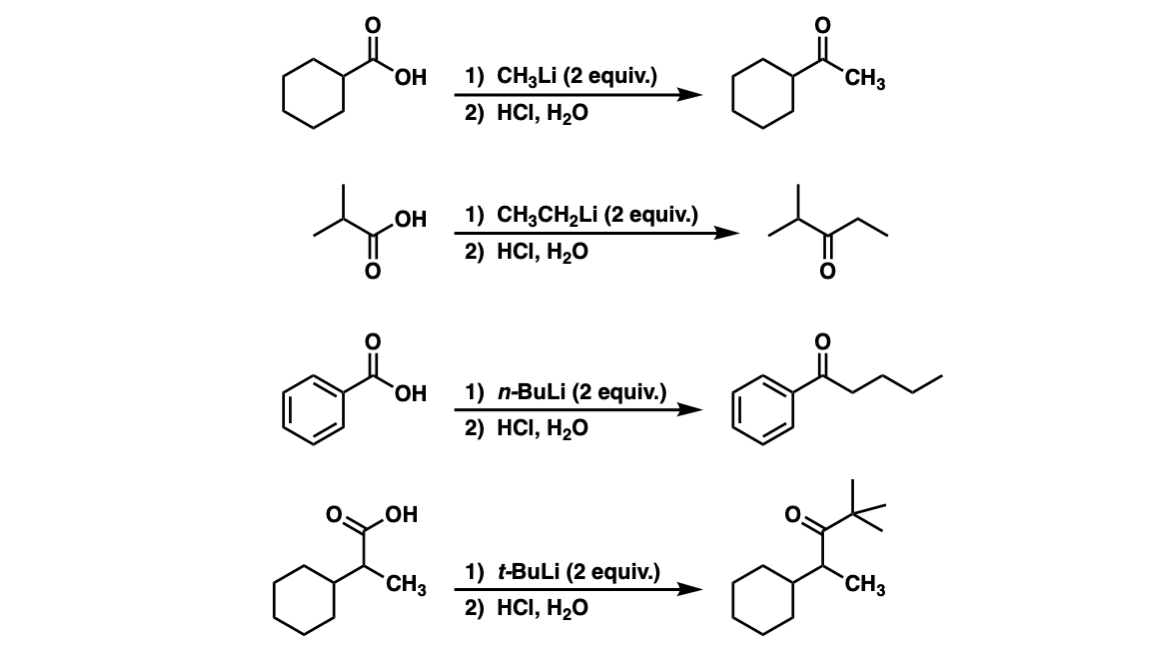
alkyl lithium
Organometallic Reagent that can be used to make new c-c bonds
highly reactive
Carbon bonded to lithium has a partial negative charge, making it nucleophilic.
This property allows them to react readily with compounds like water, alcohols, and carbonyl groups in ketones and aldehydes, forming new carbon-carbon bonds
Grignard Reagents
Mg inserts itself into a carbon-halogen bond
can add to carbonyls to make alcohols
can open epoxides to make alcs
check for chiral centers that make racemic mixtures
Limitations of Gringards
can’t have any water or other acidic protons
can’t have more than one type of electrophillic mulit bond group or it will compete for the reaction
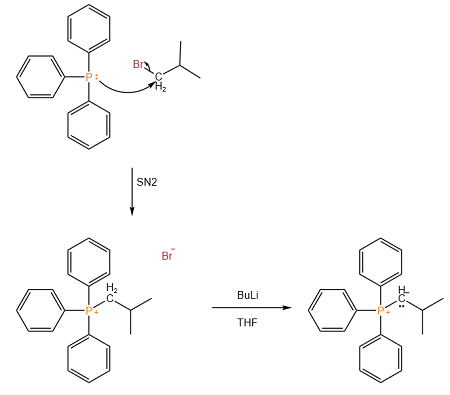
Wittig Reagents
Phosphorus attached to three benzene rings and a negatively charged carbon with two methyl groups
helps make alkenes but unlike E2 reactions, uses SN2
Reaction Speed of carbonyls
formaldehyde reacts faster than aldehyde which reacts faster than a ketone
ketones have the most steric hindrance
Organocuperates
also called gilman’s reagents, and lithium dialkylcuprates (R₂CuLi)
softer nucleophiles than than Grignard or organolithium reagents cus smaller difference in electronegativity
useful nucleophiles for conjugate addition as well as SN2 reactions
halide/tosylate couplings, substituted epoxide ring openings, conversion of acid chlorides to ketones
Which reagent(s) will undergo the 1,4 addition to an alpha, beta unsaturated carbonyl?
Cuprates (aka Gilman Reagents)
Which reagent(s) will undergo the direct addition to a polar pi bond?
Organolithium reagents (R-Li), LiAlH4 and Grignard reagents (RMgX)