BBB
 Studied by 0 people
 Call Kai
 Learn
Learn Practice Test
 Spaced Repetition
 Match
Match Flashcards
 Knowt Play
1/242

There's no tags or description
Looks like no tags are added yet.
Name | Mastery | Learn | Test | Matching | Spaced |
|---|
No study sessions yet.
243 Terms
definition of sensation?
the arriving info from the senses - specialised receptors dedicated to each sensation (transduce info)
definition of perception?
once info from senses is sent to the brain, this is where processing occurs
what is vestibulation?
vestibulation system made up of receptors in inner ear that respond to body position/tilting of the head - this info used alongside other senses in order to perceive what is happening → also important for balance
the vestibular organ, in the ear, consists of how many organs?
2
the vestibular organ, in the ear, consists of organs which are?
the semicircular canals, the otolith organ
what is the structure of the semicircular canals?
has 3 canals pointed in different directions, filled with fluid (endolymph) with hair cells in it
what is the function of the semicircular canals?
movement causes endolymph to move against hair, bending said hair (orientated on 3 planes - comparative stimulation gives brain info about movement of head)
what is the structure of otolith organs?
comprised of utricle and saccule - different orientations (similar to the endolymph but they are glutinous, movement due to gravity)
what is the function of otolith organs?
these sends messages about our position in 3D space, sensitive to acceleration/deceleration/direction changes
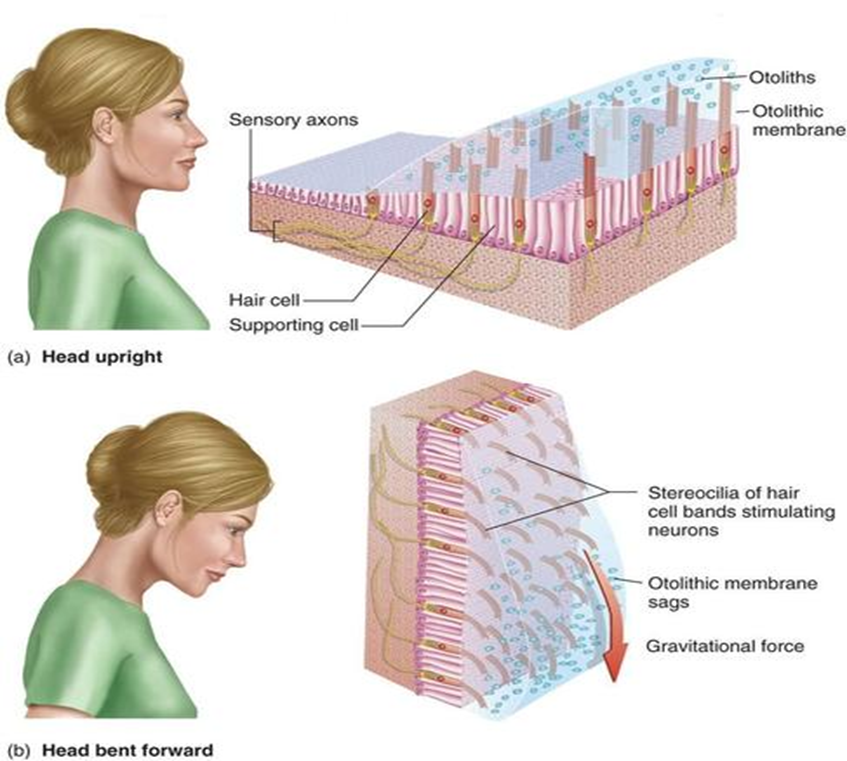
how do otoliths work?
otoliths have weight, so when we move our heads back or forward, the weight shifts and stimulates/bends the hair cells, which sends signals to the brain
what is somatosensation?
the sense of the body
what are some key aspects of somatosensation?
Hapsis, kinesthesis/vestibular, proprioception, temperature, pain
What is Hapsis?
fine touch/pressure
what is kinesthesis/vestibular?
movement, position and spatial orientation/balance
what is proprioception?
awareness of our body in space, walking/running, not falling over
there are 20 different types of receptors for touch, where/what are they?
sensory neurons, in all parts of the body (except brain), vary in density and sensitivity to stimuli
there are different varieties of receptors according to location, what are the ones where stimuli is inside the body?
Interoceptors, Proprioceptors
there are different varieties of receptors according to location, what are the ones where stimuli is outside the body?
Exteroceptors
what are the 2 types of skin on mammals?
hairy and glabrous
What is glabrous skin?
hairless, very sensitive because we use it to explore objects, specialised for discriminative touch to mediate things like grip control
what is the functions of skin overall?
protective function, prevents evaporation of bodily fluids, provides direct contact with the world →sensitivity of our skin varies by location and function
what does discriminative touch mean?
This is what we normally mean when we discuss touch, being able to determine stimuli from skin and body tissue → facilitated by specialised touch receptors with different structures
What are haptic receptors?
These are receptors on our skin which detect vibration and pressure, these are ‘touch receptors’, detecting fine touch/pressure
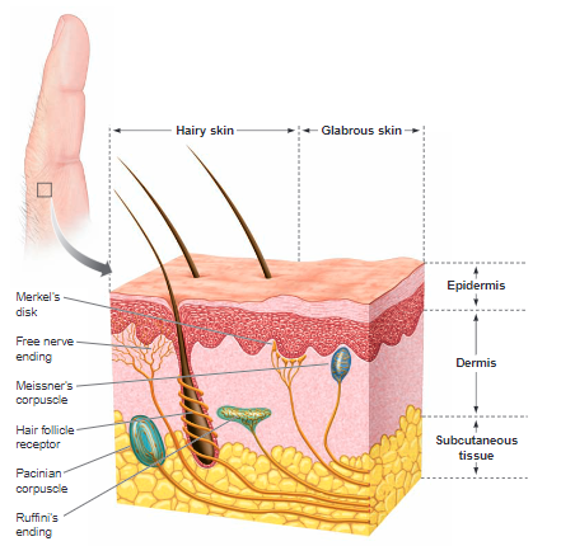
what is the epidermis (skin)?
Top layer of skin, contains cells that produce pigment and protect immune system
what is the dermis (skin)?
Contains much of our nerve endings, oil and sweat glands, and hair follicles
what is the subcutaneous tissue (skin)?
Fat, connective tissue, blood vessels, protecting underlying organs/muscles
function of hair receptors?
Dendrite attached to hair on your skin, as an object moves across skin, these hairs move, sending a nerve impulse → detects direction because specialised receptors for each direction
what are the 2 types of cutaneous receptors known to be found?
Encapsulated (surrounded by a capsule) and Unencapsulated (Includes free nerve endings)
what are properties to free nerve endings (unencapsulated)?
mostly common in skin (different forms), dendrite of sensory neuron, polymodal (meaning not specialised) so its sensitive to painful stimuli, hot and cold and to light touch, slow to adjust to a stimulus
what are the 4 primary tactile mechanoreceptors?
Pacinian Corpuscles, Ruffini’s Corpuscles, Merkel’s Disks, Meissner’s Corpuscles
properties of the Pacinian Corpuscle?
the specific capsule involved in pressure detection, important for detecting deep touch and vibration, rapidly-adapting (changing stimuli), thin layer structure, found in both hairy and glabrous skin
properties of Ruffini’s Corpuscle (AKA Ruffini’s ending)?
also found deep in dermis and subcutaneous tissue, also found in both glabrous and hairy skin →sensitive to stretching/sustained deep touch, slow adapting
properties of Merkel’s disk + nerve endings?
Unencapsulated, found in epidermis and deeper, found in both glabrous and hairy skin, tonic receptors (sustained light touch, slow adapting)
properties of Meissner’s Corpuscle (AKA Tactile Corpuscle)?
encapsulated receptor, found high within dermis, particularly found in glabrous skin and finger pads, rapidly adapting, sensitive to light touch (changing stimuli), sensitive to shape/textural changes in exploratory and discriminatory touch
what do nociceptors do?
They detect pain and temperature
what do thermoreceptors do (temperature receptors)?
Detects temperature, separates for hot and cold
What is another term for the sense of taste?
gustation - allows perception of taste through chemical stimuli
What is the name of the muscular organ which is the primary organ of gustation?
the tongue
What is the surface of the tongue covered in?
papillae and taste buds (different papillae across tongue) - tiny bumps ON papillae are our taste buds
What is the sense organ for taste?
taste buds
where are taste receptors located?
on and under tongue, on soft palate, side and back of mouth
How many receptor types are grouped into a taste bud?
5
What are the the 5 receptor types grouped into taste buds?
sweet, sour, salty, bitter, umami
How do the receptors work in our taste buds?
they respond to different chemical components → chemicals from food must first dissolve in saliva
About how many clusters of taste receptor cells consists of in each taste bud?
50 - 150
Why does our ‘taste’ change over time?
it appears to change because by the age of 20, we lose half our receptors
stimuli interact with receptors tips, opening ion channels, leading to change in ______ potential
membrane
what types of papillae are there?
circumvallate, foliate, fungiform
form/location of circumvallate papillae?
large, round - back of tongue
form/location of foliate papillae?
arranged in folds - sides of tongue
form/location of fungiform papillae?
mushroom-shaped - scattered but primarily tip of tongue
How does the sense of taste travel from taste buds to the brain?
nerve fibres connected to taste buds travel from tastebuds to the brain stem via cranial nerves - forms the gustatory nerve
How many pathways does the gustatory nerve divide into?
2
What is the first pathway that the gustatory nerve take?
through posterior medulla to ventroposterior medial nucleus of thalamus - from there two SUB-pathways
What are the sub-pathways that are taken from pathway one of the gustatory nerve?
-one to primary somatosensory cortex (for tactile info)
-one to gustatory cortex of the insula (for flavour)
What is the second pathway the gustatory nerve divides into?
projects through pons to hypothalamus and amygdala → hypothesized to play a role in feeding behaviour
what are 3 abnormalities of taste?
ageusia, hypogeusia, dysgeusia
what is the definition of ageusia?
absence of the sense of taste
What may ageusia be caused by?
may be caused due to cranial nerve damage or problems with endocrine system (eg, salivary glands)
what is the definition of hypogeusia?
diminished taste sensitivity
what may cause hypogeusia?
often due to medication
what is the definition of dysgeusia?
disturbed sense of taste - various potential causes/treatments, diagnosis complicated as taste is tied with other sensory systems
what may cause dysgeusia?
various potential causes/treatments, diagnosis complicated as taste is tied with other sensory systems
what are modern methods of studying brain and behaviour?
neuropsychology, electroencephalography (EEG), neuroimaging (PET, fMRI, MEG), transcranial magnetic stimulation (TMS)
What is neuropsychology?
The study of brain damage and how certain regions affect behaviour
what is electroencephalography (EEG)?
Measures electrical activity of the brain - WHEN activity in brain happens
what are PET scans? (neuroimaging)
Oldest method of neuroimaging - injects mildly radioactive material in brain, machine then captures which regions of brain is active during a task - WHERE activity happens
what is fMRI? (neuroimaging)
Similar process as PET but more precise - captures WHERE activity happens
What is magnetoencephalography (MEG)? - neuroimaging
Captures WHERE and WHEN activity happens
what is transcranial magnetic stimulation (TMS)?
Allows stimulation (increase or decrease) of brain activity in a specific region of the brain - involves looking at consequences of such stimulation
What is one type of information that can be gathered from EEGs?
Event Related Potentials (ERPs)
What are event related potentials (ERPs)?
Measures activity in response to a specific stimulus - ERPs often used in neurobiological research investigating psychological functions
what does an MRI (magnetic resonance imaging) show?
Neuroanatomy- identifies different regions of the brain and the nervous system
how/what does fMRI (functional magnetic resonance imaging) do?
Measures blood flow in the brain during a (mental) activity → establishes the role of different brain regions in psychological functioning (WHERE brain activity occurs)
How is the Nervous System divided?
Central nervous system (CNS), Peripheral nervous system (PNS)
what is the central nervous system (CNS) made up of?
Brain, spinal cord
what is the Peripheral nervous system (PNS) made up of?
Somatic nervous system (SNS), autonomic nervous system (ANS), enteric nervous system
what is the autonomic nervous system (ANS) made up of?
Sympathetic nervous system, Parasympathetic nervous system
what is the somatic nervous system (SNS) connected to?
It connects the brain to the sensory organs to receive incoming info (AFFERENT pathways → also connects the brain to the muscles to produce movement (EFFERENT pathways)
What does the somatic nervous system (SNS) enable?
It enables interaction between us and the environment
How many pairs of cranial nerves does the somatic nervous system (SNS) consist of?
12 pairs
which cranial nerves in the somatic nervous system (SNS) are responsible for sensory info?
1 (smell), 2 (vision), 7 (hearing and balance)
which cranial nerves in the somatic nervous system (SNS) are responsible for motor functions?
3, 4, 6 (eye movements), 9 (neck muscles), 12 (tongue)
Which of the cranial nerves in the somatic nervous system (SNS) makes up the sensory AND motor functions?
5, 7, 8, 10, 11
how many pairs of spinal nerves does the somatic nervous system (SNS) consist of?
31 pairs
what is the autonomic nervous system (ANS) responsible for?
Regulating internal organs - regulating ‘autonomous’ systems that are involuntary
what is the function of the sympathetic nervous system?
Responsible for fight or flight response (prepares body for action/response to danger) → increases heart rate, blood pressure, pupil dilation
what is the function of the parasympathetic nervous system (PNS)?
Promotes recovery from the actions of the sympathetic system (rest/digest, helps body relax) → decreases heart rate, blood pressure, stimulated digestion
what is the function of the enteric nervous system?
Functions largely independently outside ANS - regulates digestion, helps control nutrient absorption and waste elimination
what are neurons structurally?
Building blocks of the nervous system
what are neurons often described as?
Basic information-processing units
Who proposed the neuron doctrine?
Ramon y Cajal
what are 2 ways that neurons can be categorised by?
By function, by shape
what are the 3 types of neurons BY FUNCTION?
Sensory, motor, interneurons (relay neurons)
what are the 3 types of neurons BY SHAPE?
Multipolar, Bipolar, Unipolar
what are sensory neurons?
They carry information from the body to the spinal cord and brain
what are motor neurons?
They carry info from the nervous system to the muscles and internal organs
what are interneurons/relay neurons?
They receive info from neurons and pass it on to other neurons
what is a multipolar neuron?
A neuron that has many dendrites, single axon