Chap 27B - Transition Metals
 Call Kai
 Learn
Learn Practice Test
 Spaced Repetition
 Match
Match Flashcards
 Knowt Play
1/13

There's no tags or description
Looks like no tags are added yet.
Name | Mastery | Learn | Test | Matching | Spaced | Call with Kai | Chat |
|---|
No analytics yet
Send a link to your students to track their progress
14 Terms
Describe transition elements with low OS
Transition elements with low OS
Usually found in ionic compounds because the ionisation energy involved is small
Oxides are basic
Some oxides of transition elements are amphoteric (Eg. Cr2O3)
Describe transition elements with high OS
Usually found in covalent compounds because formation of ions with high charge is difficult as it involves large amount of ionisation energy
Oxides are acidic
When excess zinc is added to a solution occurring VO2+ ions, a series of colour changes (yellow -> blue) Use Eo to explain reactions and the respective colour changes.
Zn2+ + 2e– ⇌ Zn Eo = –0.76 V
VO2+ + 2H+ + e– ⇌ VO2+ + H2O Eo = +1.00 V
Eo = +1.76V > 0
Reaction is spontaneous. Overall equation: Zn + 2VO2+ + 4H+ -> Zn2+ + 2VO2+ + 2H2O
VO2+ is reduced to VO2+ which is blue in colour
A mixture of yellow VO2+ and blue VO2+ gives rise to a green
When more powdered zinc is added to the solution, more VO2+ is formed and the solution turns blue
Define complex
Complex/complex ion (Def.): species which consists of a central metal atom or metal ion surrounded by ligands bonded to it by dative bonds
Define ligands
Ligands (Def.): molecules or anions that have at least one lone pair of electrons which can be used for forming dative bond with a metal atom or ion
Describe [Pt(NH3)4Cl2]Cl2 complex
6 ligands in the complex ion (4NH3 and 2Cl–)
2Cl– ligands inside the square brackets are datively bonded to central Pt(IV) ion
Cl– outside of [ ] are ions held by ionic attraction to the complex
Describe denticity
Number of atoms that the ligands use to bind to the metal atom/ion
Describe Multidentate ligands
Multidentate ligands (Aka chelate): a ligand that forms two or more dative bonds to the same metal centre
Highly stable
Describe type of ligands
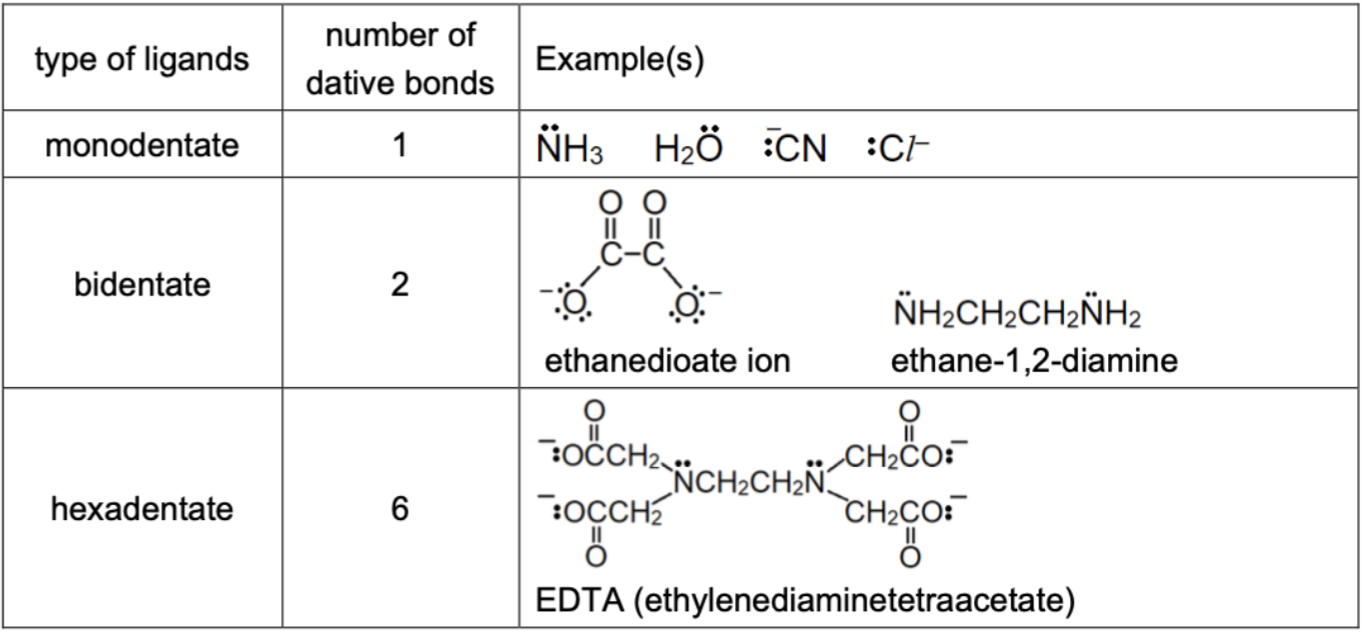
Complexes are formed because…
Transition metals have high charge density -> high polarising power to accept lone electron pairs from surrounding ligands into 3d/4s/4p available vacant orbitals -> bond is formed by overlapping a filled orbital of the ligand with an empty orbital of the metal atom or ion -> form dative bonds
Define coordination number
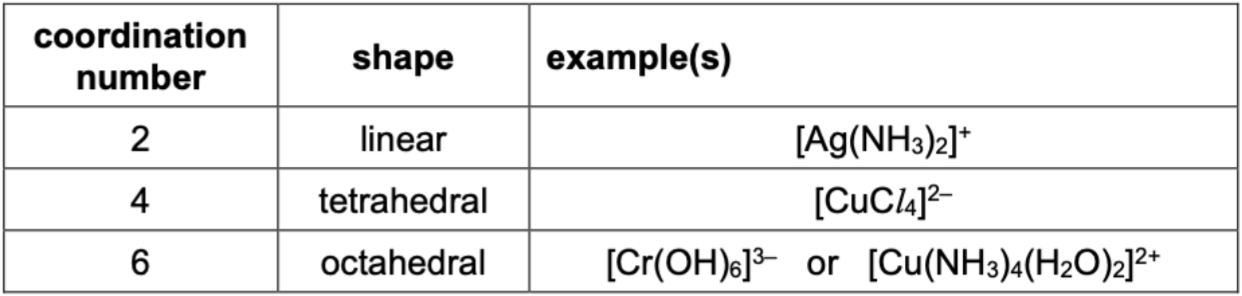
Coordination number of a transition metal complex is the number of dative bonds formed by the transition metal atom or ion with the ligands in the complex
Describe types of shapes of complex ions
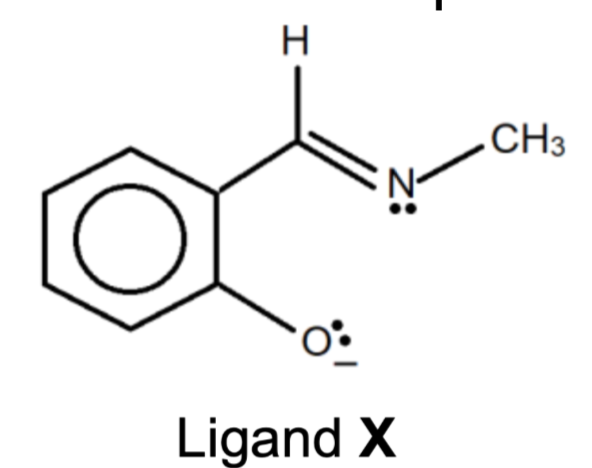
What is the likely coordination number of nickel in this complex ion
X is a bidentate ligand
Each X molecule forms 2 dative bonds with Ni2+
Since the ratio of X : Ni2+ is 2:1 (Given) , and each
X forms 2 dative bonds, the coordination number is 4
PtCI4 combines with NH3 to form compounds in which the coordination number of platinum is 6. A formula unit of one such compound contains a cation and only two chloride ions. What is the compound?
OS Pt is +4 -> 4 CI- in formula unit to balance charges
2 of CI- are ions -> 2 CI- are ligands
Coordination number is 6 -> 2 CI- ligands, remaining 4 ligands are NH4
Ans: [Pt(NH3)4(Cl)2]Cl2