L11 - The Citric Acid Cycle
 Call Kai
 Learn
Learn Practice Test
 Spaced Repetition
 Match
Match Flashcards
 Knowt Play
1/11

There's no tags or description
Looks like no tags are added yet.
Name | Mastery | Learn | Test | Matching | Spaced | Call with Kai | Chat |
|---|
No analytics yet
Send a link to your students to track their progress
12 Terms
Goal of TCA
oxidizing every single carbon of glucose for energy
TCA found in
matrix of mitochondria
Total ATP from oxidation =
28 ATP
+2 ATP from glycolysis and 2 GTP = 32 ATP total
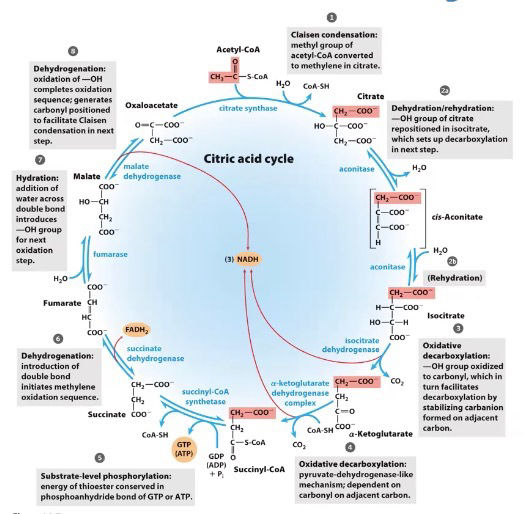
Reactions of The Citric Acid Cycle (TCA cycle)
Acetyl-CoA + Oxaloacetate/OAA (Gluconeogenesis) → Citrate via Citrate synthase (Creates CoA-SH byproduct); Large -ΔG; Irreversible
Citrate → Isocitrate via aconitase; Dehydrating and rehydrating to move an OH group (Tert to Sec alc), creating a more accessible area for reduction
Isocitrate → α-Ketoglutarate (α-KG) via Isocitrate dehydrogenase (Needs NAD(P)+), creates NAD(P)H + H+ + CO2 as byproduct; Irreversible
α-KG → Succinyl-CoA via α-Ketoglutarate dehydrogenase complex (Needs CoA-SH + NAD+), creates NADH + CO2 byproduct; This complex is similar to PDH (Has all 3 Ex subunits); Irreversible
Succinyl-CoA → Succinate via succinyl-CoA synthetase (substrate-level phosphorylation), removes CoA group (CoA-SH), and turns GDP/ADP to GTP/ATP
Succinate → Fumarate via succinate dehydrogenase (Needs FAD), makes FADH2 byproduct
Fumarate → L-Malate via fumarase
L-Malate → Oxaloacetate via L-malate dehydrogenase (Needs NAD+) NADH + H+ byproduct
If not specified, reversible
Notes: Step 8: Oxaloacetate sink (Low concentration) drives the reaction forward
There are several ways to enter the TCA cycle
TCA Mnemonic (Enzymes)
Can (Citrate synthase)
Anyone (Aconitase)
Interested (Isocitrate dehydrogenase)
Kindly (a-Ketoglutarate dehydrogenase)
Send (Succinyl-CoA synthetase)
Some (Succinate dehydrogenase)
Freaking (Fumarase)
Money (Malate dehydrogenase)
TCA Mnemonic (Products)
Can → Citrate
I → Isocitrate
Keep → α-Ketoglutarate
Selling → Succinyl-CoA
Sex → Succinate
For → Fumarate
Money → Malate
Officer → Oxaloacetate
Citrate synthase inhibitors and activators
Inhibitors: NADH, succinyl-CoA, citrate, ATP
Activators: ADP
Isocitrate dehydrogenase inhibitors and activators
Inhibitors: ATP
Activators: Ca2+, ADP
α-Ketoglutarate dehydrogenase complex inhibitors and activators
Inhibitors: succinyl-CoA, NADH
Activators: Ca2+
Amphibolic
Contributes precursors for anabolic processes
Cataplorotic reaction
Reaction that contributes to emptying a certain cycle or pathway
Anaplerotic reactions
Reactions that contributes to replenishing metabolites within a cycle