PSYCH 1 FINAL - UCSC
 Call Kai
 Learn
Learn Practice Test
 Spaced Repetition
 Match
Match Flashcards
 Knowt Play
1/82

There's no tags or description
Looks like no tags are added yet.
Name | Mastery | Learn | Test | Matching | Spaced | Call with Kai | Chat |
|---|
No analytics yet
Send a link to your students to track their progress
83 Terms
drive theory
when physiological needs arouse tension, people are motivated to fulfill the need (ex: i'm hungry --> i'm tense --> i will fill the need by eating)
arousal theory
when people are motivated to obtain optimal arousal (ex: i am tired --> i will drink coffee; i am too anxious --> i will get a massage)
incentive theory
when people motivated to do something because of a reward (ex: i am motivated to do well on this final because i want an A)
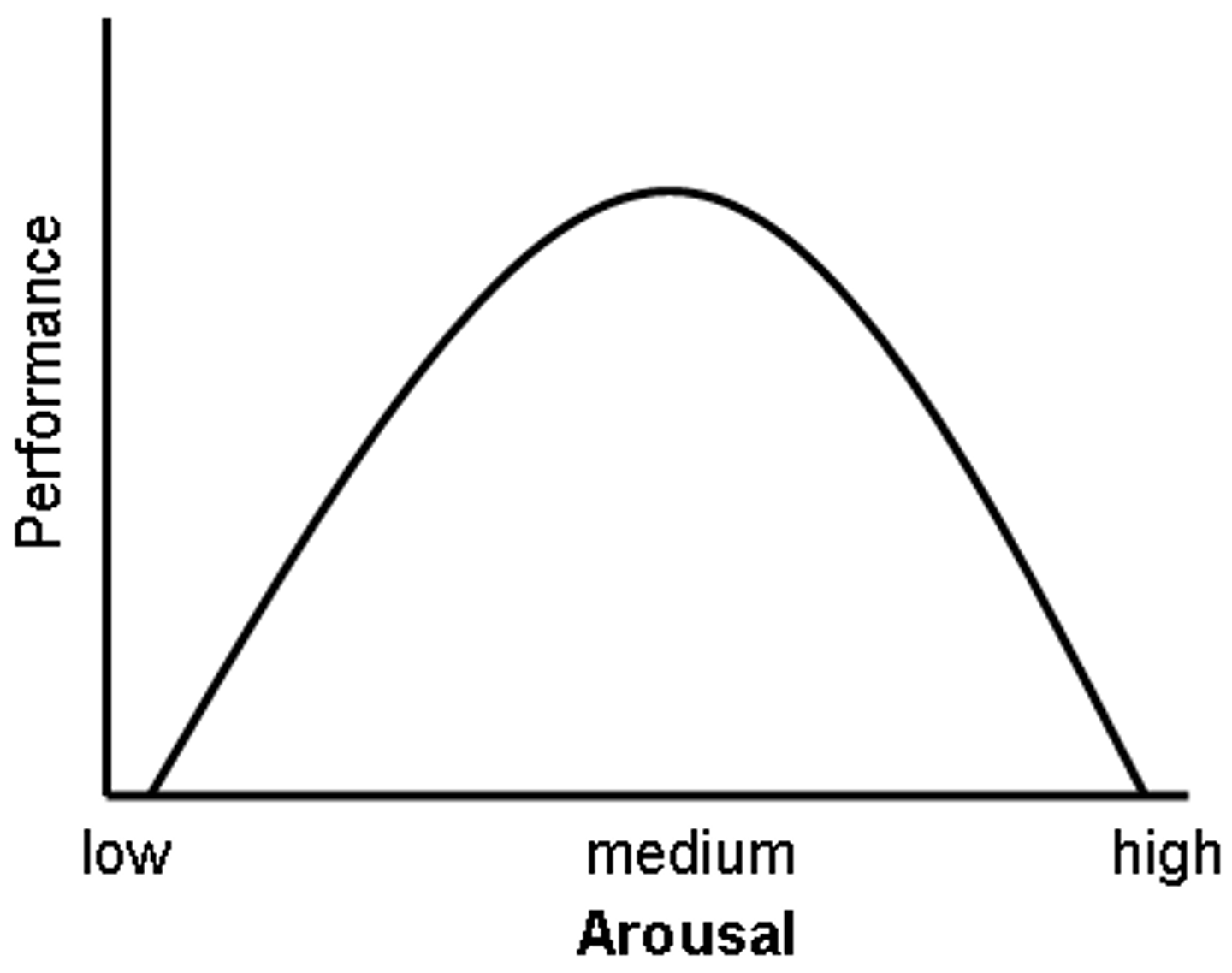
yerkes-dodson law and what motivation theory is it associated with?
medium arousal = optimal! jus right
*associated w/ arousal theory
extrinsic motivation & example
a desire to perform a behavior to receive promised rewards or avoid threatened punishment, ex: you're trying hard in a class for the sake of getting an A
intrinsic motivation & example
a desire to perform a behavior effectively for its own sake, ex: you're trying hard in a class bc you genuinely enjoy it
Julian Rotter's social learning theory
the probability that you will engage in a given behavior is determined by your expectation of attaining a goal; discrepancies between your expectations and values can lead to corrective behavior (expectation of a good outcome = more motivation to do it)
Maslow's hierarchy of needs
physiological needs: food, water, air, sex, sleep
safety needs: security in health, family, shelter, resources
loving/belongingness needs: friendship, family, intimacy, social interaction, affection
esteem needs: respect for yourself/others, positive perception of yourself
self-actualization: fulfilling goals unique to yourself and knowing what's good for you/living up to your potential
need for affiliation
desire to establish and maintain social contacts & good relationships w ppl
need for intimacy
desire for close relationships characterized by open and intimate communications
need for affiliation example
social rejection and pain, exclusion from a group, lack of social belonging
need for intimacy example
self disclosure, sharing of intimate details with another person through trust; gender differences study found that women self disclose more than men on average
Eisenberger's study (2003)
people were told to play a computer game in a group and at some point someone was randomly chosen to get kicked out of the game, experienced social rejection --> found that emotional pain brain activity resembled the same one as physical pain
Kross's study (2010)
people who jus went through a breakup were told to bring a pic of their ex, they were shown a bunch of neutral pictures (like of a bunny) and then amongst the neutrality had to react to the pic of their ex --> found that emotional pain brain activity resembled the same one as physical pain
self-disclosure & its properties
the sharing of intimate details about oneself to another person
properties: reciprocity (expectation of reciprocation from the person you're disclosing to), gender diffs (women tend to disclose more than men on avg), revelation (people reveal more over time as relationship strengthens, trust is built)
DePaulo and Kashy (1998) & what property does it relate to?
researched to whom ppl lie the most, found that they mostly lie to strangers because strangers wouldn't be able to prove anything
relates to property of revelation bc trust must be built and there was no trust when ppl lied to strangers
need for achievement
desire to accomplish problems, excel, outperform others
performance orientation
a learning orientation characterized by a focus on presenting oneself well and appearing intelligent to others
mastery orientation
a learning orientation characterized by a focus on gaining new knowledge or abilities and improving
need for power
the extent to which an individual desires to control or influence others
Japanese/Canadian students research study
both cultures were given a test and by random, no matter how well they actually did, were either told that they passed or failed; for Canadians, if they did well, they studied more during the break and if they didn't do well they didn't study more; for Japanese, if they did well, they studied less during the break and if they didn't do well they studied more
optimistic attributional style
sees failure as the result of external causes and of events that are unstable or modifiable and specific
pessimistic attributional style
focuses on the causes of failure as internally generated; situation and individual's role in causing it are seen as stable and global
what effect do tangible rewards have on intrinsic motivation?
can cause intrinsic motivation to decrease the more tangible rewards are offered; can undermine them
attachment
an enduring emotional bond between infant and primary caregiver(s)
Behavioral milestones that precede attachment
1) emergence of social smiling: signals a new quality of emotional sharing b/w infant and caregiver; restricted face-to-face interactions
2) separation protest: infants begin to exhibit behavioral expressions of distress when their primary caregiver leaves (before attachment actually begins, infants show little distress when parents leave)
3) stranger anxiety: infants exhibit anxiety or fear toward unfamiliar adults; before attachment emerges infants don't show much distress towards strangers
describe harlow's experiment
took freshly born monkeys and assigned them to be removed from care of their mamas, they were kept in cages by themselves instead, in these cages there were fake "substitute monkeys" which were just a wire "monkey" giving biological needs and a cloth monkey, baby monkey preferred to spend time with cloth monkey!
contradiction of harlow's experiment
showed that contrary to the previous belief that animals prioritize biological needs over physical contact, the opposite is actually true (monkeys wanted to spend more time with cloth monkey rather than the one that gave them food and agua)
aftermath of harlow's experiment
monkeys who later had offspring completely neglected their children/acted aggressive towards them/even killed them bc they didn't experience emotional contact when they were little themselves
Bowlby's definition of an internal working model
a mental model that children construct based on their experiences with their caregivers that guides their interactions with their caregivers and in other interpersonal relationships
who created the strange situation paradigm?
Mary Ainsworth
strange situation paradigm
a parent and infant separation and reunion exercise that is used to test the security of an infant's attachment to its caregiver
secure attachment
during separation, infant may become distressed, protest, and would not be able to be consoled easily; during reunion, infant seeks contact with caregiver and is instantly soothed
insecure avoidant attachment
during separation, there is minimal reaction (but if infant does get upset, the stranger is willing to comfort them); during reunion, infant avoids proximity to caregiver
insecure resistant (anxious-ambivalent) attachment
during separation, infant becomes highly distressed; during reunion, both seeks and rejects proximity, hard to soothe, is ambivalent
insecure disorganized attachment
during separation, infant behaves oddly, lacks coherence, organized method for dealing w stress; during reunion, distorted attempts at proximity seeking
secure attachment social/emotional development patterns
competent with peers, socially skilled, self-confident, autonomous, good friendships
insecure avoidant attachment social/emotional development patterns
lacking empathy and negative with peers, insensitive, prefers solitude, low in social support
insecure resistant attachment social/emotional development patterns
passive, immature, easily victimized by peers, anxious, distressed, poor self concept
insecure disorganized attachment social/emotional development patterns
aggressive, oppositional, externalizing problems, personality disorganziation
factors that may affect attachment?
parental responsiveness (consistently responsive parents to infant's emotional needs), temperament (infant's temperament can have an effect on parental responsiveness), culture, daycare
authoritative parenting style
parents make appropriate demands onto their children but are also responsive to their children, keep channels of communication open
authoritarian parenting style
parents apply discipline with little attention to the child's autonomy
indulgent parenting style
parents are responsive but fail to help children learn about the structure of social rules in which they must live
neglecting parenting style
parents neither apply discipline nor are they responsive to their child's individuality
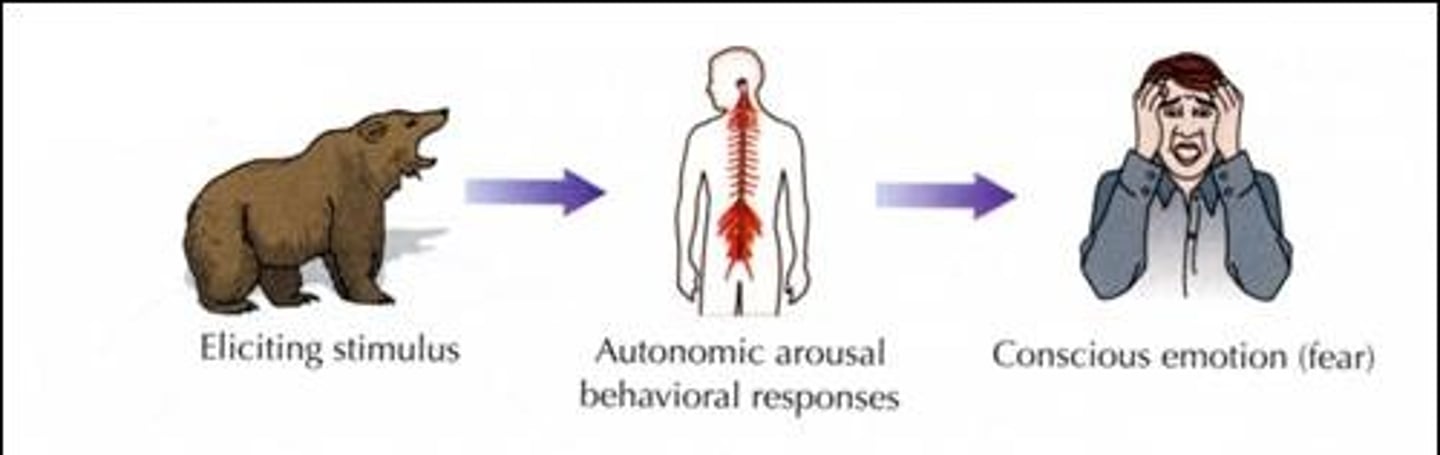
James-Lange theory of emotion
states that emotions stem from the physiological arousal that is triggered by an emotion-eliciting stimulus
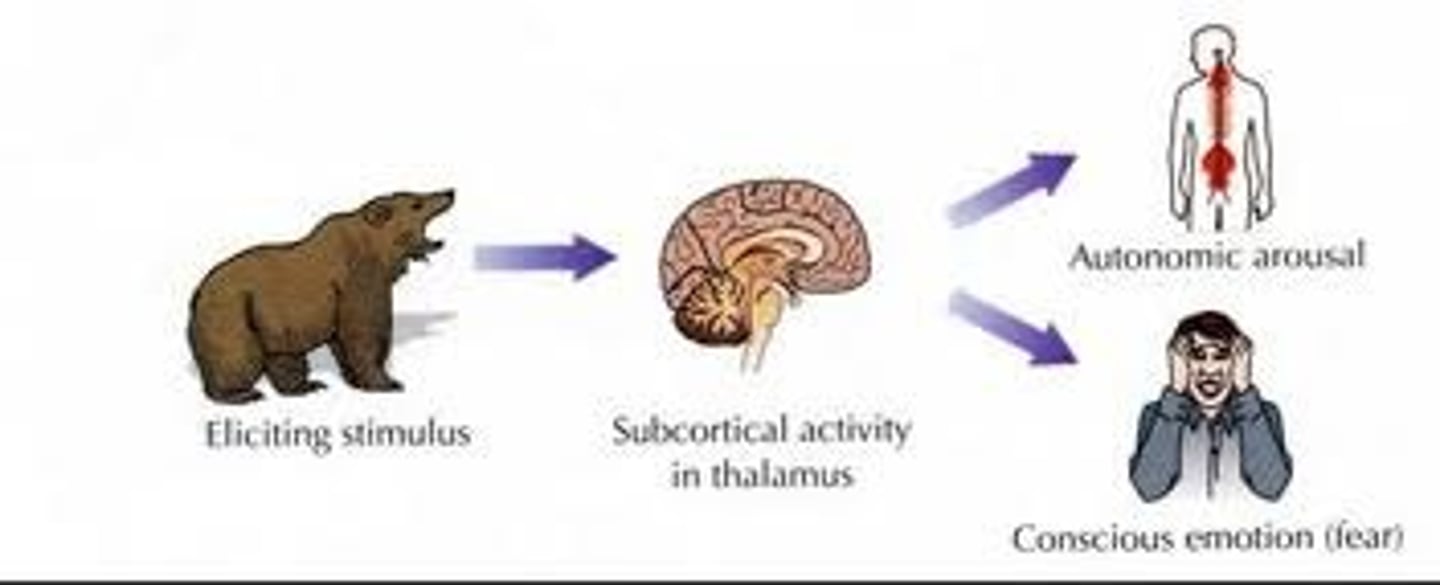
Cannon-Bard theory of emotion
states that an emotion-eliciting stimulus simultaneously triggers physiological arousal and the experience of emotion (parallel processes)
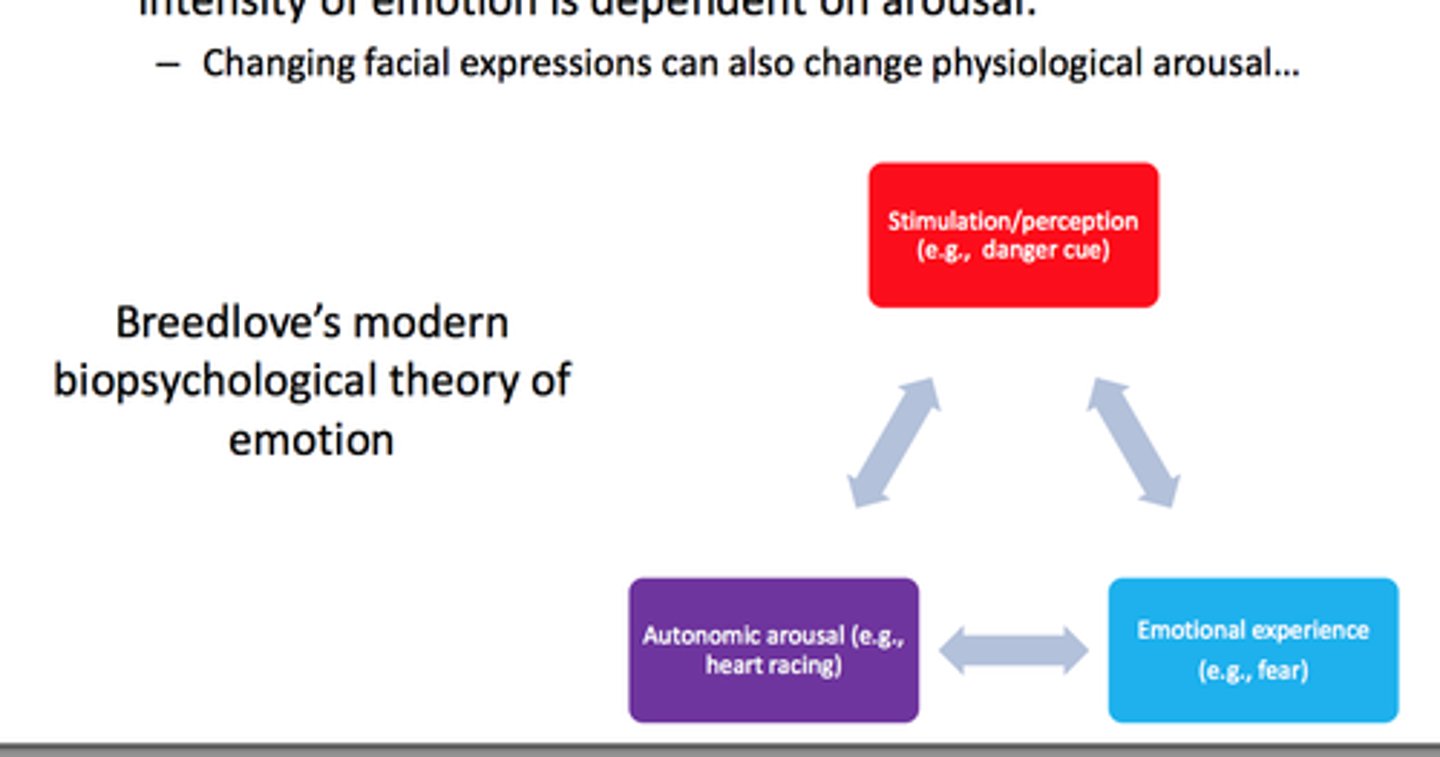
modern biopsychological view
states that perception, psychological reactions, and emotional experience (feelings) are mutually influential
sympathetic nervous system
fight or flight response, how you respond to threats, mildly unpleasant stimuli
parasympathetic nervous system
mildly pleasant stimuli, the more pleasant it is the more the heartbeat decreases (kim's example: if someone gives you a big hug you may be into it or not)
2 primary functions of the expressive component of emotion
non-verbal communication signals to others how we feel, sensory feedback signals to ourselves how we feel
cultural display of emotions and how they may constrain emotional expression
diff cultures have diff standards for how emotion should be managed, some forms of emotion are culturally unique, cultures establish social rules for when people may show certain emotions & for the social appropriateness of of certain types of emotional displays by given types of people in particular settings
6 most universally recognizable emotions
anger, disgust, fear, happiness, sadness, surprise
most recognizable emotion
happiness!! :)
how should one interpret emotional expression via eye contact or gaze?
interpreted in light of pre-existing relationship: you're either gonna fight or frick
gender diffs in people's ability to recognize emotion via touch
when women communicated anger to men, the men didn't recognize right away; when men communicated compassion, the women didn't recognize right away
Lazarus's cognitive appraisal approach
environmental event occurs -> person determines whether or not event is a threat to oneself (primary appraisal), if event is a threat -> person selects a potential response to threat (secondary appraisal), then executes the response (coping)
stress moderator variables
influence primary and secondary appraisals (i.e. fatigue, intoxication, personality)
3 major life stressors
catastrophes/traumatic events (natural disasters, abuse, combat), major life events (death, marriage, divorce, graduation), microstressors (nervous about test, about going to a party alone, etc)
which life stressor is most predictive of how an individual would cope w depression/anxiety?
microstressors
problem-focused coping
reducing stress by changing events that cause stress or by changing how we react to stress
emotion-focused coping
attempting to alleviate stress by avoiding or ignoring a stressor and attending to emotional needs related to one's stress reaction
adaptive coping strategy
successful in reducing negative emotions; do not have long-term costs
maladaptive coping strategy
unsuccessful in reducing negative emotions, associated w long-term costs that outweigh benefit of short-term reduction of negative emotions
situation selection
an example of problem-focused coping, to approach or avoid certain situations
situation modification
an example of problem-focused coping, to directly modify the situation so as to alter its emotional impact
positive reappraisal & example
create a positive meaning for the event (in terms of personal growth), considered adaptive (ex: moving away to college and seeing it as meaningful and positive)
rumination & example
compulsive fretting; overthinking about our problems and their causes (ex: being hung up over an ex and thinking about them over and over)
stone age & psychopathology
psychopathology was viewed as the work of the evil spirits, people practiced exorcisms and trephination (cutting holes inside ppl's skulls) to "rid them" or evil spirits
ancient egypt & psychopathology
aches/pains, sadness, apathy, and toothache were believed to be caused by the "wandering uterus"
greeks/romans & psychopathology
classified "wandering uterus" as hysteria, treatment was to ingest strong-smelling uterus to drive uterus into place
middle ages & psychopathology
witchcraft/demonic possession/animal possession took place in the mentally ill, beliefs in lycanthropy (turning into a wolf) and tarantism (belief that wolf bite caused illness)
rennaisance & psychopathology
rise of asylums, hospitals and monasteries were transformed into them, institutions whose purpose was to take care of mentally ill, were overcrowded, filthy, bad conditions, patients treated cruelly
early 20th century & psychopathology
emergence of modern science, somatogenic (abnormal behavior is bc of medial condition) and psychogenic (abnormal behavior is bc of ppl's psychology) approaches, most med treatments were inefficient and crude
current trends in mental health care
psychotropic medication (depression/anxiety/anything else meds) allows patients to leave hospitals, private psychotherpay
psychological disorders
behavior that is judged as atypical, disturbing, maladaptive, and unjustifiable
generalized anxiety disorder
excessive anxiety and worry abt a number of events/activities (hard to control the worry, restless, fatigued, unfocused, irritable)
anxiety disorder treatments
cognitive behavioral therapy, cognitive therapy, group therapy, biofeedback, meds
depressive disorder [depression]
depressed mood/anhedonia, anxious distress, catatonic, psychotic features, seasonal, peripartum onset
either clinical which is chronic or dysthymia which is less detrimental
schizophrenia
a chronic mental disorder characterized by disturbances in thought, perception, and behavior. Symptoms may include delusions, hallucinations, disorganized thinking, and social withdraws. Progressive grey matter loss is seen.
avolition
person doesn't move
obsessive-compulsive disorder
persistent, intrusive difficult to control thoughts, urges, mental images
bipolar disorder
cyclic pattern of depressed and elevated moods, described with symptoms of hypomania, mania, and psychosis