NBRC EXAM
 Call Kai
 Learn
Learn Practice Test
 Spaced Repetition
 Match
Match Flashcards
 Knowt Play
1/24

There's no tags or description
Looks like no tags are added yet.
Name | Mastery | Learn | Test | Matching | Spaced | Call with Kai | Chat |
|---|
No analytics yet
Send a link to your students to track their progress
25 Terms
A patient’s sputum specimen is purulent
green in appearance, has separated into
layers, and has a foul odor. Which of the
following is most likely causing the patient
to produce this type of sputum?
a. Aspiration
b. Tuberculosis
c. Emphysema
d. Bronchiectasis
d. Bronchiectasis
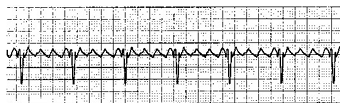
A patient in the ICU complains of light-headedness, nausea, and chest pains. The patient is diaphoretic and has a blood pressure of 90/60 mmHg. A respiratory therapist observes the following ECG pattern:
a. Lidocaine HCl
b. Cardioversion
c. Defibrillation
d. Epinephrine
b. Cardioversion
A patient with Guillain-Barre syndrome has a vital capacity of 625 mL. A respiratory therapist should recommend which of the following be performed FIRST?
a. MIP evaluation
b. Edrophonium chloride (Tensilon) test
c. MVV test
d. EMG and nerve conduction study
a. MIP evaluation
Which of the following bedside pulmonary function testing results for a patient with multiple sclerosis most strongly indicates the need for ventilatory assistance?
a. 5%decrease in peak expiratory flow
b. FEV1/FVC of 85%
c. MIPof-23 cmH2O
d. Vital capacity of 5 mL/kg
d. Vital capacity of 5 mL/kg
The following patient pulmonary function results were obtained:
Vital capacity 3.6L
FRC 6.0L
ERV 1.0L
a. 6.0
b. 7.0
c. 8.6
d. 9.6
c. 8.6
A 62-year-old patient with a history of COPD becomes hypotensive following a drug
overdose. Following intubation, VC, AC ventilation should be initiated with which of
the following oxygen concentrations?
a. 0.21
b. 0.50
c. 0.70
d. 1.0
d. 1.0
A patient has been receiving VC ventilation for 24 hours. A respiratory therapy is called to the bedside because high pressure alarm is sounding with each breath. Which of the following should the therapist do FIRST?
a. Change to PC Ventilation
b. Withdraw the endotracheal tube 4cm
c. Manually ventilate the patient
d. Increase the high-pressure alarm limit
c. Manually ventilate the patient
Just prior to removing the endotracheal tube, a respiratory therapist should
a. decreases the oxygen concentration
b. deflates the cuff
c. cut the pilot tube
d. ask the patient to breathe-hold
b. deflates the cuff
While preparing to assist with a chest tube insertion, a respiratory therapist learns that pleurodesis will follow. Which of the following additional equipment should the therapist provide?
a. Pressure manometer and hemostat
b. 3-way stopcock and hypertonic saline
c. Hemostat and 3-way stopcock
d. Hypertonic saline and pressure manometer
c. Hemostat and 3-way stopcock
Dynamic compliance is obtained by dividing VT by:
a. (PIP - PAW)
b. (PIP - PEEP)
c. (Pplat- PEEP)
d. (Paw- Pplat)
b. (PIP - PEEP)
A 52-year-old patient with newly diagnosed OSA undergoes a CPAP titration study. With a CPAP of 12 cm H20, the AHI is 3 and the lowest observed oxygen saturation is 90%. The patient continues to snore. A respiratory therapist should
a. maintain the current settings.
b. increase the CPAP level.
c. add supplemental oxygen.
d. switch to bilevel PAP.
b. increase the CPAP level
What is the target FiO2 range of a nasal cannula in a patient with normal minute ventilation?
a. 0.85– 1.0
b. 0.64– 0.80
c. 0.45– 0.60
d. 0.24– 0.40
d. 0.24– 0.40
A respiratory therapist is called to the ED to assist with the intubation of an alert, agitated patient in respiratory failure. Two intubation attempts were unsuccessful. In addition to a neuromuscular blockade, which of the following drugs will best facilitate intubation?
a. propranolol HCI (Inderal)
b. midazolam HCI (Versed)
c. amlodipine (Norvasc)
d. nitroprusside sodium (Nipride)
b. midazolam HCI (Versed)
A 14-year-old male who is 163 cm (5 ft 4 in) tall and weighs 51 kg (112 lb) is brought to the ED for a suspected drug overdose. He is intubated and receiving VC, A/C ventilation. The following data are available:
Mandatory rate 14
Tidal volume 300 mL
Inspiratory flow 20 L/min
Pressure limit 50 cmH2O
A physician notices the I:E display indicates 1:1.2 and asks a respiratory therapist to
make an adjustment so the I:E will be 1:3. The therapist should increase the
a. tidal volume.
b. inspiratory flow.
c. mandatory rate.
d. sensitivity
b. inspiratory flow.
A 180-cm (5-ft 11-in), 75-kg (165-Ib) male had a cardiac arrest and is admitted to the ICU. The patient is apneic, is receiving 100% 02 by a bag-valve-mask resuscitator, and has an Sp02 of 94%. Which of the following are the most appropriate ventilator settings?
SIMV 1.0 10 400ML 3 CM H20
SIMV 0.40 12 750ML 5 CM H20
A/C 1.0 12 600 ML 5 CM H20
A/C 0.40 10 550ML 3 CM H20
a. 4
b. 1
c. 2
d. 3
d. 3
While instructing a 9-year-old child with pneumonia in use of a PEP therapy device, a respiratory therapist observes that the child is consistently unable to keep a seal around the mouthpiece. Which of the following should the therapist recommend?
a. Discontinue therapy
b. Use nose clips in addition to the mouthpiece
c. Select a mask rather than a mouthpiece
d. Increase the pressure level by 4 cmH2O
c. Select a mask rather than a mouthpiece
A 23-year-old patient is in moderate respiratory distress while receiving oxygen.
Blood gas analysis results are:
pH 7.42
PaCO2 31 mm Hg
PaO2 38 mm Hg
HCO3 20 mEq/L
BE -3 mEq/L
SaO2 71%
A respiratory therapist should interpret these results as:
a. Compensated metabolic alkalosis with mild hypoxemia
b. Chronic respiratory alkalosis with severe hypoxemia
c. Chronic hypercapnia with severe hypoxemia
d. Acute respiratory alkalosis with moderate hypoxemia
b. Chronic respiratory alkalosis with severe hypoxemia
Which of the following can be used to confirm correct endotracheal tube position?
a. Tube marking at incisor
b. Pulse oximeter
c. Colorimetric CO2 detector
d. Chest radiograph
d. Chest radiograph
Lung fields will appear whiter on a chest radiograph when the imagine technique is
a. Overexposed
b. A lateral view
c. Rotated
d. Underexposed
d. Underexposed
A 71-year-old male who has a femur fracture had a chest CT angiogram due to increased shortness of breath. A respiratory therapist observes multiple pulmonary arterial thrombi. SpO2 is 94% while receiving oxygen at 2 L/min by nasal cannula. Which of the following should the therapist recommend?
a. intravenous heparin
b. sublingual nitroglycerin
c. intravenous epoprostenol (Prostacyclin)
d. nitric oxide inhalation
a. intravenous heparin
A 49-year-old female with polyneuropathy has received mechanical ventilation for 74 days. For the past week, the patient has been receiving an Fi02 of 0.28 by tracheostomy collar for progressively longer periods of time. Data collected for a daily 3-hour weaning trial are below: