NASM Ch 7 HMS Planes of Motion
 Call Kai
 Learn
Learn Practice Test
 Spaced Repetition
 Match
Match Flashcards
 Knowt Play
1/42

There's no tags or description
Looks like no tags are added yet.
Name | Mastery | Learn | Test | Matching | Spaced | Call with Kai | Chat |
|---|
No analytics yet
Send a link to your students to track their progress
43 Terms
osteokinematics
Movement of a limb that is visible.
arthokinematics
The description of joint surface movement; consists of three major types: roll, slide, and spin.
joint motion
Movement in each plane occurs on an axis running perpendicular to that plane
sagittal plane
purple
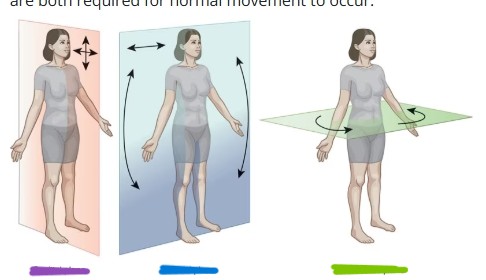
frontal plane
blue
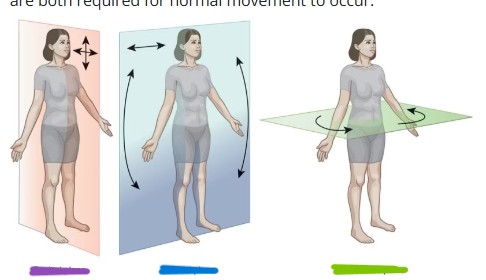
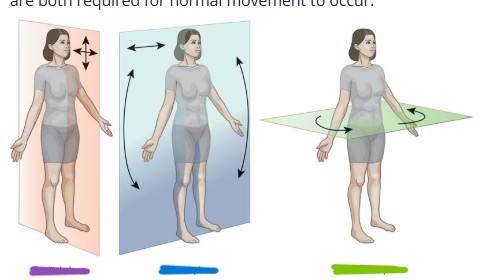
transverse plane
green
sagittal plane
An imaginary bisector that divides the body into left and right halves.
flexion
A bending movement in which the relative angle between two adjacent segments decreases.
extension
A straightening movement in which the relative angle between two adjacent segments increases.
hyperextension
Extension of a joint beyond the normal limit or range of motion.
flexion and extension
Movements in the sagittal plane include
dorsiflexion
Flexion occurring at the ankle.
plantar flexion
Extension occurring at the ankle. Pointing the foot downwards.
hip flexion
when an individual decreases the angle between the femur (thigh bone) and the pelvis or lumbar spine.
abduction and adduction of limbs, lateral flexion of spine, and eversion/inversion of foot and ankle complex
Movements in the frontal plane include
frontal plane
An imaginary bisector that divides the body into front and back halves. Movement in the frontal plane includes abduction, adduction, and side-to-side motions.
abduction
A movement in the frontal plane away from the midline of the body.
adduction
Movement in the frontal plane back toward the midline of the body.
lateral flexion
Bending of the spine from side to side.
eversion
A movement in which the inferior calcaneus (heel bone) moves laterally. The bottom of foot faces outward.
inversion
A movement in which the inferior calcaneus (heel bone) moves medially. Bottom of foot faces inward.
transverse plane
An imaginary bisector that divides the body into top and bottom halves.
internal rotation
Rotation of a body segment toward the middle of the body.
external rotation
Rotation of a body segment away from the middle of the body.
horizontal abduction
Movement of the arm or thigh in the transverse plane from an anterior position to a lateral position.
horizontal abduction
Movement of the arm or thigh in the transverse plane from a lateral position to an anterior position.
radioulnar pronation
Inward rotation of the forearm from a palm-up position to a palm-down position.
radioulnar supination
Outward rotation of the forearm from a palm-down position to a palm-up position.
transverse plane
rotational movement of the head, torso, arms, and legs. horizontal abduction
pronation of the foot
Multiplanar movement of the foot and ankle complex consisting of eversion, dorsiflexion, and ankle abduction; associated with force reduction.
supination of the foot
Multiplanar movement of the foot and ankle complex consisting of inversion, plantar flexion, and ankle adduction; associated with force production.
gait
Biomechanical motion of the lower extremities during walking, running, and sprinting.
scapular retraction
Adduction of scapulae; shoulder blades move toward the midline.
scapular protraction
Abduction of scapulae; shoulder blades move away from the midline.
scapular depression
Downward (inferior) motion of the scapulae.
scapular elevation
Upward (superior) motion of the scapulae.
scapular movements
aka translations
elasticity
The ability of soft tissues to return to resting length after being stretched.
ligament
A fibrous connective tissue that connects bone to bone.
flexibility
The normal extensibility of soft tissues that allows for full range of motion of a joint.
hypermobility
A state where a lack of neuromuscular support leads to a joint having more range of motion than it should, greatly increasing the risk of injury at that joint.
hypomobility
When range of motion at a joint is limited.
normal movement
represents efficient, cooperative functioning of the skeletal, nervous, and muscular systems and requires full ROM