L11 Emotional and Temperamental Development
 Call Kai
 Learn
Learn Practice Test
 Spaced Repetition
 Match
Match Flashcards
 Knowt Play
1/42

There's no tags or description
Looks like no tags are added yet.
Name | Mastery | Learn | Test | Matching | Spaced | Call with Kai | Chat |
|---|
No analytics yet
Send a link to your students to track their progress
43 Terms
What is an Emotion?
“An inferred complex sequence of reactions to a stimulus(including) cognitive evaluations, subjective changes, autonomic and neural arousal, impulses to action, and behavior designed to have an effect upon the stimulus that initiated the complex sequence” (Plutchik, 1980)
emotion is not just a feeling, it has several components involved - change in thoughts, feeling, behaviours to respond to important events (reactions to events)
cognitive appraisal of situation
subjection emotional experience
physiological changes
impulse to action
behavioural response (flight vs. fight)
e.g. snake - heart rate increases, experience fear, then flight vs. fight (anger + fear fit these situations well b/c they meet all criteria)
Is Happiness an Emotion or something else?
happiness can be reaction to an event + happiness remains relatively stable over time, although momentary happiness varies daily
although associated with smiling, researchers have not defined a characteristic physiological, behavioural signature to define happiness
does not have a clear adaptive function + more closely linked to personality or overall wellbeing → doesn’t fit definition of emotion as well as others
subjective well-being: An overall evaluation of one’s life as pleasant, interesting, and satisfying (not part of emotion criteria)
Life satisfaction
Frequent positive emotions
Infrequent negative emotions
Emotional Development - review
is smiling/crying emotions or natural reactions?
young infants express specific emotional states through facial expressions
Basic/Discrete or Primary Emotions
Present at birth: interest, distress, disgust, contentment
Emerge between 2 and 7 months: anger, sadness, joy, surprise, fear
Basic emotions are biologically based and seen at similar times across all cultures
with age, emotions becomes more connected to how they are understanding the world (e.g., excitement for being able to hold a toy) → therefore not just not biological, but also environmental + related w cog dev
Complex (Self-Conscious) Emotions
In second year, self-conscious (self-evaluative) emotions emerge: embarrassment, shame (something wrong w me), guilt (related to self), envy, pride
These emotions require:
Self-recognition (sense of self)
Understanding social rules and standards
Emotions and social behavior
Emotional display rules
Cultural rules that guide when and how emotions should be expressed (e.g., being pleased + saying thank you even when disappointment w g
Children learn to:
Express appropriate emotions
Suppress inappropriate emotions
parents respond positively to positive emotions, etc. to guide how to act in certain situations
Western cultures: excitment + joy encouraged
emotional calmess + restraint may be more encouraged in other cultures
Can Facial Expressions Influence Feelings?
hypothesis, evidence, limitation
Facial Feedback Hypothesis
Facial expressions may slightly influence emotional experience. (facial expressions send feedback to brain to influence emotional experience; e.g., smiling may increase feeling of happiness, frowning may intensify feelings)
Evidence
Smiling can enhance positive feelings in some situations.
Limitation
People with Möbius syndrome experience emotions despite being unable to smile, showing facial expressions are not necessary for emotion (facial paralysis)
video:
Emotional Self-Regulation - review
Ability to control and manage emotional reactions
Early development (Infants):
Infants rely on caregivers for soothing (to regulate emotions)
Later development (1-2 years old):
Self-soothing strategies emerge (turn away from unpleasant things, thumb-sucking, playing w toys) by half of 1st yr
Language helps regulate emotions (language development helps children express their emotions + for regulation)
Social Referencing
Using others’ emotional reactions to guide behaviour (response)
Typically emerges around: 7-10 months of age (when they start encountering unfamiliar situations)
Example: Infants look to caregivers to decide whether a situation is safe or dangerous (e.g., visual cliff experiment)
Empathy and Emotional Competence
Empathy: Understanding another person’s emotional experiences of others → motivates prosocial behaviour
Emotional competence includes:
Recognizing emotions, understanding emotional causes, regulating emotions, responding appropriately in social situations
closely related to Emotional Intelligence (EQ) - perceiving emotions accurately, understanding them, managing them effectively
higher EQ - get along with peers better (less EQ may experience peer rejection, social withdrawal) → hence emotional development closely tied to social development
Measuring Emotional Intelligence, MSCEIT
Perceiving Emotions: Correctly identify emotions expressed by people, designs.
Understanding Emotions: Predict others’ emotional responses to situations.
Managing Emotions: Select best strategy to regulate one’s own, others’ emotions.
Using Emotions: Select helpful emotion for addressing a particular situation.
each has a key aspect in how we react
The Meyer-Salovey-Caruso Emotional Intelligence Test (MSCEIT) assesses ability to solve problems thought to require emotional intelligence.
MSCEIT-type item → expressions of 2 emotions combined
Temperament - review last bit
helps explain why children react differently in situations
Constitutionally based individual differences in: Emotional reactivity, Motor activity, Attention and Self-regulation
child’s typical style for responding to an event, stimuli, etc.
6 Common dimensions:
Fearful distress (Ex., withdrawal in new situations)
Irritable distress (ex., crying when goals are blocked)
Positive affect (willingness to approach others)
Activity level (how physically active the child tends to be)
Attention span/persistence (how long the child can focus on something)
Rhythmicity (Predictability/ regularity of functions, e.g. eating pattern)
some dimensions become more clear w age, like fearful distress until 6-7m
early foundations for how personality traits will develop (but not the same as traits)
Hereditary Influences on Temperament
Temperament has a biological basis
Twin studies show:
Identical twins are more similar than fraternal twins on many temperament dimensions
Heritability is moderate, not absolute → Genes influence temperament, but do not determine it completely
temperament involves both genetics + environment
Environmental and Cultural Influences
Environment also shapes temperament
Shared environmental influences (e.g., family life)
Contribute more to positive traits like sociability, soothability
Nonshared environmental influences (get example review)
Contribute more to negative traits like irritability, fearfulness
Culture matters
Temperamental traits are valued differently across cultures
shyness viewed as a disadvantage in western cultures, but in earlier studies, in asian cultures this was seen as a sign of maturity + social appropriateness (e.g., China from collectivist → individualistic viewed outgoing children more positively)
Stability of Temperament
Temperament is moderately stable over time
More stable dimensions include: • Activity level • Irritability • Sociability • Positive and negative emotionality • Fearfulness
Behavioural inhibition: Tendency to withdraw from unfamiliar people or situations (tensions, high physical arousal)
Often shows moderate stability over time (
Stability is strongest at the extremes.
Thomas and Chess Temperament Profiles
some features can be clustered into broader categories
Thomas and Chess: three common temperament profiles
Easy (40%) • Positive mood • Regular habits • Adaptable to novelty
Difficult (10%) • Active and irritable • Irregular habits • React negatively and intensely to change + harder to soothe and require more time to adapt
Slow-to-warm-up (15%) • Less active, somewhat moody • Mildly negative to novelty • Adapt gradually over time (may withdraw at beginning but gradually adapt)
Many children do not fit one clear profile
Temperament and Later Development
Temperamental patterns can influence later adjustment (development)
Examples:
Difficult temperament → greater risk for behavior problems • Slow-to-warm-up temperament → greater risk for shyness or peer neglect (but does not determine development.. review)
Goodness-of-fit model: Development depends on the match between:
Child’s temperament
Parenting style / caregiving environment - how well parenting style may match children’s developmental needs
highlights importance of mother’s nutrition, parenting styles, as there is a biological aspect underlying development
A good fit supports positive outcomes.
Temperament: Key Takeaways
refers to early individual differences in reactivity and self-regulation
shaped by both heredity and environment (as well as parenting + culture)
Some traits are moderately stable over time
Behavioural inhibition is one important temperamental style
Goodness of fit helps explain later adjustment
Attachment and Development
John Bowlby
Attachment: a strong emotional bond between two people (in infancy, bond b/w baby + caregiver)
Key features: Mutual affection, Desire to maintain closeness, Comfort in times of stress (securely attached infants smiles more when attached to caregiver, crawl more towards them, etc.) → meaningful, emotional relationships (just not about contact)
Attachments are reciprocal
Infants become attached to caregivers
Caregivers become attached to infants
important that attachment is built gradually thru interactions
depends on responsive, reciprocal relationships (not just early contact or w biological families)
Interactional Synchrony
Coordinated back-and-forth interaction between infant and caregiver (over first few months) (coordinated social exchanges)
Features:
Each partner adjusts to the other (responses to signals)
Often described as a “dance”
Occurs many times each day
Helps attachment grow
Examples: Mutual gaze, Smiling back, Turn-taking vocalizations
Still-Face Procedure (Edward Tronick) - children become distressed when mother is not responding/reacting (not just about skin-to-skin touch or feeding
Phases of Attachment Development
Schaffer & Emerson, 1964
Asocial phase (0-6 weeks): Little protest due to limited skills; responds positively to many stimuli
Indiscriminate attachments (6 weeks–6/7 months): Prefers people > objects, but enjoys attention from many adults
Specific attachment (7-9 months): Strong attachment to one familiar caregiver, Stranger wariness begins → (often when first real attachment occurs)
Multiple attachments (9-18 months): Attachments expand to other familiar people
Secure Base
A caregiver can serve as a secure base, allowing the infant to explore the environment, return for comfort when needed, balance independence + safety
infant uses caregiver as point of safety to gain more confidence to explore environment + surroundings; and when tired or fearful, the parent is there for comfort
it doesn’t make them dependent on parent in -ve way, they are able to explore more effectively due to trust in their parent; security + emotional safety supports exploration
secure attachments are more common than insecure ones, though child-rearing traditions vary dramatically across cultures (e.g., dependence favoured in Japanese culture + there is more closeness)
Secure attachment supports exploration
Early Theories of Attachment
learning + psychoanalytic theory
Do infants become attached because caregivers feed them?
believed that attachment arises through satisfaction of biological needs
Learning theory
Food is a primary reinforcer (reduces hunger + feels pleasurable)
Caregiver becomes a secondary reinforcer through association (w feeding, comfort, etc.)
Psychoanalytic theory
Attachment linked to oral gratification
Freud argued that pleasure is through sucking/feeding and because caregiver provides feeding, they become attached to the caregiver (review)
Problem: feeding alone does not fully explain attachment → became clear through Harlow tests
Harlow and Zimmerman (1959)
tested the feeding hypothesis
Infant rhesus monkeys were raised with two surrogate “mothers”:
Wire mother
Cloth mother covered in soft material
Design:
For some monkeys, the wire mother provided milk
For others, the cloth mother provided milk
Question: Would infants prefer the one who fed them or the one who provided comfort?
Harlow’s Monkeys
Key finding: Infants formed stronger attachment to the cloth mother, even if it was the wire mother who fed them.
Stayed with the cloth mother most of the time, Went to the wire mother mainly to feed, Sought the cloth mother when frightened
challenged attachment theory - for attachement, comfort is important, not just feeding
Other Theories of Attachment
cognitive-development view
ethological view (imprinting)
Cognitive-developmental view
Attachment depends partly on cognitive development
Infants must distinguish familiar people from strangers before developing attachment
Object permanence helps support attachment (familiar people still exist when out of sight) → same age when Piaget suggested the 4th motor substage enters (where they find hidden objects according to just description)
Ethological view (Imprinting)
Humans are biologically prepared to form attachments
Attachment is adaptive because it promotes survival, more likely for needs to be met
Inspired by Lorenz’s work on imprinting
gooselings follow first movement they say after hatching; imprinting only occurs in birds but now scientists say it occurs in a sensitive period? review
Adaptive Behaviours That Promote Attachment
Infants show built-in behaviours that elicit caregiving
Examples:
Rooting, sucking, grasping (reflexive)
Crying • Smiling • Cooing and babbling (social)
These behaviors:
Attract care and attention • Help maintain closeness to caregivers • Support survival and later development
these behaviors increase likelihood of care, projection, and attachment, which in turn increases chances of survivals
Bowlby’s Ethological Theory (Human Attachment)
Argued that both Infants and caregivers are biologically predisposed (prepared to form this attachment) to respond to each other
Secure attachment develops through repeated responsive interactions (when parents can understand + respond to signals appropriately)
Insecure attachment may develop when signals are not responded to consistently
combined both biology + relationship quality (levels of responding, attention)
Attachment-Related Fears of Infancy + Explaining Attachment-Related Fears
Stranger Anxiety
Fear or distress in response to unfamiliar people
Appears after infants form a primary attachment
Typically peaks around 8–10 months
Separation Anxiety
Distress when separated from primary caregiver
Reflects strength of attachment bond
Typically peaks around 14–18 months (review last bit of this)
Explaining Attachment-Related Fears
Ethological Perspective
Fear responses are biologically programmed that evolve to protect infants
Promote survival by keeping infants close to caregivers (they are genetically predisposed to be close to caregivers)
Cognitive-Developmental Perspective
Fear reflects advances in perception and memory
Infants recognize unfamiliar people and missing caregivers
Assessing Attachment Security
Strange Situation + episodes
The strange situation procedure (Anisworht)
Laboratory procedure used to measure infant attachment
Consists of 8 structured episodes
Simulates everyday caregiver–infant interactions
Includes separations, reunions, and interaction with a stranger
assess if infant uses parent as secure base + level of distress when parent leaves + returns back
Infant behaviour is observed to classify attachment style that reflect the quality of emotional bonding w parents
Episodes
Parent and infant enter playroom
Infant explores while parent is present
Stranger enters and talks to parent
Parent leaves (first separation)
Parent returns and greets infant
Parent leaves again (second separation)
Stranger attempts to comfort infant
Parent returns and comforts infant
Attachment Styles-Secure (view end of video to add to notes + Caregiver Sensitivity Hypothesis)
Secure Attachment (65% in NA samples) - associated w better social + emotional outcomes later
Infant explores environment when caregiver is present (use caregiver as secure base)
Shows distress when caregiver leaves + seeks comfort when caregiver returns
Quickly calms and resumes exploration
Comfortable with strangers when caregiver present
Avoidant (20%)
Little distress when caregiver leaves
Avoids or ignores caregiver on reunion
May treat caregiver and stranger similarly
Resistant/Anxious-Ambivalent Attachment (10%)
Infant remains close to caregiver
Limited exploration
Extremely distressed by separation, Ambivalent during reunion, May seek contact but resist comfort → thought to develop when parenting style is inconsistent (varying levels of responsiveness to their needs)
Disorganized/Disoriented (5%) (review)
Confused or contradictory behaviour toward caregiver; May approach caregiver but then avoid or withdraw; May freeze, appear dazed, fearful, or anxious
Often shows distress even when caregiver is present
Linked to frightening, inconsistent, or highly stressed caregiving environments
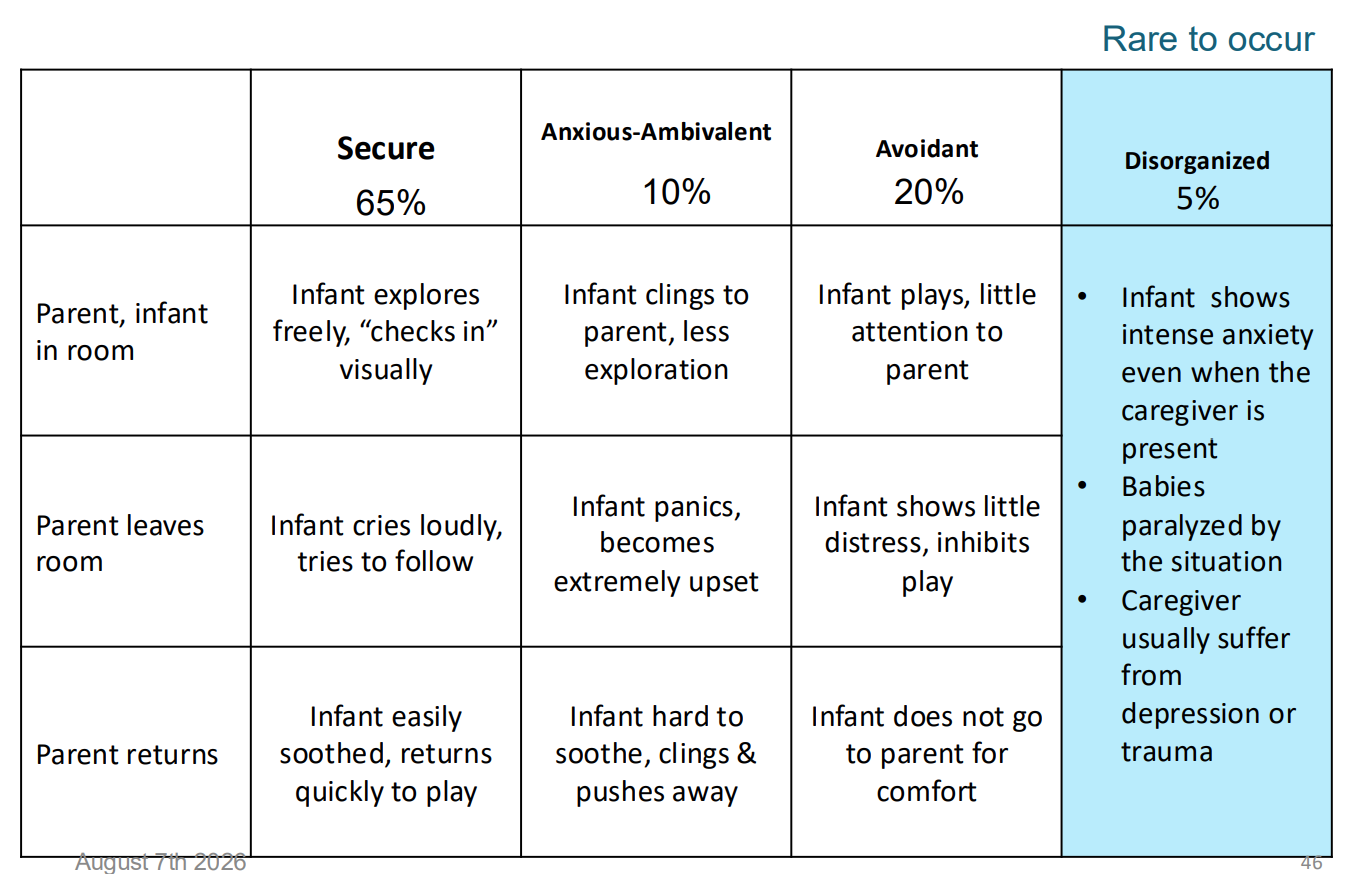
Attachment and Development
Cultural Differences in Attachment
Attachment patterns vary across cultures
Reflect cultural caregiving practices
Example: Amae in Japan; emphasis on dependence and closeness - show strong distress upon separation
Fathers as Caregivers
Fathers can form strong attachments with infants
Often engage in playful stimulation (while mothers often soothe)
Contribute to social and emotional development
Influences on Attachment - Caregiving hypothesis
Caregiving hypothesis (Ainsworth)
Attachment quality reflects caregiver sensitivity (behaviour that is senstitive, responsive to infant’s needs)
Secure attachment → sensitive caregiving
Resistant attachment → inconsistent caregiving
Avoidant attachment → rejecting or overstimulating caregiving
Disorganized attachment → frightening or abusive caregiving
Risk Factors for Insensitive Caregiving
Parental depression
Emotionally insecure caregivers
Unplanned or unwanted pregnancies
Financial, health, or legal stress
Marital conflict
Temperament and Attachment review
Temperament hypothesis
Integrative theory
Temperament hypothesis: Infant temperament influences attachment behaviour
Evidence against pure temperament explanation:
Infants may show different attachments with different caregivers
Improving caregiving can change attachment outcomes
Integrative theory:
Attachment = caregiving quality + infant temperament
Quality of caregiving determines secure/insecure, but temperament predicts type of insecurity
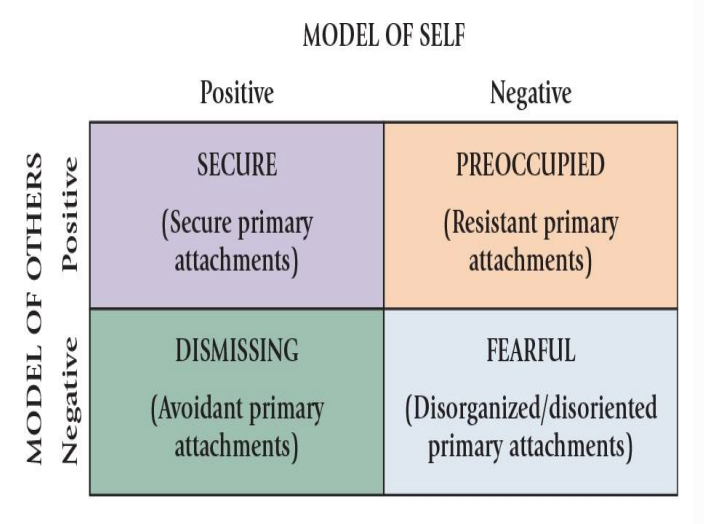
Attachment and Later Development - Internal working models
Mental representations of: (internal mental relationships children develop about them self + others based on early caregiver interactions) → start to form relationships expectations
The self (am I lovable?)
Others (are people reliable?)
e.g., develops positive model of self + others (they can be trusted + provide support when needed)
These models influence: Future relationships Emotional regulation Expectations about social interactions
Four perspectives on close emotional relationships that evolve from the positive or negative “working models” of self and others that people construct from their experiences with intimate companionsou
Attachment: Key Takeaways
Attachment is a strong emotional bond with a caregiver
It develops gradually through reciprocal interaction
Interactional synchrony helps attachment grow
Specific attachment emerges around 7-9 months
A secure attachment figure serves as a secure base
Contact comfort matters more than feeding alone
Bowlby’s ethological theory emphasizes biology + responsive caregiving
Stranger and separation anxiety often emerge after attachment forms
Q.1 What is the central developmental claim being made? (What is being argued about development, change, or risk?)
Kindness develops across childhood and adolescence
It is a multidimensional construct
Kind emotions, Kind cognitions, Kind behaviors
These components can be self-oriented or other-oriented
Development is influenced by social
Q.2 What type of evidence is used? (Correlational, longitudinal, experimental, animal models, review?)
Conceptual / theoretical framework
Integrates findings from: Developmental studies, Longitudinal research, Prosocial behaviour research, Moral development research
Includes evidence on: Empathy development, Prosocial behaviour, social-emotional learning interventions
Q.3 What does the article not claim? (Where are the limits, cautions, or unresolved questions?)
The article does not claim that:
Humans are naturally born fully kind (kindness is developed thru social interactions)
Kindness develops in a simple or linear way
All children develop kindness at the same rate (environmental influences, culture, social relationships)
Kindness is determined only by individual traits
Development depends on
context ▪ socialization ▪ developmental capacities
Q.4 How would this evidence be misused in the media or public discourse? (Correlation vs causation, overgeneralization, determinism)
Possible misinterpretations:
“Children are naturally kind or unkind”
“Kindness can be taught instantly”
“Kindness is only about helping behaviour”
Ignoring the role of development and context
Q.5 Which developmental lens or theory helps interpret these findings best? (Biological, learning, cognitive, sociocultural, transactional)
Cognitive lens perspective - taking moral reasoning
Sociocultural lens - socialization cultural values
Emotional lens - empathy sadness over wrongdoing
Transactional lens - interaction between child and environment
Applied Activity
Case 1: A 12-month-old baby becomes extremely upset when their mom leaves the room. When the mom returns, the baby clings to her but also pushes her away and remains difficult to soothe.
Developmental Concept: Resistant (anxious-ambivalent) attachment
Mechanism: Inconsistent caregiving; the child cannot predict caregiver responsiveness.
Developmental Period: infancy - 12-18m
Case 2: A child sees another child falls and begins to feel sad for them before helping them stand up.
Developmental Concept: kind emotions
Mechanism: Empathy and perspective
Developmental Period: Early childhood.
Case 3 : A child believes: “People will help me when I need them.”
Developmental Concept: Positive internal working model of others
Mechanism: Secure attachment from responsive caregiving
Developmental Period: Formed in infancy but influencing later development