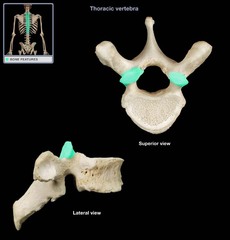
Structure of the Vertebrae
 Call Kai
 Learn
Learn Practice Test
 Spaced Repetition
 Match
Match Flashcards
 Knowt Play
1/14

There's no tags or description
Looks like no tags are added yet.
Name | Mastery | Learn | Test | Matching | Spaced | Call with Kai | Chat |
|---|
No analytics yet
Send a link to your students to track their progress
15 Terms
Typical vertebrae components are...
Vertebral body
posterior vertebral arch
2 pedicles
2 laminae
2 transverse process
Spinous process
articular processes

Vertebral body
most anterior portion and largest part
connected to other vertebrae using intervertebral disc
supports body weight

Does the vertebrae body increase or decrease as you go down the spine?
increase in size as you go down
Vertebral arch
link between vertebral body to the posterior structures
Forms the lateral and posterior parts of the vertebral foramen (hole in center)
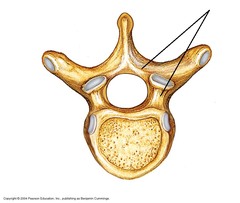
Vertebral Foramina
A on the chart, forms the vertebral canal for the spinal chord
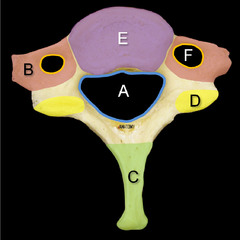
pedicles of vertebra
on posterior surface near body of vertebrae
Attach vertebral arch to vertebral body
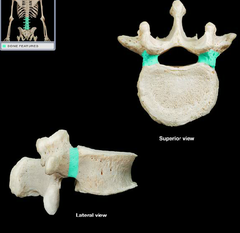
Laminae of vertebra
2 projections that extend poster-medially from each pedicle and them meet midline

Transverse process of vertebra
projection laterally at union of pedicle and laminae
for muscle and ligament attachment as well as rib

Spinous Process
a midline posterior projection
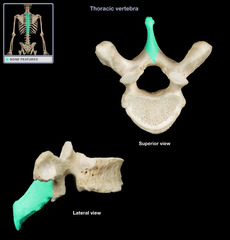
Vertebral Notch (superior/inferior)
form intervertebral foramen through which spinal nerve exits from vertebral canal

Intervertebral discs (what are two components)
joint connection between vertebrae
made of two components
Annulus fibrosis and Nucleus pulposus
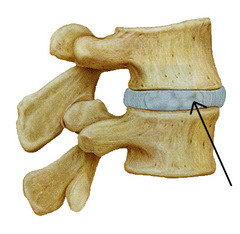
Annulus fibrosis
peripheral area of disc, dense interwoven cartilaginous fibers, attached to vertebral body

Nucleus pulposus
able to change shape, capacity to absorb and hold water, subject to dehydration (green area)

Nucleus pulposus creates what joint that allow what motions?
sizzle joint that allows 3 plane motion (gliding, shearing)
Superior and Inferior articular processes
projection that forms a synovial joints called a facet joint