Marine Algae
 Call Kai
 Learn
Learn Practice Test
 Spaced Repetition
 Match
Match Flashcards
 Knowt Play
1/32

Earn XP
Description and Tags
smc bio 15
Name | Mastery | Learn | Test | Matching | Spaced | Call with Kai | Chat |
|---|
No analytics yet
Send a link to your students to track their progress
33 Terms
Algae is…
mostly photosynthetic, less structurally complex than plants, polyphyletic (not one evolutionary group)
Diatoms
have glass (silica) cell walls, make up 90 percent of eukaryotic phytoplankton
summarize dinoflagellates
have two flagella (for movement), can cause red tides (harmful algal blooms), some are bioluminescent
brown algae
division phaeophyta, includes kelp, dominates cold and nutrient-rich waters
Red Algae
division rhodophyta, just red algae
green algae
division chlorophyta, closest relatives of land plants
Parts of Kelp?
Holdfast, Stipe, Blades, and Pneumatocysts
What does the holdfast do?
Anchors the kelp to a rocky substrate so waves don’t tear it away, not the true root
What does the stipe do?
A stem-like support that connects the holdfast to the blades
What do kelp blades do?
basically the leaves, where photosynthesis occurs
What are pneumatocysts?
gas-filled floats, they lift the blades towards the surface where there is more light so they can do more photosynthesis
Kelp Bed vs Kelp forest
kelp beds don’t reach the surface, they grow on the bottom and stay underwater while kelp forests grow all the way up to the surface
Macrocystis
giant kelp that dominates the west coast, forms the California kelp forests
Laminaria
kelp that dominates the East Coast
What is a red tide?
harmful algal bloom (HAB), caused by a massive increase in dinoflagellates that can make the water appear red, brown, or orange
What are mangroves?
Trees that grow along tropical coastlines, important because they can be fish nursery habitats, improve coastal water quality, protect coastlines from storms and erosion, as well as supporting many different organisms
Why do people cut down mangroves?
Humans cut them down to build houses, hotels, and create beaches
Why is it harmful to cut down mangroves?
Less storm protection.
More coastal erosion.
Worse water quality.
Damage to coral reefs.
Loss of nursery habitat.
Economic Uses of Algae?
Food
Agar (research media, food industry)
Algin/Carrageenan (thickeners & stabilizers)
Fertilizer
Animal feed
Why are kelp, algae, and corals so important?
They are the bases of the ecosystems, in tropical systems its corals.
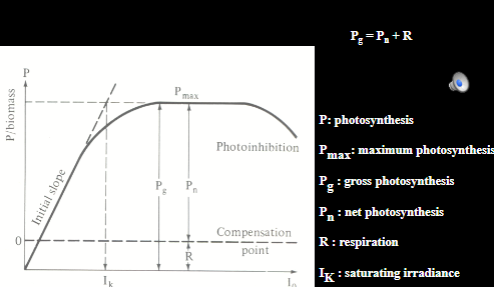
KNOW HOW TO DO THE PHOTOSYNTHESIS GRAPH!!!
know how to label this
Chemical formula for photosynthesis?
6CO2 + 6H2O —(light)→C6H12O6(sugar) + 6O2
Chemical formula for respiration?
C6H12O6 + 6O2 —(light)→ 6CO2 + 6H2O + chemical energy
What is the maximum level of photosynthesis referred to as?
Pmax
What is Ik in a photosynthesis vs irradiance graph?
Saturating irradiance, the amount of light it takes to achieve maximum photosynthesis
What is it called when plants make as much as they consume?
the compensation point
Do we ever know the full amount of oxygen produced in photosynthesis?
No, we can only measure how much comes out after the plant is also respirating. know Pgross = Pnet + Respiration
What is the most important part of photosynthesis?
Chloroplasts
Do all organisms that use photosynthesis have the same pigments?
No, deeper ocean organisms require different types of pigments that are able to capture light all the way down there
How do red algae adapt to harsher habitats?
they deposit calcium carbonate into their bodies which makes parts of them hard
What are some benefits and tradeoffs to corals hardening?
beneifts: “armor” against sea urchins), support to resist waves, and protection from intense sunlight
tradeoffs: costs energy and resources, makes algae heavier and less flexible, and reduces growth rate compared to non-calcified species
sea grasses
are not algae, true vascular plants that have xylem(transports water and minerals) and phloem (transports sugar/food). felxible and bend with the waves