1.2.3 -READING - OBSERVATION LESSON: LLAMAS ON THE LOOSE
 Call Kai
 Learn
Learn Practice Test
 Spaced Repetition
 Match
Match Flashcards
 Knowt Play
1/39

Earn XP
Description and Tags
11. Sample Reading Lesson - Llamas on the Loose
Name | Mastery | Learn | Test | Matching | Spaced | Call with Kai | Chat |
|---|
No analytics yet
Send a link to your students to track their progress
40 Terms
OBSERVATION LESSON: “LLAMAS ON THE LOOSE”
Notes on Reading Framework:
You can vary the framework of the lesson
and move tasks as needed.
Go from less detailed to more detailed tasks.
.
If you choose to Pre-teach Vocabulary,
do it just before or after the Gist Task (the initial reading task).
.
Choose the order which makes sense for your lesson.
In this lesson, the Pre-teach Vocab will go before the Gist Task.
.
The focus of the Pre-teach Vocab will be 8 blocking words, including “llama”.
.
‘Llama’ will be used to show Ss how to do the Matching Task.
Meaning, Pronunciation and Form (MPF) will be taught for ‘llama’.
.
Once Ss have finished the matching task, they will be taught MPF for the remainder of the word list.
READING Lesson - Observation
.
“Llamas on the Loose”
Reading Lesson Framework
Lead-in (5 min)
Pre-teach Vocab (8 min)
Gist Task (5 min)
Detailed Task (5 min)
Productive Task (5 min)
Part 1: Lead-in (5 min)
.
Do you watch the news?
(The context of the lesson is a news story about llamas.)
Ss respond.
WC discusses why they do/don’t watch the news.
End of Lead-in
Part 2: Pre-teach Vocab
.
The teacher will use the word ‘llama’ to demonstrate the following:
Its Meaning, Pronunciation and Form.
Matching the word with the definition
Pre-teach Vocab - 8 min
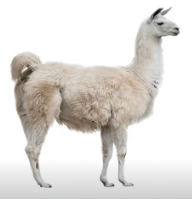
*MEANING - LLAMA
I recently saw some funny news about this animal.
(Ties back in with the Lead-in about news stories.)
.
Do you know the name of this animal in English?
Ss: “llama”
Pre-teach Vocab
*MEANING - CCQs - Llama
.
Where would you normally see a Llama?
Ss: “Farm, in the wild”
.
Is it normal to see llamas on the streets of a city?
Ss: “No”
Pre-teach Vocab
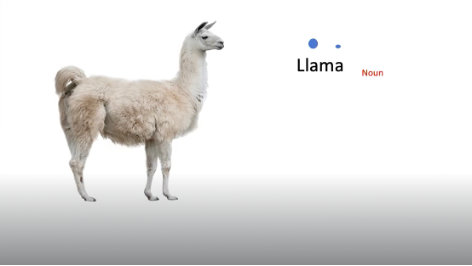
*PRONUNCIATION - LLAMA
.
Ok listen to the pronunciation in English: Llama.
Ss repeat.
Perfect
Pre-teach Vocab
*FORM - PART OF SPEECH - LLAMA
.
What part of speech is llama?
.
Ss: Noun.
.
Right. It's an animal.
Pre-teach Vocab - TASK CYCLE - Instructions
*Matching Task
I saw a news story which has something to do with llamas.
Let's check some vocab words before the story.
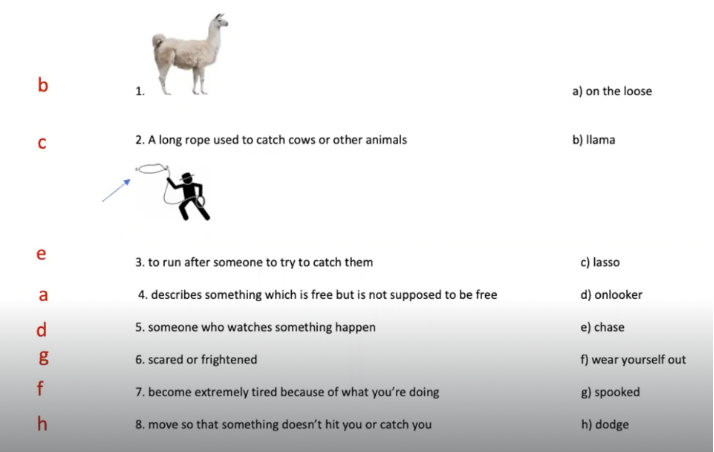
By yourself, match the words to the correct definitions.
Pre-teach Vocab - TASK CYCLE - Instructions
*Matching Task
.
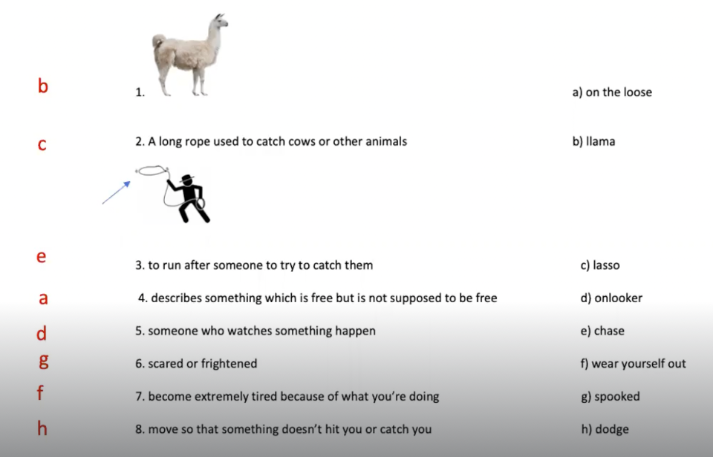
We've actually done the first one already (llama) - DEMO.
Which definition matches ‘llama’? B? Yes
.
Now take a few minutes to do the rest on your own. - WORK ALONE
(Note this class is only 2 Ss, so no need for BORs.)
Pre-teach Vocab - TASK CYCLE - Work in Pairs
*Matching Task
.
If you're not totally finished, that's ok.
(Ss stop working alone.)
.
I'm going to turn my camera off and you two can check your answers together.
.
Ss check answers in pairs. - WORK IN PAIRS
Pre-teach Vocab - TASK CYCLE - WCFB
*Matching Task
.
Teacher switches camera back on.
.
Note: teacher was monitoring the whole time and so could jump straight back into conversation.
.
Check answers as a class. - WCFB
Pre-teach Vocab - TASK CYCLE - WCFB
*Matching Task
.
So you were right about most of them. Number 2 you were correct. Number 3 also correct.
.
The next one was harder. Number 4 was actually (a). You were correct about the next 3, so number 8 must be? (h)? Correct.
Pre-teach Vocab
Pre-teach Vocab - TASK CYCLE
*MEANING, PRONUNCIATION and FORM
.
Teacher has already taught the first word: Llama
Now she addresses the rest of the blocking words.
.
Use CCQs to check Ss understand. Quick process as this is a reading lesson, not a grammar or vocabulary lesson.
.
Teacher spends no more than 60 seconds per word in MPF.
Pre-teach Vocab
.
ONE MINUTE PER WORD:
Llama
Lasso
Chase
On the loose
Onlooker
Spooked
To wear yourself out
Dodge
Pre-teach Vocab - TASK CYCLE
*MEANING - Lasso
.
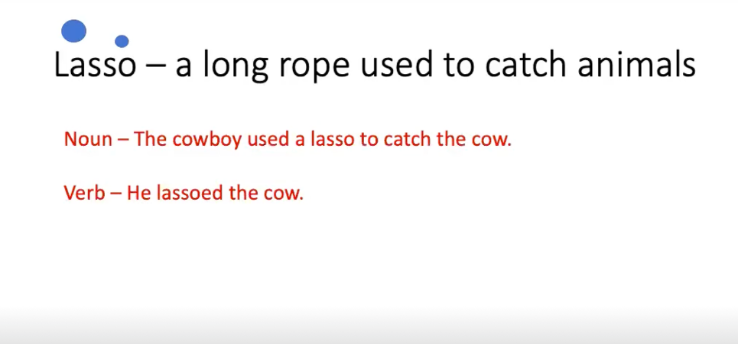
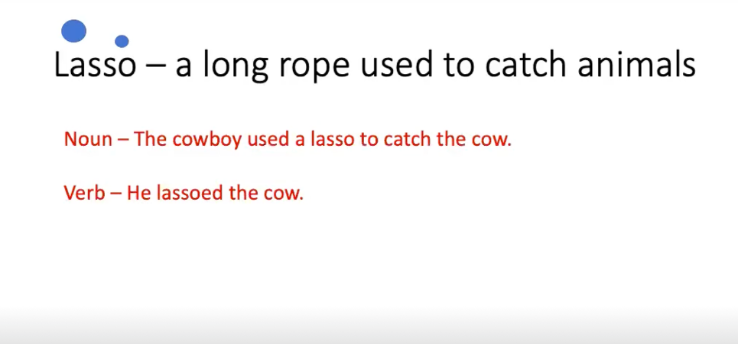
Lasso is a long rope used to catch animals. - DEFINITION
.
Who normally uses it?
What do cowboys usually catch with a lasso? CCQ
Pre-teach Vocab - TASK CYCLE
*PRONUNCIATION - Lasso
The pronunciation in English is “lasso”.
(Points to her ear and then points to the Ss to repeat).
.
Ss repeat the pronuciation once.
.
Teacher: "Lasso" (Points to her ear. Points to Ss to repeat.)
.
Ss repeat a 2nd time. “Very good”.
Pre-teach Vocab - TASK CYCLE
*FORM - SYLLABLE - Lasso
.
Which syllable is stressed? The first or second? Lasso.
.
Ss: The first one?
.
Correct
Pre-teach Vocab - TASK CYCLE
*FORM - PART OF SPEECH - Lasso
.
What part of speech is lasso? Ss: “Noun?” Yes, in this context it is a noun.
.It can be a verb which is the action the cowboy does with the rope.
eg: “To lasso a cow.”
.
End of MPF for Lasso. Next word: Chase.
Pre-teach Vocab - TASK CYCLE
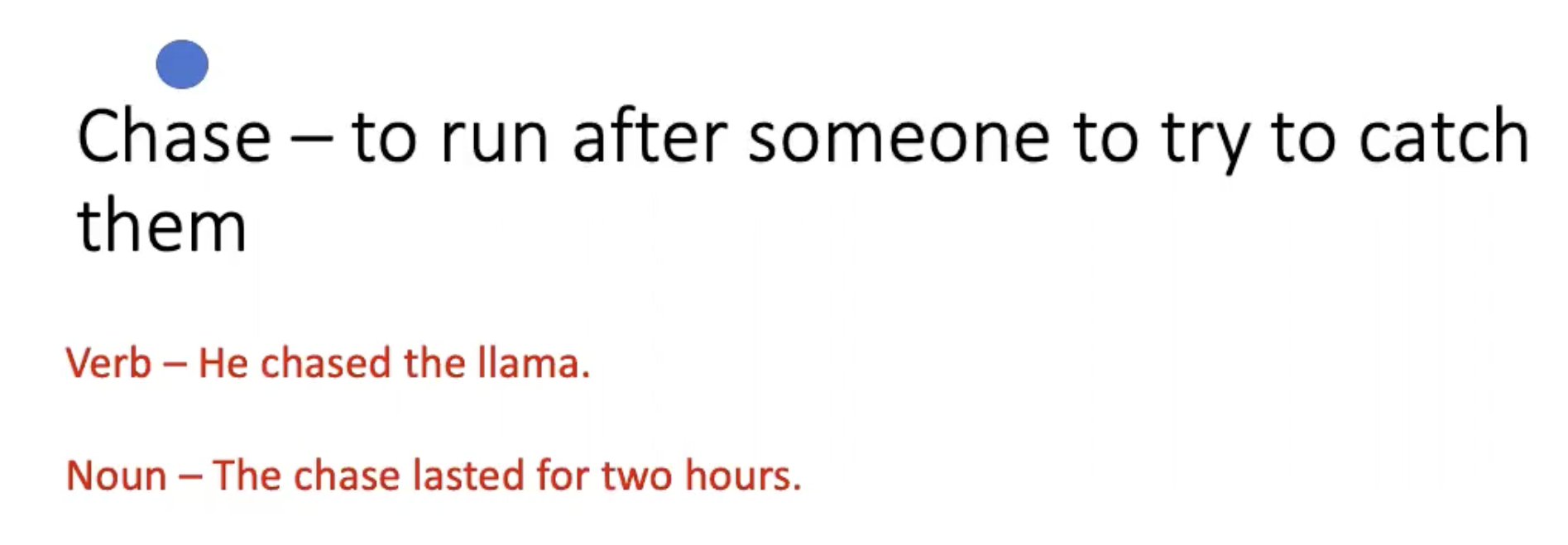
*MEANING - Chase
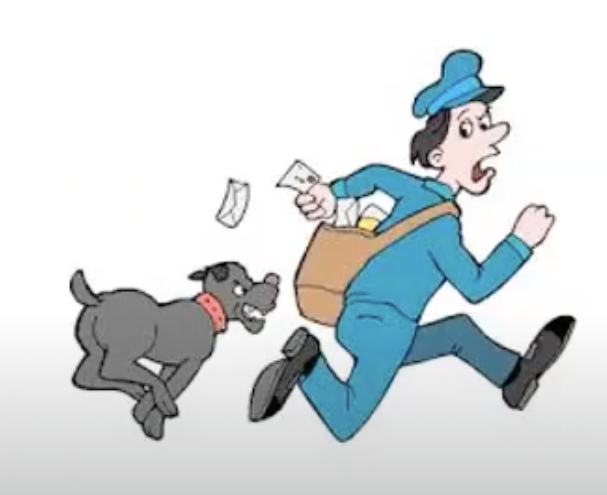
Is this a chase? (Shows slide) - DEFINITION
Does the dog want to catch the man?
Does the man want to stay away from the dog?
If someone was chasing you, how would you feel?
Would you run fast? - CCQ
Pre-teach Vocab - TASK CYCLE
*PRONUNCIATION - Chase
And the pronunciation is “Chase”.
(Points to her ear and then points to the Ss to repeat).
Ss repeat the pronuciation once.
.
Teacher: "Chase" (Points to her ear. Points to Ss to repeat.)
.
Ss repeat a 2nd time. “Perfect”.
Pre-teach Vocab- TASK CYCLE
*FORM - SYLLABLES - Chase
.
How many syllables?
.
Ss: One
.
Correct
Pre-teach Vocab - TASK CYCLE
*FORM - PART OF SPEECH - Chase
.
What part of speech is Chase? Ss: “Verb?”
Yes, in this context it is a Verb.
.
It can be also be a noun.
eg: “The chase lasted hours. It was a long chase.”
.
End of MPF for Chase. Next: On the loose.
Pre-teach Vocab - TASK CYCLE
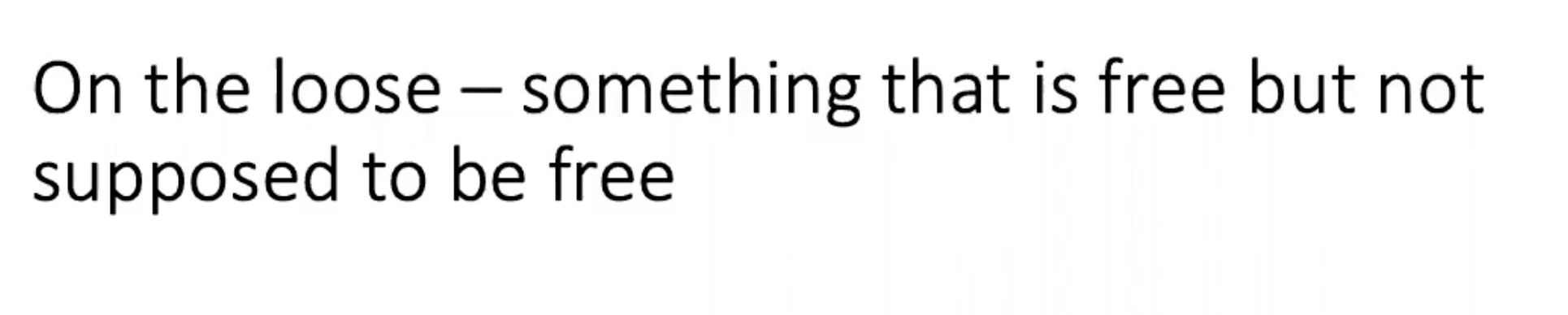
*MEANING - On the loose
“On the loose” (Shows slide) - DEFINITION
.
A lion escapes from the zoo and walks around the city. Is the lion "on the loose"?
Ss: yes
Right. It's supposed to be inside the zoo but now it's out. - CCQ
Pre-teach Vocab - TASK CYCLE
*MEANING - CCQs - On the loose
If a criminal escapes from jail, and is now free in the city, can we say that the criminal is "on the loose”?
Yes
If someone or something is on the loose, what do we need to do?
Ss: “You need to chase and catch it.”
Exactly. And put it back where it should be. - CCQ
Pre-teach Vocab - TASK CYCLE
*PRONUNCIATION - On the loose
Listen: “on the loose”.
(Points to her ear and then points to the Ss to repeat).
Ss repeat the pronuciation once.
.
Teacher: "On the loose" (Points to her ear. Points to Ss to repeat.)
.
Ss repeat a 2nd time. “Perfect”.
Pre-teach Vocab - TASK CYCLE
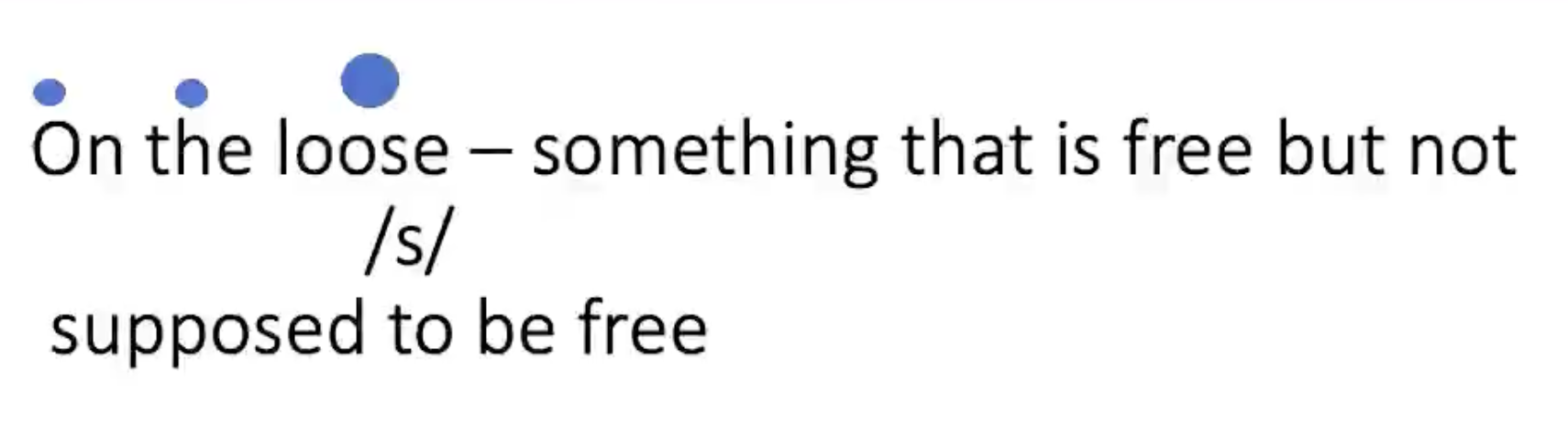
*FORM - STRESSED WORD - On the loose
.
Which word is more stressed? On the loose.
.
Ss: Loose?
.
Correct
Pre-teach Vocab - TASK CYCLE
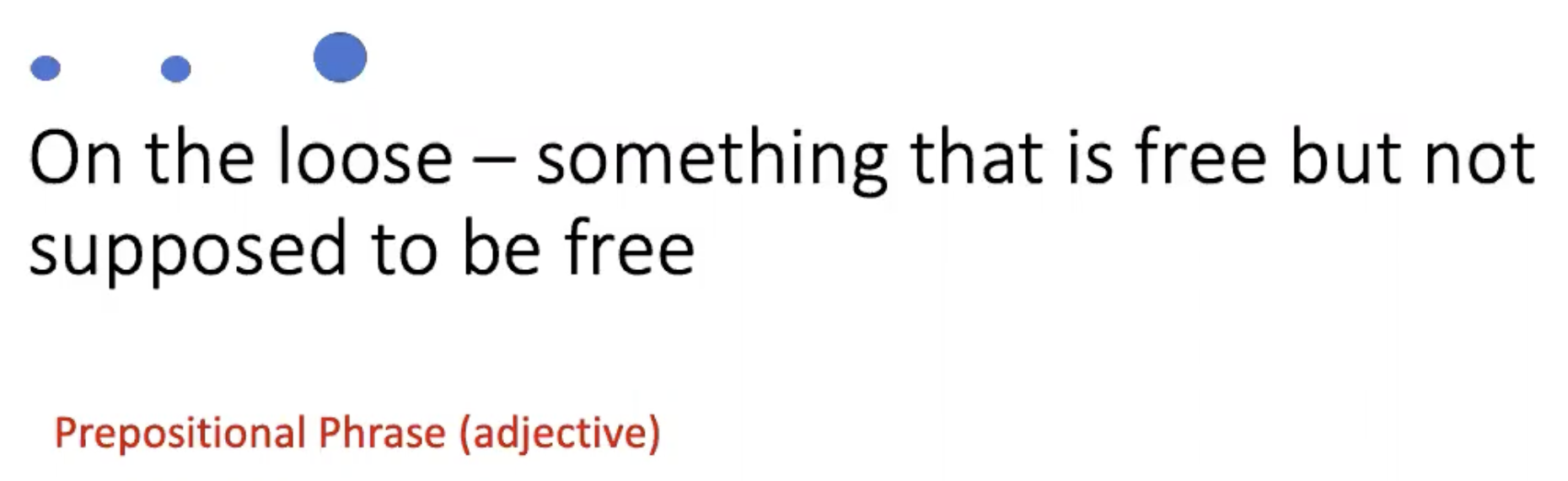
*FORM - PART OF SPEECH - On the loose
.
What part of speech is On the loose? It’s a bit difficult.
Ss: “It's an object?” No.
Ss: “It's a verb?” No.
Pre-teach Vocab - TASK CYCLE
*FORM - PART OF SPEECH - On the loose
.
It works like an adjective.
.
Technically it's a prepositional phrase but we
use it in a sentence like an adjective.
It describes something.
eg: “The criminal is on the loose."
.
End of MPF for On the loose. Next: Onlooker
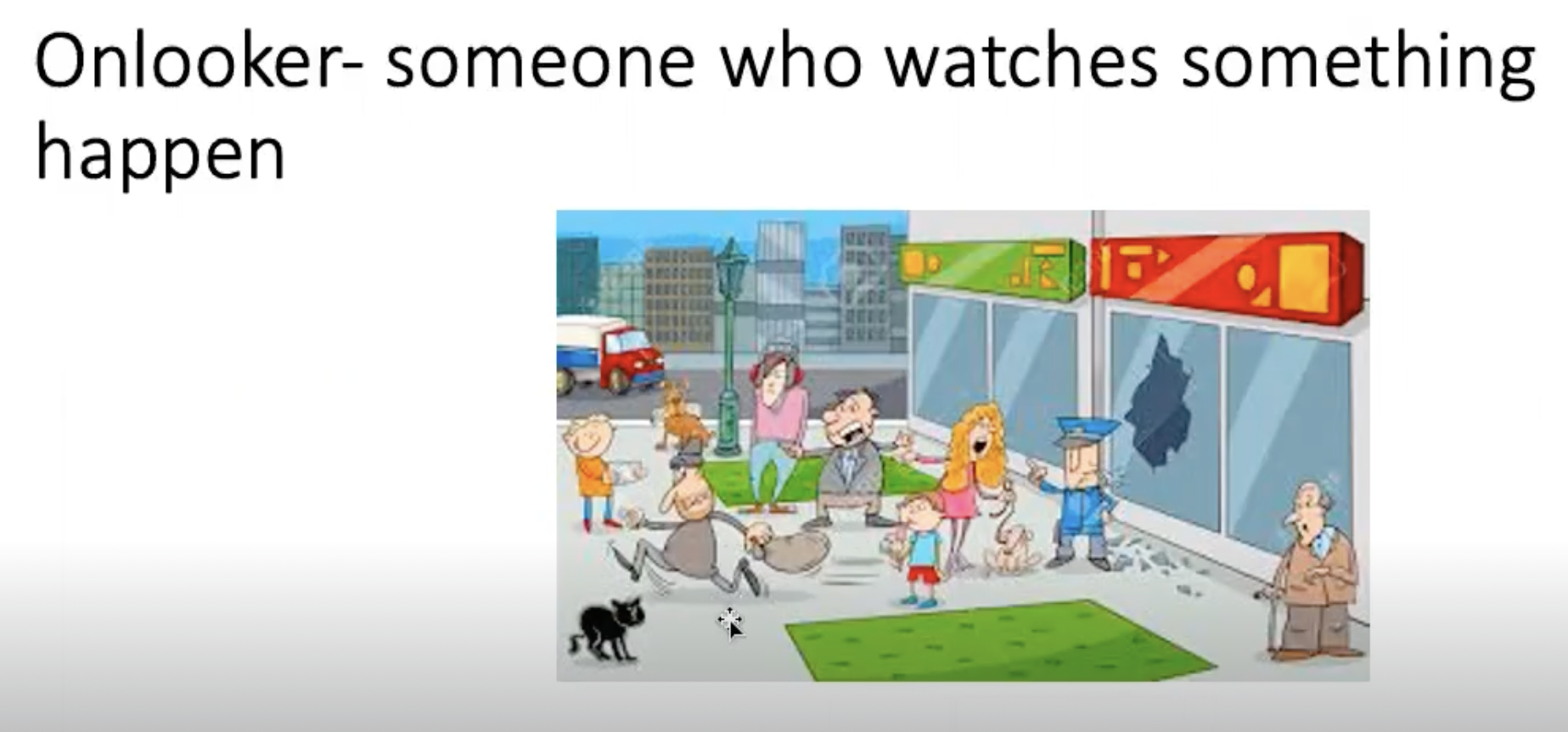
Pre-teach Vocab - TASK CYCLE
*MEANING - Onlooker
.
Show slide - DEFINITION
Look at the thief. Is he an onlooker? “No”.
Right. He is not watching the action - he is doing something.
What about this guy (bystander)? Is he an onlooker? “Yes” Perfect.
Pre-teach Vocab - TASK CYCLE
*PRONUNCIATION - Onlooker
Listen: “Onlooker”.
(Points to her ear and then points to the Ss to repeat).
Ss repeat the pronuciation once.
.
Teacher: "Onlooker" (Points to her ear. Points to Ss to repeat.)
Ss repeat a 2nd time. “Perfect”.
.
So is it “on looo-ker” or “onlooker”? “Onlooker” Perfect.
Pre-teach Vocab - TASK CYCLE
*FORM - SYLLABLES - Onlooker
.
Which syllable is stressed? Onlooker.
.
Ss: 2nd one?
.
No. Not “OnLOOKER” but “ONlooker”
Ss: Oh ok.
Pre-teach Vocab- TASK CYCLE
*FORM - PART OF SPEECH - Onlooker
And what part of speech is it?
Ss: Adjective? No
Ss: A noun?
Yes a noun. An onlooker is someone - a person - a noun.
.
End of MPF for Onlooker. Next: Spooked

Pre-teach Vocab - TASK CYCLE
*MEANING - Spooked
.
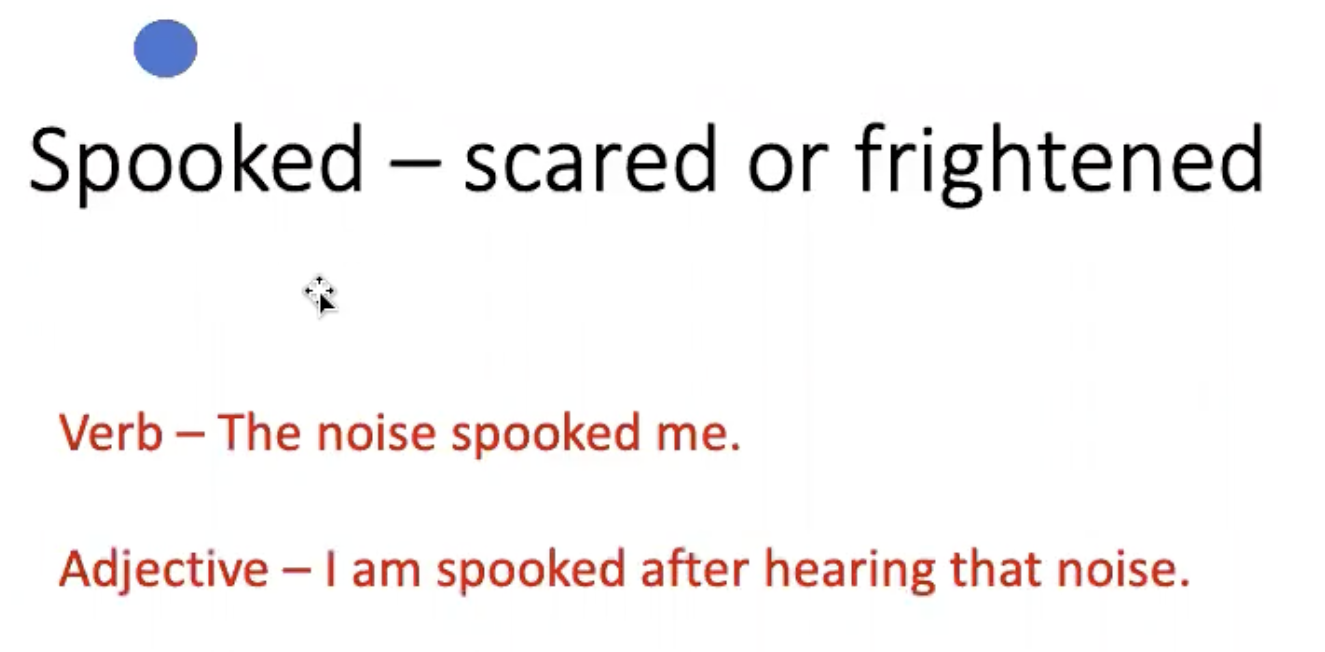
Show slide with definition. - DEFINITION
.
If you heard a noise in the middle of the night, would you be spooked? “Yes” - CCQ
Pre-teach Vocab- TASK CYCLE
*PRONUNCIATION - Spooked
.
"Listen: spooked" (points to her ear and then points to the Ss to repeat). Ss repeat.
.
Spooked (Points to her ear. Points to Ss to repeat.)
Ss repeat a 2nd time. Good!
.
Is the ending sound a duh or a tuh? /d/ or /t/
Ss: /t/. Right!
Pre-teach Vocab - TASK CYCLE
*FORM - SYLLABLES - Spooked
.
How many syllables in spooked?
.
Ss: One
.
Correct
Pre-teach Vocab - TASK CYCLE
*FORM - PART OF SPEECH - Spooked
What part of speech is spooked? Ss: Adjective?
Yes it can be an adjective that describes your feelings.
.
It can also be a verb.
Eg: 'the noise spooked me' (verb) or 'I am spooked' (adj)."
.
End of MPF for Spooked. Next: To wear yourself out.

Pre-teach Vocab - TASK CYCLE
*MEANING - To wear yourself out
.
Show DEFINITION
If I don’t get enough sleep, did I wear myself out or am I just tired? Ss: “tired”. Right.
If I ran a marathon. Did I wear myself out? Ss: “yes”
Yes. I've made myself very tired due to an action. - CCQ
Pre-teach Vocab - TASK CYCLE
*PRONUNCIATION - To wear yourself out
.
Listen: wear yourself out (points to her ear and then points to the Ss to repeat).
Ss repeat the pronunciation once.
Wear yourself out (Points to her ear. Points to Ss to repeat.)
Ss repeat a 2nd time.
Pre-teach Vocab - TASK CYCLE
*FORM - STRESSED WORD - To wear yourself out
.
Which word is more stressed? Wear yourself out?
.
Ss: Out?
.
Correct
Pre-teach Vocab - TASK CYCLE
*FORM - PART OF SPEECH - To wear yourself out
.
What part of speech is it?
.
Ss: verb?
.
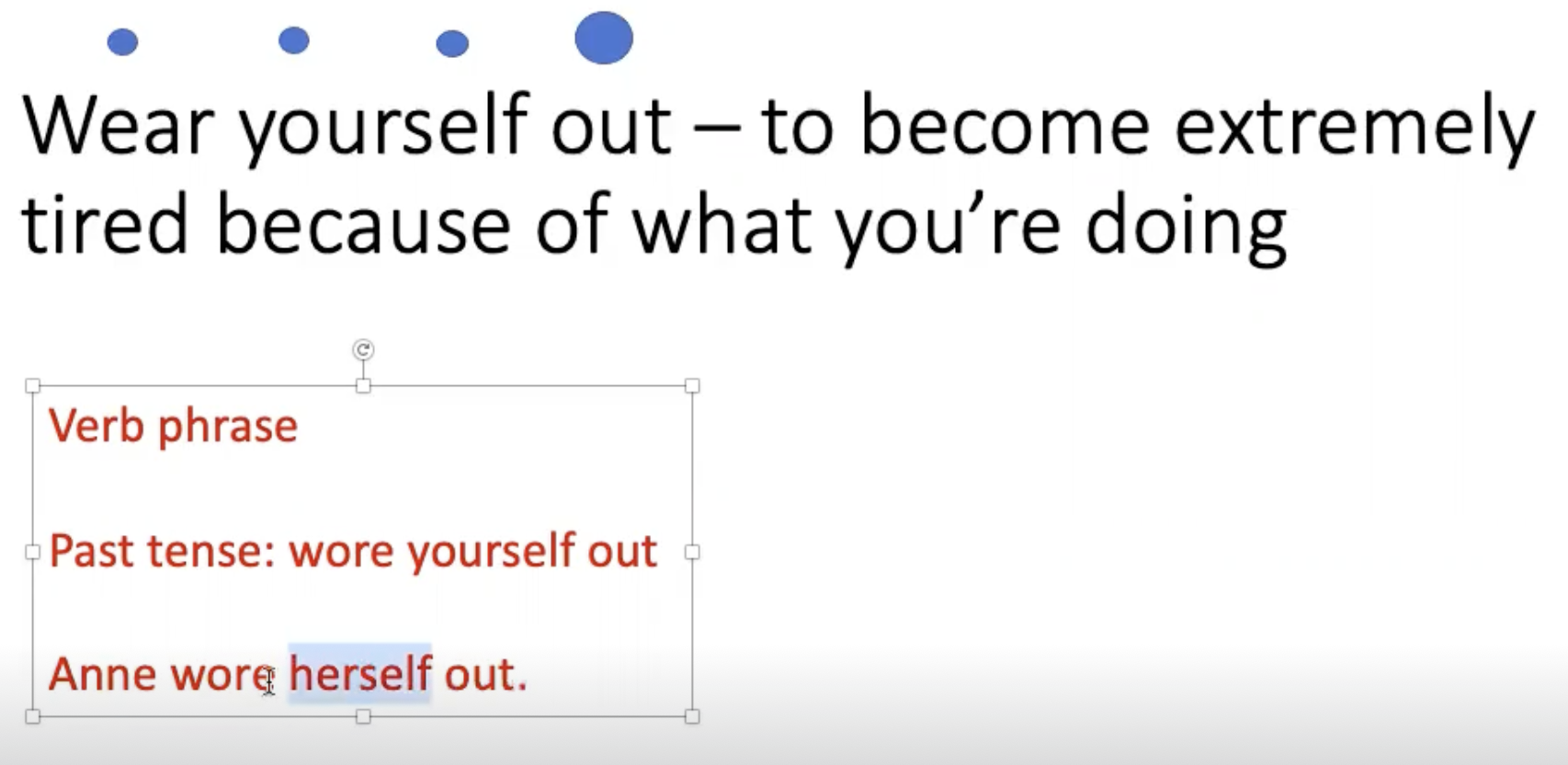
"Yes. It's actually a verb phrase.
Pre-teach Vocab - TASK CYCLE
*FORM - TENSE - To wear yourself out
.
And in the past tense?
.
Ss: “Worn yourself out?” Yes exactly.
Pre-teach Vocab - TASK CYCLE
*FORM - TENSE - To wear yourself out
.
What if it was a she, what would we say? Let's say "Anne wore … is it "yourself" out?
Ss: “She wore herself out?”
.
Yes exactly. You change the words according to the subject.
.
End of MPF for To wear yourself out. Next: Dodge
Pre-teach Vocab - TASK CYCLE
*MEANING - To Dodge
.
Show slide with definition of Dodge - DEFINITION
Pre-teach Vocab - TASK CYCLE
*MEANING - CCQs - To Dodge
If someone throws a ball at my face, will I dodge?
(Mimes moving head out of the way.) Ss: “Yes”.
.
If I dodge, is it a quick motion or a slow motion? Ss: “Quick”
.
Very quick. And am I trying to protect myself? Ss: “Yes - CCQ
Pre-teach Vocab - TASK CYCLE
*PRONUNCIATION - To Dodge
Listen to the pronunciation: Dodge.
(points to her ear and then points to the Ss to repeat).
Ss repeat the pronunciation once.
Dodge" (Points to her ear. Points to Ss to repeat.)
Ss repeat a 2nd time.
Pre-teach Vocab - TASK CYCLE
*FORM - PART OF SPEECH - To Dodge
What part of speech is Dodge?
.
Ss: verb?
.
Yes
Pre-teach Vocab - TASK CYCLE
*FORM - TENSE - To Dodge
.
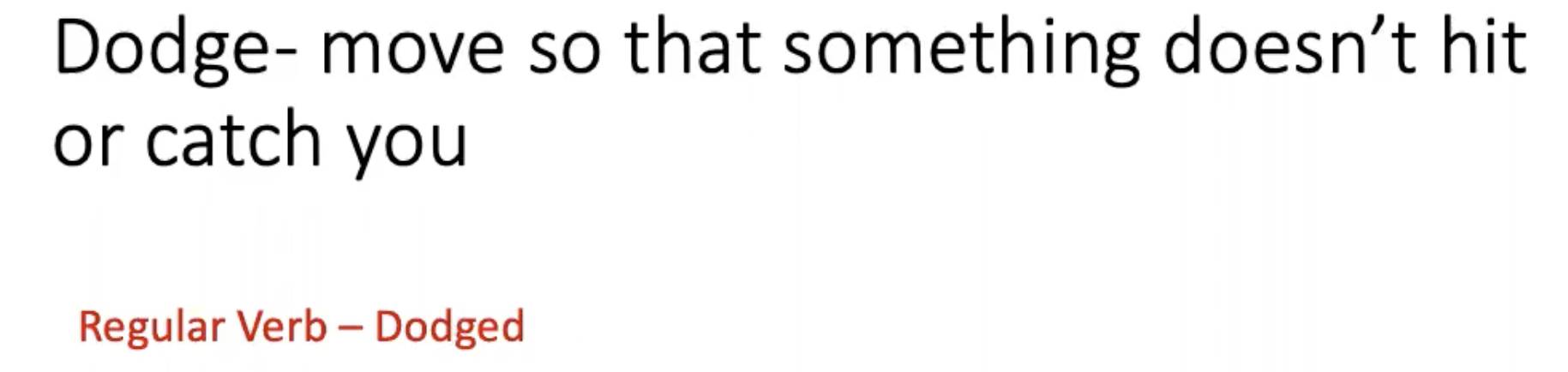
And it’s regular, so the past tense is?
.
Ss: “Dodged”. Ends in -ed.
.
End of MPF for Dodge. End of Word List.
Pre-teach Vocab - TASK CYCLE
.
Duration of Task Cycle for Blocking Words: 8 minutes.
.
End of MPF . Next: Detailed Task
Gist Task - TASK CYCLE - Summary
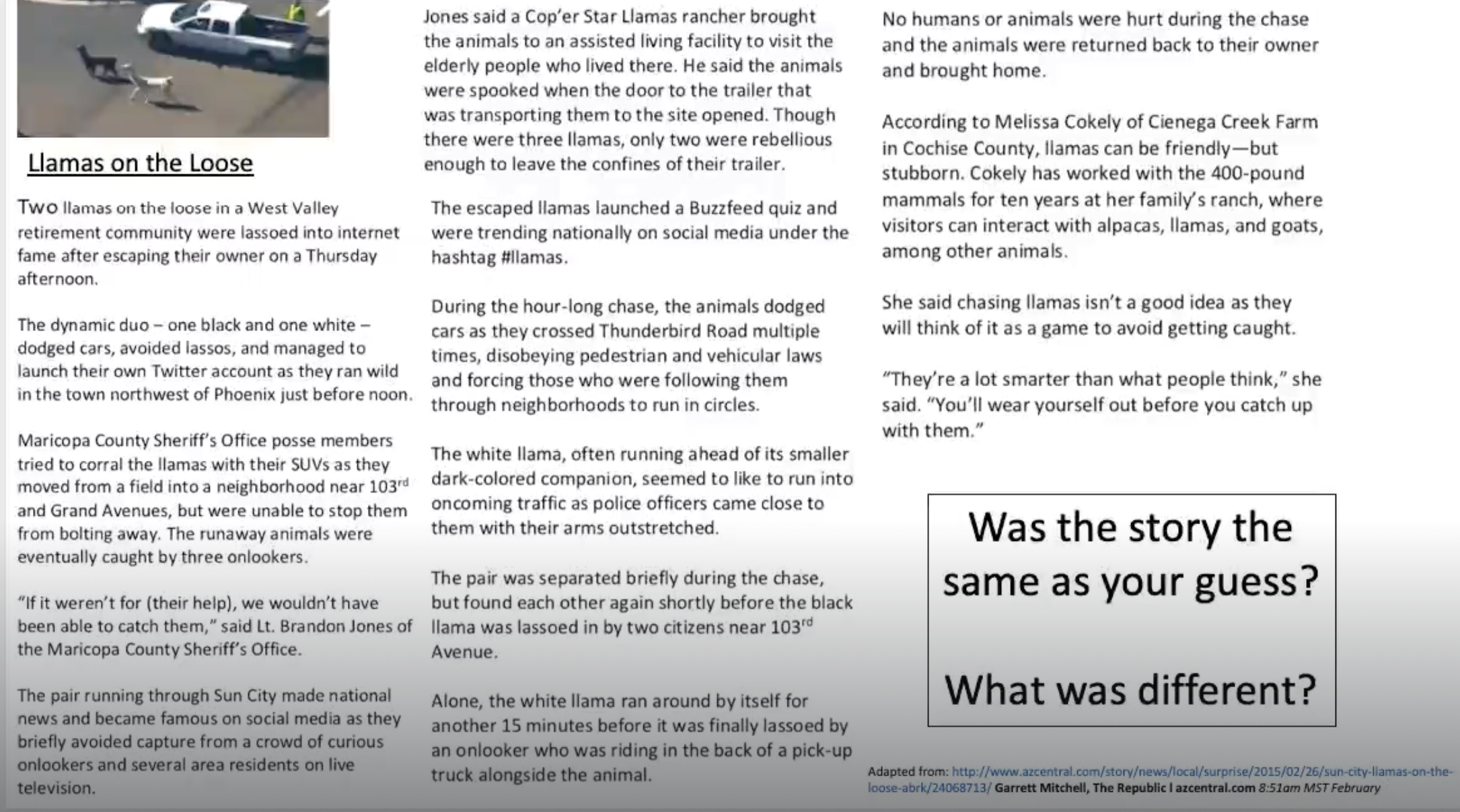
SET TASK - In pairs, Ss to use blocking words to predict the news story
WORK IN PAIRS - Ss discuss their predictions for the story
WORK ALONE - Reading for Gist - Ss skim story and check their predictions
WORK IN PAIRS - Discuss what was the same/different in the story vs your predictions.
WHOLE CLASS FEEDBACK - Discuss findings with WC.
Gist Task - TASK CYCLE - 10 min
On the next pages we look at each part of the
Task Cycle for the Gist Task
Gist Task - TASK CYCLE - SET TASK
So all of these words that we’ve just talked about, they are all in the story we are about to read. A story about llamas.
.
Instructions:
Talk together for 2 minutes and try to guess what you think will happen in this story using all of these words.
- SET TASK - PREDICTION
.
Teacher turns off camera and monitors.
Gist Task- TASK CYCLE - WORK ALONE
Teacher turns camera back on. Good guesses everyone.
Instructions:
You have 3 min to quickly read the story and check if your guesses were accurate. What was the same/ different?
- CHECK PREDICTIONS - 3 min
.
CCQ: Will you be able to read every word? “No”
Do you have to read a bit quickly? “Yes”Teacher turns camera off.
Gist Task- TASK CYCLE - WORK IN PAIRS
Prediction - Checking
Teacher turns camera on. It’s ok if you didn’t read everything.
Instructions:
Talk together and see what was the same as your predictions and what was different. - 1 min
Teacher turns camera off.
Ss discuss for 1 min.
Gist Task- TASK CYCLE - WHOLE CLASS FEEDBACK
Teacher turns camera on.
.
Your guesses were very close. Was anything different? How many llamas were there?
.
Ss answer
.
End of Gist Task. Next Reading for Detail.
Detailed Task - TASK CYCLE - Summary
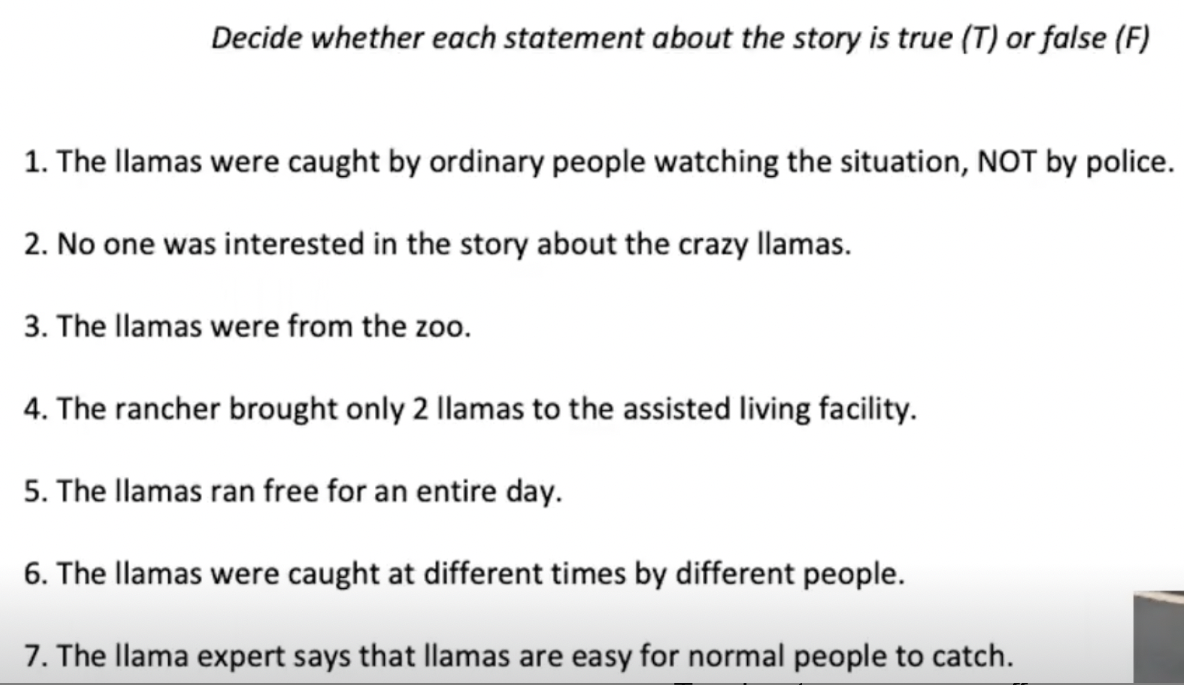
SET TASK - Ss read story and answer T/F questions.
WORK ALONE - Ss do the task alone first (read story / answer T/F questions)
WORK IN PAIRS - Ss discuss their answers. Do they agree with each other? If answer is false, what is the right answer?
WHOLE CLASS FEEDBACK - Discuss findings. Teacher highlights on the text the places where the answers are located.
Detailed Task - TASK CYCLE - Summary
WHOLE CLASS FEEDBACK (continued):
Teacher engages Ss in brief fun conversation about the text they just read. This mimics real life situations where we discuss things we’ve read with others and share our opinion.
.
On the next pages we look at each part of the
Task Cycle for the Detailed Reading Task
Detailed Task - TASK CYCLE - SET TASK
Ss read the story again, this time looking for more details.
.
Eg: open-ended questions or True or False questions.
.
Detailed task prompts the Ss to go back and read text more closely.
Detailed Task - TASK CYCLE - WORK ALONE
.
Instructions:
We’re going to read it one more time and answer these T/F questions. Take 6-7 min to do this.
.
First read the questions. Then read the story. - WORK ALONE
.
Teacher ensures all Ss have a copy of the story (screenshot and / or Google doc link).
Teacher turns camera off.
Detailed Task - TASK CYCLE -
WORK IN PAIRS - Instructions
Ok, are you ready or would you like a little more time?
Maybe one more minute?
Ok, please check your answers together in pairs.
Teacher turns camera off.
Detailed Task - TASK CYCLE -
WORK IN PAIRS
Teacher turns camera back on.
.
See if you agree with each other whether it’s True or False.
If it’s false, see if you can find what the real information is.
.
Teacher turns camera off.
Ss work in pairs.
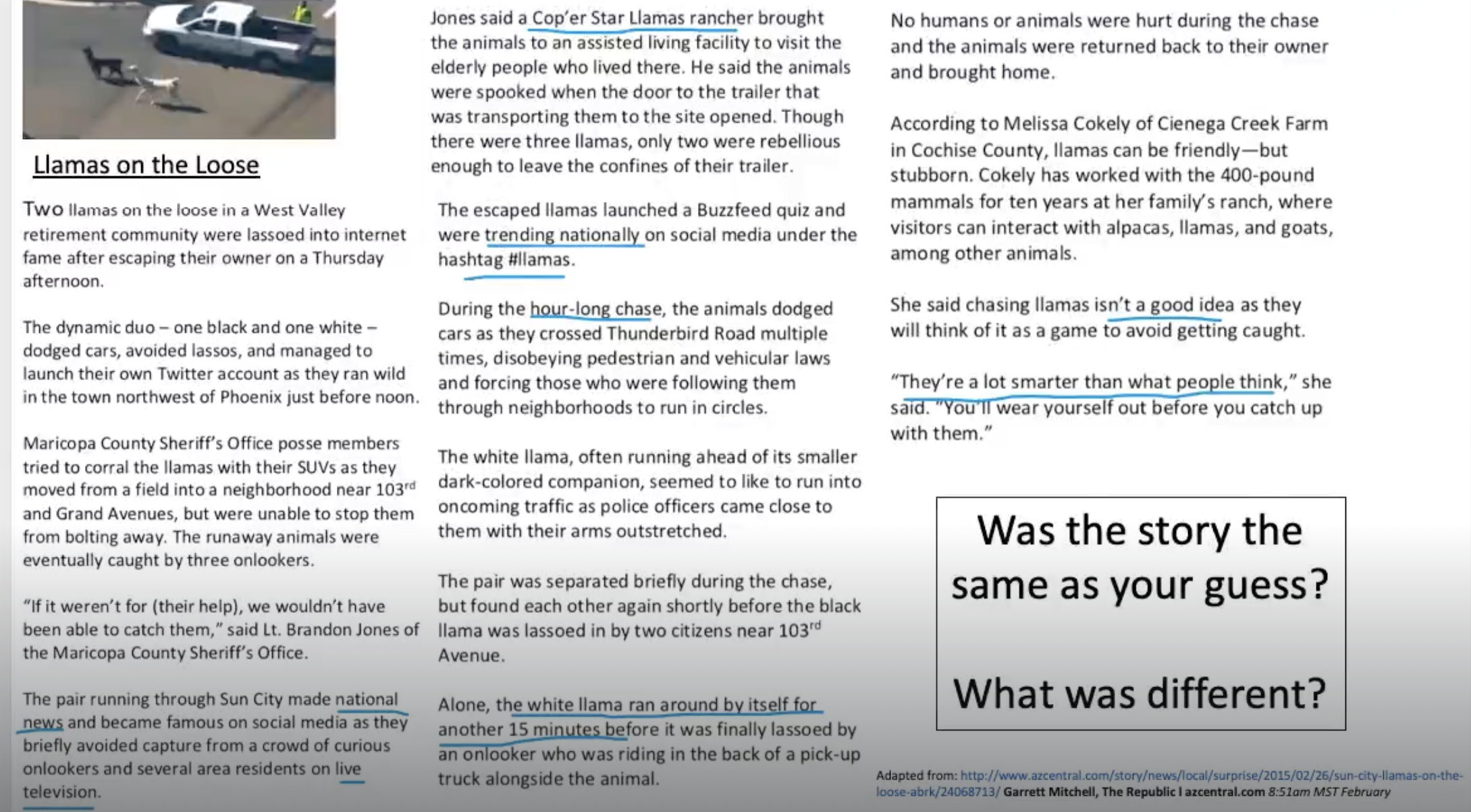
Detailed Task - TASK CYCLE -
WHOLE CLASS FEEDBACK
.
Teacher turns camera back on.
Great job. You seemed to agree on most of them.
.
Teacher reads the list of questions eliciting answers from Ss.
.
Teacher underlines the places in the story where the answers are found.
Detailed Task - TASK CYCLE -
WHOLE CLASS FEEDBACK - Getting Ss opinions
Teacher further engages Ss interest by asking them their opinions on the story.
.
If you saw a llama walking down the street, what would you do?
Would you try to lasso the llama? No? Me neither. I would be too scared. lol.
[Ss name] what would you do? (engages each Ss in responding and joining conversation.)
End of Reading for Detail. Next Productive Task.
Productive Task - TASK CYCLE - SET TASK
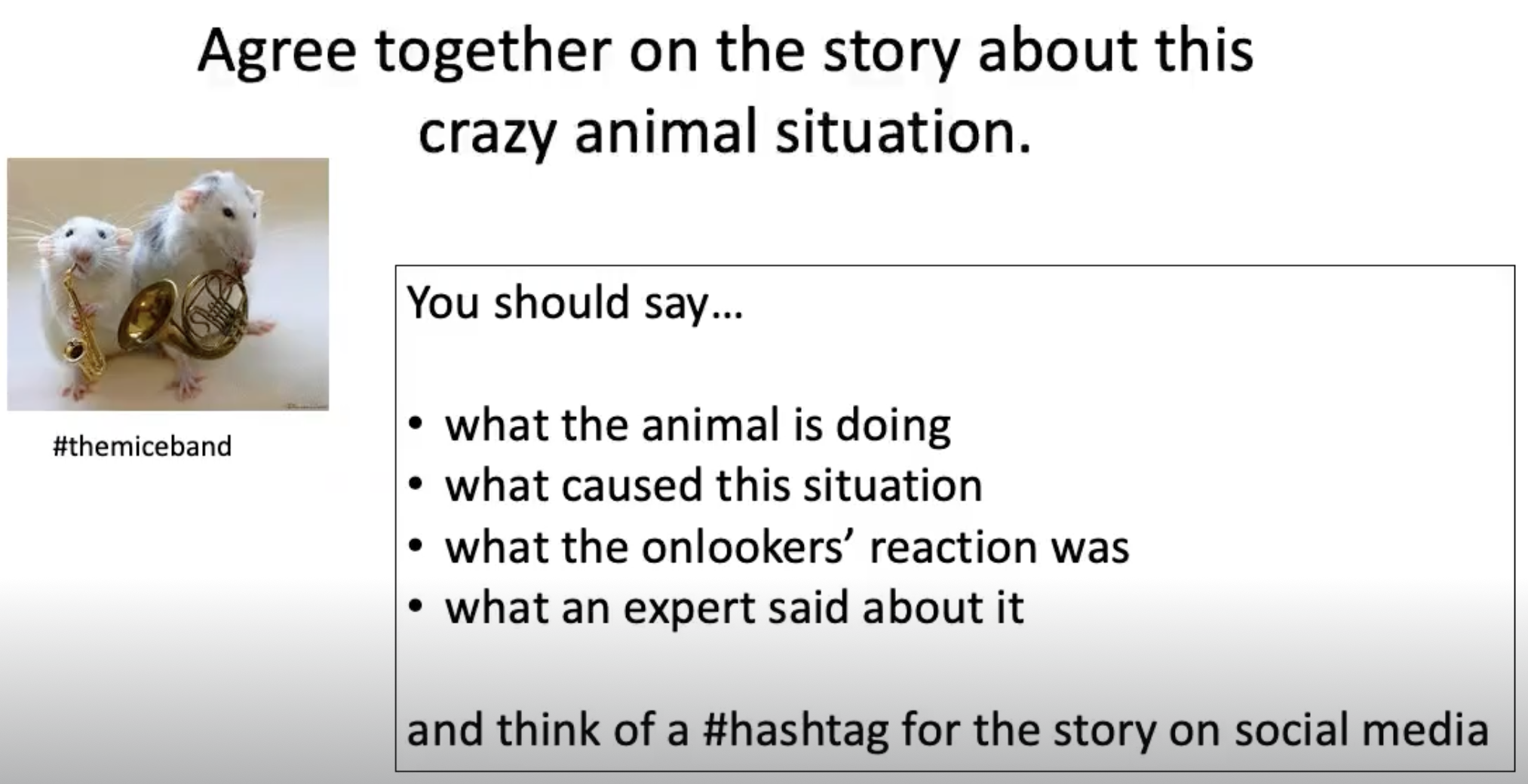
SET TASK - In pairs, Ss write a news story of their own using the picture and prompts provided.
WORK IN PAIRS - Ss discuss
WORK ALONE - Reading for Gist - Ss skim story and check their predictions
WORK IN PAIRS - Discuss what was the same/different in the story vs your predictions.
WHOLE CLASS FEEDBACK - Discuss findings with Whole Class.
Productive Task - TASK CYCLE - Summary
The Productive Task is most effective when there is a communicative goal.
.
By necessity Ss will give their opinions, listen to each other’s opinions, discuss and decide on the best course of action to write an appropriate news story.
.
This helps Ss develop their overall English skills.
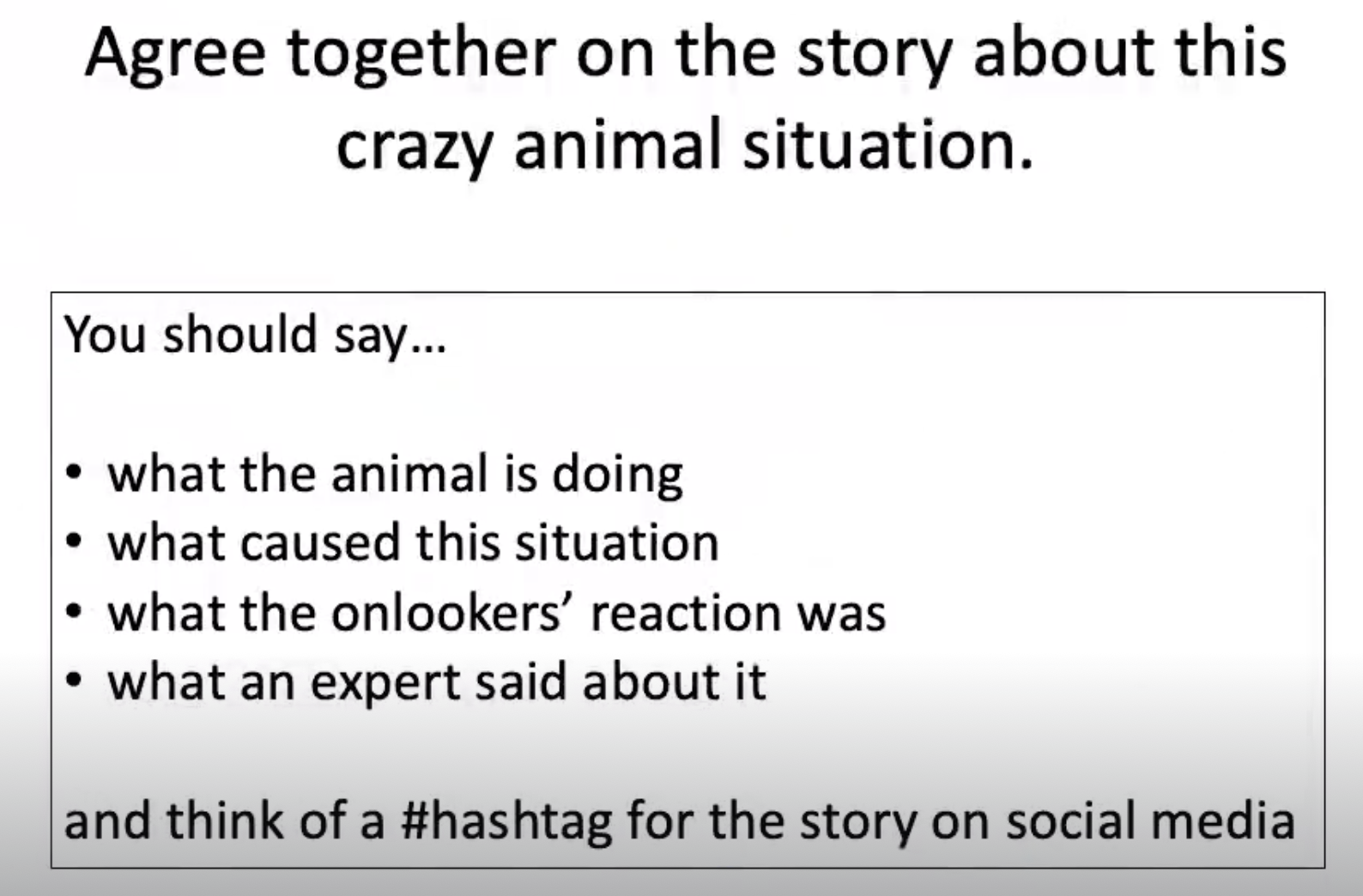
Productive Task - TASK CYCLE - SET TASK - 5 min
Instructions: Ss will be shown a picture of two mice playing musical instruments. They will be given a list of prompts and asked to create a news story incorporating these elements.
Productive Task - TASK CYCLE - SET TASK - 5 min
Instructions:
So now I have one more crazy news story.
But this time I’m going to show you just the picture of the story and you need to talk together to agree on what the story is.
You need to work together to tell the story based on the picture I’m about to show you. - WORK IN PAIRS
Use these prompts to tell the story.
5 minutes
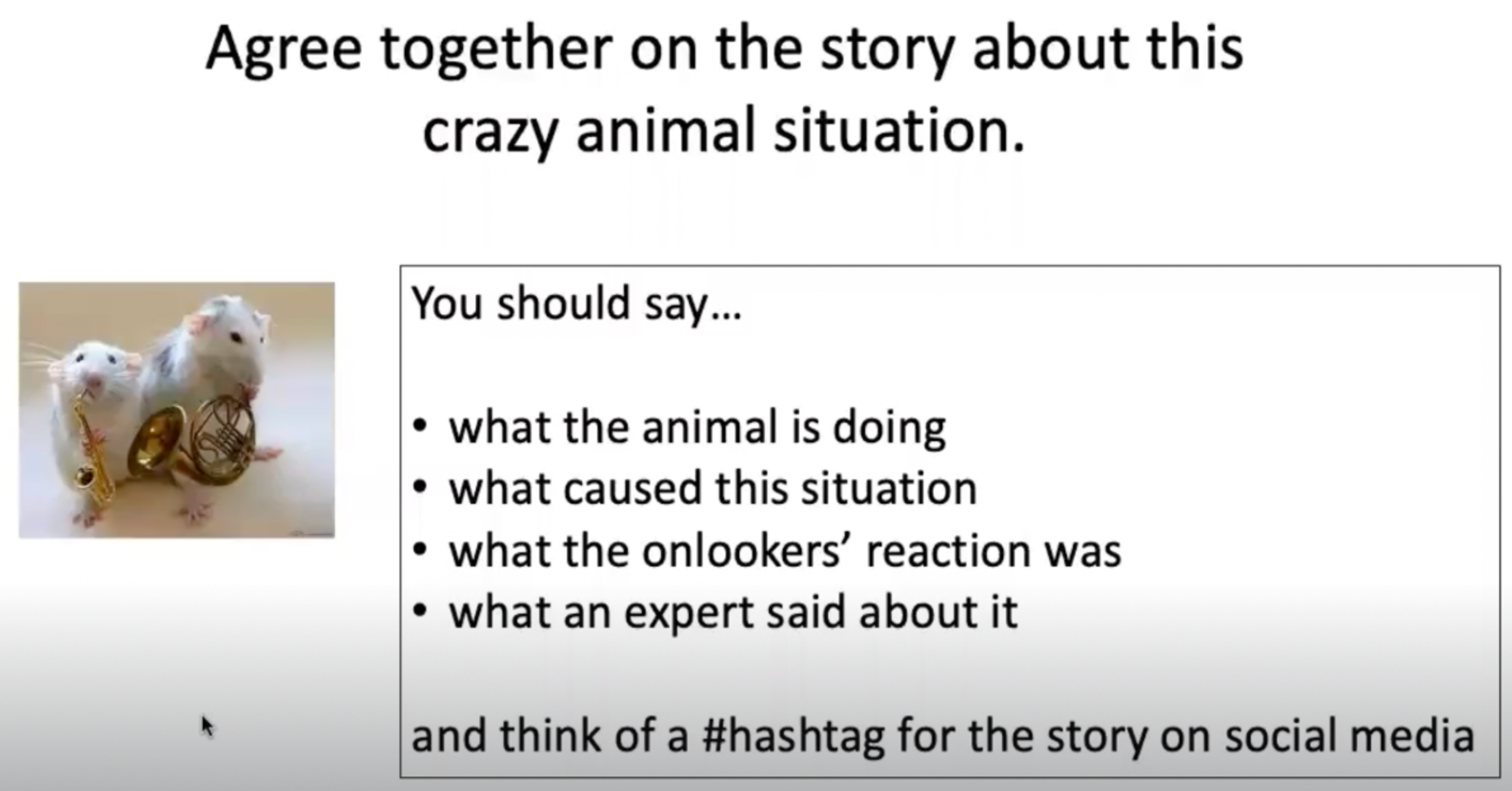
Productive Task - TASK CYCLE - WORK IN PAIRS
.
CCQS:
So will you each be writing your own stories? Or will you be working together to write one story? Ss: “We’ll work together to write one story.”
Teacher turns off camera and monitors.
Productive Task - TASK CYCLE - WCFB
.
Teacher turns camera back on.
Ok, I heard a few things but I want to hear the whole story. So what is the story with these animals?
.
Ss tell the story to the whole class.
Teacher asks the other Ss in the pair if they have anything they want to add to the story. Ss: No.
Productive Task - TASK CYCLE - WCFB
That was a great story! I think that should be trending on Twitter now lol. Ss: lol
End of Productive Task. Next Vocabulary Error Correction.
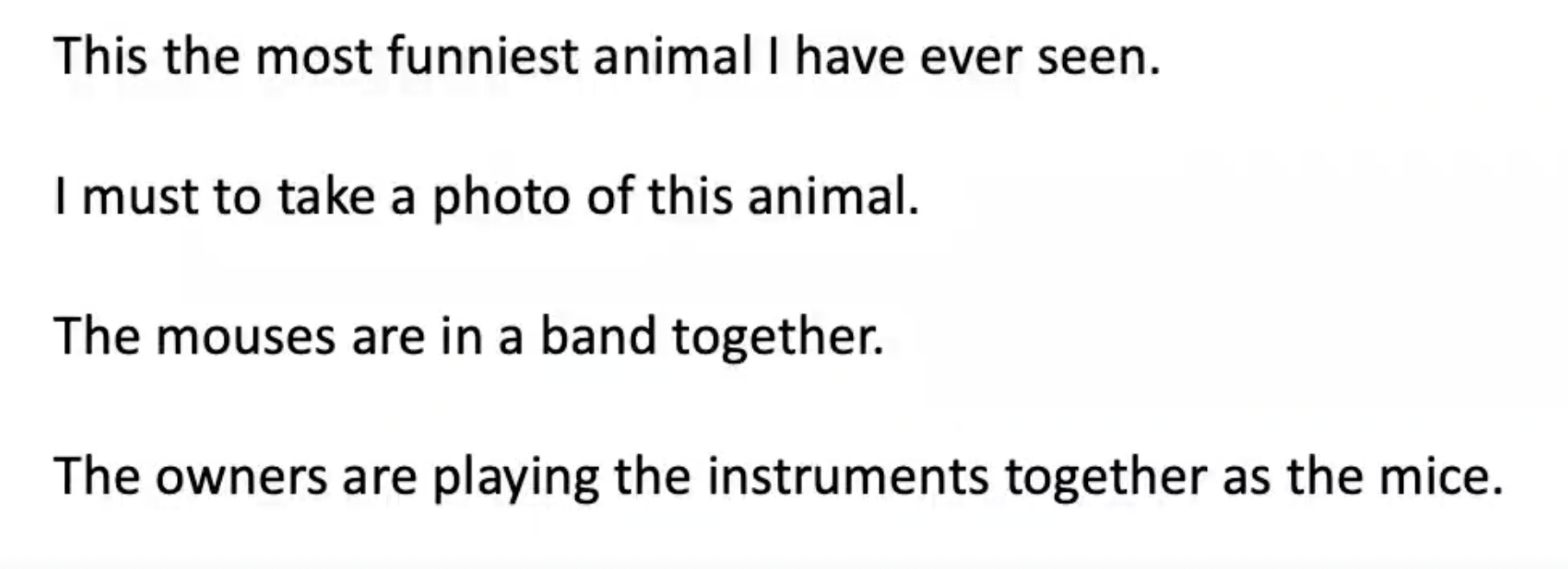
Vocab Error Correction
I’m going to write a few sentences on the slide now. Think about whether the sentences are correct or whether they have a few mistakes.
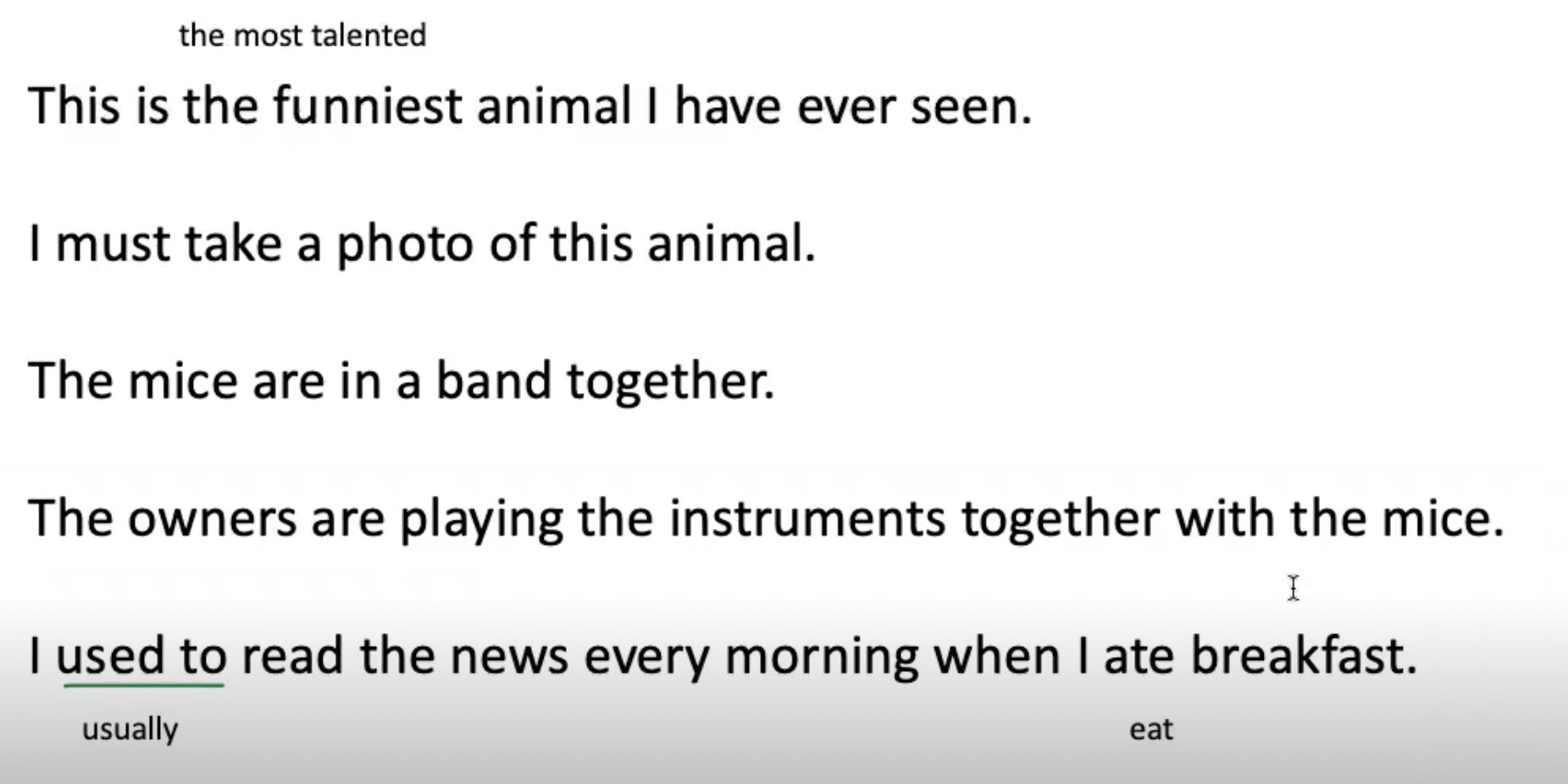
Whole Class participation. Ss provide ways to correct the errors.
Vocab Error Correction
Is the last sentence correct? “I used to read the news every morning when I eat breakfast.”
Ss: ‘ate breakfast’ because it’s in the past.
T: Correct. What about ‘used to’? Is this something I did once in the past or regularly in the past?
Ss: Regularly?
T: Yes.
Vocab Error Correction
.
What if I want to keep the word ‘eat’ because I want to say it’s something I still do now. What if I want to have a word similar to ‘used to’? A similar meaning to regularly or often?
Ss: ‘usually’? I usually read the news every morning when I eat breakfast?
T: Right. So if you want to use ‘used to’ but in the present, you can say ‘usually’.
End of Vocabulary Error Correction. End of lesson.