American Gov Midterm
 Call Kai
 Learn
Learn Practice Test
 Spaced Repetition
 Match
Match Flashcards
 Knowt Play
1/50

There's no tags or description
Looks like no tags are added yet.
Name | Mastery | Learn | Test | Matching | Spaced | Call with Kai | Chat |
|---|
No analytics yet
Send a link to your students to track their progress
51 Terms
Government
the system by which a society organizes itself and allocates authority in order to accomplish collective goals and provide benefits to that society.
Democracy
a form of government in which power is vested in the people, who rule either directly (direct democracy) or through freely elected representatives (republic)
Monarchy/Oligarchy/Totalitarian
forms of government where power is concentrated in the hands of a single ruler (monarchy) / a small & elite group (oligarchy) / a centralized authority that maintains strict control over many aspects of daily life (totalitarian).
Capitalism vs Socialism
Capitalism emphasizes private ownership and free markets, while socialism advocates for government ownership and means of production
Politics
the process of gaining and exercising control within a government for the purpose of setting and achieving particular goals // Lasswell: who gets what, when, how
Political Science
the study of government and politics
“bowling alone” theory
ppl are less involved with community groups than in the past
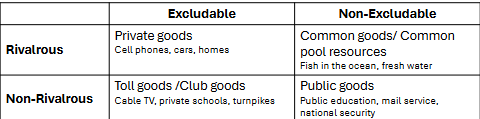
KNOW THIS DIAGRAM
Magna Carta
rights granted to English ppl in 1215
John Locke
natural law/rights
Hobbes
state of nature
The 2nd cont. cong. was mainly written by
Jefferson
AOC main points
desire for republic not monarchy
each state had its own const.
all states had equal rep.
central gov. would only have authroity in national defense, settling issues between states, foreign policy
issue w/ the AOC
national gov. was intentionally weak (no taxation, many used state-backed currency, and amending required unanimous votes)
Const. Convention of 1787 made _____ pres. of convention
Washington
Issues talked about @ Const. Convention 1787
Fair representation: by population or same for all states?
• Strengthen national government but preserve state autonomy
• What to do about slavery?
• Political rights for all free men without mob rule
Virginia Plan vs NJ Plan
Virginia plan: two houses apportioned
by population (HOR)
NJ plan: one house with one member
from each state (Senate)
Federal System
pwr is divided between state and national gov.
Federalists (won out)
more educated/wealthy
stronger national gov.
concerned about “excess of democracy”
Anti-federalists
concerned about state and individual rights
distrust of powerful interest
What was one of the first things congress did?
amend the constitution
proposed by congress (2/3), ratified by states (3/4)
Issues talked about at Great Compromise
Bicameral legislature known collectively as Congress
Senate has equal representation
House of Representatives has single-member districts apportioned by population
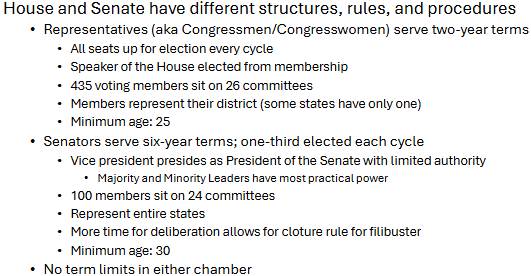
HOR vs Senate
Enumerated Powers
explicitly stated in the constitution (levy and collect taxes; declare war; print money; create rules for immigration; etc.)
Implied Powers
Inferred as needed to govern (minimum wage; interstate highway system; environmental regulation)
Inherent Powers
assumed to exist bc the US exists (acquire territory; legislate for Indian tribes; conduct foreign relations)
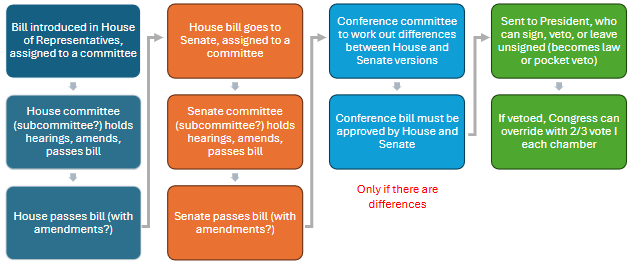
The Legislative Process (this is not always followed nowadays—no single subject rule, budget reform laws, some bills skip committees)
Models of Representation
Delegate: do the will of their constituents
Trustee: use their own judgment
Politico: little bit of both
Types of Representation
economic: pork and barrel
collective: congress as a whole
descriptive: shares characteristics w/ voters
pres. qualifications
35yrs old
natural born citizen
lived in US for 14 consecutive yrs
Checks and balances shown in executive branch (president has pwr to veto legislation)
• Can be overcome by Congress
• Congress can impeach and remove the president from office
• Three have been impeached by House, none removed by Senate
• The president appoints federal judges and Supreme Court Justices, confirmed by Senate
• President negotiates treaties, approved by Senate
• Judicial review of presidential actions
EC pros
protects interests of minorities
gives more pwr to states
allows for two-party system
EC cons
complex system makes ppl tend to back away from voting
candidate favored by majority may not win
swing and small states are given more pwr
role of VP
Actual role depends upon the president
• Sometimes not very active outside of official duties in Senate
• Can act as policy advisor or be put in charge of specific issues
• Might be chosen as running mate for mostly political purposes
First Lady
mostly been a ceremonial role
• Eleanor Roosevelt and civil rights
• Nancy Reagan and antidrug campaigns
• Hilary Clinton and national health care reform
most important role of the pres.
leadership
What does the fed. bureaucracy do?
carry out routine tasks of governance (it is also hierarchical form)
Weberian model of bureaucracy
formal procedures (want everything to be the same)
Acquisitive model of bureaucracy
competitive
Monopolistic model of bureaucracy
agencies behave like private sector monopolies
the bureaucracy is mainly staffed by
spoil systems
Civil Service Reform Act of 1883
professionalized government workers (the merit system replaced spoils system)
Independent agencies
smaller in size and scope than cabinet level agencies (CIA, SEC)
Government corporations
created to fulfill a vital service and indented to be self sufficient (post office)
Why do elected official struggle with controlling the federal burecracy?
bc bureaucrats vastly outnumber them
Nature of bureaucracy makes it self-sustaining
It has some policymaking authority
Public Policy
A government action made in the public interest with government authority
pros and cons of bureaucracy
• Bureaucrats have expertise most legislators lack
• Career government professionals should be nonpartisan
• Bureaucrats are not elected and are unaccountable to voters
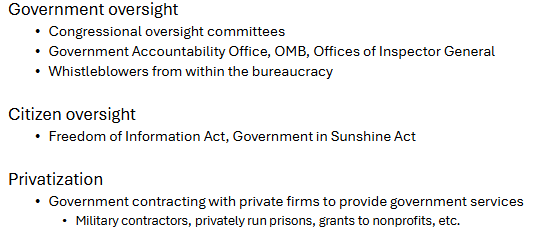
How diff. ppl oversee bureaucracy