MLS2213 Unit 10
 Call Kai
 Learn
Learn Practice Test
 Spaced Repetition
 Match
Match Flashcards
 Knowt Play
1/238

Earn XP
Description and Tags
Enymes
Name | Mastery | Learn | Test | Matching | Spaced | Call with Kai | Chat |
|---|
No analytics yet
Send a link to your students to track their progress
239 Terms
The first enzyme to be measured for clinical purposes was , higher levels of which is associated with a greater _
LDH, tumor burden
Enzymes are this type of molecule
protein
Enzymes participate in but are not by a reaction
consumed
An alteration in the structure of an enzyme will also alter its
functionality
Enzymes may require one or both of these to catalyze a reaction
coenzyme, activator
Coenzymes are often ____ acceptors or donors
hydrogen
Activators are usually
metal cations
An enzyme composed of more than one protein subunit is said to have
quarternary structure
When subunits have minor variations leading to multiple forms of a functionally identical enzyme, it is said to be a(n)
isoenzyme
These two enzymes are particularly well known for having isoenzymes
CK, LDH
The two possible subunit types of CK are
M, B
The two possible subunit types of LDH are
L, H
Isoenzymes are often produced mostly by one organ or tissue type, allowing some degree of
specificity
Enzymes are found in the blood after
leaking out of cells
Although enzymes in the bloodstream are still functional, they typically
serve no purpose
In a healthy individual, the rate at which enzymes leak from cells is
known
Cellular stress or disease may cause enzymes to leak from cells due to
increased cell membrane permeability
Cellular necrosis may cause enzymes to escape cells due to
rupture
An overall increase in blood enzyme levels may occur when cells are
proliferating
Enzymes may be found in elevated levels in the bloodstream even if a normal percentage is leaking out of cells if
enzyme production is high
When enzyme levels are below the reference range, it is typically
clinically insignificant
Enzymes with very low specificity, like LDH, provide very good _ for presence of disease.
sensitivity
LDH is found in this metabolic pathway
ebden-meyerhoff
These two enzymes are assayed by mass quantitation
prostatic acid phosphotase, CK-MB
Most enzymes are indirectly measured based on their
activity
Enzyme activity is
rate at a reaction is catalyzed
In the context of enzyme quantitation, rate of reaction is defined as
absorbance change per minute
Absorbance change is due to the of substrate or the of product or coenzyme.
disappearance, appearance
A common target for enzyme assays is the appearance or disappearance of
NADH
This type of assay is not ideal for measuring enzyme activity
endpoint
This type of assay is most ideal for measuring enzyme activity
multipoint kinetic
At the beginning of a reaction, reaction rate is slow and this is termed
lag phase
After lag phase, reaction rate increases in a linear fashion until
enzymes are saturated
Once all enzymes are saturated, the reaction rate remains stable and the reaction is said to be in
equilibrium
Enzyme assays must use absorbance readings taken when the reaction is in the _ phase in order to be accurate
linear rate
This equation gives provides an enzyme activity result in
international units
In this equation, ε is the
molar absorptivity constant
One international unit is the amount of enzyme activity that will catalyze _ of substrate into product per ____.
one micromole, minute
In an enzyme assay, the only _ should be the amount of enzyme present.
rate limiting factor
Enzyme assays operate on the assumption that and are proportional.
reaction rate, amount of enzyme
Substrate concentration, coenzyme concentration, temperature, pH, and presence of inhibitors are all
rate limiting factors
Most commonly, inhibitors are
anticoagulants
The fastest a reaction can go with a given amount of enzyme and unlimited substrate is
vmax
The amount of substrate that will give you half of the maximum velocity is
Km
Km may be thought of as the amount of substrate at which _ of enzymes are saturated.
half

On this chart, A represents
vmax

On this chart, B represents
km
When substrate concentration is low, a 10% increase in substrate concentration will result in
10% increase in rate
When substrate concentration is high, a 10% increase in substrate concentration will result in
no effect on rate
For LDH assays, substrate level must be _x that of the Km to prevent substrate exhaustion
20
For most enzyme assays, substrate level must be _x that of the Km to prevent substrate exhaustion
100
Enzyme reagents are typically buffered to the _ of the enzyme in question
optimal pH
Enzyme assays are typically performed at ___ or ___℃, which is lower than the typical optimum temperature
30, 37
Below the point of denaturation, each 10℃ increase in temperature typically will
double the reaction rate
Each 1℃ increase in temperature increases reaction rate by
10%
pH and temperature affect enzymes by altering the
active site
A chemical which decreases the rate of a reaction is a(n)
inhibitor
This type of inhibitor can be overcome by simply adding more substrate
reversible
Reversible inhibitors typically are
competitive with substrate
This type of inhibitor cannot be overcome by simply adding more substrate
irreversible
A location on an enzyme where an inhibitor might bind that is NOT the active site is termed a(n)
allosteric site
This type of chart can be used to determine if an inhibitor is present
lineweaver-burk plot
The lineweaver-burk plot is also known as the _ grap
double reciprocal
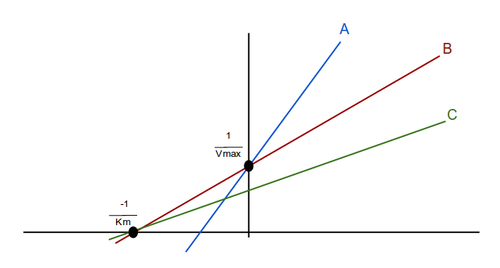
On this Lineweaver-Burk plot, B represents
normal rate

On this Lineweaver-Burk plot, C represents
non-competitive inhibitor
If an enzyme reaction is measured when the reaction is not in zero order, rates will appear falsely
low
In the presence of extremely high levels of , the reaction rate may be so fast that measurement does not begin until after equilibrium is reached.
enzyme
In assays which measure increasing absorbance, initial absorbance should be below
0.300 abs
In assays which measure decreasing absorbance, initial absorbance should be above
0.900 abs
If false results are suspected because of high enzyme levels, this is the solution
dilution
CK is mostly found in these types of tissue
muscle, brain
The CK enzyme adds groups to _.
phosphate, creatine
These are the specimens of choice for CK analysis
serum or heparin plasma
The CK of hemolyzed blood may be falsely
low
CK levels begin to rise within 1-2 hours of
muscle trauma
Within _ hours of an AMI, CK levels should be above the reference range.
3-4
The two possible subunits of CK are
M, B
CK-1 is
CK-BB
CK-2 is
CK-MB
CK-3 is
CK-MM
The has a higher concentration of CK-MB than other muscles
CK-MM
The CK-MB index ratio is calculated by this equation
CK-MB / CK
A CK-MB above ____% is chemically consistent with an AMI
6
CK-MM, CK-MB, and CK-BB are
oenzymes
The M subunits of CK contain terminal groups which can be
lysine, deaminated
A CK-MM molecule with both subunits deaminated is termed
CK-MM1
A CK-MM molecule with neither subunit deaminated is termed
CK-MM3
CK-MM and MB isoforms can be used to provide an idea of
how long ago muscle damage occured
LDH isoenzymes convert
keto groups, hydroxy groups
LDH's most preferred substrates are
pyruvic acid, lactic acid
The substrate of the LDH Wacker reaction is
lactic acid
The substrate of the LDH Wroblewski reaction is
pyruvic acid
The tissues which contain especially high amounts of LDH are
blood cells, muscles
The LDH of hemolyzed blood may be falsely
high
LDH is the only enzyme which should never be
frozen
LDH has ___ subunits and __ types of subunit
4, 2
LDH 1 & 2 are most commonly found in
blood cells, heart
LDH-3 is most commonly found in
lung
LDH 4 & 5 is most commonly found in
muscle, liver, kidney
Only these LDH isoenzymes will use alpha-hydroxybutyric acid as a substrate
1, 2