208 Test 1
 Call Kai
 Learn
Learn Practice Test
 Spaced Repetition
 Match
Match Flashcards
 Knowt Play
1/48

There's no tags or description
Looks like no tags are added yet.
Name | Mastery | Learn | Test | Matching | Spaced | Call with Kai | Chat |
|---|
No analytics yet
Send a link to your students to track their progress
49 Terms
Which of the following depth cues requires two functional eyes
convergence
Affordances:
provide the observer possibilities for action
according to feature integration theory, colour, shape, and other features of object are initially processed at which stage?
pre-attentive
Jack had a stroke recently. SInce the stroke, he has normal vision but problems recognising objects. What area of his brain is likely to be damaged?
The ventral/ “what” pathway
If you look around your room and move your eyes (but not your whole head), no motion will be perceived. Why is this according to CDS Theory?
There is both a CDS and an IDS
Which of the following determines our perception of colour?
all of these
frontal eyes (seen in most preditor species) facilitate:
optimal depth perception but limited range of vision
We don’t “see” our blindspot because:
all of these
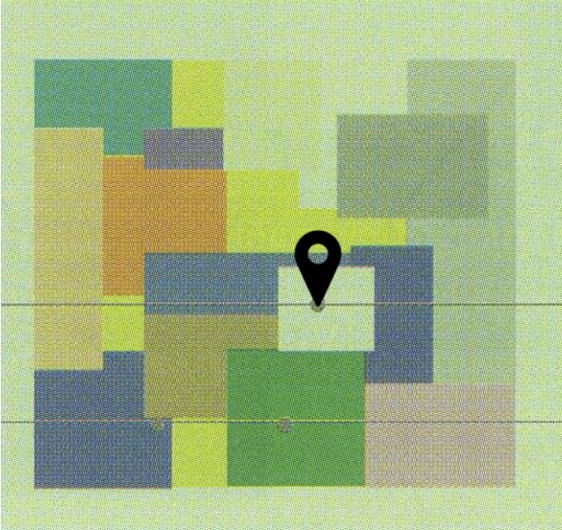
Despite being attuned to green, a neuron in V4 does not fire when the patch corresponding with the marker is presented to it. This is due to what phenomenon?
Colour constancy
Which is an example of covert orienting?
you are looking at a person you are in a conversation with but are secretly paying attention to the person’s voice behind you
Which of these is an example of apparent motion?
all of these
A signal detection payoff matrix has an observer win +$10 for a hit, -$1 for a miss, -$1 for a false alarm, and +$1 for a correct rejection. This is likely to induce a:
Liberal response criterion
Mia is a dichromat, missing one type of cone. What colours will she be able to see?
some colours, but not as many as someone with normal colour vision
Which of the following is not a visual cue the brain uses to infer depth?
accommodation
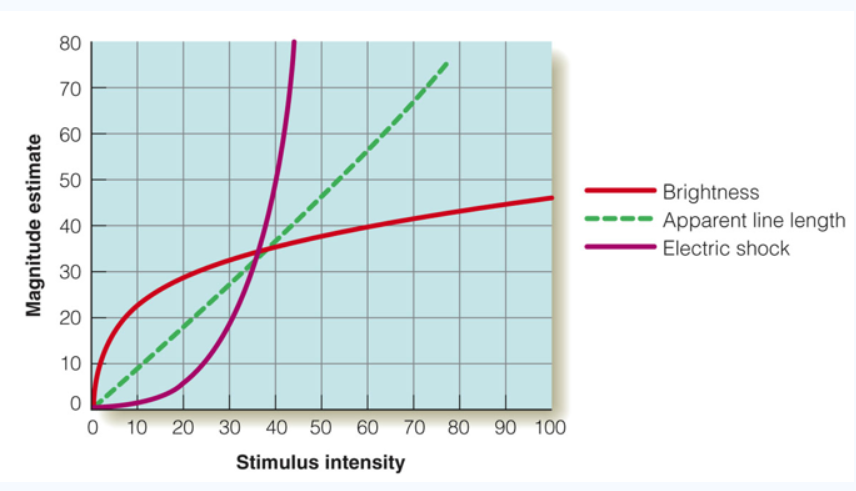
based on the graph below, what would happen if the stimulus intensity of a light doubled from 20 to 40?
it would less than double

Which gestalt principle is responsible for grouping the images we perceive below?
similarity
An object that absorbs all wavelengths of visible light would appear as:
black
How do we process faces
Wholistically
Together, what is perception?
Intelligent, constructive, and selective
Is perception top down or bottom up
Both
What is Psychophysics?
The study of the relationship between physical stimuli and the sensation they produce.
What determines a persons absolute threshold?
The minimum intensity a stimulus has to be to be perceived 50% of the time
Method of Adjustment
Participant continually adjusts the intensity of a stimulus until it is just detectable for the participant. Then turns volume down until it is just undetectable. measurements are then averaged to find out absolute threshold. Quick but innacurate
Method of constant stimuli
Several sets of stimuli intensity are presented in a random order and participant ranks if they can perceive the stimulus or not. The absolute threshold is determined at when a stimulus is detected 50% of the time. Slow but accurate
Why do we determine the absolute threshold at when a stimulus is detected 50% of the time?
Because there is always noise in the system
Method of limits
Stimuli around the absolute threshold are presented in one direction until the response changes, then the researcher presents in the opposite direction. Sometimes called the staircase method. Fast and accurate
Just noticible difference
The minimum difference in stimulus magnitude to trigger perception a certain percentage of the time.
Weber’s Law
The JND depends on the proportion of the difference between the original stimulus magnitude, not a specific value or ratio.
Mental Chronometry
The study of reaction times to infer the mental processes.
Donders Subtractive Method
The difference in reaction time between two tasks that only differ by one element, that difference is how long that additional task takes to process in the brain.
In a simple reaction time experiment _____ is measured. In a go/no-go experiment, ______ is added. In a choice reaction time task ______ is added.
Perception and motor response; discrimination; choice between buttons
Donders subtracted the choice task from the simple reaction time task to infer how long that decision took. What is this an example of?
The subtractive method
How long did Donder’s infer a decision took to make?
1/10th of a second
What was Dondas’ contribution to cognitive psychology?
How you can use experiments to infer mental processes by looking at observable measures (behaviour)
Our overall experience is determined by combining basic elements of experience called sensations
Wundt’s Structuralism
How did Wundt investigate sensations within the perceptual experience?
Analytic introspection - trained people to report how they felt when they experienced different stimuli
What are the limitations of analytic introspection?
highly variable, subjective and difficult to verify, limited to subjective awareness, difficult to replicate
What is a strength of analytic introspection over chronometry?
Focuses specifically on the conscious experience and introduces systematic laboratory methods
where mental processes should be understood in terms of their adaptive purpose, what is consciousness for?
James’ functionalism
What is the main difference between James’ Functionalism and Wundt’s Structuralism?
Structuralism asked what the basic elements of consciousness are, whereas functionalism asked what consciousness is for
“My experience is what I agree to attend to” is referring to
goal-directed attention and selective attention
Why did psychology turn to behaviourism?
The general want for psychology to become an ‘objective science’
What did Tollman (1930) find in the rat maze task?
Animals can learn without reward
What were the two measures in Tollman (1930)?
Errors (how many times they crossed the curtain boundaries) and times (time taken to reach food box)
How did Tollman’s results contradict behaviourism?
The later rewarded group of rats showed a very steep decrease in errors and time after rewarding started on day 11, indicating learning must have occured before the rewards
What is the unactioned/ unrewarded learning in Tollman’s rat maze experiment called that resulted in the construction of a cognitive map they could later use?
Latent learning
What is the cognitive turn/revolution?
when psychology started to notice holes in behaviourist approaches, and turned to cognition.
What developments contributed to the cognitive revolution?
Language nature vs nurture debate, World War 2, computers and information processing
How do we study mental processes today?
measures include behavioural, physiological, neuroimaging, computational modelling