A&P I: chapter 1 - 4 (8/2026)
 Call Kai
 Learn
Learn Practice Test
 Spaced Repetition
 Match
Match Flashcards
 Knowt Play
1/119

There's no tags or description
Looks like no tags are added yet.
Name | Mastery | Learn | Test | Matching | Spaced | Call with Kai | Chat |
|---|
No analytics yet
Send a link to your students to track their progress
120 Terms
Gross anatomy
study of structures that can be seen with naked eye
Histology
examination of tissues w/ microscope (microscopic anatomy)
Cytology
study of structure and function of cells
Anatomy
is the study of structure
physiology
is the study of function
until 19th century, the very words anatomy and dissection both mean…
cutting apart
endocrinology
physiology of hormones
pathophysiology
study of diseases mechanisms
comparative physiology is the study of…
how different species have solved problems of life (ex: water balance
Organelles are
structures inside a cell that perform specific jobs (ex nucleus, mitochondria, ribosomes)
4 major classes of tissue are
Epithelial tissue (covers surfaces and lines organs)
Connective tissue (supports, connects, and protects)
Muscle tissue (produces movement)
Nervous tissue (sends electrical signals)
dynamic equilibrium is…
the internal state of the body
The receptor is a…
… is a mechanism that processes this information
structure that senses a change in the body (ex the stretch receptors that monitor blood pressure)
The integrating (control) center
Integrating (control) center
processes sensory information and directs response (ex: cardiac center of brainstem)
Positive feedback is a
process where a change causes more of the same change to occur, making the original change stronger
(textbook: self-amplifying mechanism in which a physiological change leads to an even greater change in the same direction)
Negative feedback is a
mechanism that keeps a variable close to it's set-point (ex body temp)
Effector is a
cell or organ that directly carries out a response to a stimulus (ex heart, muscles, sweat glands)
A physiological gradient is a
difference in chemical concentration, electrical charge, physical pressure, temperature, etc
charged particles (like Na+) flow…
down electrical gradients
pressure gradient is difference in…
thermal gradient is difference in…
pressure between two areas (ex blood move down a pressure gradient from higher pressure place to lower)
temperature between two areas (ex heat flows from warm areas to cool areas down a thermal gradient)
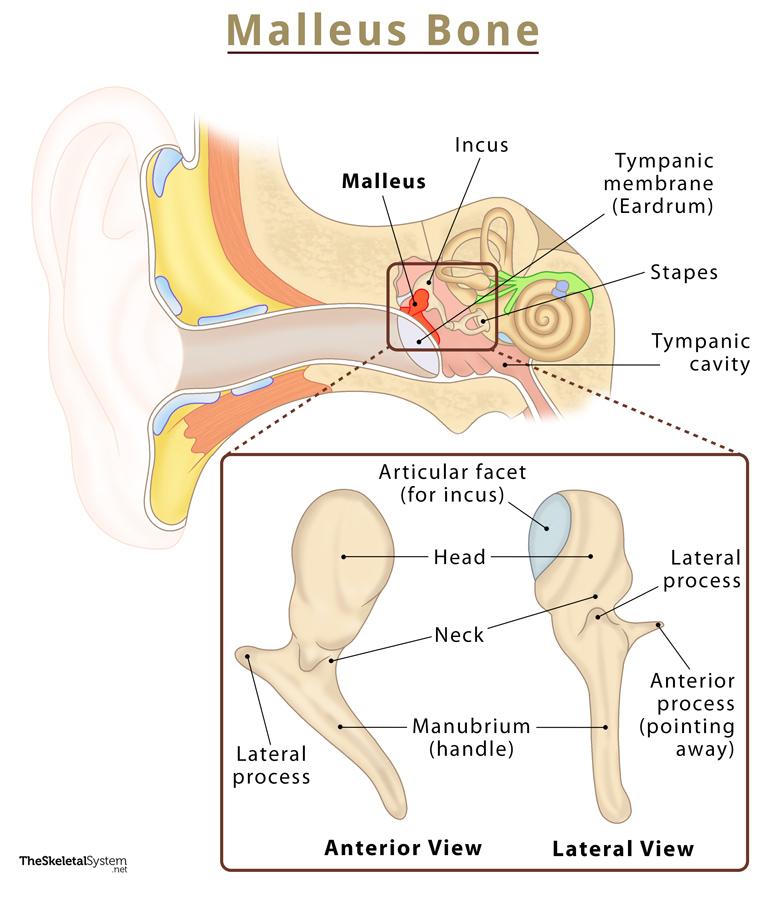
malleus?
middle-ear bone
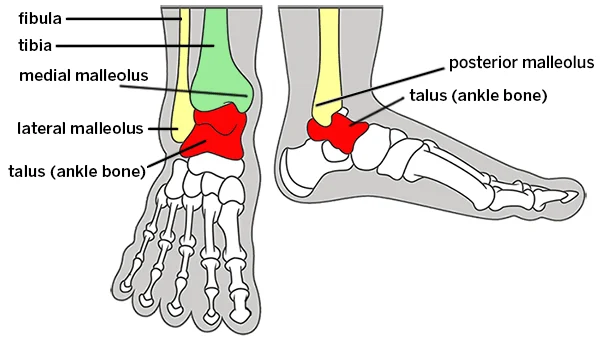
malleolous?
bony protuberance of ankle
Terminologia Anatomica gives the
official Latin name for each structure and accepted English equivalent (eponyms were rejected)
the older system of Terminologia Anatomica is…
Nomina Anatomica
living organisms exhibit genetic change from generation to generation, in other words
organisms pass genetic info (DNA) from parents to offspring, and that DNA can change over generations
Eponyms is…
Eponyms provide…
a term named after a person
little or no clue as to what a structure or condition is
The integumentary system
contains the skin and hair
Sonography uses a…
Sonography produces…
handheld device pressed against the skin
produces high-frequency ultrasound waves
until X-ray, computed tomography (CT scan) creates
many X-ray images from different angles that look like the body has been cut into thin sections
older term for CT scan (computed tomography) is…
CAT (Computerized Axial Tomography)
compared to X-rays, MRIs are better at going through
extremely dense structures like bones
magnetic resonance imaging (MRI) uses…
magnets and radio waves
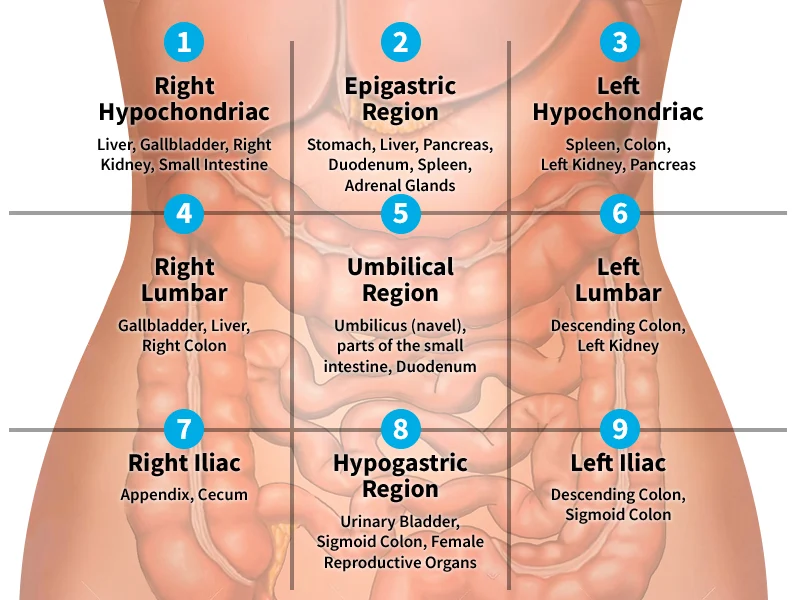
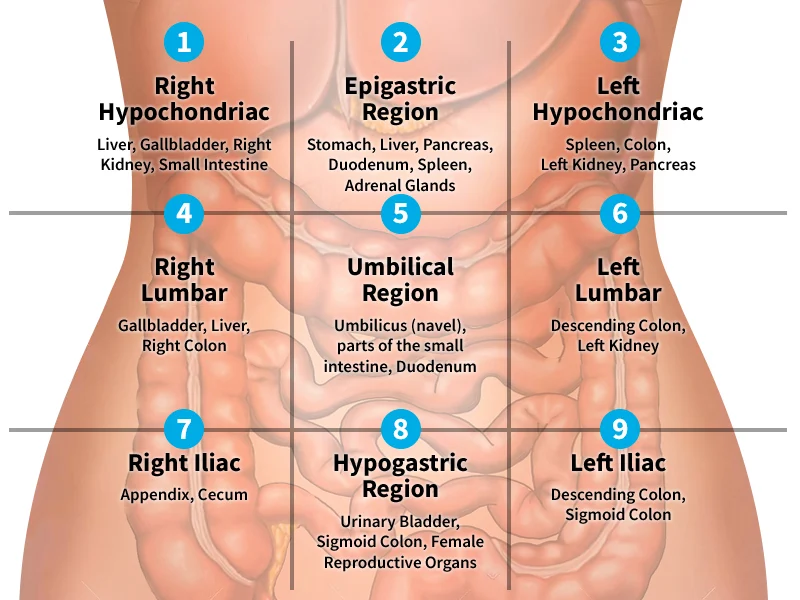
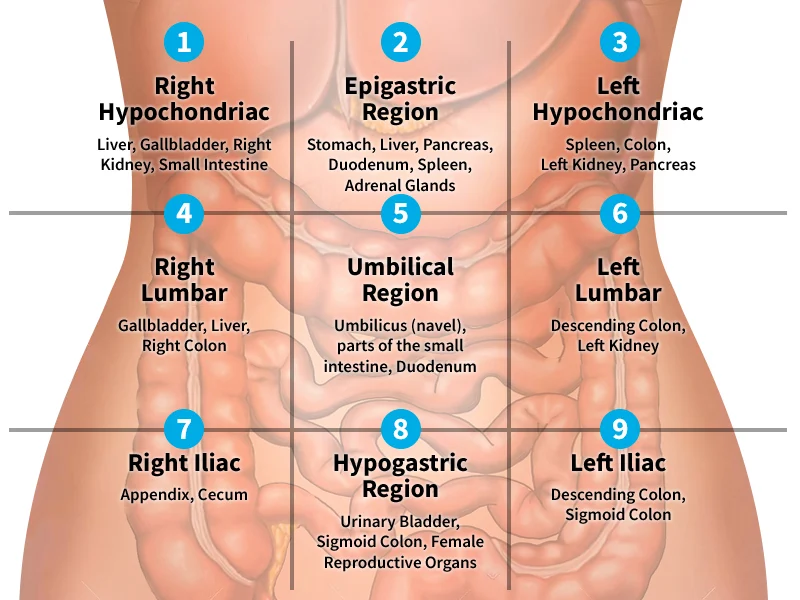
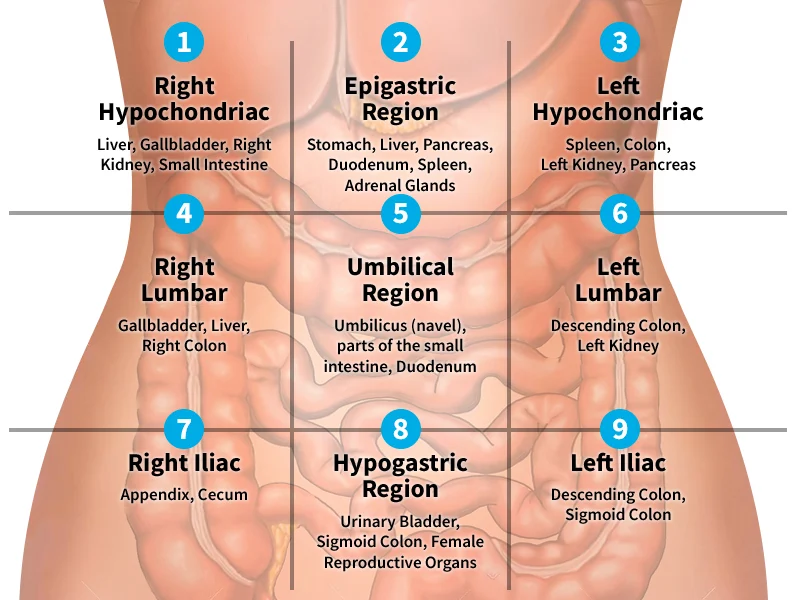
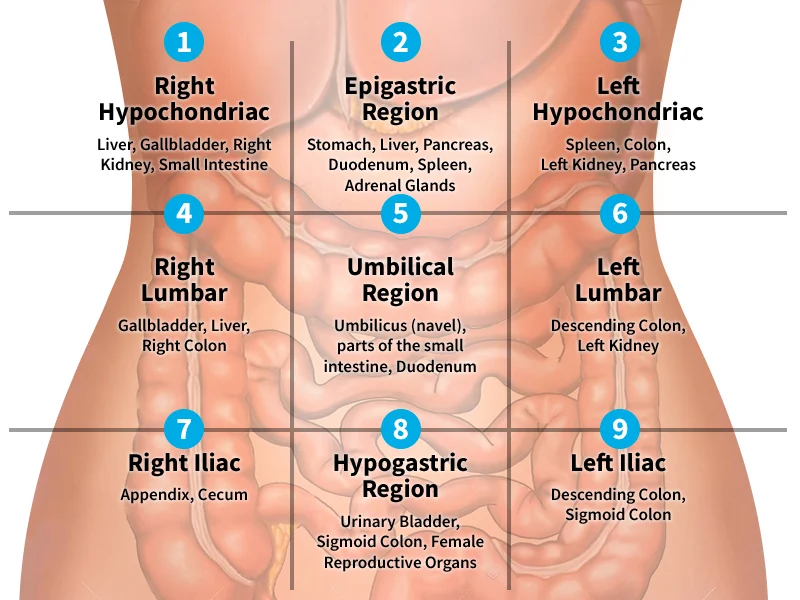
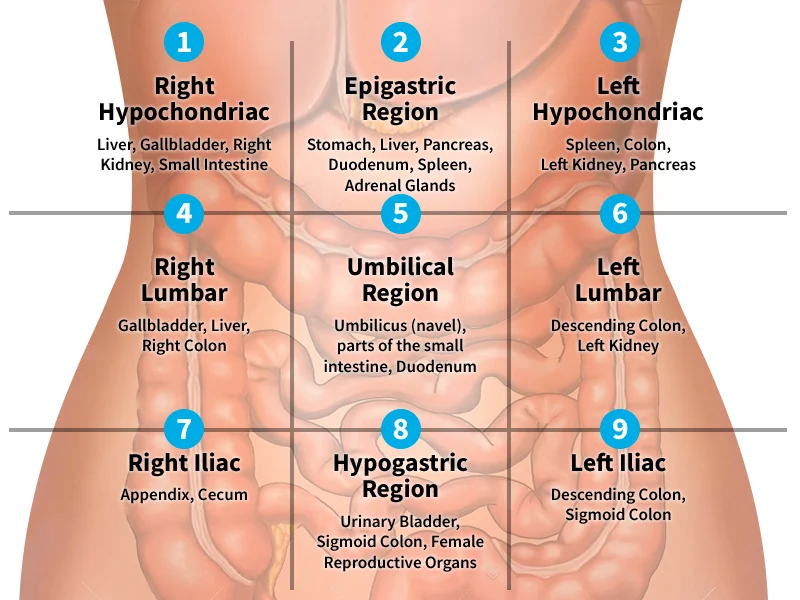
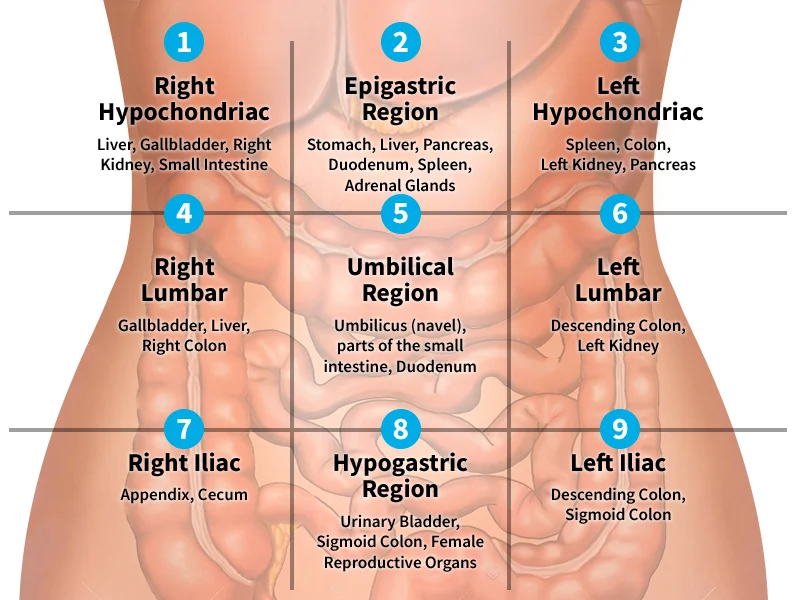
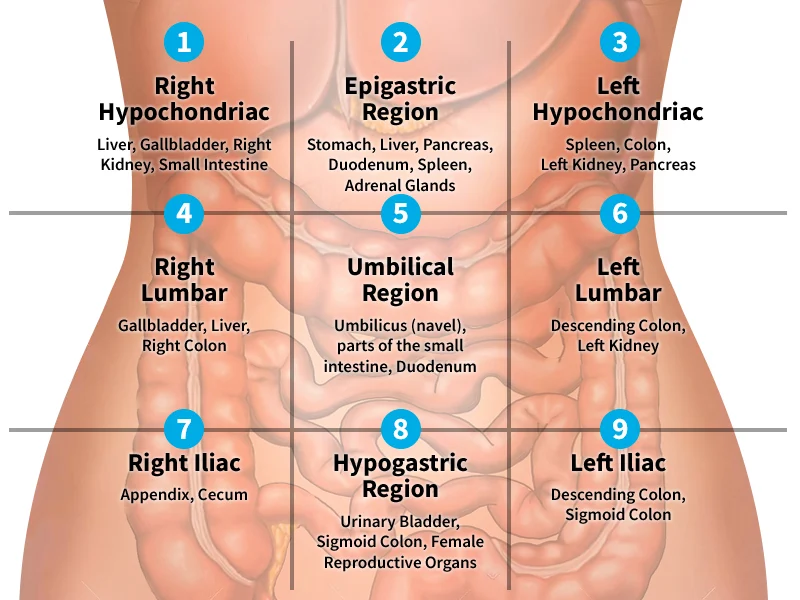
What are the 3 abdominal regions in the top row?
Right hypochondriac, epigastric, left hypochondriac
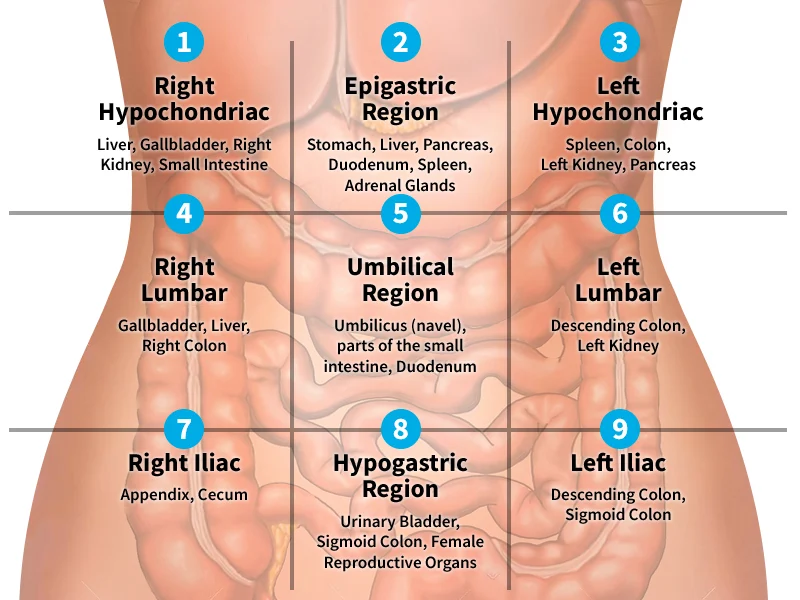
What are the 3 abdominal regions in the middle row?
Right lumbar, umbilical, left lumbar.
What are the 3 abdominal regions in the bottom row?
Right iliac, hypogastric, left iliac
Situs inversus means
(rare conditon)
the organs in chest and abdomen are flipped into a mirror image of normal anatomy
(situs: position)
(inversus: reversed)
Right hypochondriac region?
liver, gallbladder, right kidney, small intestine
(notes: Liver: processes nutrients and makes bile
Gallbladder: stores and releases bile
Right kidney: filters blood and makes urine
Small intestine: digests food and absorbs nutrients)
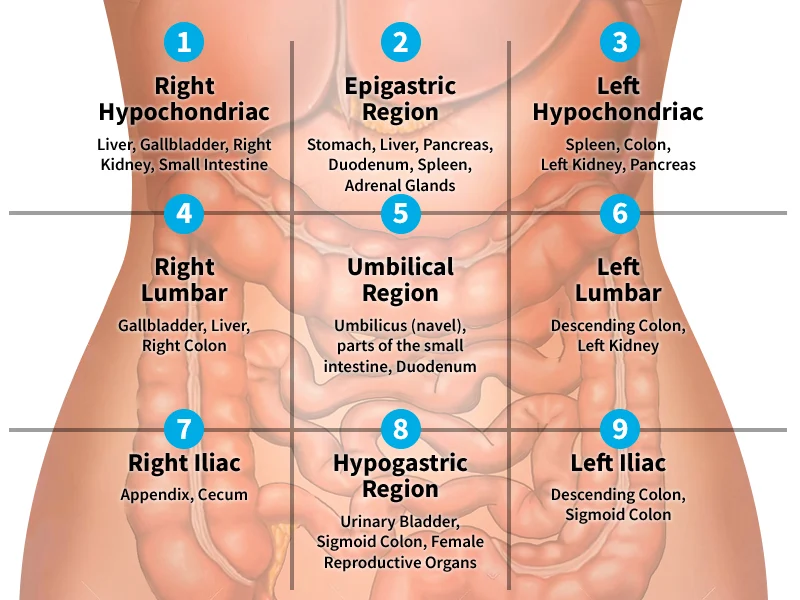
Epigastric region?
stomach, duodenum, liver, pancreas, spleen, adrenal glands
(notes: Stomach: digests food
Duodenum: continues digestion
Liver: processes nutrients and makes bile
Pancreas: makes digestive enzymes and hormones
Spleen: filters blood and helps immune defense
Adrenal glands: produce hormones for stress, metabolism, and blood pressure)
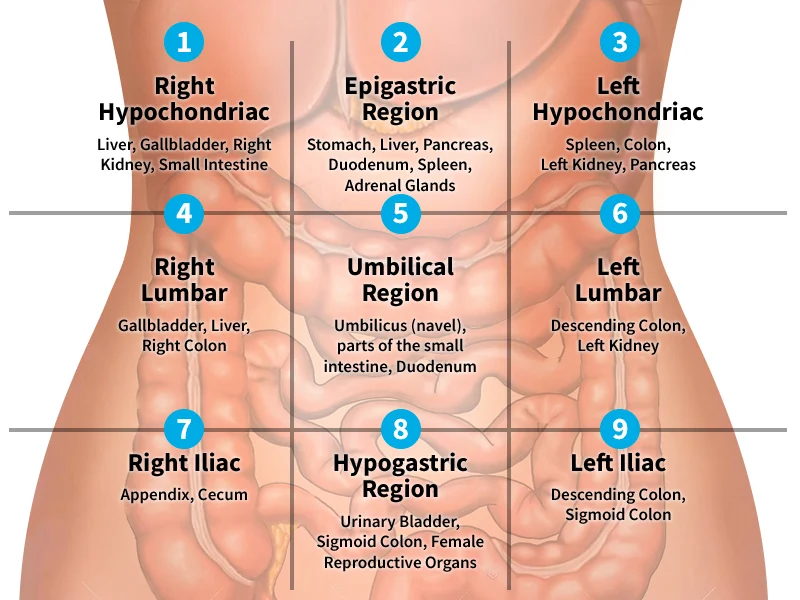
Left hypochondriac?
spleen, colon, left kidney, pancreas
Claudius Galen is an ancient Greek physician who studied…
animals because human dissection was restricted
Terrestrial adaptations
adaptations for living/moving on land
widened pelvis (terrestrial adaptation) helps
support the body and organs during walking
Bipedalism (terrestrial) is where
an organism moves using its two lower limbs
Arboreal adaptations
adaptations for living/moving in trees
Prehension (arboreal adaptation) is the
ability to grasp/hold onto branches with the hands or feet
Percussion is a
physical examination technique where a healthcare provider taps on body
trapezium bone is a
bone in the wrist

zygomaticus bone is
the cheekbone
Progesterone is a
hormone that helps maintain the uterus for pregnancy
(negative feedback loop with the hypothalamus and the anterior pituitary)
the more estrogen, the more
(estrogen involved in postive feedback during menstrual cycle)
luteinizing hormones release
Luteinizing hormone (LH)
triggers ovulation and helps produce sex hormones
Gonadotropin is a
hormone that acts on the ovaries/testes (ex: luteinizing horome and follicle-stimulating hormone)
Gonadotropin-releasing hormone (GnRH)
signals the pituitary to release luteinizing hormone (LH) and Follicle-stimulating hormone (FSH)
Hippocrates (460 - 370 BCE)
Aristotle (384 - 322 BCE)
promoted observation-based medicine
studied animal anatomy
Metrodora (200-400 CE) wrote text focused on…
women’s health and gynecology
Avicenna (980-1037) wrote
wrote The Canon of Medicine, an influential medical textbook.
Maimonides (1138 - 1204) contributed to…
medical ethics
Andreas Vesalius (980 - 1037)
father of modern anatomy, studied human body through dissections, and corrected Claudius Galen errors
Michael Servetus (1511-1553) & William Harvey (1578-1657) helped
establish understanding of blood circulation
Robert Hooke (1635-1703) & Antonie van Leeuwenhoek (1632-1723)
advanced microscopy (hooke named cells, leeuwenhoek observed microorganisms)
Matthias Schlediden (1804-1881) and Theodor Schwann (1810-1882)?
concluded that all organisms were made of cells (aka cell theory)
-ac
-ocytes
-itis
-ectomy
-pulmonary
pertaining to heart
cells
inflammation
surgical removal
pertaining to lungs
peri-
dextro-
angio-
around/surrounding
right
blood vessel
vasodilation is the
(hint: heat leaves inside)
widening of blood vessels as muscle walls relax, which increases blood flow and lowers blood pressure
Vasoconstriction is the
(hint: heat stays inside)
narrowing of blood vessels as muscles tighten, which decreases blood flow and raises blood pressure
The inductive method builds moves from…
hypothetico-deductive method moves from…
specfic observations to general conclusion
general to specific (using hypothesis and experiments)
Physiological variation refers to
functional differences in how the body's internal systems operate due to natural factors (ex age, activity level, enviornment)
Cadaver
deceased human body used for medical examination, dissection, or autopsy to determine cause of death.
holism theory is that a
complex system is more than sum of individual parts and can only be understood by looking at the entire system
Chemicals flow down a ____ gradient
concentration
Homeostasis
ability to detect change, activate mechanisms that oppose it, and maintain relatively stable internal conditions
Biochemistry
study of molecules that compose living organisms
abundant elements that account for 98.5% of body weight?
carbon, hydroge, oxygen, nitrogen, phosphorus, calcium
minerals?
inorganic elements extracted from the soil by plants and passed up food chain
inorganic molecules?
dont contain carbon-hydrogen bonds
molecules are…
(ex: …)
chemical particles made of 2 or more atoms united by a chemical bond
N2 or C6H12O2 (glucose)
Nonpolar covalent
Polar covalent
Electrons are shared equally
Electrons are shared unequally
hydrogen bond is a
weak attraction between a slightly positive hydrogen (H) and a slightly negative atom
Phosphorylation =
adding a phosphate group to a molecule
Phosphagenesis =
generating ATP using phosphate (ex: creatine phosphate)
most common colloids are?
mixtures of protein and water (ex: albumin in blood plasma)
colloids are chemical mixtures that contain particles that…
are 1-100 nm and scatter light (so usually cloudy)
acid (below pH 7) is any …
base (above pH 7) is …
proton donor
proton acceptor
mmol (millimole) tells us what?
how much of a substance we have
mEq (milliequivalent) tells us what
how much electrical charge these particles have
mEq (milliequivalent) formula?
mmol (millimole) x ion’s charge
mEq/L (milliequivalents per liter) tells us what?
the amount of electrolyte’s electrical charge
Reversible reactions follow the law of mass action which they tend to move from
the side (of reaction) with a higher concentration of substances to the side with a lower substances