JSU - Mgt 301 - Exam 3
 Studied by 4 people
 Call Kai
 Learn
Learn Practice Test
 Spaced Repetition
 Match
Match Flashcards
 Knowt Play
1/82

Earn XP
Description and Tags
JSU Mgt 301 - Exam 3 Flashcards
Name | Mastery | Learn | Test | Matching | Spaced | Call with Kai |
|---|
No analytics yet
Send a link to your students to track their progress
83 Terms
Motivation
forces that energize, direct, and sustain a person’s efforts.
Meaningful
Challenging but attainable
Specific and quantifiabe
Acceptable
According to goal-setting theory, what types of goals are motivational?
Law of Effect
a law formulated by Edward Thorndike in 1911 stating that behavior that is followed by positive consequences will likely be repeated. – Behavior that is followed by positive consequences will probably be repeated.
Four Consequences of Behavior
Positive Reinforcement
Negative Reinforcement
Punishment
Extinction
Positive Reinforcement
applying a consequence that increases the likelihood of a person repeating the behavior that led to it.
Manager says “good job”
Negative Reinforcement
removing or withholding an undesirable consequence
Manager doesn’t criticize it
Punishment
administering an aversive consequence
Manager gives reprimand
Extinction
withdrawing or failing to provide a reinforcing consequence
Manager offers no praise
Three components of expectancy theory
Expectancy
Instrumentality
Outcome Valence
Expectancy
employees’ perception of the likelihood that their efforts will enable them to attain their performance goals.
Instrumentality
the perceived likelihood that performance will be followed by a particular outcome.
Outcome Valence
the value an outcome holds for the person contemplating it.
Five job characteristics that lead to higher motivation
Task identity
Task significance
Autonomy
Feedback
Skill variety
Task Identity
the degree to which a job requires completion of a whole and identifiable piece of work.
Task Significance
the degree to which a job has a substantial impact on the lives or work of other people
Autonomy
the degree to which a job provides substantial freedom, independence, and discretion to the individual in scheduling the work and determining the procedures to be used in carrying it out.
Feedback
the degree to which doing work activities required by a job results in an individual obtaining direct and clear information about the effectiveness of his or her performance.
Skill variety
the degree to which a job requires a variety of activities so that an employee can use a number of different skills and talents.
5 Layer of Maslow’s Hierarchy of Needs
Physiological
Safety or security
Social
Ego
Self-actualization
Physiological Need
food, water, sex, and shelter
Safety or security need
protection against threat and deprivation
Ego
independence, achievement, freedom, status, recognition, and self-esteem
Self-actualization
realizing one’s full potential, becoming everything one is capable of being
ERG Theory
Existence
Relatedness
Growth
Existence
needs are all material and physiological desires
Relatedness
needs involve relationships with other people and are satisfied through the process of mutually sharing thoughts and feelings
Growth
needs motivate people to change themselves or their environment productively or creatively. Satisfaction of the growth needs comes from fully using personal capacities and developing new capacities.
What is procedural justice?
using a fair process in decision making and making sure others know that the process was as fair as possible
Group
a collection of people who interact to undertake a task but do not necessarily perform as a unit or achieve significant performance improvements.
Team
a small number of people with complementary skills who are committed to a common purpose, set of performance goals, and approach for which they hold themselves mutually accountable.
Work teams
make or do things such as manufacture, assemble, sell, or provide service. They typically are well defined, a clear part of the formal organization structure, and composed of a full-time, stable membership.
Management teams
coordinate and provide direction to the subunits under their jurisdiction and integrate work among subunits
Parallel teams
operate separately from the regular work structure of the firm on a temporary basis. Members often come from different units or jobs and are asked to do work that is not being done by the standard structure.
Project teams
also known as development teams; work on long-term projects, sometimes over a period of years. They have specific assignments, such as research or new product development, and members usually must contribute expert knowledge and judgment.
Transnational teams
are composed of multinational members whose activities span multiple countries. Transnational teams tend to be virtual teams, communicating electronically more than face to face, although other types of teams may operate virtually as well; tend to be virtual teams.
Team Cohesiveness
the degree to which a group is attractive to its members, members are motivated to remain in the group, and members influence one another; Example: Blue Angels
Low cohesiveness
Low performance
Poor goal attainment and task performance
High cohesiveness
High performance
High goal attainment (group’s perspective) and lowest task performance (management’s perspective)
Low cohesiveness
High performance
Moderate goal attainment and task performance
High cohesiveness
High performance
High goal attainment and task performance
Conflict
a process in which one party perceives that its interests are being opposed or negatively affected by another party.
different conflict management strategies
avoidance, accommodation, compromise, competing, and collaboration.
Avoidance
A reaction to conflict that involves ignoring the problem by doing nothing at all or deemphasizing the disagreement
Accommodation
a style of dealing with conflict involving cooperation on behalf of the other party but not being assertive about one’s own interests
Compromise
a style of dealing with conflict involving moderate attention to both parties’ concerns; a give and take of resources
Competing
a style of dealing with conflict involving strong focus on one’s own goals and little or no concern for the other person’s goals
Collaboration
a style of dealing with conflict emphasizing both cooperation and assertiveness to maximize both parties’ satisfaction; emphasizes both cooperation and assertiveness
Bureaucratic control
the use of rules, standards, regulations, hierarchy, and legitimate authority to guide performance. It includes such items as budgets, statistical reports, and performance appraisals to regulate behavior and results. It works best where tasks are certain and workers are independent
Bureaucratic (or formal) control systems
designed to measure progress toward set performance goals and, if necessary, to apply corrective measures to ensure that performance achieves managers’ objectives
Feedforward Controls
takes place before operations begin and includes policies, procedures, and rules designed to ensure that planned activities are carried out properly. Examples include inspection of raw materials and proper selection and training of employees.
Concurrent Controls
takes place while plans are being carried out. It includes directing, monitoring, and fine-tuning activities as they occur.
Feedback Controls
focuses on the use of information about results to correct deviations from the acceptable standard after they arise.
Six Sigma
Robust and powerful application of feedback control designed to reduce defects in all organizational processes – not just product defects but anything that may result in customer dissatisfaction.
The lower the _______ number, the higher the ________.
sigma ; level of variation or defects
The _______ the sigma number, the lower the level of variation or defects
higher
Management Audit
means of evaluating the effectiveness and the efficiency of various organizational systems from social responsibility programs to accounting control.
External Audit
occurs when one organization evaluates another organization.
Balance Sheet
shows the financial picture of a company at a given time; a report that shows the financial picture of a company at a given time and itemizes assets, liabilities, and stockholders’ equity.
Assets
the values of the various items the corporation owns.
Liabilities
the amounts the corporation owes to various creditors.
Stockholder’s Equity
the amount accruing to the corporation’s owners.
__________ = Liabilities + Stockholder’s Equity
Assets
Profit and loss statement
an itemized financial statement of the income and expenses of a company’s operations.
Liquidity ratios
Indicate the company’s ability to pay long-term debts.
Clan Control
involves creating relationships built on mutual respect and encouraging each individual to take responsibility for his or her own actions.
Market Control
Use economic forces—and the pricing mechanisms that accompany them—to regulate performance.
Market Controls at the Corporate Level
Large, diversified companies use market controls to regulate independent business units. Conglomerates that act as holding companies treat business units as profit centers that compete with one another.
Market Controls at the Business Unit Level
used within business units to regulate exchanges among departments and functions. Transfer pricing is one method that organizations use to try to reflect market forces for internal transactions. A transfer price is the charge by one unit for a good or service that it supplies to another unit of the same organization.
Market Controls at the Individual Level
when organizations hire employees, the supply and demand for particular skills influence the wages employees can expect to receive. Employers pay higher wages to people with skills most valued by labor markets.
Four technology categories
base, key, pacing, and emerging
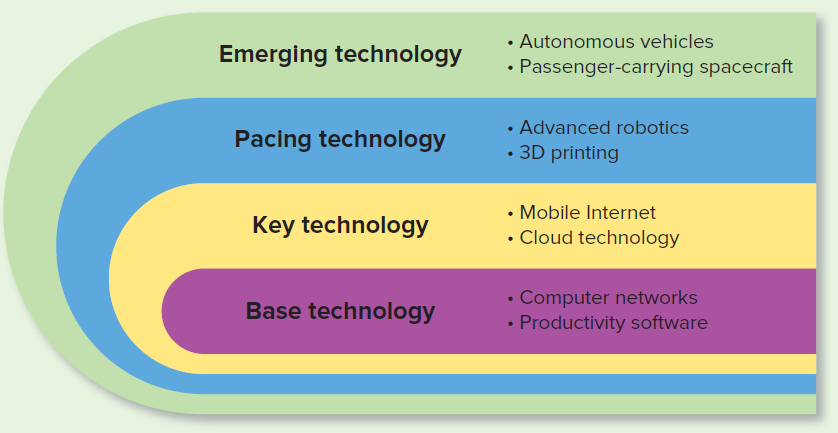
Base Technologies
are commonplace in the industry; everyone must have them. They provide little competitive advantage, but managers have to invest to ensure their organization’s continued competence in the technology.
Key Technologies
have proved effective but offer a strategic advantage because not everyone uses them.
Pacing Technologies
have yet to prove their full value but have the potential to provide a significant advantage that alters the rules of competition.
Emerging Technologies
are still under development but may significantly alter the rules of competition in the future.
Different ways that companies use to acquire a technology
internal development, acquisition of the technology owner, contracted development, purchase, license, trade, joint venture, research partnership.
Internal development
Developing a new technology within the company can keep the technology proprietary – exclusive to the organization. However, internal development usually requires dedicated staff and funding for long periods. Even if the development succeeds, considerable time elapses before practical benefits arrive.
Purchase Development
Most technologies already in use can be purchased openly. Usually this is the simplest, easiest, and most cost-effective way to acquire new technology. However, the technology itself will not offer a competitive advantage.
Contracted Development
If the technology is not available and the company can’t or won’t develop it internally, it can contract the development from other companies, independent research laboratories, and university or government institutions.
Licensing Development
Technologies that are not easily purchased can be licensed for a fee. One such technology for manufacturing and marketing beauty products is Makeup Genius (made by Image Metrics). The free app allows users to do a virtual makeover or try out a new color eyeliner before purchasing the products.
Technology Trading
Some companies are willing to share technology. Google and Tencent share their patents to develop future products. Google has teamed up with China’s largest company to expand in to the sizeable Chinese market. Tencent hopes to expand its reach beyond China’s borders into other markets.
Research Partnerships and Joint Ventures
A research partnership jointly develops a new technology. Typically, each member equally contributes a new set of skills or resources, as when an established company contributes money and management-know-how. And a startup contributes technical expertise.
Acquisition of the technology owner
A company lacking and desiring technology might purchase a company that owns it. The transaction can be an outright purchase of the company or a minority interest sufficient to gain access to the technology.
Organizational Development
a systemwide application of behavioral science knowledge to develop, improve, and reinforce the strategies, structures, and processes that lead to organization effectiveness.
 Note
Note  Flashcards (96)