ChTLE 2024 Organic Chemistry Pre-Board Exam 2 (1/4)
 Call Kai
 Learn
Learn Practice Test
 Spaced Repetition
 Match
Match Flashcards
 Knowt Play
1/49

There's no tags or description
Looks like no tags are added yet.
Name | Mastery | Learn | Test | Matching | Spaced | Call with Kai | Chat |
|---|
No analytics yet
Send a link to your students to track their progress
50 Terms
Which of the following pairs of compounds represents skeletal isomers?
a) 1-butene & 2-butene
b) 2-methylpropene & 1-butene
c) 2-butene & cyclobutene
d) 2-methylpropene & cyclobutene
B.
Identify the expected hybridization state and geometry for the central atom in the given structure:
a) sp2, trigonal planar
b) sp2, trigonal pyramidal
c) sp3, trigonal planar
d) sp3, trigonal pyramidal
A.

Which of the following statements is true about methamphetamine, a widely-abused stimulant commonly known as shabu and shown at right?
a) It is a tertiary amine.
b) It is systematically named as N-methyl-1-phenylpropan-2-amine.
c) One of the functional groups present is an amide group.
d) All of the above statements are true.
B.

Hydrogenation of an alkene yields:
a) alkane
b) alkyne
c) alcohol
d) aldehyde
A.
Consider the following reaction of cyclohexanol and determine the necessary reagent that would be
appropriate for the given transformation:
cyclohexanol → cyclohexanone
a) Na metal (H2 gas is evolved)
b) H2SO4 , heat (elimination rxn)
c) CH3COOH. H+ (acyl substitution reaction)
d) CrO3, H+ (oxidation rxn)
D.
Which of the following carbon-carbon bonds is the shortest?
a) ≡C−C≡
b) =C=C=
c) −C≡C−
d) None of these, all carbons are sp-sp hybrids
C.
Which isomeric pentane has the highest boiling point?
a) n-pentane
b) 2-methylbutane
c) 2,2-dimethylpropane
d) None of these
A.
Which isomeric pentane gives only one monobromination product?
a) n-pentane
b) 2-methylbutane
c) 2,2-dimethylpropane
d) None of these
C.
An unknown compound with a molecular weight of 84 contains 85.71% carbon and 14.29% hydrogen. How many rings or multiple bonds does it have?
a) 1 triple bond
b) 1 double bond only
c) 1 ring and 1 double bond
d) 1 ring or 1 double bond
D.
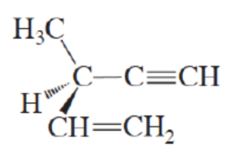
Consider the following molecule: Which represents the correct identified hybridization?
-CH3 = A: sp3;
C2 = B: sp2;
C3 = C: sp2;
C4 =D: sp
a) A and C only
b) B and D only
c) A, B and D only
d) A, B, C and D are correct
C.
A mole of an unknown hydrocarbon was combusted and produced 4 moles of CO2 and 4 moles of H2O.
unknown Hydrocarbon + O2 ⎯⎯⎯→
spark 4 CO2 + 4 H2O
What is the empirical and molecular formula, respectively, of the unknown compound?
a) CH, C4H4
b) CH2, C4H6
c) CH2, C4H8
d) CH3, C4H12
Benadryl is an antihistamine that is used for symptoms of allergic rhinitis and the common cold. The molecular formula of Benadryl and units of unsaturation, respectively, are:
a) C16H18NO, 8
b) C16H21NO, 6
c) C17H21NO, 8
d) C17H20NO, 10
C.
The following reaction is classified as:
CH3CH2OH ⎯--> CH2=CH2 + H2O
H+
a) Substitution reaction
b) Elimination reaction
c) Addition reaction
d) Rearrangement reaction
B.
For the molecule cyanoacetic acid, NCCH2COOH, which is the most polar bond?
a) C−N bond
b) C−O bond
c) O−H bond
d) C−H bond
C.
The following compounds contain carbon but may not be considered organic except ____.
a) ammonium cyanate, NH4CNO
b) carbonic acid, HOCOOH
c) formic acid, HCOOH
d) baking soda, NaHCO3
C.
Consider the structure below, what is the strongest IMFA present?
a) London dispersion forces
b) H-bonds
c) Dipole-dipole forces
d) Ionic bonds
B.

What is the IUPAC name for:
CH3CHClCH(CH3)CH2CH2CH2CH2Br?
a) 1-bromo-6-chloro-5-methylheptane
b) 7-bromo-2-chloro-3-methylheptane
c) 1-bromo-6-chloro-5,6-dimethylhexane
d) 6-bromo-1-chloro-1,2-dimethylhexane
A.
Which of the following is 2-ethyl-3-formyl-pentanoic acid?
a) C2H5CH(C2H5)CH(CO2H)CHO
b) (C2H5)2CHCH(CHO)CO2H
c) C2H5CH2CH(CHO)CO2C2H5
d) C2H5CH(CHO)CH(C2H5)CO2H
D.
The reaction H2C=CH2 + H2 --> H3C−CH3 is an example of:
a) Substitution
b) Addition
c) Esterification
d) Fermentation
B.
Which of the following is 3,3-diphenylpropanal?
a) C6H5CH2CH(C6H5)CHO
b) C6H5CH2CH2COC6H5
c) (C6H5)2CHCH2CHO
d) (C6H5)2CHCH2COC6H5
C.
Which of the following molecules will not have a dipole moment?
a) CH3Cl
b) CH3OCH3
c) CH2Cl2
d) CCl4
D.
Which of the following compounds has no isomer?
a) CH3CH2CH2Cl
b) CH3CHO
c) CH2=CHCl
d) ClCH2CH2Cl
C.
Which compound must overcome hydrogen bonds when it boils?
a) Ethyl chloride, CH3CH2Cl
b) Ethylamine, CH3CH2NH2
c) Ethane, C2H6
d) Diethyl ether, C2H5OC2H5
B.
Which force of interaction makes the nonpolar pentane, C5H12 , exist as a liquid?
a) ion-dipole interaction
b) van der Waals forces
c) dispersion forces
d) dipole-dipole attraction
C.
Which compound has greater dispersion forces than dipole-dipole interaction between its molecules?
a) Benzene, C6H6
b) Fluoroethane, CH3CH2F
c) Lauric acid, CH3(CH2)10COOH
d) Toluene, C6H5CH
C.
Which of the following molecules contain an sp-hybridized atom in its functional group?
a.) CH3CN
b.) CH3CHO
c.) CH3OCH3
d.) CH3OH
A.
The hybridization of the central carbon in CH3C≡N and the bond angle CCN are:
a) sp2, 180°
b) sp, 180°
c) sp2, 120°
d) sp3, 109°
B.
The correct geometry around oxygen in CH3OCH3 is:
a) linear
b) bent
c) tetrahedral
d) trigonal planar
B.
The balanced equation for the combustion of pentane is:
a) 4 C5H12 + 2 O2 ® 20 CH4 + 4 H2O
b) 2 C3H8 + O2 ® CH4 + 2 H2O
c) C5H12 + 8 O2 ® 5 CO2 + 6 H2O
d) C3H8 + 5 O2 ® 3 CO2 + 4 H2O
C.
Another name for tetrachloromethane:
a) Chloroform
b) Carbon Tetrachloride
c) Freon
d) Chloromethane
B.
The functional group for organic acids is the:
a) hydroxyl group
b) amine group
c) carbonyl group
d) carboxyl group
D.
The general formula for an ester is
a) ROR'
b) RCOOH
c) RCOR'
d) RCOOR'
D.
Which of the following is the product from the dehydration of an alcohol?
a) alkane
b) alkene
c) aldehyde
d) ketone
B.
Which of the following contains a tertiary carbon?
a) 2,2-dimethylpropane
b) 3-methylheptane
c) 2-pentene
d) Neopentane
B.
Rank the following compounds in the order of increasing basicity:
I. p-nitroaniline
II. p-aminobenzaldehyde
III. N-methylaniline
IV. p-methylaniline
a) I, II, III, IV
b) IV, III, II, I
c) I, II, IV, III
d) III, IV, I, II
C.
Aldehydes and ketones generally react by:
a) nucleophilic addition
b) electrophilic addition
c) nucleophilic substitution
d) electrophilic substitution
A.
What is formed when an alcohol reacts with a carboxylic acid?
a) ester
b) anhydride
c) acid chloride
d) thioester
A.
Alkanes react primarily by:
a) free radical substitution
b) electrophilic addition
c) electrophilic substitution
d) nucleophilic addition
A.
The most acidic phenolic compound:
a) p-chlorophenol
b) 2,4-dichlorophenol
c) 2,4,6-trichlorophenol
d) Phenol
C.
Non-polar atoms and molecules condense due to _____.
a) ion-dipole interaction
b) polarizability of dispersion forces
c) van der Waals forces
d) dipole-dipole attraction
B.
Which of the following has the lowest boiling point?
a) CH3COCH3
b) CH3OCH3
c) CH3COOH
d) CH3CHO
B.
Which of the following has the lowest boiling point?
a) o-hydroxynitrobenzene
b) p-hydroxynitrobenzene
c) m-hydroxynitrobenzene
d) p-hydroxybenzoyl chloride
A.
Which of the following is 3,3-diphenylpropanal?
a) C6H5CH2CH(C6H5)CHO
b) C6H5CH2CH2COC6H5
c) (C6H5)2CHCH2CHO
d) (C6H5)2CHCH2COC6H5
C.
Arrange the following according to increasing melting point.
I. 2-nitrobenzaldehyde
II. 4-nitrobenzoic acid
III. sodium 4-nitrobenzoate
IV. 2-nitrobenzoic acid
a) I, II, III, IV
b) III, II, IV, I
c) I, IV, II, III
d) I, II, IV, III
C.
Which of the following can be used to prepare 3-methyl-3-hexanol?
a) CH3CH2CH2COCH2CH3 + CH3MgBr, H2O
b) CH3CH2CH2COCH3 + CH3CH2MgBr, H2O
c) CH3COCH2CH3 + CH3CH2CH2MgBr, H2O
d) All of these are possible
D.
Which of the following properties indicates very strong intermolecular forces in liquids?
a) very low surface tension
b) very low boiling point
c) very low critical temperature
d) very low vapor pressure
D.
Which pair of functional group and characteristic reaction type are NOT a match?
a) Alkane, Radical Substitution
b) Alkyl halide, Nucleophilic Substitution
c) Alkyne, Electrophilic Substitution
d) Carboxylic acid, Nucleophilic Acyl Substitution
C.
Which would be the strongest acid?
a) CH3CH2CH2COOH
b) CH3CH2CH(F)COOH
c) CH3CH(F)CH2COOH
d) FCH3CH2CH2COOH
e) CH3CH2CH2CH2OH
B.
Which hydrogen of the given alkanes can form the most stable free radical intermediate?
A. CH3CH2CH2CH2[H]
B. C[H](CH3)
C. CH3CH2CH[H]CH3
D. CH(CH3)2CH2[H]
B.
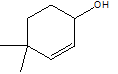
What is the correct name for the following compound?
a) 1,1-dimethyl-2-cyclohexenol
b) 3,3-dimethyl-1-cyclohexen-6-ol
c) 6,6-dimethyl-1-cyclohexen-3-ol
d) 4,4-dimethyl-2-cyclohexenol
D.