Anatomy Lecture 1
 Call Kai
 Learn
Learn Practice Test
 Spaced Repetition
 Match
Match Flashcards
 Knowt Play
1/58

There's no tags or description
Looks like no tags are added yet.
Name | Mastery | Learn | Test | Matching | Spaced | Call with Kai | Chat |
|---|
No analytics yet
Send a link to your students to track their progress
59 Terms
What is anatomy
It’s the study of structures and shapes of the body and its components and those observations can be used to see sizes and relationships of parts
What do we mean by gross anatomy
By gross anatomy, we mean the large structures and everything that is easily observable
What do we mean by microscopic anatomy
We mean the structures that are too small to be seen with the naked eye such as cells and tissues that can only be viewed with a microscope.
What is physiology
It’s the study of how the body and its parts function
By observing the structure (by studying the anatomy), we can determine which functions can occur.
Ex: air sacs of lungs = very thin walls. Why? It’s because it allows them to exchange gas easily and provide oxygen to the body compared to if they had thicker walls, the oxygen would stay emprisonned.
What are the 6 levels of structural organization
Atoms
Cells
Tissues
Organs
Organ systems
Organisms
Atoms combine to form molecules which make up the cells and tissues are made from a group of similar types of cells while organs are made of different types of tissues. Organ systems consist of different organs that work tgth closely while human organisms are made of many organ system.
What is the integumentary system
It’s the outer covering of the body, so the skin and it also includes hair, fingernails, glands…
It waterproofs the body
It cushions (serves as a cushion) and protects the deeper tissues from injuries
Produces vitamin D with help of sunlight
Excretes salts in perspiration (while sweating)
Helps regulate the body temperature
Physical house/primary location of cutaneous nerve receptors
What are cutaneous nerve receptors?
They are different nerve endings that are embedded to detect sensations such as touch, pressure, pain and temperature located on a specific skin layer
Define the skeletal system
Consists of bones, cartilage, ligaments and joints
Provides muscle attachment for movement
It protects vital organs
Site of blood cell formation
Stores minerals (calcium, phosphorus (it makes the bones stronger))
The skeletal system provides a framework that the muscles use to cause movement. The blood cells are formed within the bones and it stores minerals
Define the muscular system
So basically, we have a groupment of muscles that contract, in other words, shorten to produce the movement of the bones such as the manipulation of the environment, of the facial expression, of locomotion, the maintaning of the posture.
It also produces heat
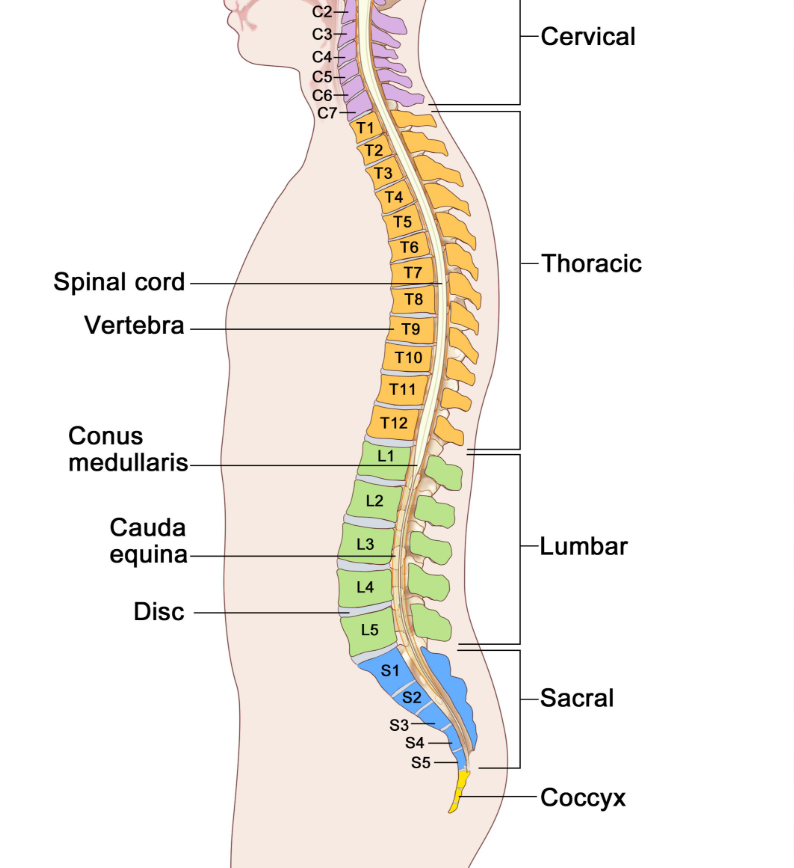
Define the nervous system
It’s a fast acting control system
Made of brain/ spinal cord/ nerves/ sensory receptors
Responds to internal and external stimuli
The sensory receptors detect changes
Messages are sent to the central nervous system which assesses information and activates effectors (so the muscles and glands)

Define the endocrine system
It secretes hormones which are chemical molecules into the blood
Hormones control body functions such as growth, reproduction and use of nutrients
What are the 7 categories the endocrine glands include:
Pituitary gland
Thyroid and parathyroids
Adrenal glands
Thymus
Pancreas
Pineal gland
Ovaries in females and testes in males

Mnemo technique: Please Try Any Tricks, Practice Pass Okay → PTAT-PPO
Define the cardiovascular system
It includes the heart and the blood vessels where the heart pumps the blood and the blood vessels transport the blood to tissues
What does blood contain and what does it transport
Blood contains white blood cells and chemicals that provide protection against forein invaders
It transports: Oxygen and carbon dioxide, nutrients and hormones
Define the lymphatic system
Contains lymphatic vessels, lymph nodes and lymphoid organs
Complements the cardiovascular system by returning the leaked fluids back to the bloodstream
The lymph nodes and the lymphoid organs clean the blood
The lymphatic system also houses the white blood cells which are involved in immunity
Define the respiratory system
Components involved:
Nasal passages, pĥarynx, larynx, trachea, bronchi and lungs
Gases are exchanged with the blood through the air sacs in the lungs which:
Supplies the body with oxygen
Removes carbon dioxide

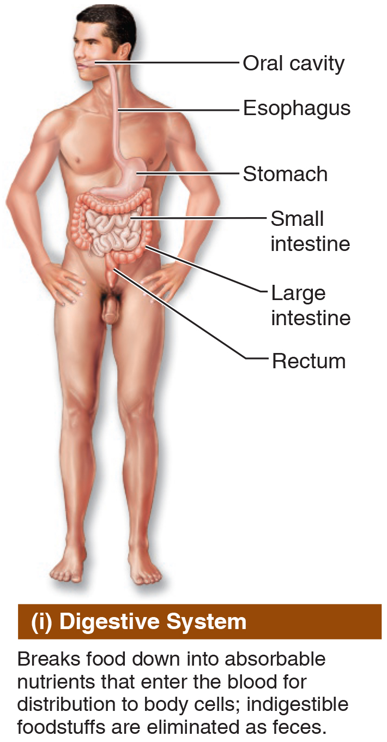
Define the digestive system
Components:
Oral cavity (the mouth), esophagus, stomach, small and large intestines, rectum and accessory organs
Role:
Break down food
Allows for nutrient absorption into the blood
Eliminates indigestible material as feces
Define the urinary system
Components:
Kidneys, ureters, urinary bladder and urethra
Role:
Eliminates nitrogenous wastes
Maintain acid-base balance
Regulates water and electrolyte balance
Helps regulate normal blood pressure

Define the reproductive system
Components in male:
Testes, scrotum, penis, accessory glands and duct system
Role in male:
The testes produce the sperm and the duct system carries it to the exterior
Components in females:
Ovaries, uterus, uterine tubes, vagina
Role in females:
Ovaries produce eggs and the uterus provides a site of development for the uterus
8 important life functions
Maintaining boundaries
Movement
Responsiveness/irritability
Digestion
Metabolism
Excretion
Reproduction
Growth
Maintaning boundaries?
Ensure there is a boundary between the inside and the outside which separates them
Movement?
There must be locomotion and the movement of substance in the body and in the cells
Responsiveness/irritability
It’s the ability to sense changes and react accordingly to it
Digestion?
Breakdown and absorption of nutrients
Metabolism?
It’s the chemical reactions within the body
Breaking down of the complex molecules into the smaller ones
The build of of larger molecules from smaller ones
Produces energy (ATP)
Regulated by hormones
Excretion?
Eliminates excreta (waste) from metabolic reactions
Waste may be removed in the form of urine, feces, sweat…
Reproduction?
It is essential on the cellular and organismal level:
On the cellular level: New cells are used for growth and repair
On the organismal level: It’s the reproductive system that handles it
Growth?
There must be an increase in cell size or body size and that is done through increasing the number of cells and hormones play a huge role in the process
What are the 5 major survival needs?
Nutrients
Oxygen
Water
Normal body temperature
Atmospheric pressure
Why are nutrients essential for our survival?
By nutrients, we include carbohydrates, proteins, lipids, vitamins and minerals
They are essential because they are used for energy and cell building
Why is oxygen required for chemical reactions?
It is made available by the cooperation between the respiratory and cardiovascular systems
It is so essential because it is required for chemical reactions
Why is water so essential to our survival?
Water is the most abundant chemical in our body since it composes about 60-80% of our body weight
It provides a fluid base for body secretions and excretions
Why is normal body temperature so important?
It’s because below a certain temperature (in humans generally 36-37), the chemical reactions slow down such as slowing down the heart beat (remember when meredith fell in cold water)
Above a certain temperature, chemical reactions proceed way to rapidly which will lead to enzyme denaturation and oxygen depletion which lead to brain tissue damage, heart failure and widespread multi-organ failure death
Why is atmospheric pressure so essential
It’s because it must be appropriate for gas exchanges
What is the anatomical position
It is the standard body position used to avoid confusion
The terminology always refer to this position regardless of the actual body position
The position is the following:
Standing erect, feet parallel, arms hanging on each sides with palms facing forward and thumbs pointing away from the body
The directional terms
They explain the location of one body structure in relation to another
Superior (cranial or cephalic) = above, toward the head or upper part of a structure or of the body
Inferior (caudal) = away from the head or toward the lower part of a structure or the body = below
Anterior (ventral) = in front of, toward or at the front of the body
Posterior (dorsal) = toward or at the backside of the body
Medial = toward or at the midline of the body (inner side of)
Lateral = away from the midline of the body (outer side of)
Intermediate = between a more medial and lateral structure
Proximal = close to the origin or attachment of the body part
Distal = farther from the origin or point of attachment of body part
Superficial (external) = toward or at the body surface
Deep (internal) = away from body surface, more internal
Body planes
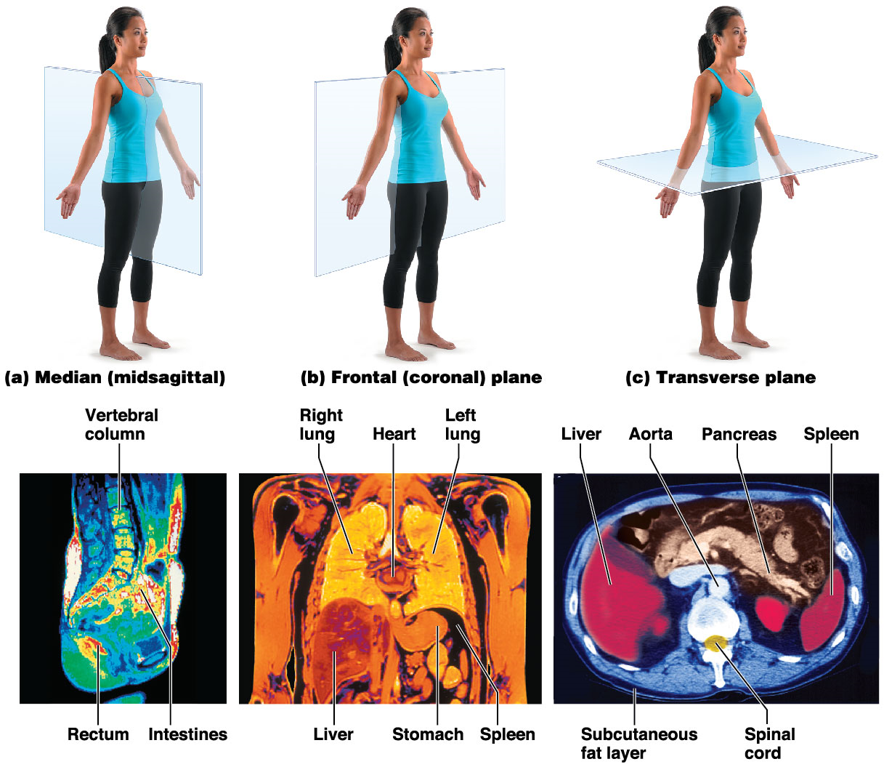
There exists 3 types of planes which are sections that we cut along imaginary lines
Sagittal section which is a plane that separates the body into 2 pieces from up to down without it being necessarily 2 equal pieces (broad term):
There is also the midsagittal that is the section that cuts the body into 2 equal left and right parts
The coronal/frontal which divide the the body into anterior and posterior parts
The transverse/cross divides the body into superior and inferior parts
What are body cavities?
They are fluid-filled spaces inside the body that provides varying degrees of protection to organs within them
What are the 2 main groups of internal body cavities
Dorsal
Ventral
Body cavities illustrated

Dorsal body cavity separated into: spinal cavity and cranial cavity
Ventral body cavity separated into: thoracic cavity and the abdominopelvic cavity composed of pelvic cavity and abdominal cavity
Dorsal body cavity subdivisions
1- Cranial cavity (role and structure):
It houses the brain and is protected by the skull
2- Spinal cavity (role and structure):
It houses the spinal cord and is protected by the vertebrae
Ventral body cavity subdivisions
Thoracic cavity
Abdominopelvic cavity
Thoracic cavity structure and role
It’s the cavity superior to the diaphragm. It holds the heart, lungs and other organs. The mediastinum which is the central region in the thoracic cavity houses the heart, the trachea and other organs, while the left plural cavity holds the left lung and the right plural cavity holds the right lung.
The thoracic cavity is protected by the rib cage.
Abdominopelvic cavity structure and role
It contains the pelvic cavity and the abdominal cavity
It’s the cavity inferior to the diaphragm
The abdominal cavity contains the stomach, the liver and other organs. It is protected by trunk muscles
The pelvic cavity contains the reproductive organs, the bladder and the rectum and it is protected somewhat by bony pelvis
There is no physical structure that separates the abdominal cavity from the pelvic cavity
Abdominopelvic cavity subdivision
There exists:
4 quadrants
9 regions
Name 4 other body cavities
Oral and digestive cavities
Nasal cavity
Orbital cavities
Middle ear cavities
Homeostasis definition
It’s the maintenance of a relatively stable internal condition
It is a dynamic state of equilibrium/balance which is essential for normal body functioning and to sustain life
A homeostatic imbalance leads to disease
What are the 2 main controlling systems of homeostasis
Nervous system
Endocrine system
What are the 3 components of homeostatic control mechanism
Receptor
Control center
Effector
Define what is a receptor in the homeostatic control mechanism
It’s some form of sensor
It responds to changes in the environment (response to stimuli)
It sends information to the control center on the afferent pathway
What is an afferent pathway
It’s a neural route that carries sensory information from the body’s peripheral receptors toward the central nervous system (the brain and spinal cord)
Define the control center in a homeostatic control mechanism
It’s the component that receives signal from the receptor
It determines a set point
It analyses the information it received from the receptor by comparing it to the normal set point
It determines an appropriate response
Define the effector on a homeostatic control mechanism
It’s the muscle/organ/gland that acts as the output device on a homeostatic control mechanism to carry out the response that restores the balance
It provides a means for response to the stimulus
The information flows from the control center to the effector on the efferent pathway
What are feedback mechanisms
They are regulatory hoops that the body uses to monitor internal conditions and keep them within a safe and stable range.
Define negative feedback
It includes most homeostatic control mechanisms
It shuts of original stimulus or reduces its intensity
It works like a household thermostat
The elements of a homeostatic control system
In a logical way:
The stimulus produces changes in variable which causes an imbalance
The receptor detects a change
Input: Information is being sent to the control center through an Afferent pathway
Output: Information is sent through an Efferent pathway to the effector
The response from the effector feeds back to reduce the effect of stimulus and returns the variable to a homeostatic level
Examples of negative feedback
Blood sugar regulation
Regulation of the body temperature (thermoregulation)
House thermostat
What is a positive feedback
It’s rare in the human body
It increases the original stimulus to push the variable even farther so an even bigger imbalance.
The reaction occurs at a faster rate as a result and in the human body such positive feedback occurs only in blood clotting and during the birth of a baby because for the childbirth, the baby pushing against the cervix release oxytocin which causes stronger uterine contractions which would make the baby pushed harder until birth. In blood clotting, the injuried tissues release chemicals that activate platelets which attracts even more platelets to seal fastly the wound or even in breastfeeding to release even more milk until feeding stops
Whats the big difference between positive and negative feedback
In negative feedback, the body fight to reduce or reverses a change to bring a system back to a stable state. However, positive feedback amplifies or increases the change which moves the system further away from its starting point