Biological explanations & atypical sex chromosome patterns
 Call Kai
 Learn
Learn Practice Test
 Spaced Repetition
 Match
Match Flashcards
 Knowt Play
1/24

There's no tags or description
Looks like no tags are added yet.
Name | Mastery | Learn | Test | Matching | Spaced | Call with Kai | Chat |
|---|
No analytics yet
Send a link to your students to track their progress
25 Terms
What are chromosomes?
Found in the nucleus of living cells carrying information in the form of genes
The 23rd pair of chromosomes determines biological sex
What are the typical chromosome pairs for a male & female?
Males: XY
Females: XX
What are gonads & when do they develop?
Sex organs (ovaries & testes)
Develop at 6 weeks old
What are male hormones known as?
Androgens (e.g. testosterone → associated with aggression)
What is congenital adrenal hyperplasia (CAH) ?
Occurs when females have XX chromosomes but excessive secretion of adrenal hormones
Exposes them to excessive androgens in the womb → a significant number later identify as tomboys
What are hormones?
Chemical messengers secreted by endocrine glands into the bloodstream that control & regulate the activity of certain cells or target organs
What hormone is responsible for female characteristics & menstruation?
Oestrogen
What is pre-menstrual syndrome (PMS) ?
Occurs when women experience heightened emotionality & irritability during their menstrual cycle
What is oxytocin?
A hormone which causes contraction of the uterus during labour & stimulates lactation
Reduces cortisol (stress hormone) & facilitates bonding → referred to as the “love hormone”
Both sexes produce equal amounts during amorous activities (e.g. kissing & sexual intercourse)
How is social learning theory an alternative explanation to gender development?
Highlights the importance of social context:
the influence of social norms would explain cross-cultural differences in gender-role behaviour
in some societies, males & females are gradually becoming more androgynous in their behaviour
What are atypical sex chromosome patterns?
Any sex chromosome pattern that deviates from the usual XX & XY formation
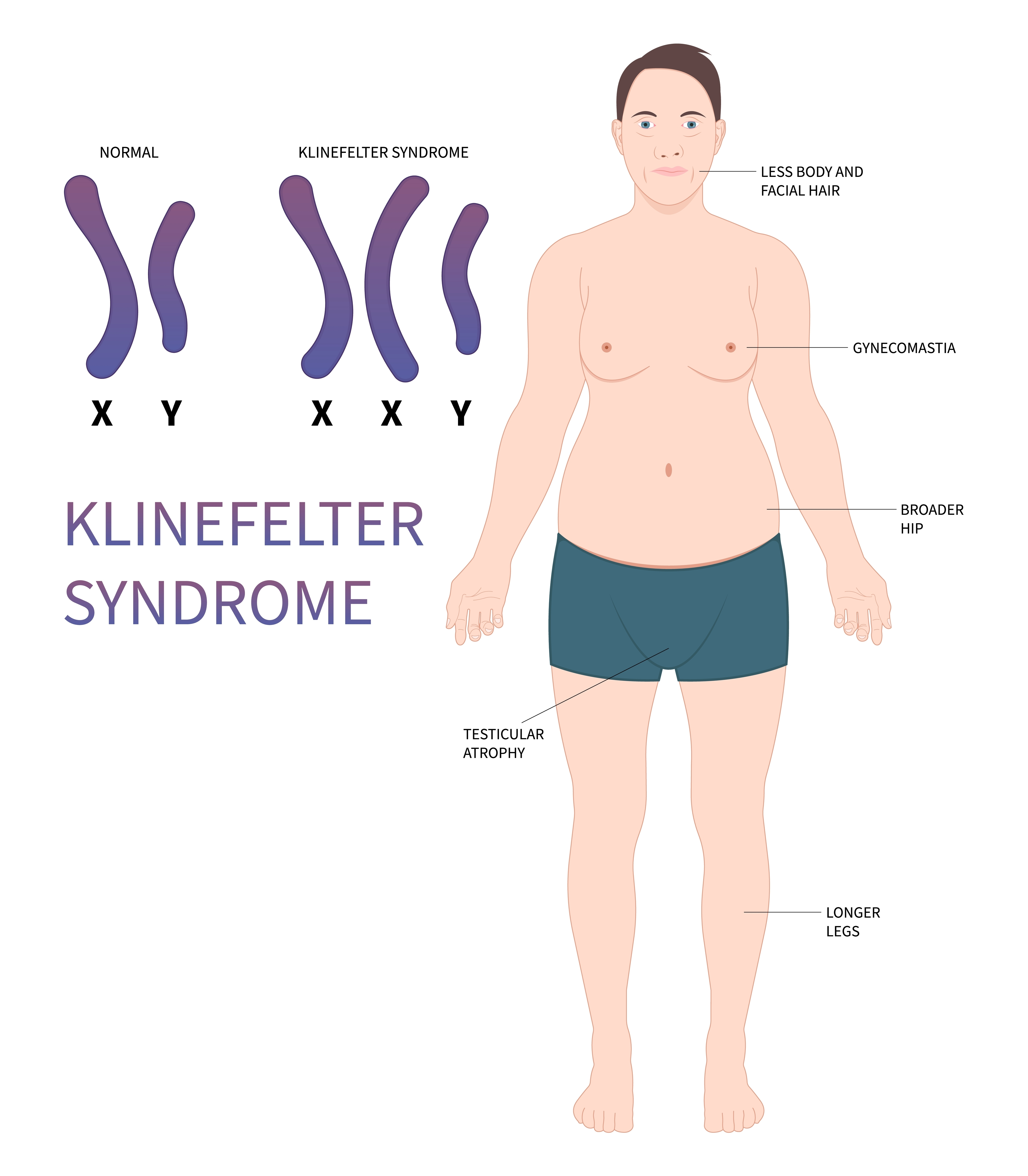
What is the chromosome pattern for Klinefelter’s syndrome?
XXY:
additional X chromosome
biologically male (affects 1 in 500 to 1 in 1,000 males)
What are the physical characteristics of Klinefelter’s syndrome?
Reduced facial hair
Tall, thin physique
Small, infertile testes
Development of breast tissue at puberty
What are the psychological characteristics of Klinefelter’s syndrome?
Poorly developed language skills & reading ability (e.g. dyslexia)
Tend to be passive, shy & lack interest in sexual activity
Easy to upset, showing aggressive outbursts
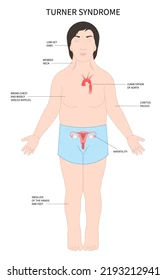
What is the chromosome pattern for Turner’s syndrome?
X0:
no second chromosome
biologically female (affects 1 in 5,000 girls)
What are the physical characteristics of Turner’s syndrome?
No menstrual cycle & failed ovaries (thus, are sterile)
Limited breast development & wide chest
Short, webbed neck & pre-pubescent appearance
What are the psychological characteristics of Turner’s syndrome?
High level of verbal skills (e.g. reading & writing)
Low visual ability & socially immature
Discuss the role of chromosomes and hormones in sex and gender (16 marks)
Write your AO1 paragraph
Humans have 46 chromosomes arranged into 23 pairs, with the 23rd pair determining biological sex (XX for females & XY for males). Sex is determined by the sperm, as eggs always carry an X chromosome, while sperm carry either X or Y. The Y chromosome contains the SRY gene, which triggers testes development. The testes produce androgens, causing male development - without these hormones, the embryo develops as female.
Hormones play a major role in gender development. Testosterone controls the development of male sex organs from around eight weeks of foetal development. Oestrogen regulates female sexual characteristics, menstruation & may contribute to emotional changes (e.g. heightened emotionality & irritability) during PMS.
Oxytocin is produced in higher amounts in women, especially during childbirth. This stimulates lactation, reduces cortisol & promotes bonding between mother & infant. However, both men & women release oxytocin during amorous activities (e.g. kissing & sexual intercourse).
Discuss the role of chromosomes and hormones in sex and gender (16 marks)
Write your strength AO3 PEEL (Van Goozen)
Point: One strength of the biological explanation of gender is there is research evidence to support the influence of hormones in gender development.
Evidence: For example, Van Goozen found that male-to-female transsexuals showed decreases in aggression & visuospatial skills after their gender reassignment, whereas female-to-male transsexuals showed the opposite effect.
Explain: This improves our understanding of how gender development is acquired, as it suggests that hormones (e.g. testosterone) influence gender-related behaviours.
Link: As such, innate factors must contribute towards a person’s gender, as the biological approach proposes.
Discuss the role of chromosomes and hormones in sex and gender (16 marks)
Write your limitation AO3 PEEL (Gorski)
Point: One limitation of the biological approach is that many studies into the role of hormones in sex & gender utilise animals.
Evidence: For example, Gorski’s research into the effects of hormones on gender development involved injecting female rats with testosterone for a period prior to their birth.
Explain: Whilst results found masculinised behaviours & genitals, this might not necessarily generalise to humans, given the complexity of human gender development, which includes social & cultural factors.
Link: Overall, this reduces the external validity of biological explanations, as such findings cannot be generalised beyond the laboratory.
Discuss the role of chromosomes and hormones in sex and gender (16 marks)
Write your limitation AO3 PEEL (Seavey et al.)
Point: One limitation of biological explanations of sex & gender is that they suffer from biological reductionism & determinism.
Evidence: For example, Seavey et al. investigated the interactions of adults with a 3-month-old baby dressed in pink, blue or yellow. Results found that the baby’s perceived sex influenced the toys used, with boys given a ball & girls a doll.
Explain: This demonstrates the influence of socialisation on gender development, which the biological approach ignores by focusing only on innate factors & proposing that behaviour is fixed by biology.
Link: Overall, a more interactionist explanation is necessary to account for the complex interaction between nature & nurture in shaping gender development.
Discuss what psychological research has told us about atypical sex chromosome patterns (16 marks)
Write your AO1 paragraph
Atypical sex chromosome patterns differ from the typical XX (female) & XY (male) patterns. Two examples include: Klinefelter’s syndrome (XXY in males) & Turner’s syndrome (X0 in females). These variations can lead to physical & psychological differences.
Klinefelter’s syndrome has an incidence rate of between 1 in 500 & 1 in 1,000 people, though only around 1/3 of those with Klinefelter’s are aware they have it. Physical characteristics include: a tall, thin physique, reduced body hair, small infertile testes & enlarged breasts at puberty. Psychological characteristics include: passive & shy with poorly developed language skills/reading ability, along with a reduced interest in sexual activity & difficulties with memory, problem-solving & a poor response to stressful situations.
Turner’s syndrome has an incidence rate of 1 in 5000 females. Physical characteristics include: infertility (due to undeveloped ovaries), no menstrual cycle, under-developed breasts, a broad-shield chest, a webbed neck & a high waist-to-hip ratio. Psychological characteristics include: a higher than average reading ability but lower than average spatial, visual, memory & maths skills, along with social immaturity & difficulty relating to peers.
Discuss what psychological research has told us about atypical sex chromosome patterns (16 marks)
Write your strength AO3 PEEL (nature-nurture debate)
Point: One strength of research into atypical sex chromosome patterns is that it improves our understanding of the nature-nurture debate in gender development.
Evidence: For example, by comparing individuals with Klinefelter’s & Turner’s syndrome with chromosome-typical individuals, it becomes possible to see the physical & psychological differences between the two groups.
Explain: This means that it can be logically inferred that these differences have a biological basis & are a direct result of an abnormal chromosomal structure.
Link: As such, this suggests that innate, nature influences have a powerful effect on psychology & behaviour.
Discuss what psychological research has told us about atypical sex chromosome patterns (16 marks)
Write your strength AO3 PEEL (real-world applications)
Point: One strength of research into atypical sex chromosome patterns is that it has real-world applications.
Evidence: For example, an Australian study of 87 individuals with Klinefelter’s syndrome found that those who had been identified & treated from a very young age had significant benefits, compared to those who had been diagnosed in adulthood.
Explain: Early diagnosis is particularly important as only 1/3 of individuals with Klinefelter’s are aware they have it, with many cases being accidentally discovered during medical examinations for unrelated issues.
Link: Therefore, studying atypical sex chromosome patterns not only enhances our scientific understanding but also improves the quality of life of those affected.
Discuss what psychological research has told us about atypical sex chromosome patterns (16 marks)
Write your limitation AO3 PEEL (cause & effect)
Point: One limitation of research into atypical sex chromosome patterns is that it is difficult to establish cause & effect.
Evidence: For example, the social immaturity observed in females with Turner’s syndrome may a result of others treating them as younger due to their pre-pubescent appearance.
Explain: This may impact their academic performance (e.g. lower scores in visual, spatial & maths tasks), suggesting that psychological differences are also shaped by nurture.
Link: Overall, we cannot confidently conclude that the psychological differences in individuals with atypical sex chromosome patterns are solely due to innate biological factors.