Chapter 6 Quiz Guide - ITEC 2201
 Call Kai
 Learn
Learn Practice Test
 Spaced Repetition
 Match
Match Flashcards
 Knowt Play
1/43

Earn XP
Name | Mastery | Learn | Test | Matching | Spaced | Call with Kai |
|---|
No analytics yet
Send a link to your students to track their progress
44 Terms
(REVIEW) Data
raw facts that are devoid of context or intent. can be qualitative (ex: the car is ruby red) or qualitative (there are 5 cars)
(REVIEW) Information
processed data that possess context, relevance, and purpose.
ex: monthly sales calculated from the collected daily sales data.
(REVIEW) Knowledge
produced by the consumption of information. can be explicit or tacit
ex: the conceived relationship between the quality of goods and the sales is knowledge
Explicit Knowledge
Knowledge that can be expressed into words or numbers
Tacit Knowledge
Insights and Intuitions. Difficult to transfer to another person by means of simple communications
(REVIEW) Wisdom
combined knowledge and experience to produce a deeper understanding of a topic. Often takes many years to develop
Database
an organized collection of data that can be used to aggregate and analyze data. Helps minimize redundancy and eliminate inconsistency/enforce data integrity
Issues with Data
Redundancy
Inconsistency
Inaccuracy
Corruption
Lack of Integrity
Redundancy
when data is stored more than once
ex: “Student 4567 is Mary Brown, her major is Finance” is stored more than once. If Mary changes her major, all her majors stored in the system must be changed together.
Inconsistency
when the data system is huge, making changes to all redundant data is difficult if not impossible
Integrity
Consistency among stored data.
ex: this is violated when you cant find that Alex Wilson received a grade in MKT211 but cant find Alex in the student roster because the two rosters are not consistent.
Lack of integrity leads to ___________.
corrupted data
Flat Database
a single collection of data with no relation to any other collections of data
ex: spreadsheets
Relational Database
multiple collections of data that may be related to each other. a set of related tables.
Bit
stands for Binary Digit → “1” or “0”
Byte
8 bits → a single character
Field/column
one single data item
Record/Row
a set of related fields
Table
a set of related records
database management system (DBMS)
the software used to manage a database. Provide an interface to view and change the design of the database, create queries
ex: Access is Microsoft’s DBMS
Personal Use DBMS
Microsoft Access
Industrial/Enterprise Use DBMS
Oracle, MS SQL Server, MySQL
What do you put into a Database?
Entities, their attributes, and the relationships between those entities
Entity
A real or abstract object in the real world. becomes a table in the database
ex: customer, automobile, order (person, place, or thing - like a noun)
Attribute
Characteristic of an entity. becomes a column in the table.
ex: height, weight, name, address, age
Relationship
a connection or link between entities
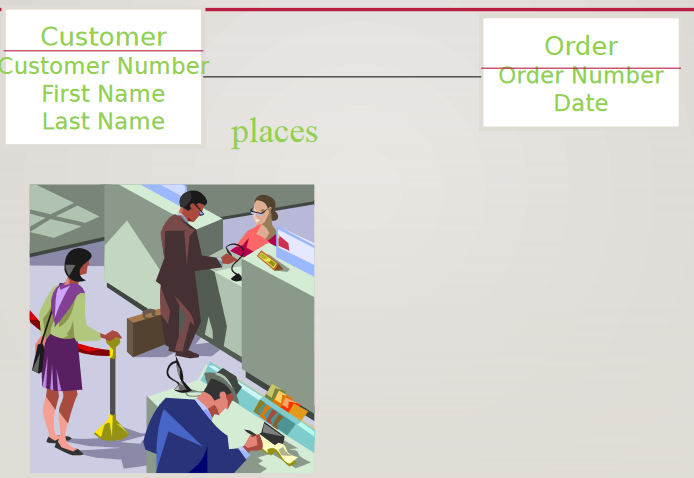
ex: a customer “places” orders
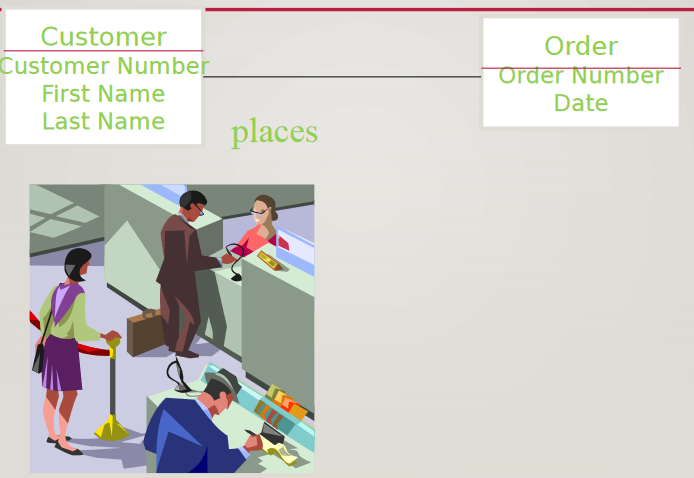
ERD
Entity-Relationship Diagram
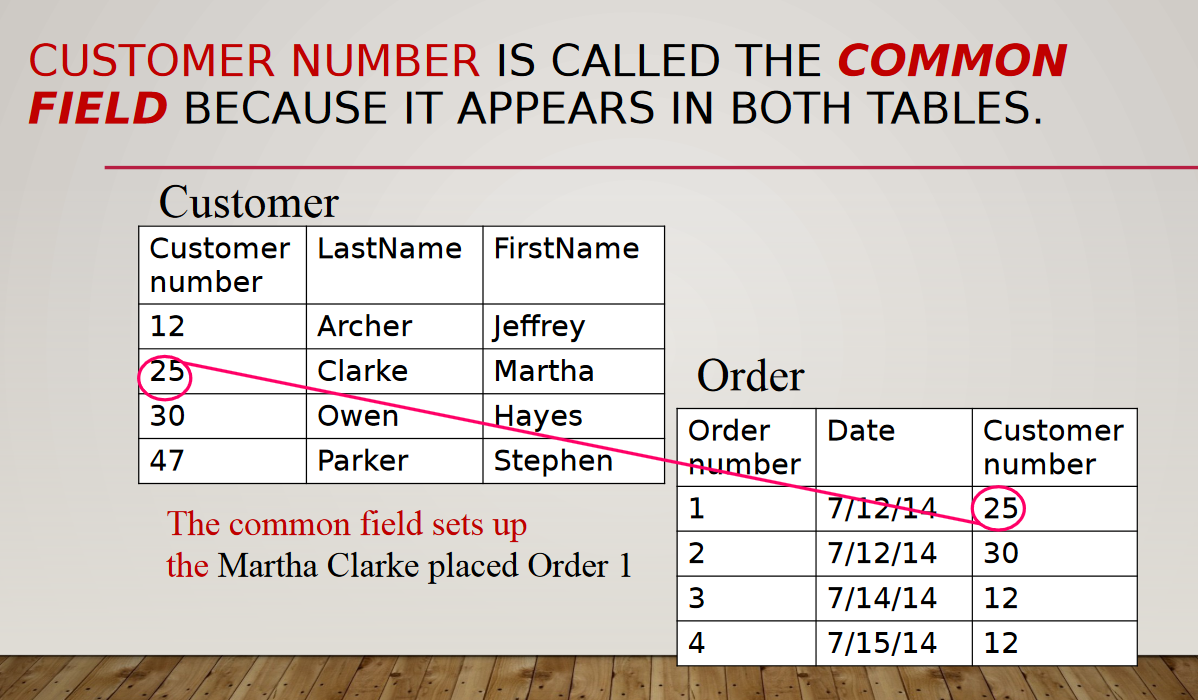
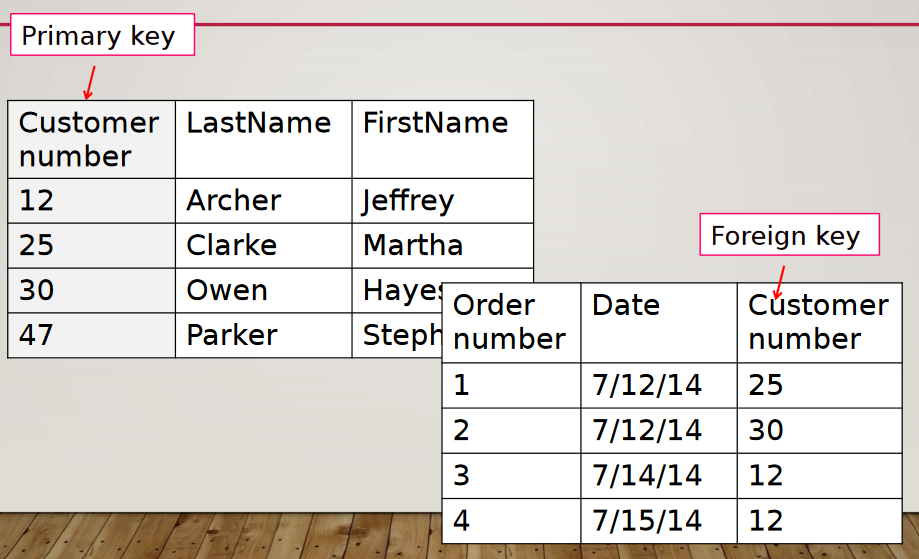
Common Field
appears in both tables
Primary Key
an identifier, a field that is unique for each record
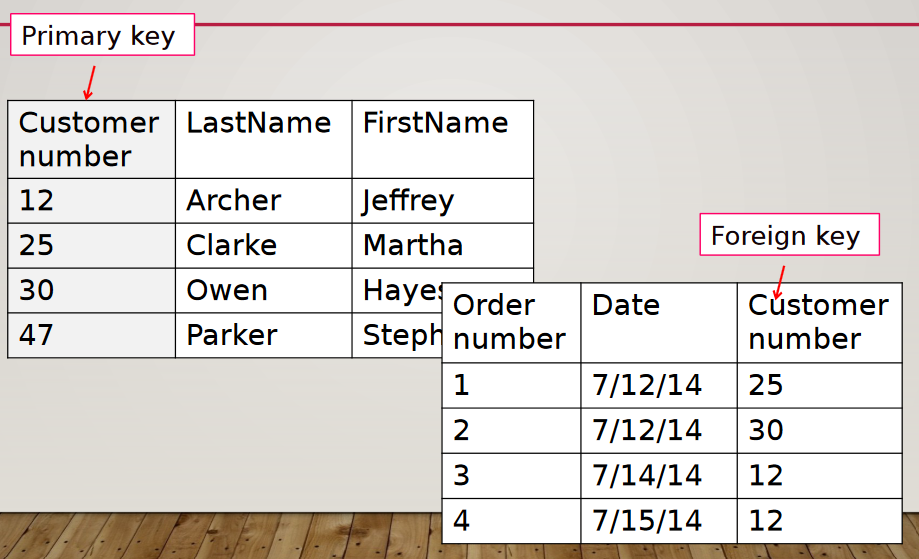
Foreign Key
a field in another table that matches one of the values of the primary key
Normalization
to normalize a database means to design it in a way that
reduced data redundancy
ensures data integrity
Business Intelligence
used to describe the process that organizations use to take data they are collecting and analyze to obtain a competitive advantage
Big Data
massively large data sets that conventional data processing technologies do not have the sufficient power to analyze
Data Visualization
graphical representation of information and data (charts, graphs, maps)
Data Warehouses
extract data from one or more of the organizations databases and load it into the data warehouse (another database) for storage and analysis
Bottom-Up Data Warehouse
starts by creating small data warehouses called data marts to solve specific business problems
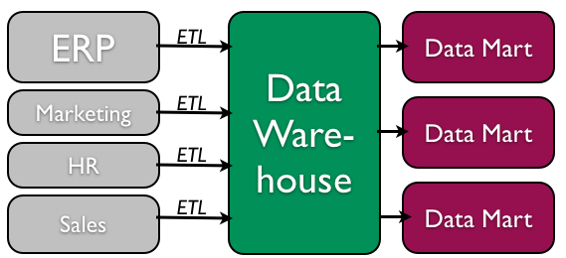
Top-Down Data Warehouse
start by creating an enterprise-wide data warehouse and then, as specific business needs are identified, create smaller data marts form the data warehouse.
Data Mining
the process of analyzing data to find previously unknown and interesting trend, patterns, and associations in order to make decisions. The Core of the Knowledge Discovery Process
Machine Learning
a data mining method that is used to analyze data and build models without explicitly being programmed to do so. Two branches: Supervised and Unsupervised.
Supervised Machine Learning
when an organization has data about past activity that has occurred and wants to replicate it
Unsupervised Machine Learning
when an organization has data and wants to understand the relationships between different data points.
You can combine data from two tables using ________
Queries
_______ are added to help with data consistency
Validation rules