BIOL1020
 Call Kai
 Learn
Learn Practice Test
 Spaced Repetition
 Match
Match Flashcards
 Knowt Play
1/339

There's no tags or description
Looks like no tags are added yet.
Name | Mastery | Learn | Test | Matching | Spaced | Call with Kai | Chat |
|---|
No analytics yet
Send a link to your students to track their progress
340 Terms
How many compounds occur in nature
92
How many compounds are necessary for life + what are the 4 that make up 96%
about 25 are essential to life
Carbon, hydrogen, oxygen and nitrogen make up 96% of living matter (CHON)
What is the basic structure of an atom
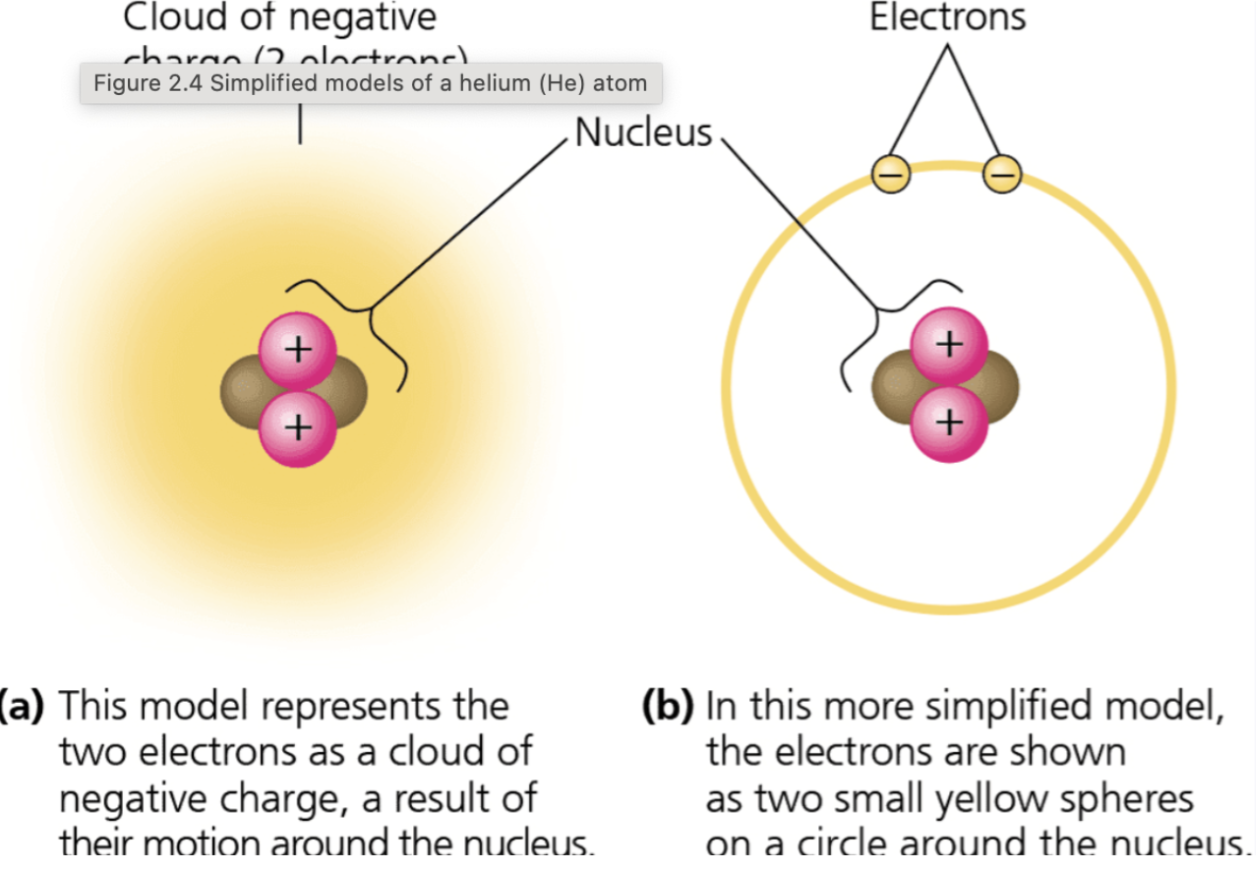
Each element consists of unique atoms composed of subatomic particles including
Protons
Neutrons
Electrons
Neutrons and protons form the atomic nucleus
Electrons form a negatively charged fast moving cloud around the nucleus
Electrons within atoms are distributed in electron shells, which determine the chemical nature and reactivity of an atom
What is matter
Anything that takes up space and has mass
What is a compound
A substance consisting of 2+ elements in a fixed ratio (eg sodium+chloride=sodium chloride)
What is an isotope
Variant of an element with more neutrons
What are chemical reactions
The making & breaking of chemical bonds leading to changes in the composition of matter are chemical reactions
How do you find atomic number and mass?
All atoms of a particular element have the same number of protons in their nuclei
the number of protons is the atomic number and is written as a subscript to the left of the symbol for that element.
unless otherwise indicated an atom is neutral in its electric charge (equal amount of proton
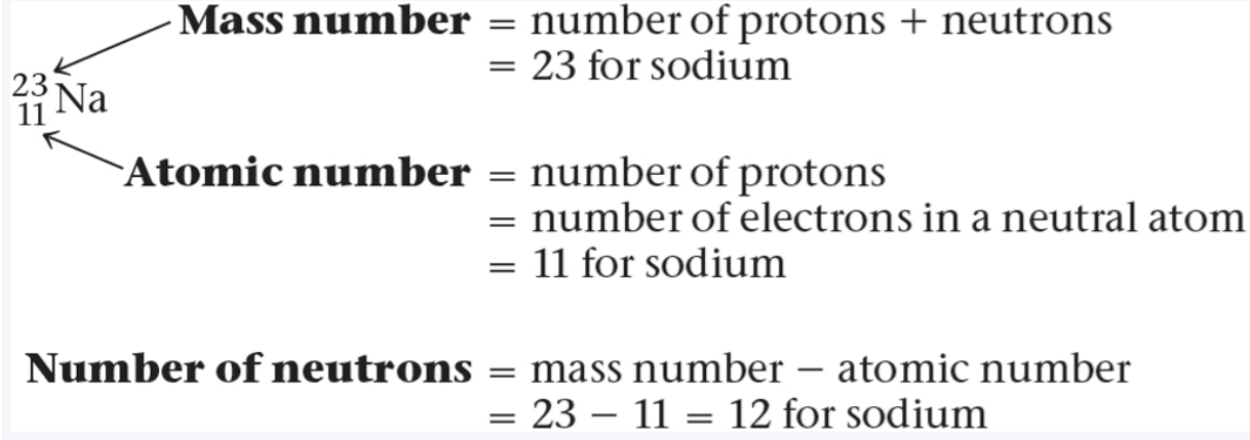
s and electrons)
What are daltons?
for atoms, subatomic particles and molecules, daltons are used as the unit of measurement
Same as atomic mass unit = amu= dalton
Neutrons and protons are both 1 dalton
Mass of electron is 1/2000th; ignored when computing atom mass
Carbon naturally occuring isotopes
carbon (atomic number 6) has 3 naturally occurring isotopes
carbon 12 (12/6) -99%-
carbon-13 (13/6)
and carbon-14 (14/6)
Isotope impact on chemcial reactions
though isotopes of an element have slightly different masses, they behave identically in chemical reactions
How do naturaly occuring isotopes affect atomic mass
For an element with more than one naturally occurring isotope, the atomic mass is an average of those isotopes, weighted by their abundance.
Thus, carbon has an atomic mass of 12.01 daltons.
What are radioactive isotopes
Radioactive isotope: isotope where nucleus decays spontaneously, giving off particles and energy
when radioactivity decay leads to a change in the number of protons, in transforms the atom to an atom of a different element
EG
both C12/13 are stable
nuclei do not have a tendency to lose subatomic particles
C-14 is unstable (radioactive)
when it decays, a neutron decays into a proton transforming the atom into a nitrogen atom
What are valence electrons
electrons in outermost shell ‘valence shell’ ; chemical behaviour of an atom is most determined by valence electrons
What happens when a valence shell is completed
atoms with completed valence shells are unreactive (will not interact readily with other atoms)
Chemically inert
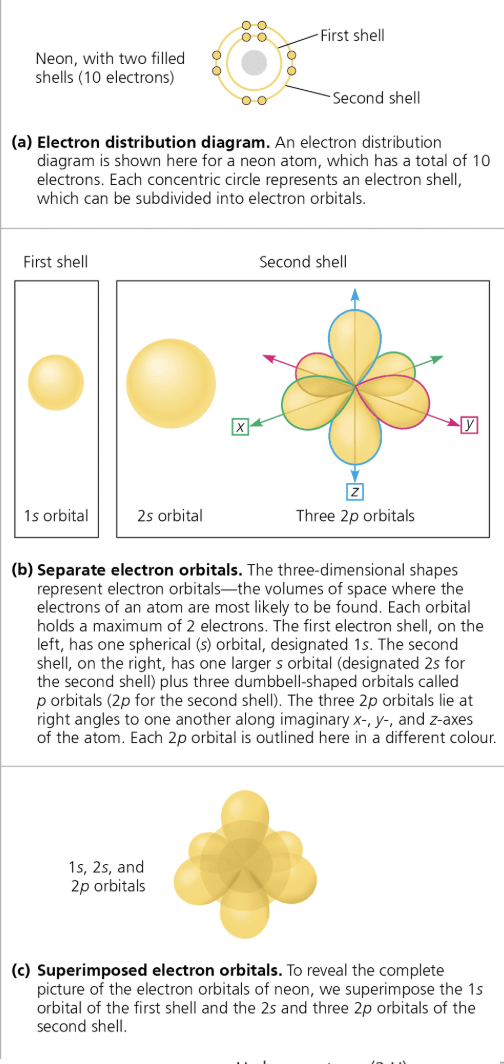
Where are electrons found?
The space where electron is found 90% of time is called an orbital
Electron orbitals: how are they shaped
think of an orbital as a component of an electron shell
first shell has one spherical s orbital (1s),
second shell has four orbitals (one large spherical orbital (2s) and three dumbbell shaped p orbitals (2p)
What are covalent bonds
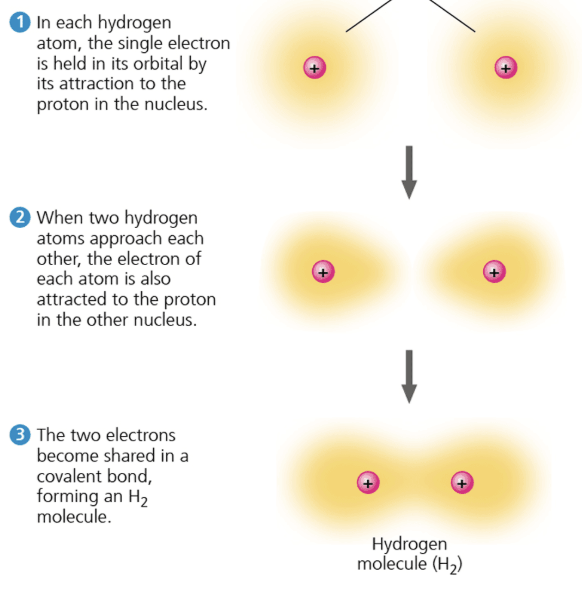
sharing of a pair of valence electrons by 2 atoms
eg two hydrogen atoms approach each other (each one has 1 electron but space for 2 in its valence)
1s orbitals overlap
they are now both associated with 2 electrons→ covalent bond
creates a molecule (in this case hydrogen molecule)
each atom that can share valencies has a bonding capacity corresponding to the number of covalent bonds the atom can form
when bonds form they give the atom a full complement of electrons
Ways of representing molecules: molecular formula
H20
Subscript indicates the molecule consist of 2 atoms of hydrogen (H) and 1 oxygen
Ways of representing molecules: electron distribution diagram
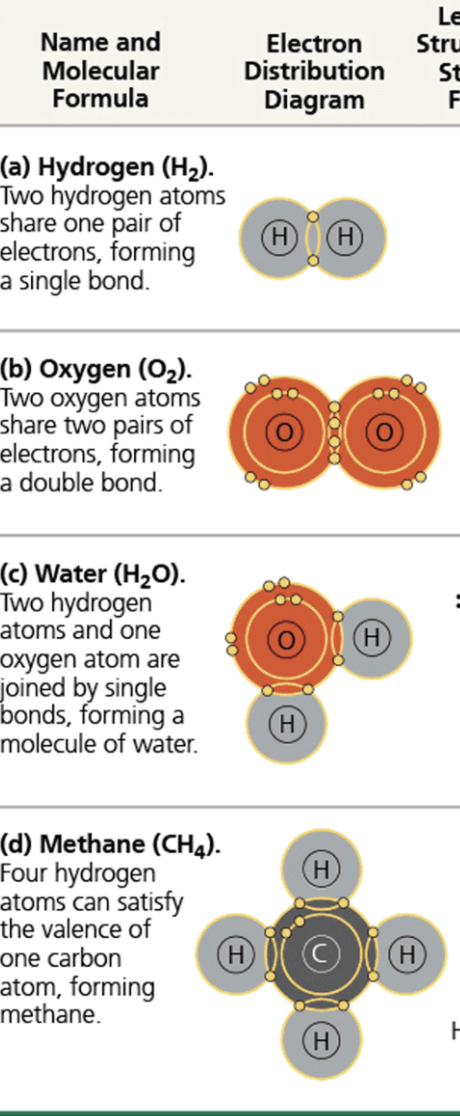
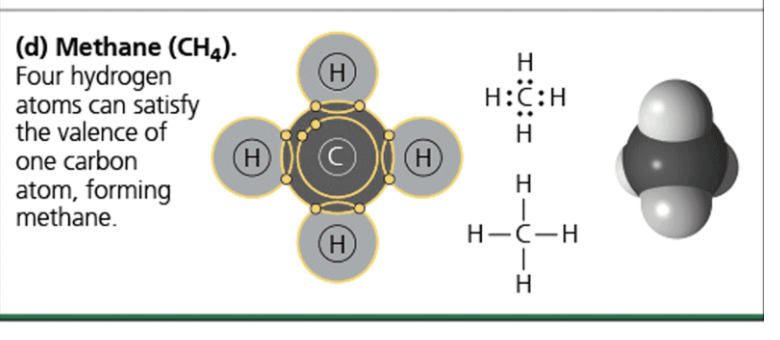
Ways of representing molecules: lewis dot structure
shows electron sharing where element symbols are surrounded by dots that represent the valence electrons
(H : H)
Ways of representing molecules: structural formula
uses lines to show bonds; single or double depending on type of bond

Ways of representing molecules: space filling models
Uses 3d spheres
What is electronegativity
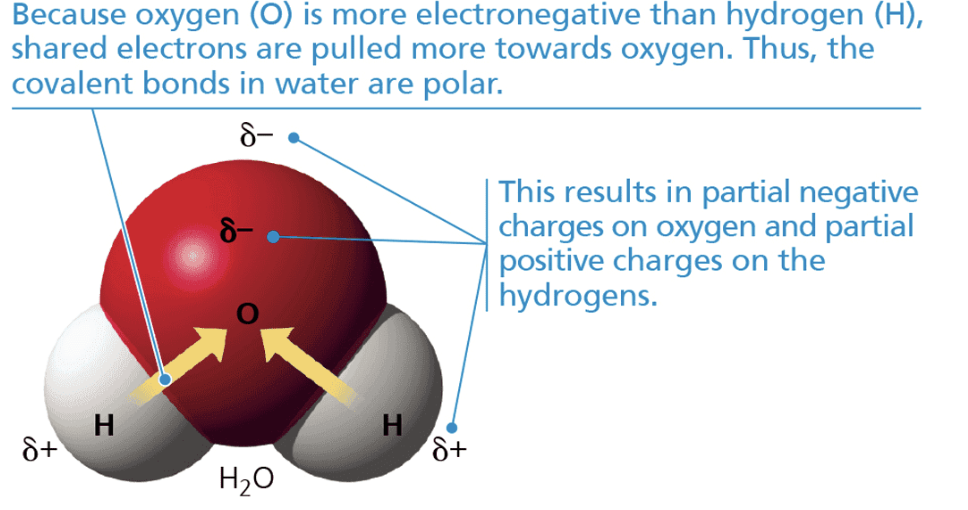
Atoms in a molecule attract shared bonding electrons to varying degrees depending on the element
attraction of a particular atom for the electrons of a covalent bond is called electronegativity
the more electronegative, the more strongly it pulls shared electrons to itself
Electronegativity in bonds of the same element
In a bond between 2 of the same elements, electrons are shared equally as both atoms have the same electronegativity
where this happens, the bond is a non-polar covalent bond
eg H2
Electronegativity in bonds of different elements
When an atom is bonded with a more electronegative atom, the electrons are not shared equally
polar covalent bond
eg H2O
What is ionic bonding
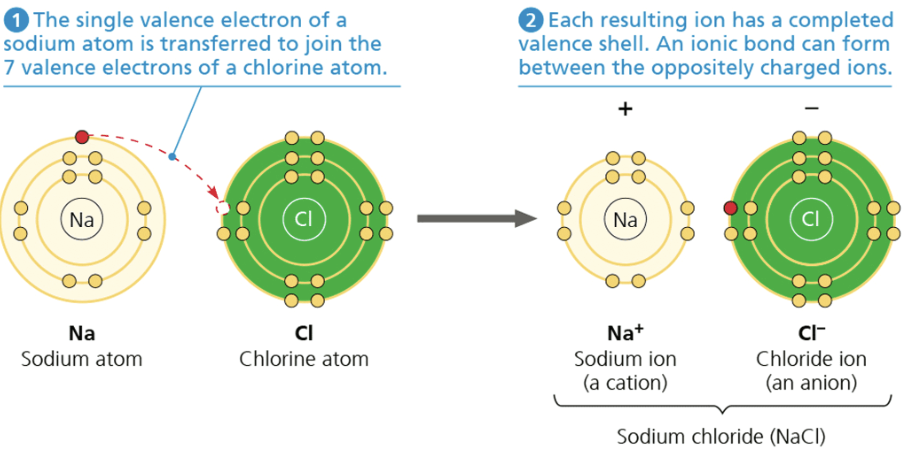
Two atoms may be so unequal in attraction for valence electrons that the more electronegative atom strips an electron away from its partner
results in charged atoms/molecules; ‘ions’
The term ion applies to entire molecules that are electrically charged
the attraction of a cation to an anion forms a 3d lattice/bond
Which ion has what charge, and what happens between them?
Cation: positively charged
Anion: negatively charged
How are ionic bonds structured
unlike covalent compounds, which consist of molecules having definite size/numbers of atoms, ionic compounds do not consist of molecules
ionic compounds are rather a ratio of elements in a crystal of the salt (NaCl is not a molecule)
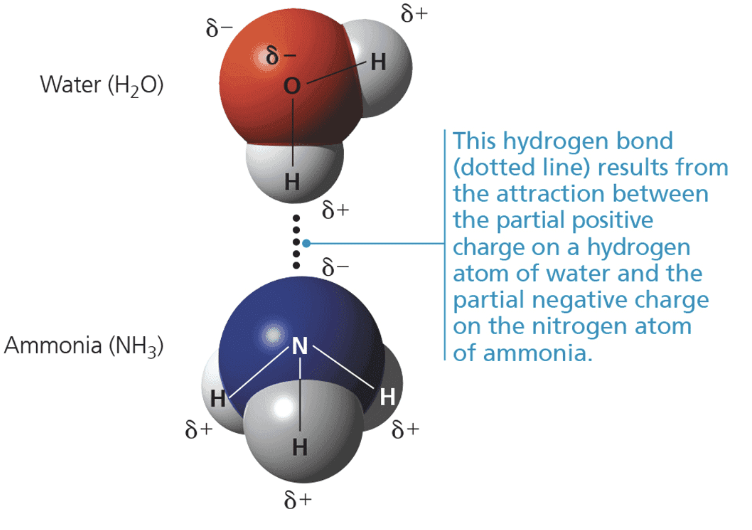
What are hydrogen bonds
When a hydrogen atom is covalently bonded to an electronegative atom the hydrogen atom has a positive charge
This allows it to be attached to a different electronegative atom with a partial negative charge nearby
What are van der waals interactions
Molecules with non polar covalent bonds may have positive and negatively charged regions
electrons are not always evenly distributed, hence may accumulate in one part of a molecule or another
results in ever changing regions of positive and negative charges that enable all atoms and molecules to stick to one another
individually weak and only occur when atoms and molecules are very close together
How are molecules shaped when consisting of 2 atoms
molecules consisting of two atoms is always linear
Eg H2 and O2
What is molecular shape determined by
most molecules with more than 2 atoms have complicated shapes
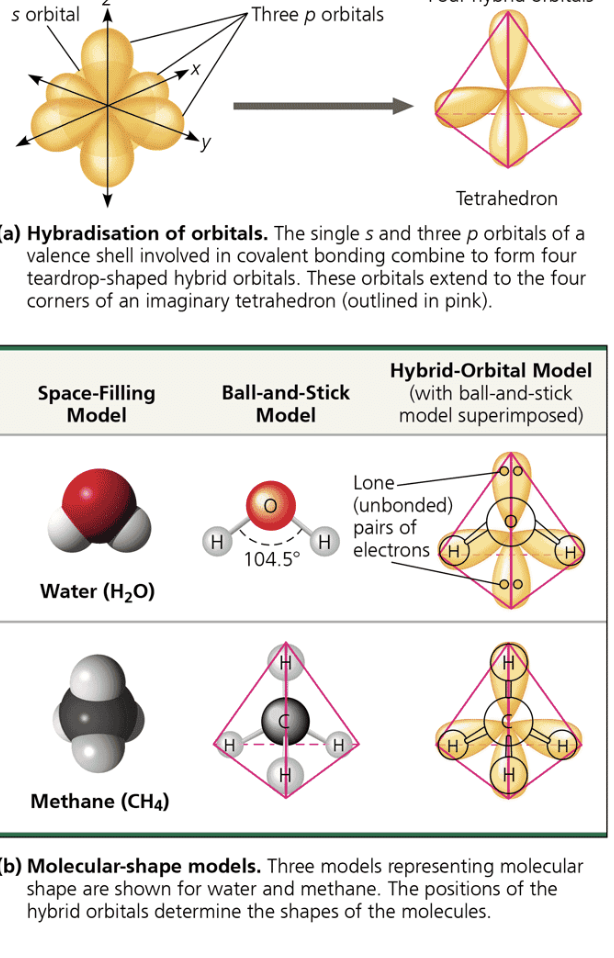
shapes are determined by positions of atoms orbitals
when an atom forms covalent bonds, orbitals in its valence shell undergo rearrangement
atoms with electrons in s and p orbitals form four new hybrid orbitals shaped like identical teardrops extending from the region of the nucleus
Why is molecular shape important
determines how biological molecules recognise and respond to one another with specificity
molecules often bind together temporarily with weak interactions but only if shapes are complementary
for example opiates have a similar chemical structure to endorphins and are recognised as such by the body
How to write a chemical reaction
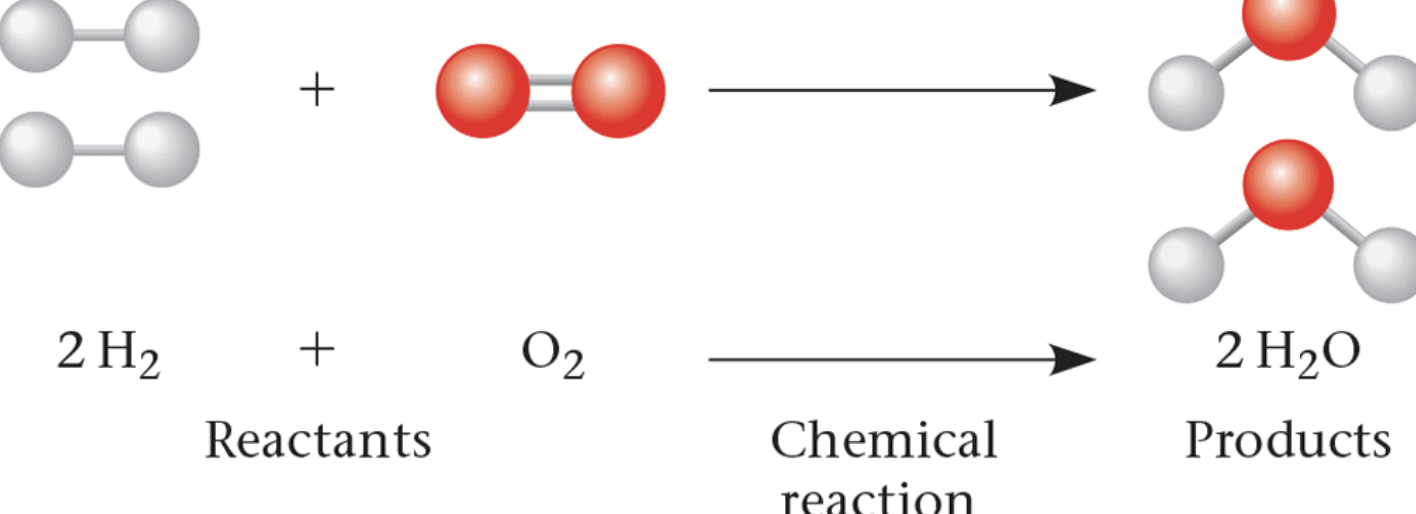
when writing the equation for a chemical reaction use an arrow to indicate the conversion of starting materials (reactants) to resulting materials (products)
coefficients indicate the number of molecules involved
all atoms of reactants must be accounted for in the products
Factors affecting reactions
concentration of reactant
the greater the concentration of reactants, the more frequently they collide with one another to react and form products
as products accumulate, collisions resulting in the reverse reaction become more frequent
eventually forward and reverse reactions occur at the same rate as relative frequency of reactants/products stop changing
called chemical equilibrium where reactions offset each other exactly
reactions still go off in both directions but with no net effect on concentrations of reactants and pollutants
Structure of water
Wide V with 2 hydrogen atoms joined to the oxygen atom by single covalent bonds\
Oxygen is more electronegative than hydrogen→ electrons in a covalent bond spend more time closer to the oxygen than hydrogen
Properties of water come from attractions between oppositely charged atoms of different water molecules
Partially positive part of water is attracted to partly negative of nearby molecules
2 molecules are held together by a hydrogen bond
when in liquid form, bonds are very fragile (1/20th of a covalent bond)
Bonds break and reform with great frequency
At any given moment, most water molecules are hydrogen bonded to neighbours
Properties of water that make it essential fro. life
cohesion
moderation of temperature
Ice floating on liquid water
What is specific heat
The specific heat of a substance is the amount of heat that must be absorbed or lost for 1g of that substance to change its temperature by 1c
WHat is waters actual specific heat
the specific heat of water is therefore 1 calorie per gram and per degree celcius
What is the significance of waters high specific heat
compared with most other substances, water has high specific heat
because of this, water will change its temperature less than other liquids when it absorbs or loses a given amount of heat
Why does water have high specific heat
A) Hydrogen bonding
heat must be absorbed in order to break hydrogen bonds
heat is released when hydrogen bonds form
a calorie of heat causes a relatively small change in the temp of water because much of the heat is used to disrupt hydrogen bonds before the water molecules can begin moving faster
when the temperature of water drops slightly, many additional hydrogen bonds form releasing a considerable amount of energy in the form of heat
Why his high specific heat importannt for life
a large body of water can absorb and store a huge amount of heat from the sun in daytime and during summer while warming up only a few degrees
at night/during winter the gradually cooling water warms the air
moderates air temperatures in coastal areas
stabilises ocean temperatures creating favourable environment for marine life
organisms consist of mostly water- able to resist changes in their own temperature
What is evaporative cooling
Molecules of any liquid stay close as they are attracted to one another
Molecules moving fast enough overcome these attractions and depart the liquid to enter the air as gas (vapor)
vaporisation/evaporation
Even at low temperatures some molecules escape into the air
Occurs at any temperature
If liquid is heated, average kinetic energy of molecules increases→ moves more quickly
What is heat of vaporisation + is it high for water?
quantity of heat a liquid must absorb for 1g to be converted from liquid to gas states
same reasons as high specific heat, water has high heat of vaporisation
What is the significance of water’s high heat of vaporisation
moderates earth's climate; considerable amount of solar heat absorbed by tropical seas is consumed by evaporation of surface water
as moist tropical air circulates towards poles, it releases heat as it condenses and forms rain
as liquid evaporates, the surface of the liquid that remains behind cools down (evaporative cooling)
occurs because liquid that evaporates tends to be the hottest molecules
meaning that as they depart the average heat flattens
What happens to water for temperatures above 4 degrees
At temperatures above 4 degrees celsius water behaves like other liquids, expanding as it warms and contracting as it cools.
What happens to water below 4 degrees
As water temperature falls from 4 to 0, water begins to freeze as more and more molecules move too slowly to break hydrogen bonds
WHy does ice float on water
at 0 degrees, molecules form a crystalline lattice where each water molecule's hydrogen bonds to 4 partners
hydrogen bonds keep molecules apart far enough that ice is 10% less dense than liquid water at 4%
hence ice floats as there is less molecules in the same volume
Why is it important that ice floats
if ice sank, eventually all water bodies could freeze solid, making life impossible;
during summer only the upper few inches of the ocean would thaw
instead when a deep body of water cools, the ice floats which insulates liquid water below
prevents it from freezing, hence allowing life to exist under a frozen surface
What is a solution
A liquid that is a completely homogenous mixture of substances is a solution
dissolving agent is the solvent
aqueous solution is a solution where water is a solvent
Why is water a solvent
water is a versatile solvent due to the polarity of the water molecule
if a spoonful of salt (NaCl) was placed in water, at the surface of each crystal of salt, sodium and chloride ios are exposed to the solvent
ions and regions of water molecules are attracted to each other due to their opposite charges
oxygens of water have partial negative charges that are attracted to sodium cations
hydrogen regions are partially positively charged and are attracted to chlorine anions
consequently water molecules surrounding the sodium and chloride ions separate and shield them from one another
sphere of water molecules is a hydration shell
Does a compound need to be ionic to dissolve in water
a compound does not need to be ionic to dissolve in water- many compounds are made up of nonionic polar molecules
such compounds dissolve when water molecules surround each of the solute molecules, forming hydrogen bonds with them
proteins can even be dissolved if they have ionic and polar regions on their surface
What causes hydrophobia
substances can be hydrophilic without dissolving
eg cotton which consists of giant molecules of cellulose, which form hydrogen bonds with water
water adheres to cellulose fibres
hydrophobic substances are those that are nonionic and nonpolar
repels water
eg vegetable oil; high number of relatively nonpolar covalent bonds
How to determine mass off a molecule
substances can be hydrophilic without dissolving
eg cotton which consists of giant molecules of cellulose, which form hydrogen bonds with water
water adheres to cellulose fibres
hydrophobic substances are those that are nonionic and nonpolar
repels water
eg vegetable oil; high number of relatively nonpolar covalent bonds
What are mols
As small numbers cannot be weighed out, we usually measure substances in moles
A mol represents an exact number of objects
6.02 x 10²³ (avogadro’s number)
There are 6.02 x 10²³ daltons in 1g
once you determine the molecular mass of a molecule, you use the same number but with the unit gram to represent the mass of 6.02x10^23 molecules of sucrose or 1 mol of sucrose (molar mass)
to obtain 1 mol of sucrose in the lab, weigh out 342 g
What is the advantage of using mols
Advantage of mols
a mol of one substance has exactly the same number of molecules as a mole of any other substance
molarity: number of moles of solute per litre of a solution is the unit most used for aqueous solutions
How are hydroxide ions formed
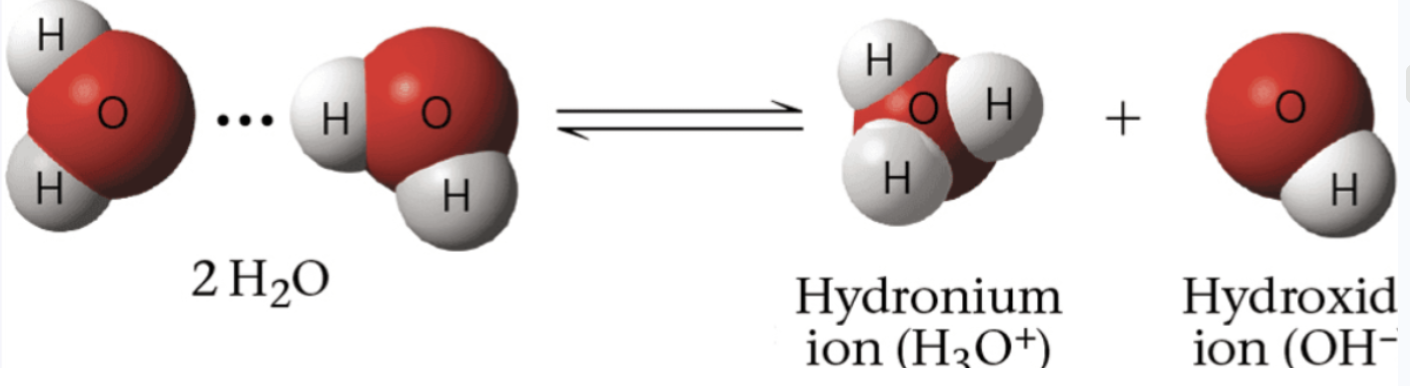
Occasionally a hydrogen atom participating in a hydrogen bond between two water molecules shifts from one molecule to the other
leaves its electron behind and what is transferred is a hydrogen ion (H+) (a single proton with a 1+ charge)
The water molecule that lost a proton is now a hydroxide ion (OH-) which has a charge of 1-
the proton binds to the other water molecule making that molecule a hydronium ion
What is an acid
A substance that increases the hydrogen ion concentration of a solution
Eg eg Hydrochloric acid (HCl): when added to water causes hydrogen ions to dissociate from chloride ions
What are bases
substance that reduces hydrogen ion concentration of a solution
some bases reduce H+ concentration directly by accepting hydrogen ions
eg ammonia NH3 acts as a base when a shared electron pair in a nitrogen valence shell attracts a hydrogen ion from the solution
resulting in an ammonium ion (NH4+)
other bases reduce the H+ concentration indirectly by dissociating to form hydroxide ions which combine with hydrogen ions and form water
eg NaOH which in water dissociates into its ions Na+ and OH-
What is the pH scale
in any aqueous solution at 25 degrees, the product of the H+ and OH- concentrations is constant at 10-14
an acid not only adds hydrogen ions to a solution, but also removes hydroxide ions due to the tendency of H+ to combine with OH- forming water
base has opposite effect
pH=-log[H+]
What are buffers
The internal pH of most living cells is close to 7
A buffer is a substance that minimises changes in concentrations of H+ and OH- in a solution.
does this by accepting hydrogen ions from the solution when there are in excess and donating hydrogen ions to the solution when they have been depleted
most buffer solutions contain a weak acid and its corresponding base, which combine reversibly with hydrogen ions
Carbon structure
Carbon has 6 electrons, with 2 in the first electron shell and 4 in the second shell
Hence, it has 4 electrons in a shell that can hold 8 electrons
Carbon usually forms single or double covalent bonds
when carbon forms 4 bonds, the arrangement of its four hybrid orbitals causes the bonds to angle towards the corners of an imaginary tetrahedron
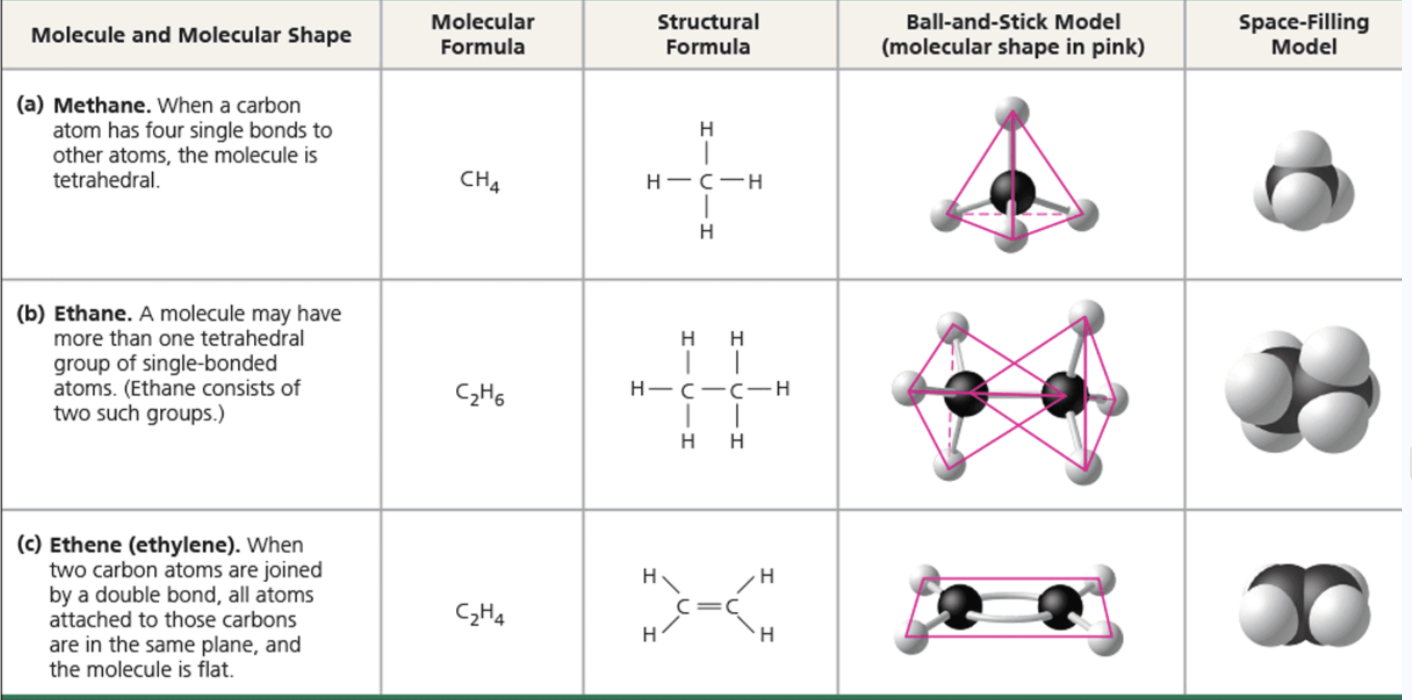
Significance of carbon electron configuration
gives covalent compatibility with many different elements
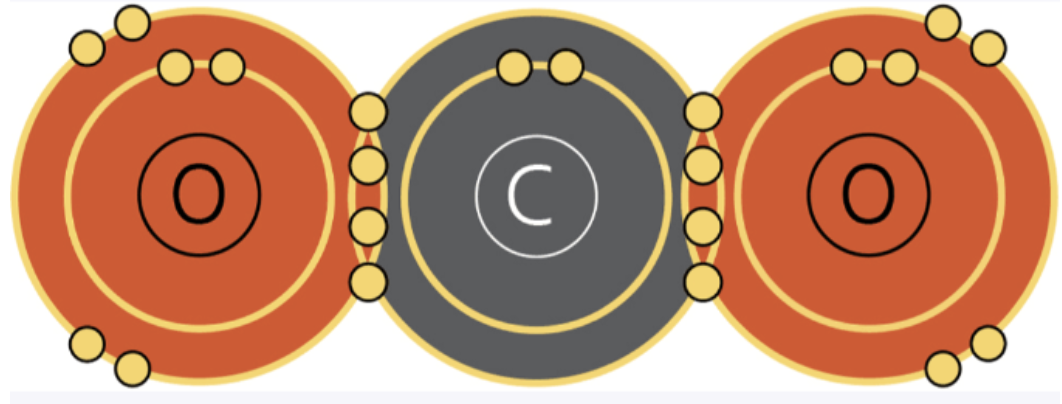
In carbon dioxide, a single carbon atom is joined to two atoms of oxygen by double covalent bonds (O=C=O)
each line in a structural formula represents a pair of shared electrons
thus the two double bonds in CO2 have the same number of shared electrons as 4 single bonds and the arrangement completes the valence shells of all atoms in the molecule
As CO2 is a simple molecule lacking hydrogen, it is often called inorganic despite containing carbon
Only has one carbon atom
But a carbon atom can also use other electrons to form covalent bonds to other atoms, linking atoms to chains
What are the chemical groups most important in life
HCCASPM
Hydroxyl group (-OH, HO-)
Carbonyl group (>C=O)
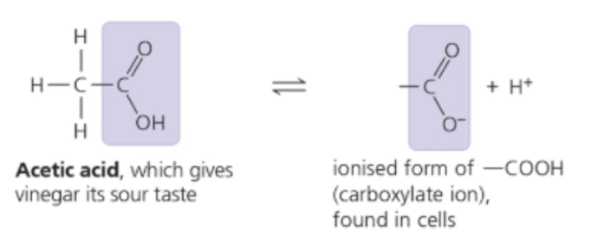
Carboxyl group (-COOH)
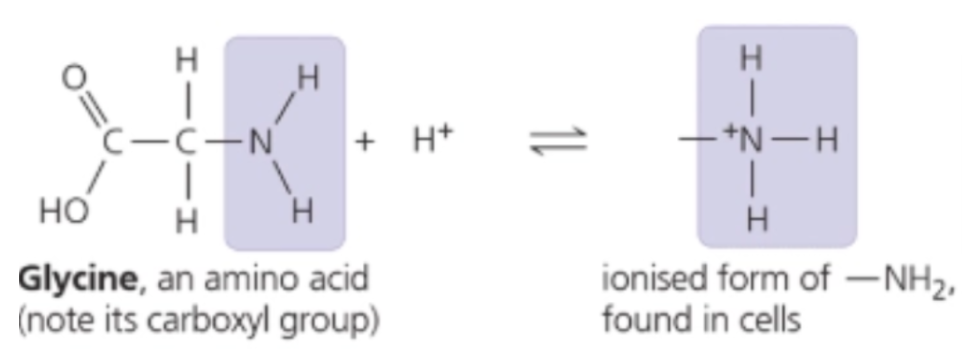
Amino group (-NH2) -N<HH
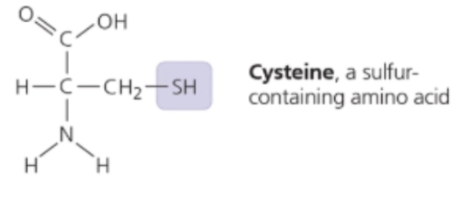
Sulfhydryl group(-SH, HS-)
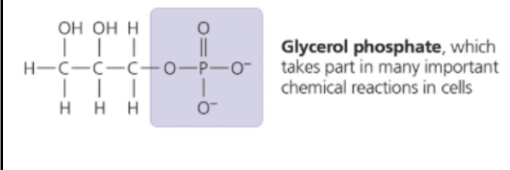
Phosphate group -OPO32-
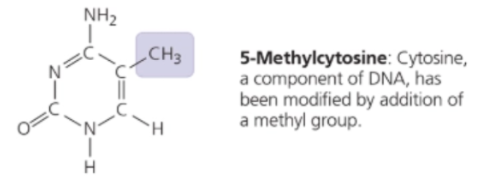
Methyl group -CH3
Hydroxyl group
Hydroxyl group (-OH, HO-) Polar due to electronegative oxygen. Forms hydrogen bonds with water, helping to dissolve compounds such as sugars Compound name: alcohol (specific name usually ends in -ol | 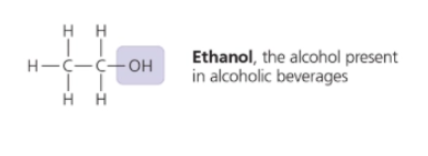 |
Carbonyl group
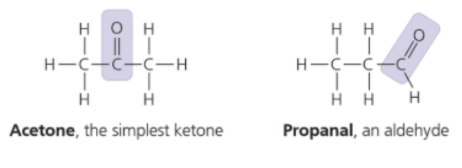
Carbonyl group (>C=O) | Sugars with ketone groups are ketosis. Those with aldehydes are called aldoses. |
Corboxyl group
Carboxyl group (-COOH) | Acts as an acid (can donate H+) because the covalent bond between oxygen and hydrogen is so polar Compound name: carboxylic acid/organic acid |
Amino group
Amino group (-NH2) -N<HH | Acts as a base. Can pick up an H+ from the surrounding solution (water, in living organisms) |
Sulfhydryl group
Sulfhydryl group(-SH, HS-) | Two -SH groups can react, forming a cross-link that helsp stabilise protein structure. Hair protein cross-links maintain hair texture. In salons, permanent treatments break cross links then reform in desired shapes Compound name: Thiol |
Phosphate group
Phosphate group -OPO32- | Contributes negative charge (1- when positioned inside a chain of phosphates; 2- when at the end). When attached, confers on a molecule the ability to react with water, releasing energy |
Methyl group
Methyl group -CH3 | Affects the expression of genes when bonded to DNA or to proteins that bind to DNA. Affects the shape and function of male and female sex hormones |
What is ATP
ATP consists of an organic molecule called adenosine attached to a string of 3 phosphate groups
where 3 phosphates are present series (such as with atp) one may split off and react with water
having lost one phosphate ATP becomes adenine diphosphate (ADP)
stores the potential to react with water/other molecules→ process that results in the release of energy
What are macromolecules
Large chain-like molecules called polymers. Large carbohydrates, proteins and nucleic acid are macromolecules
What are polymers
long molecule consisting of many similar or identical building blocks linked by covalent bonds. Repeating units that serve as the building blocks of a polymer are smaller molecules called monomers
How are polymers synthesised
In cells, these processes are facilitated by enzymes
Specialised macromolecules (usually proteins) that speed up chemical reactions
The reaction that connects a monomer to another monomer or polymer is a condensation reaction
Reaction in which two molecules are covalently bonded to each with the loss of a small molecule.
What is a dehydration reaction
Reaction in which two molecules are covalently bonded to each with the loss of a small molecule.
If a water molecule is lost it is a dehydration reaction
Carbohydrate and protein polymers are synthesised by dehydration reactions
Each reactant contributes part of the water molecule released during the reaction
One provides a hydroxyl gorip (-OH) and the other a hydrogen (-H) this reaction is repeated as monomers are added to the chain one by one, lengthening the poly
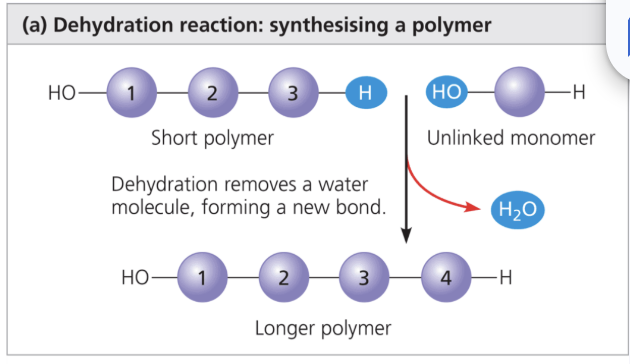
mer
How are polymers broken down
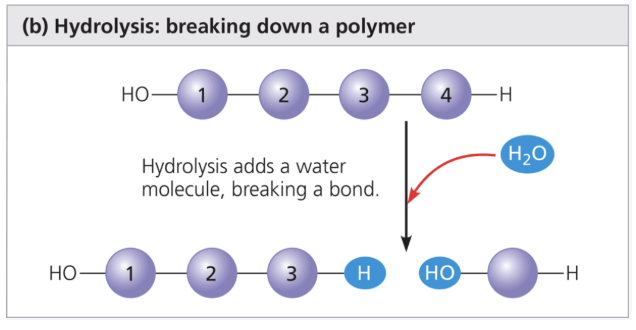
Polymers are disassembled to monomers by hydrolysis
Reverse of dehydration reaction
Bond between monomers is broken by the addition of a water molecule with a hydrogen from water attaching to one monomer and the hydroxyl group attaching to the other
Eg digestion, where various enzymes attack polymers in digestive tract, speeding up hydrolysis x
What are carbohydrates and what is their purpose
Carbs serve as fuel and building material.
Carbs include sugars and polymers of sugars
Whar are carb macromolecules
Carbohydrate macromolecules are polymers called polysaccharides, composed of many sugar building blocks
What are the simplest carbs
Simplest of carbs are monosaccharides or simple sugars
Monomers from which more complex carbohydrates are built
Disaccharides are double sugars consisting of two monosaccharides joined by a covalent bond
What are monosaccharides
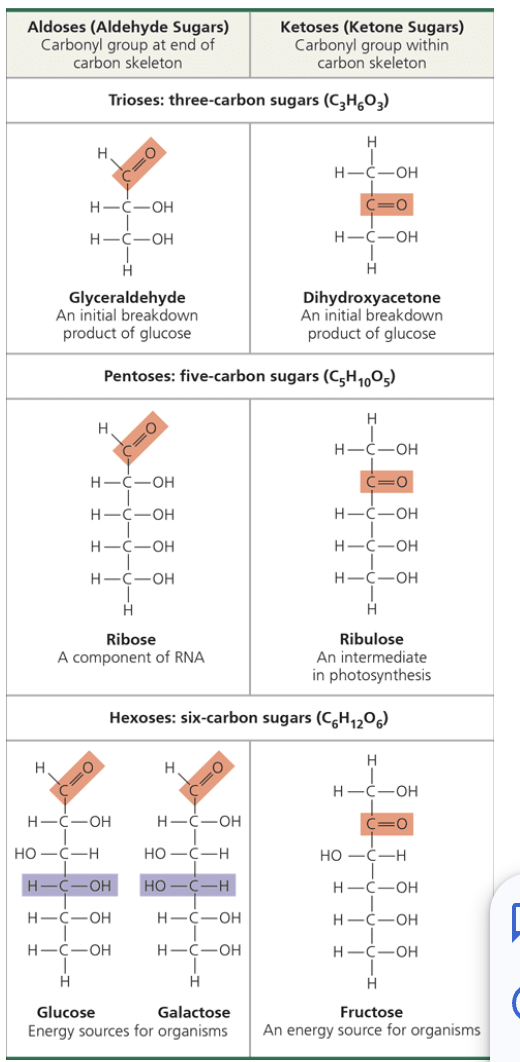
Monosaccharides generally have molecular formulas that are some multiple of the unit CH2O.
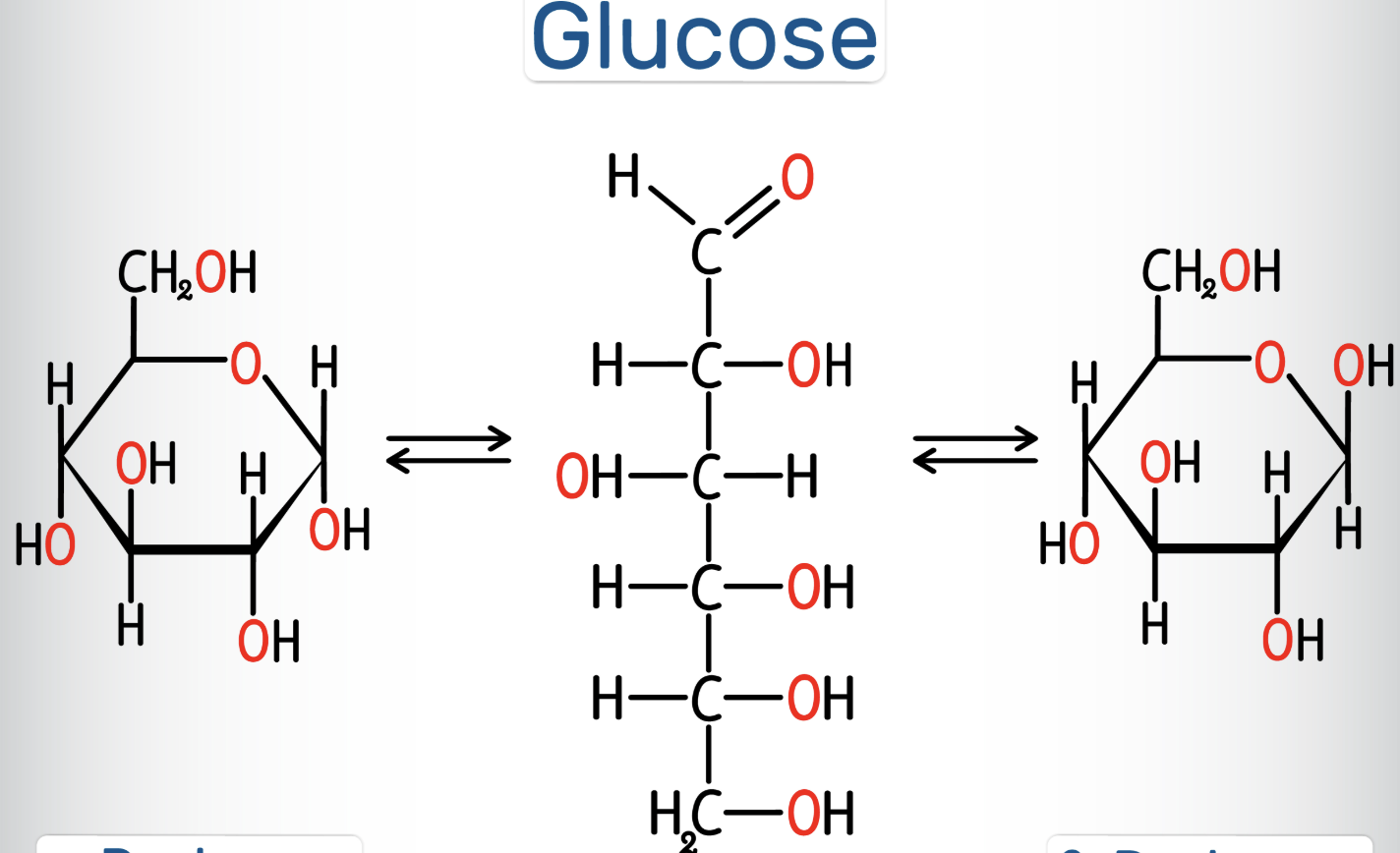
Glucose (C6H12O6) is the most common mono saccharide and is of central importance in chemistry of life
Glucose has qualities of monosaccharide; carbonyl group, multiple hydroxyl groups
Another criteria for monosaccharides is the size of the carbon skeleton which may be 3-7 carbons long
Types of monosaccharides
Depending on the location of the carbonyl group, a monosaccharide is either an aldose (aldehyde sugar) or ketose (ketone sugar)
Glucose is an aldose
Fructose is an isomer of glucose and is a ketose
Monosaccharide uses
Monosaccharides, particularly glucose, are major nutrients for cells
In cellular respiration, cells extract energy from glucose molecules by breaking them down in a series of reactions
Carbon skeletons also serve as raw material for the synthesis pf other types of small organic molecules such as amino acids and fatty acids
What is a glycosidic linakge
Covalent bond formed between to monosaccharides by a dehydration reaction
What are Disaccharides
Consists of 2 monosacs joined by a glycosidic linkage
Disaccharides must be broken into monosaccharides to be used for energy by organisms
What are polysaccharides
Macromolecules with a few hundred to a few hundred thousand monosaccharides joined by glycosidic linkages
Some polysaccharides serve as storage material, hydrolysed as needed to provide monosaccharides for cells
Others serve as building material for structures that protect the cell or the whole organism
What are storage polysachharides
Long chains of glucose that act as energy resevres
Starch — the main energy storage polysaccharide in plants.
Glycogen — the main energy storage polysaccharide in animals and fungi
What are structural polysaccharides
Structural polysaccharides are carbohydrates used for building and supporting biological structures
cellulose: structures plant walls
chitin: forms insect exoskeletons
What are lipids
A diverse group of hydrophobic molecules
Based on molecular structure
may have some polar bonds associated with oxygen, but consist mostly of hydrocarbon regions with relatively non polar C-H bonds
Most important lipid types
fats
steroids
phospholipids
What are fats
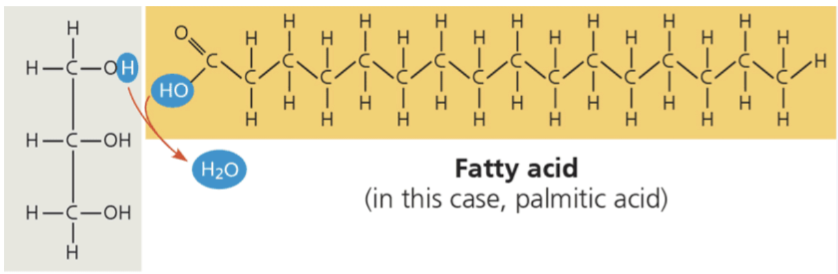
Fats (also called triglycerides) are made of:
1 glycerol molecule
3 fatty acid molecules
The fatty acids are attached to glycerol by ester bonds. (formed by condensation reaction)
How are fats made
Each fatty acid molecule is joined to glycerol by a dehydration reaction
Results in am ester linkage
a bond between hydroxyl group and carboxyl group
Completed fat consists of 3 fatty acids linked to one glycerol molecule
Fatty acids in fat can be all the same, or can be of 2-3 different kinds
What is the difference between saturated and unsaturated fats
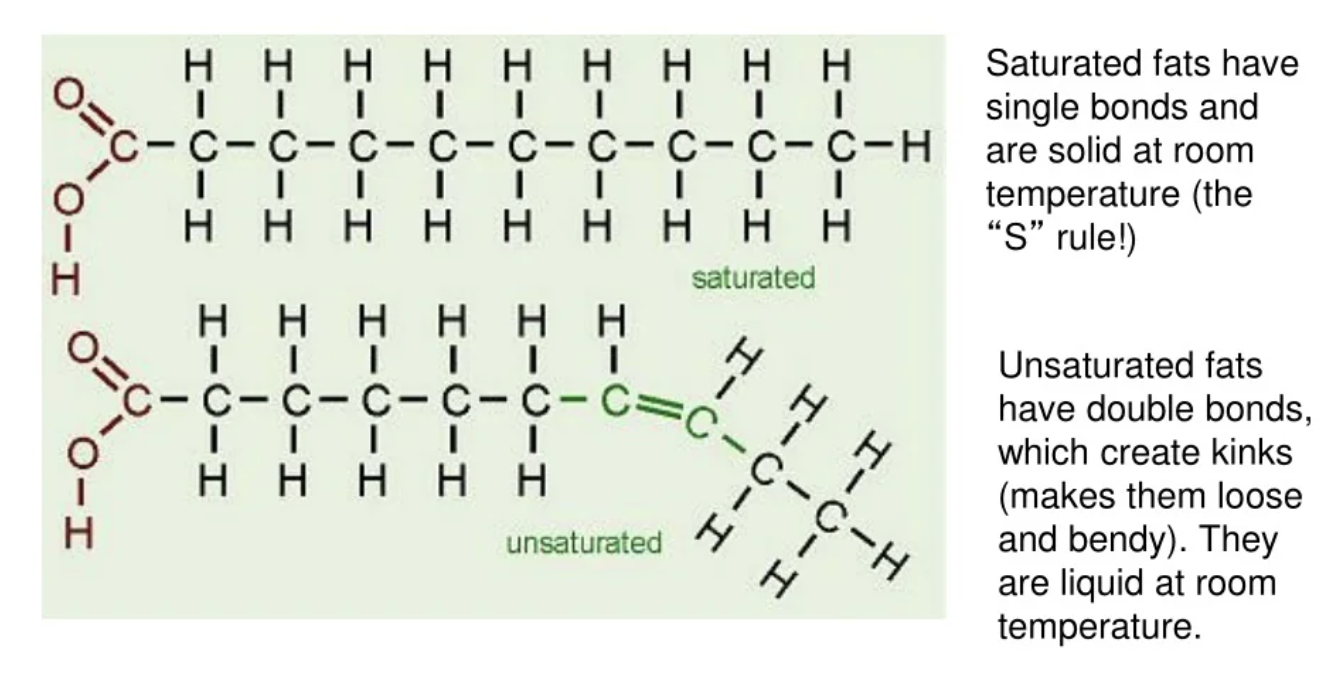
the structure of the hydrocarbon chains of the fatty acids
Saturated: no carbon=carbon double bonds 0 saturated with hydrogen
Unsaturated: one or more double carbon bonds
What is the purpose of fats
Main purpose is energy storage
Hydrocarbon chains of fats are rich in energy; one gram of fat stores more than twice as much energy as a gram of a polysaccharide such as starch
In humans long term food reserves are stocked in adipose cells
In addition to storing energy, adipose tissue also cushions vital organs
What are phospholipids
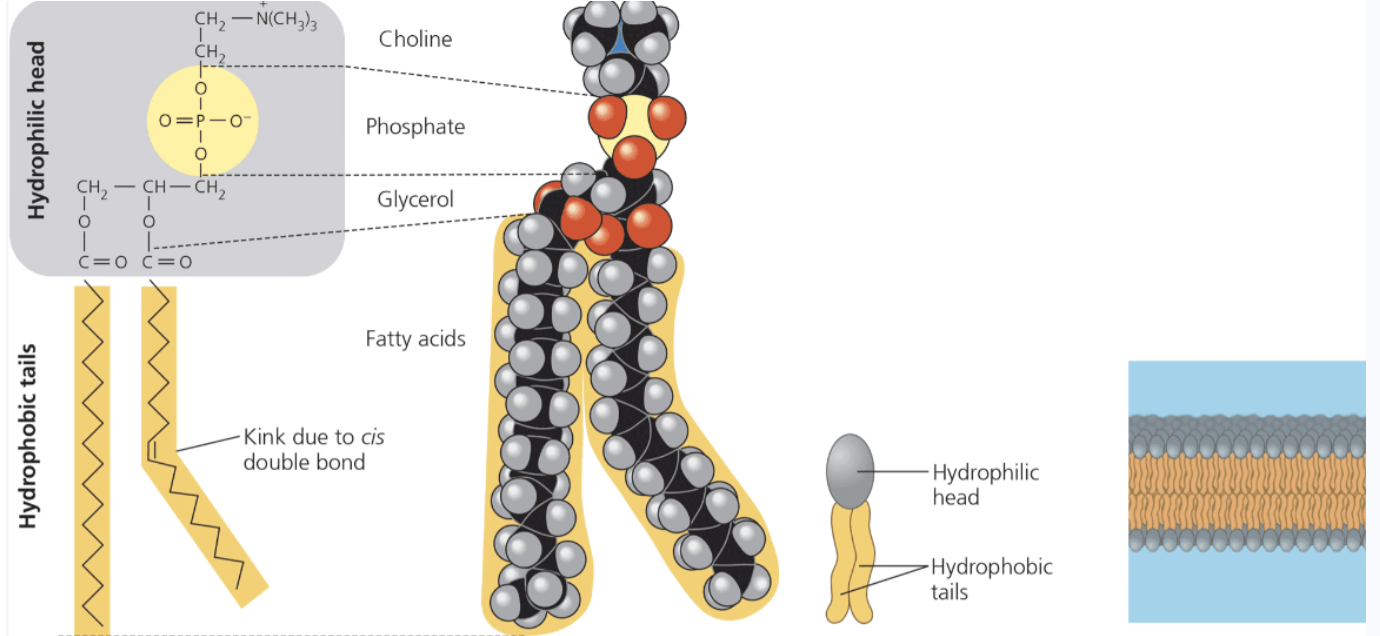
Similar in structure to a fat molecule but has only 2 fatty acids attached to glycerol rather than 3
The 3rd hydroxyl group of glycerol is joined to a phosphate group, which has a negative electrical charge in the cell
Two ends of phospholipids have different behaviours with respect to water
Hydrocarbon tails are hydrophobic
Phosphate group and its attachments form a hydrophilic head
What are the purposes of phospholipids
Essential for cells as they are the major constituent of cell membranes
When added to water, they assemble into a bilayer that shields the fatty acid tails from water
At the surface of a cell, phospholipids are arranged in a similar bilayer, forming a boundary between the cell and its external environment
Establishes separate compartments within eukaryotic cells
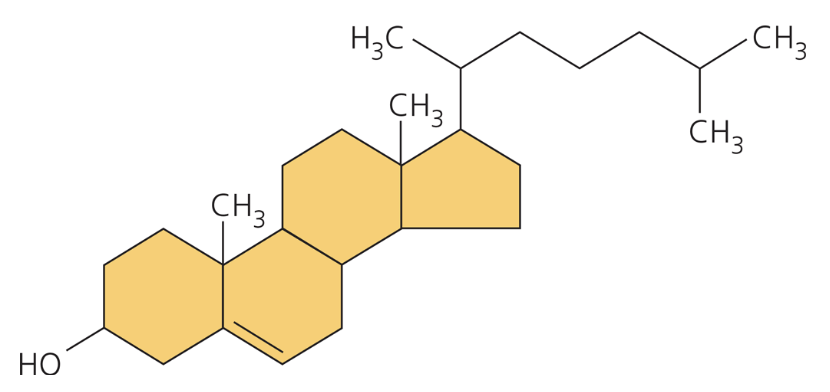
What are steroids
Lipids characterised by a carbon skeleton consisting of 4 fused rinks
Different steroids are distinguished by the particular chemical groups attached to the ensemble of rings
Eg cholesterol, used in animal cell membranes and as a precursor for other steroids to be synthesised
What are proteins
Include a diversity of structures, resulting in a wide variety of functions
Account for 50% of the dry mass of most cells
Constructed from the same set of 20 amino acids, linked in unbranched polymers
Bond between amino acids is a peptide bond, polymer of amino acids is a polypeptide
Protein is made up of one or more polypeptides, each folded and coiled into a 3d structure
Enzymatic protein function +example
Selective acceleration of chemical reactions | Digestive enzymes catalyse the hydrolysis of bonds in food molecules |