Learn: biochem notes
 Call Kai
 Learn
Learn Practice Test
 Spaced Repetition
 Match
Match Flashcards
 Knowt Play
1/106

There's no tags or description
Looks like no tags are added yet.
Name | Mastery | Learn | Test | Matching | Spaced | Call with Kai | Chat |
|---|
No analytics yet
Send a link to your students to track their progress
107 Terms
What are the three life forms?
Bacteria, Eukarya, Archaea
E. coli, salmonella, bacillus, escherichia is an example of what life form?
an example of a bacteria, prokaryotic
homo, zea, saccharomyces, animals, plants, fungi are an example of what life form?
an example of eukaryotes with a nucleus
methanococcus, archaeoglobus, halobacterium, thermophiles are an example of what life form?
an example of archaea known for living in EXTREME environments
Prokaryotic cells: unicellular
-DNA
-Cell membrane
-Cytoplasm
-Ribosomes
-Cell Wall
Eukaryotic cells: multicellular
-Nucleus
-DNA
-Cell membrane
-Cytoplasm
-Ribosomes
-Mitochondria
-ER
-Golgi A
-MEMBRANE BOUND ORGANELLES
-some have a cell wall
Prokaryotes and Eukaryotes both have?
DNA, ribosomes, cytoplasm, plasma membrane
Bacteria and Archaea are?
Prokaryotic
Eukarya are?
Eukaryotic
What are the classes of biological monomers? ANML
Amino acids, nucleotides, monosaccharides, lipids
what is the biological POLYMER of amino acid?
polypeptides
what is the biological POLYMER of nucleotides?
nucleic acids
what is the biological POLYMER monosaccharides?
polysaccharides
what is the biological POLYMER lipids?
lipids form aggregates therefore have no true polymer
Monosaccharides or sugars have a ratio of what?
they have a 1:1 ratio of carbon to oxygen
ex: C6H12O6
-they can also have deviations such as nitrogen (rare)
ex: C6H13NO5

A nucleoTIDE is made of?
ribose + phosphate + nitrogenous base
A nucleoSIDE is made of?
ribose + nitrogenous base
Lipids structure consists of?
-they have a significant hydrophobic (nonpolar) region (chain)
ex: palmitate or cholesterol
How do you identify a lipid in terms of its ratio?
Lipids have a HIGH ratio of Carbon/Hydrogen : oxygen, nitrogen, phosphorus
ex: C16 H31 O2
ex: C27 H46 O
Monomers are covalently linked to form?
macromolecules
Monomers form what when bonded together?
they form polymers, and once they have been linked it is called a residue
Polypeptide is a polymer of amino acids that is?
a chain of amino acids connected via peptides bonds
A protein is?
a functional unit consisting of one or more polypeptides that is folded into a specific 3d structure
what does endothelin do, and how many residues does it have?
it increases vasoconstriction, and is 21 residues long
What kind of bond do polysaccharides use?
they use glycosidic bonds
glucose can form starch
glucose can form cellulose

Nucleic acids are connected via?
phosphodiester bonds
Deoxyribose has what on the 2'
2' H

Ribose has what on the 2'
2' OH

Roles of proteins?
carry out metabolic reactions, support cellular structures, and can sometimes store energy
Roles of nucleic acids?
encode info, sometimes carry out metabolic reactions, sometimes supports cellular structure
Roles of polysaccharides?
sometimes encode info, store energy, support cellular structures
When Delta G <0, the reaction is
its NEGATIVE, spontaneous, favorable and EXERgonic
work is being done
When Delta G >0, the reaction is
its POSITIVE, nonspontaneous, unfavorable ENDERgonic
loss of potential energy
catabolism is what?
the process of BREAKING down large macromolecules and involves oxidation which is favorable
Anabolism is what?
is the process of building complex molecules at the EXPENSE of energy
What happens when an unfavorable rxn is coupled with a favorable one?
this can make the overall process spontaneous
What is Pi?
inorganic phosphate
ex:
PO4-3
HPO4-2
H2PO4-
the oxidation of oxygen is considered what?
this is favorable, and can drive the synthesis of monomers and macromolecules
the less H's present mean?
the molecule is the least reduced, thus the most oxidized
when something is oxidized what happens?
if carbons gain oxygen but are losing hydrogen, or if they go from a single to a double bond
when something is reduced what happens
if carbons lose an oxygen and are gaining a hydrogen, or if they go from a single to double bond
how to calculate the oxidation number?
(#bonds to en EN element)-(#bonds to less EN element like hydrogen)-(#lone pairs of electrons)
when a nonpolar molecule is placed in water it will?
get constrained by a layer or water molecules.
hydrophobic effect is what?
where a nonpolar regions cluster together to maximize the entropy of surrounding water molecules
relative strength of biological molecules: strongest to least
covalent bonds --> ionic interactions --> hydrogen bonds --> van der waals
the melting point is determined by?
the strongest intermolecular forces
KW is what at 25 degrees Celsius
1x10^-14
Keq formula?
[products]/[reactants]
![<p>[products]/[reactants]</p>](https://assets.knowt.com/user-attachments/57fc0883-6521-48a6-a485-0c96dc03ea04.webp)
pOH=
-log[OH-]
pH=
-log[H+]
pH+pOH=
14 always
To find concentration of [H+]
10^-pH
To find concentration of [OH-]
10^-pOH
Ka=
[H+][A-]/[HA]
pka is =
pH when [HA]=[A-]
The larger the Ka, the _____________________ the acid.
stronger
The smaller the pKa, the ____ the acid
stronger
What is the Henderson-Hasselbalch ratio we can use?
[A-]/[HA]=10^(pH-pKa)
When pH < pKa, what does that tell us?
that [HA] dominates
When pH > pKa, what does that tell us?
that [A-] dominates
Kidney and lung function maintain the blood pH at?
7.4
What happens to blood CO2 levels during hyperventilation?
Hyperventilation causes you to breathe out more CO₂, so blood CO₂ decreases.
What happens to the bicarbonate equilibrium when CO₂ is removed from the blood?
H+ +HCO3− ⇌ H2CO3 ⇌H2O+CO2
The equilibrium shifts right to replace the lost CO₂.
Why does hyperventilation increase blood pH?
CO₂ decreases → equilibrium shifts right → H⁺ is consumed → [H+][H^+] decreases → pH increases.
Does hyperventilation make the blood more acidic or more basic?
More basic because CO₂ and H⁺ decrease and pH increases.
What happens to blood CO₂ during hypoventilation?
You don't breathe out enough CO₂, so blood CO₂ increases.
What happens to the bicarbonate equilibrium when CO₂ builds up?
The equilibrium shifts left to consume some of the excess CO₂.
Why does hypoventilation decrease blood pH?
CO₂ increases → equilibrium shifts left → H⁺ is produced → [H+][H^+] increases → pH decreases.
Does hypoventilation make blood more acidic or more basic?
More acidic because CO₂ and H⁺ increase and pH decreases.
Le Châtelier rule, if something is removed the equilibrium shifts?
TOWARD IT
Le Châtelier rule, if something is added the equilibrium shifts?
AWAY FROM IT
Purines in DNA are?
Adenine (A) and Guanine (G)
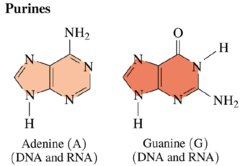
Purines are?
bicyclic
The pyrimidines in DNA and RNA are
DNA: Thymine (T) and Cytosine
RNA: (C) Uracil (U)
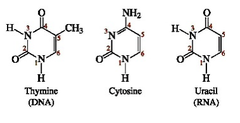
adenine + ribose =
Adenosine (nucleoside)
adenine + deoxyribose =
deoxyadenosine
guanine and ribose =
guanosine (nucleoside)
cytosine + ribose =
cytidine
uracil + ribose =
uridine
Thymine + ribose =
thymidine
Chargaff's Rule, in DOUBLE stranded DNA
%A=%T and %G=%C
DNA has a double helix structure, so if it has 100 nucleotide pairs and 25 are adenine how many of them are guanine?
(100 x 2) = 200 total
200 - (25 x 2) = 150 G and C left
150 / 2 = 75, therefore 75 Guanine
What is the structure of DNA?
dna strands are antiparallel, which results in the dna being right handed
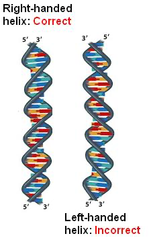
what is the size of dna?
20 Å wide, and 34 Å tall
Major and Minor grooves of dna are shown by?
distance between backbones
How is DNA separated in vitro?
DNA can be denatured by heating it up. The complementary strands can then be rennealed, and come back into a double helix when cooled
How does the G-C content in DNA affect the melting temp?
the melting temp (Tm) of DNA can is sequence and length dependent. However, G-C base pairs contribute to base stacking and hydrogen bonding more A-T pairs, where the higher % of G-C pairs does have a higher melting point
Central Dogma
DNA-transcription-RNA-translation-protein
How do errors in genes lead to diseases such as sickle cell anemia?
Sickle cell anemia is caused by an gene error where an A pair turns into a T, a mutation in the DNA that alters the amino acid sequence
Which amino-acid enantiomer is normally used in proteins?
L-amino acids. Proteins use L-amino acids rather than D-amino acids.
Where are hydrophobic amino-acid residues usually found in a soluble protein?
Mostly in the interior of the protein, away from water.
Where are polar and charged amino-acid residues usually found in a soluble protein?
Mostly on the surface, where they can interact with water.
What happens to an ionizable group when pH < pKa?
The protonated form dominates; it tends to keep H⁺.
What happens to an ionizable group when pH > pKa?
The deprotonated form dominates; it tends to lose H⁺.
How are amino acids linked together?
By peptide bonds, with H₂O lost when the bond forms.
In what direction are polypeptides synthesized?
N-terminus→C-terminus
What is the N-terminus of a polypeptide?
The end containing the free amino group.
What is the C-terminus of a polypeptide?
The end containing the free carboxyl group.
lose H+
decreased pKa
keep H+
increases pKa