PKP Kap. 2
 Call Kai
 Learn
Learn Practice Test
 Spaced Repetition
 Match
Match Flashcards
 Knowt Play
1/5

There's no tags or description
Looks like no tags are added yet.
Name | Mastery | Learn | Test | Matching | Spaced | Call with Kai | Chat |
|---|
No analytics yet
Send a link to your students to track their progress
6 Terms
How does Cervone describe the relationship between personality theory and personality research, and what methodological function does the case of Jim serve?
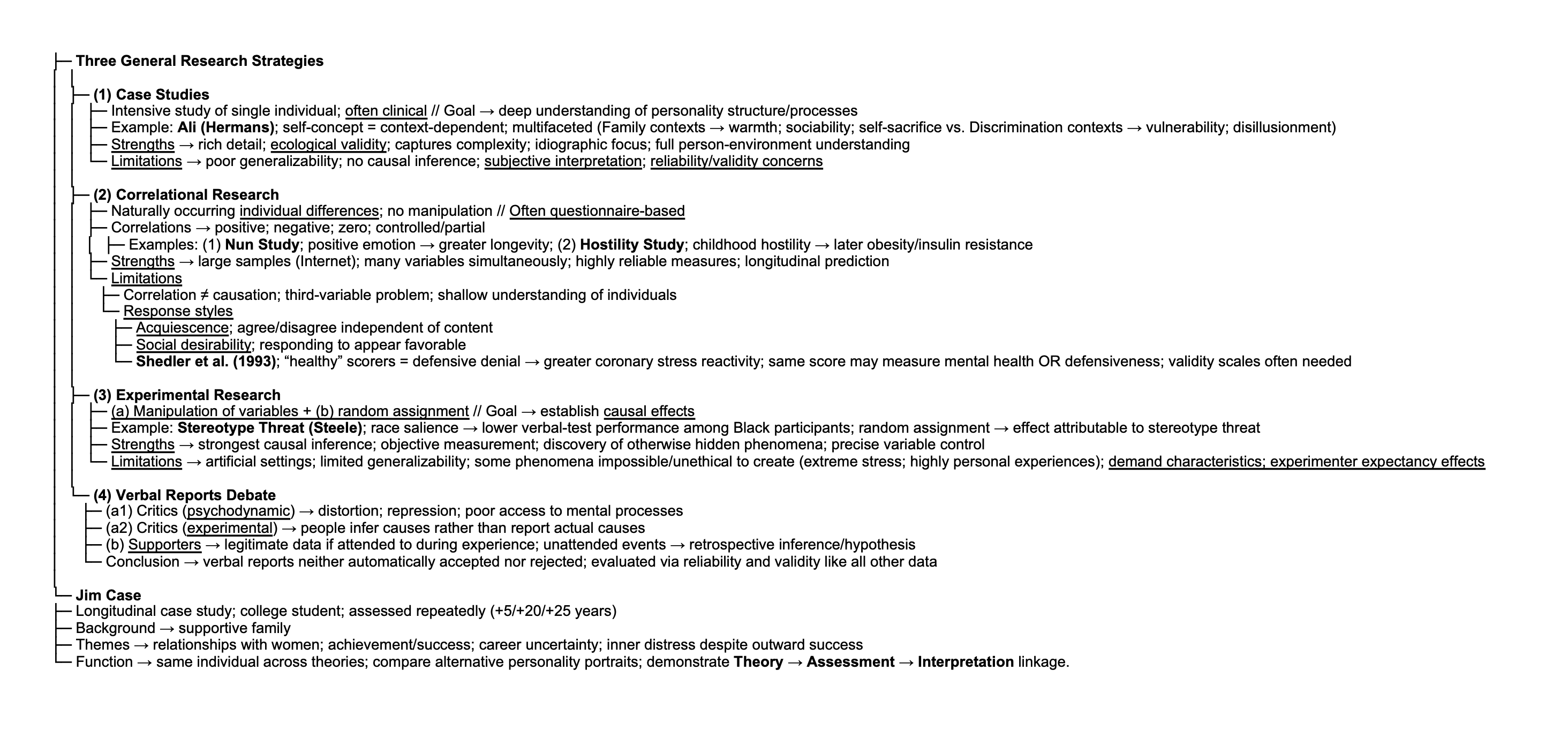
Theory ↔ research (inseparable); theory determines research questions, relevant phenomena, criteria of evidence, measurement methods; research tests/evaluates theory; theory-free research = impossible | theory without research → speculation; research without theory → meaningless fact gathering; different theories → different data sources/research strategies (experiment; case study; correlational research); no method inherently superior; each captures different aspects of personality → understanding requires integration of theory, measurement, and research.
Jim (longitudinal case study); college student; assessed repeatedly (college; +5/+20/+25 years); background: supportive family; central themes: relationships with women; achievement/success; career uncertainty; inner distress despite outward success; methodological function: same individual examined through different theories and assessment methods → comparison of alternative personality portraits; demonstration of theory → assessment → interpretation linkage.
In what ways can data be differentiated in personality psychology?
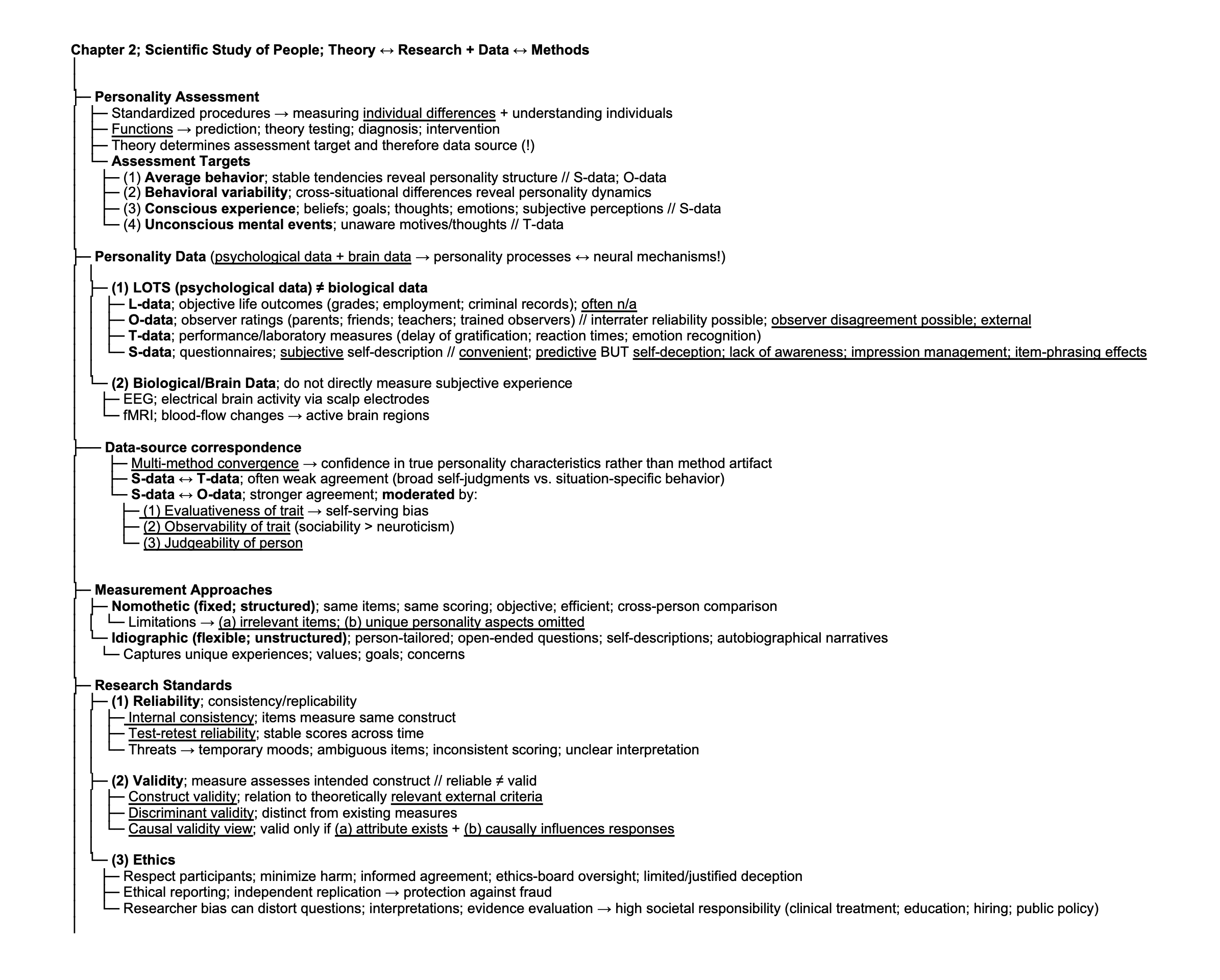
Data source differentiation: LOTS = psychological data ≠ biological data; additional brain data increasingly complement LOTS.
L-data (life records = objective outcomes, but often n/a: e.g. grades, employment, criminal records),
O-data (observer ratings; e.g. parents, friends, teachers, trained observers + interrater reliability, BUT observer disagreements and external!),
T-data (performance-based tests/laboratory tests, esp. recent; e.g. delay of gratification, reaction times, emotion recognition),
S-data (self-reports/questionnaires; subjective (!) self-description, common/useful because convenient, great predictive ability, BUT item-phrasing effects, self-deception, lack of awareness, impression management!!)
Data-source correspondence: multi-method convergence → greater confidence that findings reflect true personality characteristics rather than method artifact
S-data ↔ T-data often weak agreement (broad cross-situational self-judgments vs. situation-specific laboratory behavior),
S-data ↔ O-data generally stronger agreement; agreement moderated by (a) evaluativeness of trait (high evaluativeness → self-serving bias), (b) observability of trait (sociability > neuroticism), (c) judgeability of person.
Measurement format differentiation: Nomothetic → general laws across persons; Idiographic → understanding the unique individual.
Nomothetic/fixed + structured (same items; same scoring; objective; efficient; cross-person comparison); limitations: (a) irrelevant items, (b) unique personality aspects omitted.
Idiographic/flexible + unstructured (person-tailored; unstructured questions; self-descriptions; autobiographical narratives); captures unique experiences, values, goals, concerns.
Biological/brain data: neither measures subjective experience directly; value = psychological data + brain data → personality processes ↔ underlying neural mechanisms.
EEG (electrical brain activity via scalp electrodes),
fMRI (magnetic properties of blood tracked by scanner becuase blood-flow changes indicating active brain regions);
How does personality assessment work and what are the goals of research?
Personality assessment = standardized procedures for measuring personality differences and understanding individuals → Functions (!): prediction; theory testing; diagnosis; intervention; theory determines assessment target and therefore data source.
Assessment targets: → theory dictates what is measured and how (!)
(1) Average behavior (stable tendencies reveal personality structure // S-data/O-data),
(2) Behavioral variability (cross-situational differences reveal personality dynamics),
(3) Conscious experience (beliefs; goals; thoughts; emotions; subjective perceptions // S-data),
(4) Unconscious mental events (unaware motives/thoughts // T-data).
Goals of research: theory-guided assessment + reliable measures + valid constructs + ethical conduct/reporting.
(1) Reliability (consistency/replicability); (a) Internal consistency (items measure same construct), (b) Test-retest reliability (stable scores across time) | Threats: temporary moods; ambiguous items; inconsistent scoring; unclear interpretation.
(2) Validity (measure assesses intended construct, reliable ≠ necessarily valid!); (a) Construct validity = systematic relation to theoretically relevant external criteria, (b) Discriminant validity = distinct from existing measures, (c) Causal validity view: valid only if (A) attribute exists and (B) causally influences responses
(3) Ethics: respect participants; minimize harm/stress; informed agreement; ethics-board oversight; limited/justified deception; ethical reporting of results; independent replication protects against fraud; researcher biases can distort questions, interpretations, and evidence evaluation; high societal responsibility (clinical treatment; education; hiring; public policy).
Discuss the three general research strategies in personality psychology and their strengths and limitations.
Case studies; intensive investigation of single individual; often clinical; goal = deep understanding of personality structure/processes;
Strengths: rich detail; ecological validity; captures complexity; idiographic focus; useful when full person-environment system must be understood
Limitations: poor generalizability; causality cannot be established; subjective interpretation; potential reliability/validity problems.
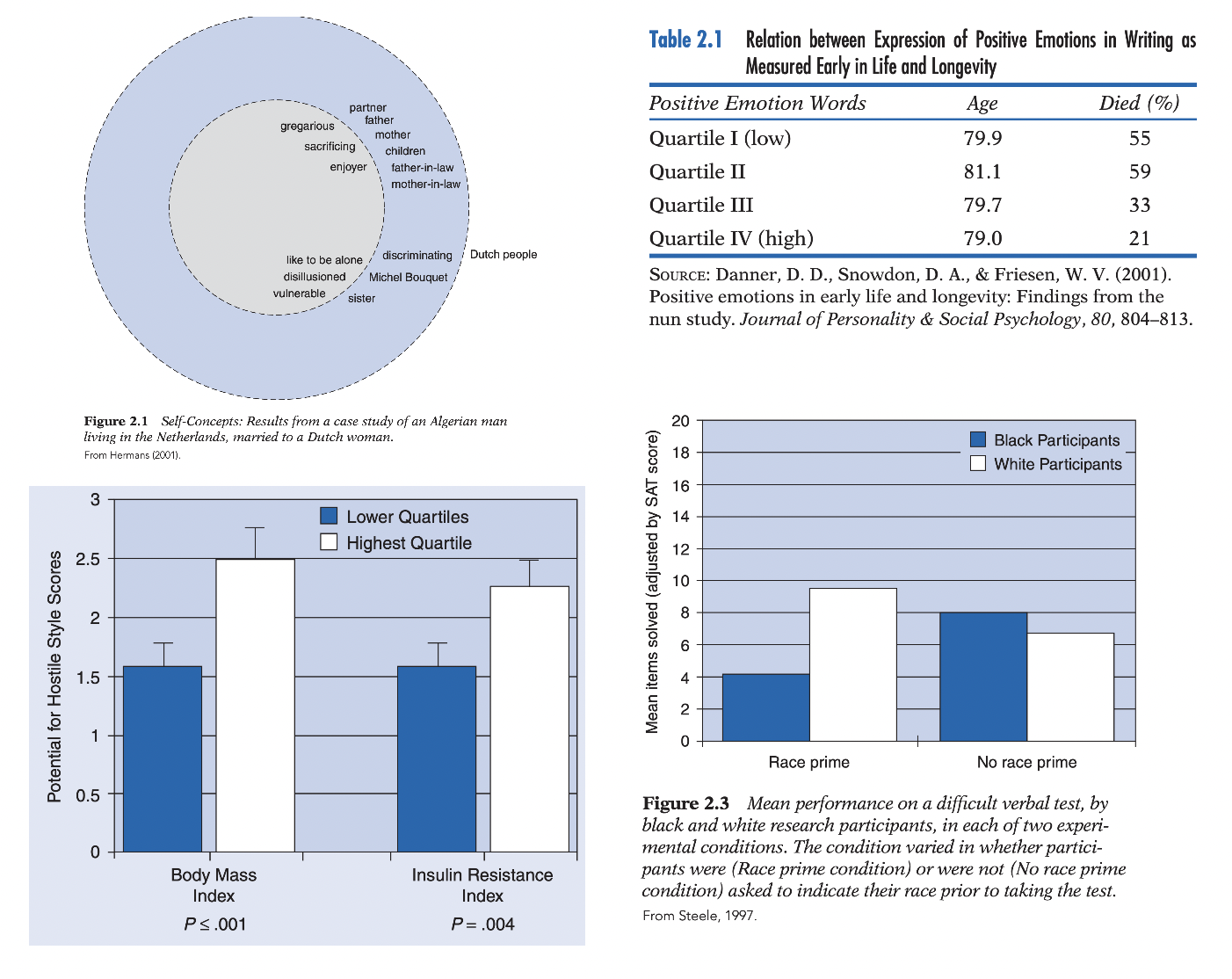
Examples: Ali (Hermans) → self-concept = context-dependent, multifaceted (family contexts → warmth/sociability/self-sacrifice; discrimination contexts → vulnerability/disillusionment)
Correlational research; examines relations among naturally occurring individual differences without manipulation; uses correlations (positive; negative; zero; simple or controlled); often questionnaire-based;
Strengths: large samples (especially Internet); many variables simultaneously; highly reliable measures; longitudinal prediction possible
Limitations: correlation ≠ causation; shallow understanding of individuals (see Shedler et al. (1993); third-variable problem; response styles: (a) Acquiescence (general tendency to agree/disagree independent of content); (b) Social desirability (responding to appear favorable);
Shedler et al. (1993): some “healthy” questionnaire scorers = clinically distressed individuals using defensive denial; greater coronary stress reactivity than openly distressed individuals → same questionnaire score may measure mental health in one person but defensiveness in another; validity scales often needed.
Examples: (1) Nun Study (positive emotion → greater longevity, see attachment), (2) Hostility → later obesity/insulin resistance (see attachment)
Experimental research; manipulation of variables + random assignment; goal = establish causal effects
Strengths: strongest causal inference; objective measurement; discovery of phenomena not observable naturally; precise variable control
Limitations: artificial settings; limited generalizability; some phenomena cannot be ethically/realistically created (extreme stress; highly personal experiences); potential demand characteristics and experimenter expectancy effects.
Example: stereotype threat (Steele); race salience manipulation → lower verbal-test performance among Black participants; random assignment → effect attributable to stereotype threat;
Verbal reports:
Critics (psychoanalytic/dynamic traditions) → distortion, repression, poor access to mental processes; experimental critics → people often infer causes rather than report actual causes;
Supporters → verbal reports are legitimate data if participants actually attended to the relevant process; if not attended → retrospective inference/hypothesis;
→ conclusion: verbal reports neither accepted nor rejected automatically; evaluated via reliability and validity like all other data.
Tree (PKP, Kap. 2) 1/2
Tree (PKP, Kap. 2) 2/2