Infrared spectroscopy (3.3.6.3)
 Call Kai
 Learn
Learn Practice Test
 Spaced Repetition
 Match
Match Flashcards
 Knowt Play
1/5

There's no tags or description
Looks like no tags are added yet.
Name | Mastery | Learn | Test | Matching | Spaced | Call with Kai | Chat |
|---|
No analytics yet
Send a link to your students to track their progress
6 Terms
How do bonds in molecules absorb IR radiation?
All bonds vibrate at a characteristic frequency, which depends on the mass of the atoms in the bond, the bond strength and the type of vibration.
The frequencies at which they vibrate are in the IR region of the electromagnetic spectrum
Thus when IR light passes through a compound, it will absorb some or all of the light at the frequency at which the bonds vibrate
Bonds in a molecule absorb IR radiation at characteristic wavenumbers
What are the regions in an IR spectra?
1) Below 1500 cm-1 is the fingerprint region
2) Above 1500 cm-1 you can identify functional group signals
How can the fingerprint region be used to confirm the identity of an unknown molecule?
Since each molecule has a unique fingerprint region, you can refer to this fingerprint region and look for an exact match in a database spectra
How can you tell the difference between a carboxylic acid and alcohol in an IR spectra?
Carboxylic acids and alcohol functional groups vibrate at similar wavenumbers. However carboxylic acid functional groups are often more broad and ‘bumpy’ whereas as alcohol functional groups aren’t ‘bumpy’
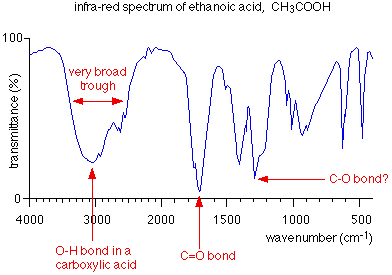

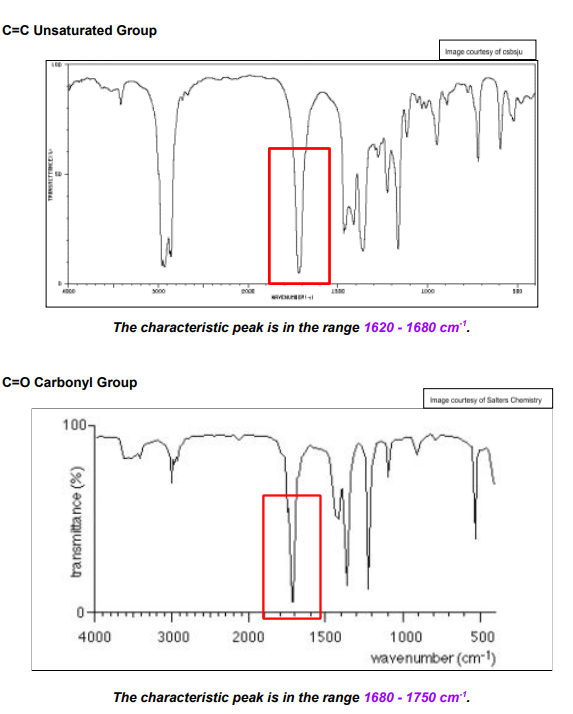
What do unsaturated and carbonyl groups look like on IR spectra?
What is the link between absorption of infrared radiation by bonds in carbon dioxide, methane and water vapour and global warming?
These molecules absorb IR radiation, causing heat to be trapped in the atmosphere. Due to more of these chemicals being released into the atmosphere this effect is enhanced, causing global warming